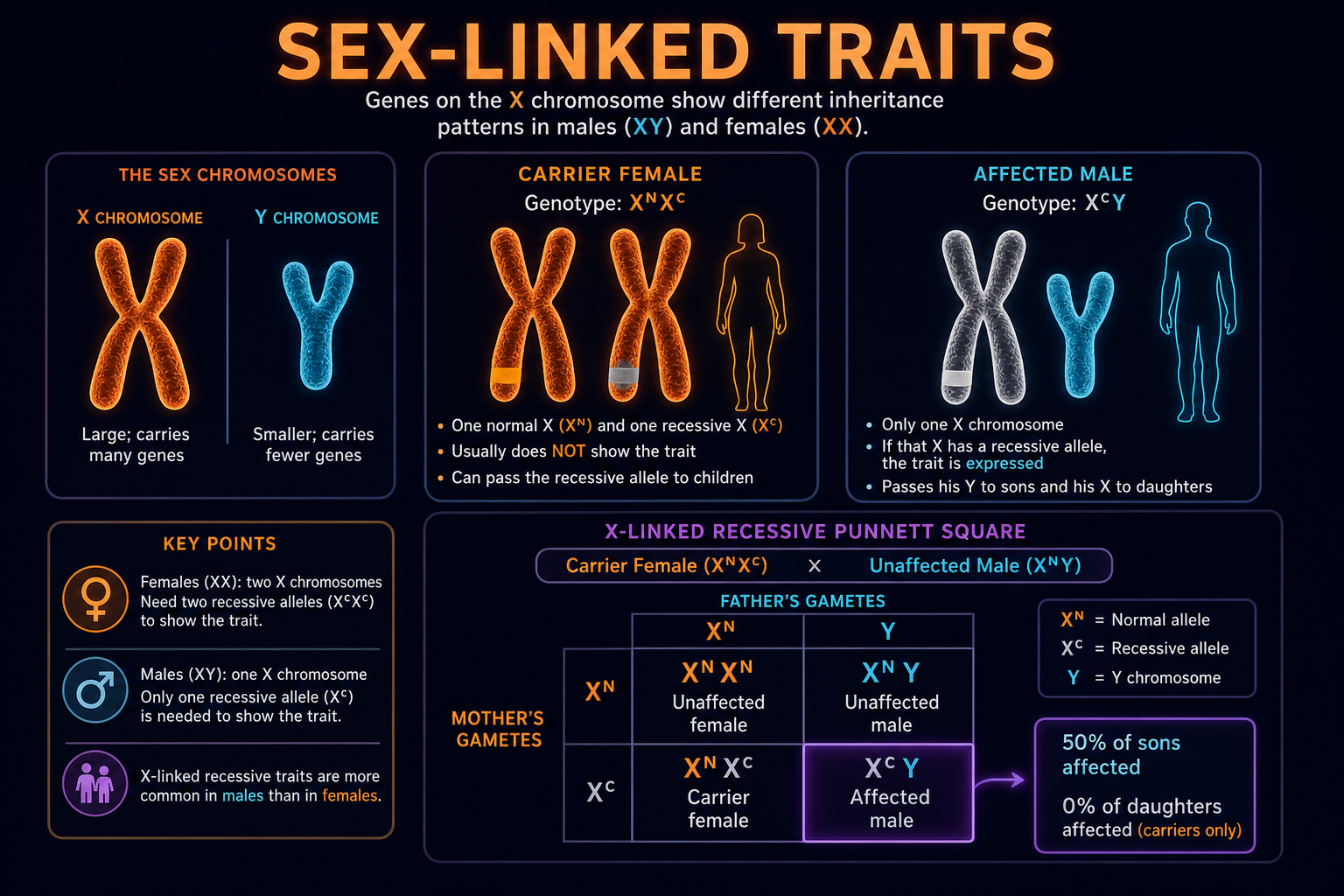
More affected males → possible X-linked recessive
What are sex-linked traits in AP Biology?
Sex-linked traits are traits controlled by genes on sex chromosomes, especially the X chromosome. In AP Biology, X-linked recessive traits appear more often in males because males usually have only one X chromosome. Females usually need two recessive X-linked alleles to show the trait, but females with one recessive allele can be carriers.
Say it fast
X-linked recessive traits show up more often in males.
AP exam tip: If a recessive trait appears more often in males or is passed through carrier females, think X-linked recessive inheritance.
Sex Chromosomes: X and Y
Sex chromosomes help determine biological sex and can carry genes for traits. In many AP Biology examples, females are represented as XX and males as XY. The X chromosome carries many genes, while the Y chromosome carries fewer genes. Because males usually have one X chromosome, a recessive allele on that X chromosome can be expressed without a second copy.
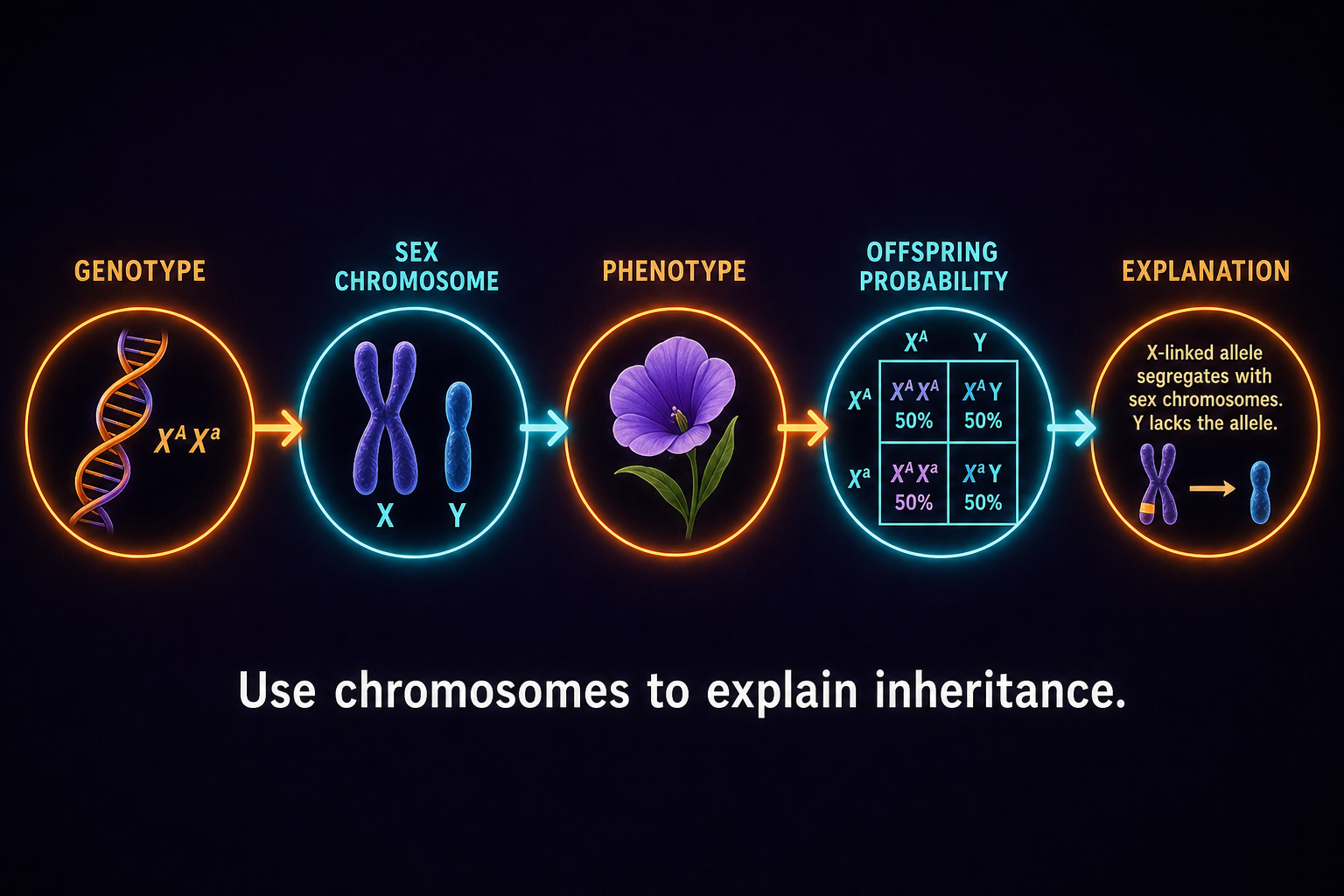
During meiosis, sex chromosomes segregate into gametes just like autosomes do. A female produces eggs that each carry one X chromosome. A male produces sperm that carry either an X or a Y chromosome. When fertilization occurs, an XX combination usually produces a female and an XY combination usually produces a male. This is why sex-linked inheritance questions always ask you to track which parent contributes the X chromosome to each offspring.
Important: AP Biology simplifies XX/XY inheritance for exam genetics, but biology can include exceptions. Use “usually” when describing male and female patterns. On the exam, focus on the simplified model unless the prompt gives different information.
| Person | Sex Chromosomes | X-Linked Alleles Present |
|---|---|---|
| Female | XX | Two X-linked allele copies |
| Male | XY | One X-linked allele copy |
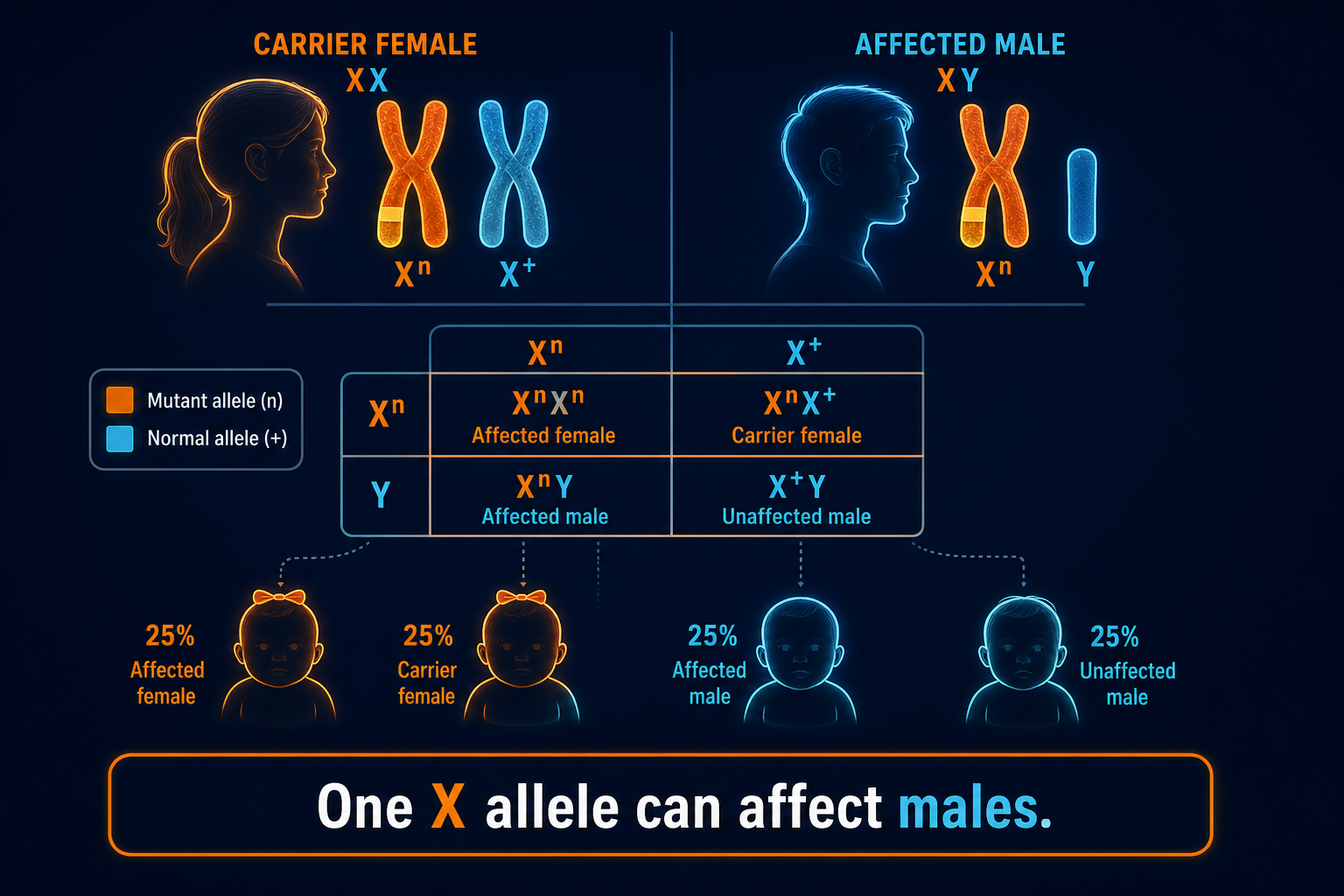
Context: meiosis separates sex chromosomes into gametes, and genetic variation explains how allele combinations differ among offspring.
X-Linked Recessive Traits
An X-linked recessive trait is caused by a recessive allele on the X chromosome. A male with the recessive allele on his X chromosome usually shows the trait because he does not have a second X chromosome to mask it. A female usually shows the trait only if she inherits the recessive allele on both X chromosomes.
This pattern differs from autosomal recessive inheritance. For an autosomal recessive trait, males and females are affected at similar rates when both inherit two recessive alleles. For X-linked recessive traits, males are affected more often because they have only one X-linked copy. Females can carry the allele without showing the trait, which creates the carrier pattern AP questions love to test.
Use this notation:
- Xᴺ = normal dominant allele
- Xⁿ = recessive trait allele
- Y = Y chromosome with no matching allele for this trait
Common genotypes:
- XᴺXᴺ = Unaffected female
- XᴺXⁿ = Carrier female
- XⁿXⁿ = Affected female
- XᴺY = Unaffected male
- XⁿY = Affected male
For the umbrella overview of non-Mendelian patterns, see non-Mendelian genetics.
Carrier Females in X-Linked Inheritance
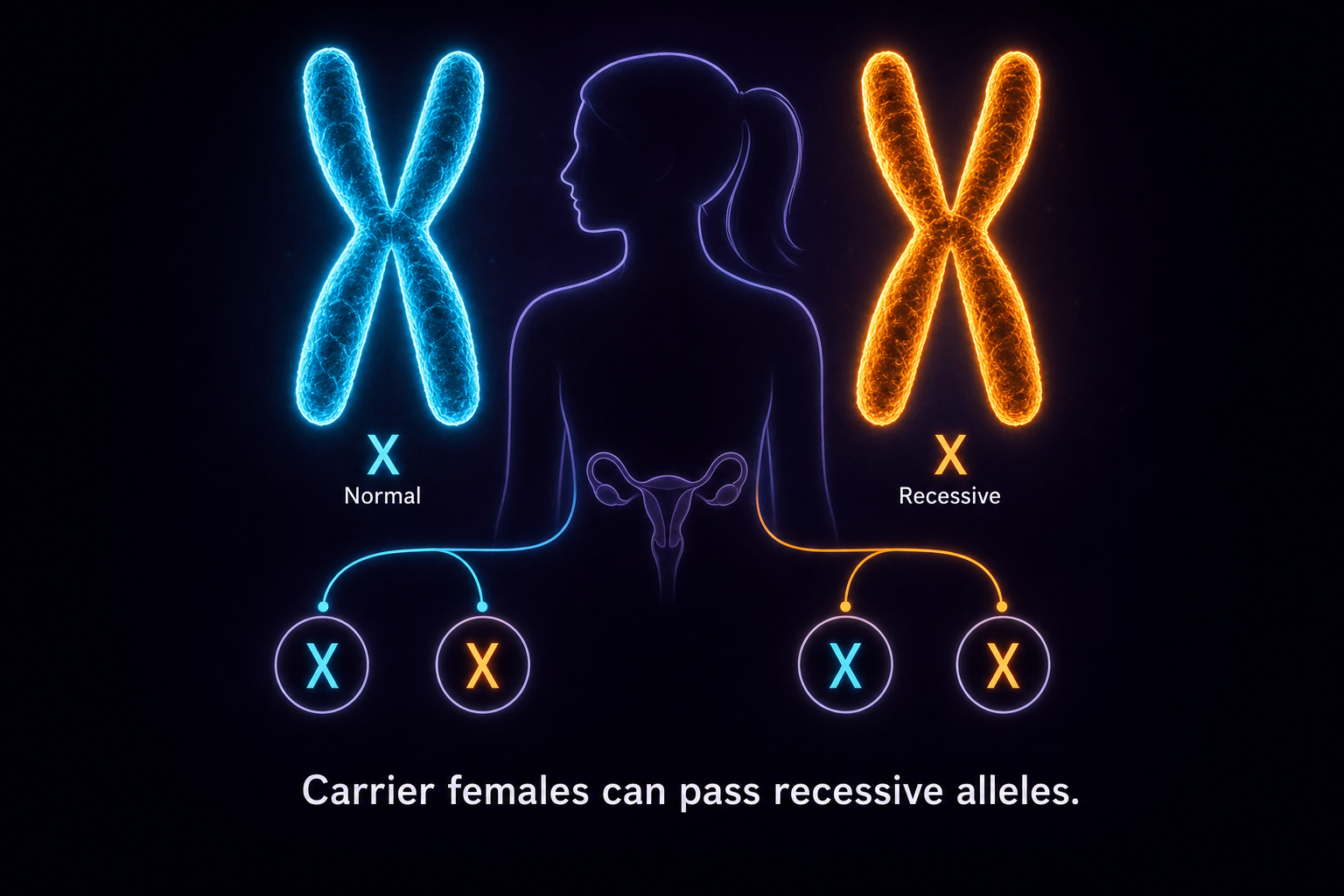
A carrier female has one normal allele and one recessive allele on her X chromosomes. She usually does not show an X-linked recessive trait because the normal allele can mask the recessive allele. However, she can pass the recessive allele to sons or daughters.
When a carrier female has children with an unaffected male, daughters who inherit the recessive allele become carriers like their mother. Sons who inherit the recessive allele are affected because they have no second X chromosome to mask it. This is why an unaffected mother can have an affected son—the recessive X came from her, even though her own phenotype looks normal.
A carrier female is usually written as XᴺXⁿ.
AP exam clue: If a son has an X-linked recessive trait, he inherited the recessive X chromosome from his mother.
Why Are X-Linked Recessive Traits More Common in Males?
Males are more likely to show X-linked recessive traits because they usually have only one X chromosome. If that X chromosome carries the recessive allele, the trait appears. Females usually have two X chromosomes, so a dominant allele on one X can mask a recessive allele on the other X.
Say it fast
Males need one recessive X-linked allele. Females usually need two.
Males with one recessive X-linked allele are sometimes described as male hemizygous because they have only one copy of X-linked alleles for that trait.
How to Solve a Sex-Linked Punnett Square
Sex-linked Punnett squares must include X and Y chromosomes. Do not write only A and a. The allele must stay attached to the X chromosome.
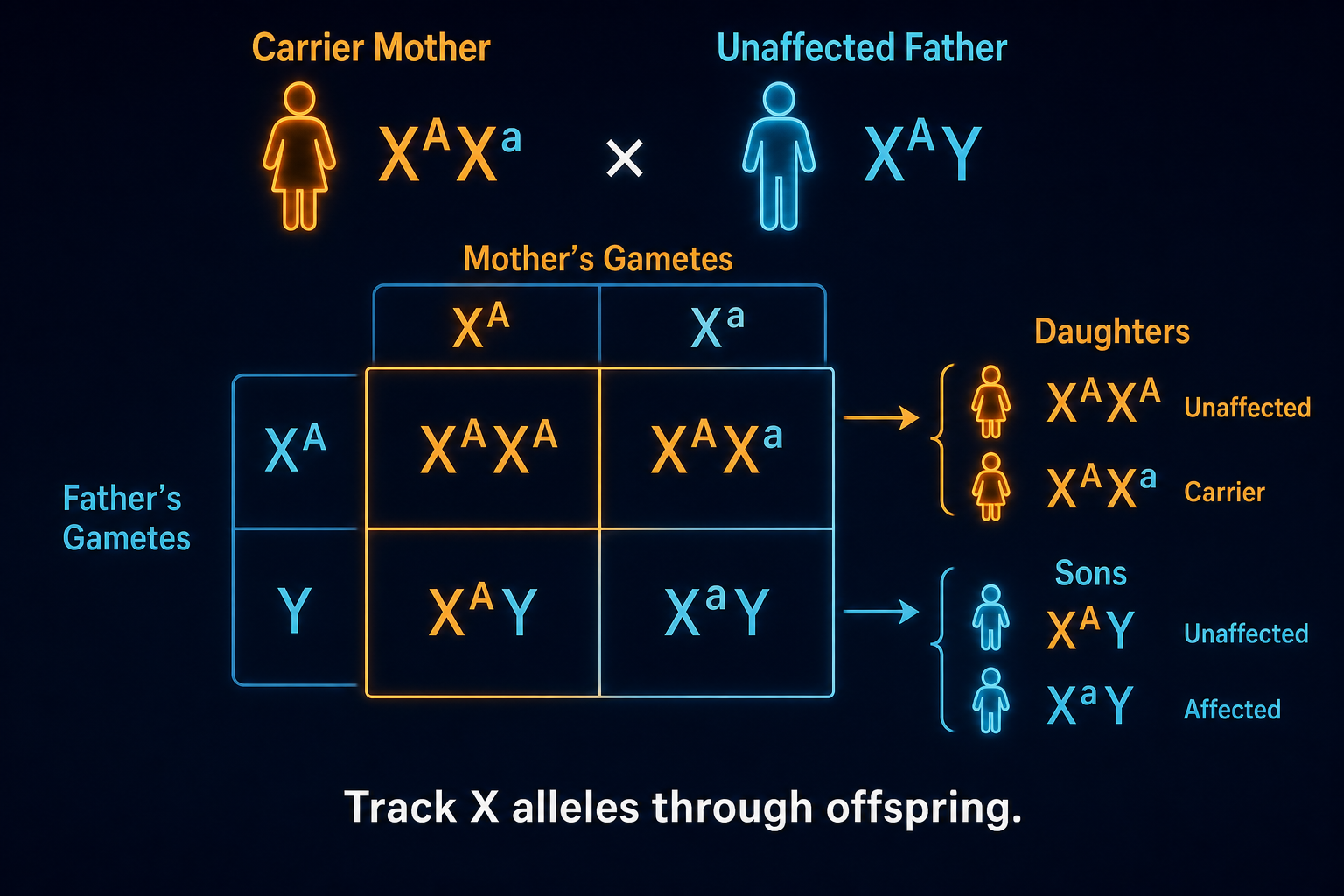
Example cross: Carrier mother × unaffected father
XᴺXⁿ × XᴺY
Gametes:
Mother: Xᴺ or Xⁿ
Father: Xᴺ or Y
Offspring outcomes:
- XᴺXᴺ = unaffected daughter
- XᴺXⁿ = carrier daughter
- XᴺY = unaffected son
- XⁿY = affected son
Conclusion: There is a 25% chance of an affected son overall, or a 50% chance among sons.
Important AP wording: Be careful whether the question asks “among all offspring” or “among sons.”
For general Punnett square method, review Punnett squares. For Mendelian baseline patterns, see Mendelian genetics.
Sex-Linked vs Autosomal Inheritance
| Feature | Sex-Linked Trait | Autosomal Trait |
|---|---|---|
| Chromosome location | Sex chromosome | Non-sex chromosome |
| Male pattern | Often affected more for X-linked recessive | Usually not strongly male-biased |
| Female carrier | Common in X-linked recessive | Depends on trait |
| Punnett notation | Uses X and Y | Uses allele letters like A and a |
| AP clue | More affected males | Similar rates in males and females |
Sex-Linked Traits in Pedigrees
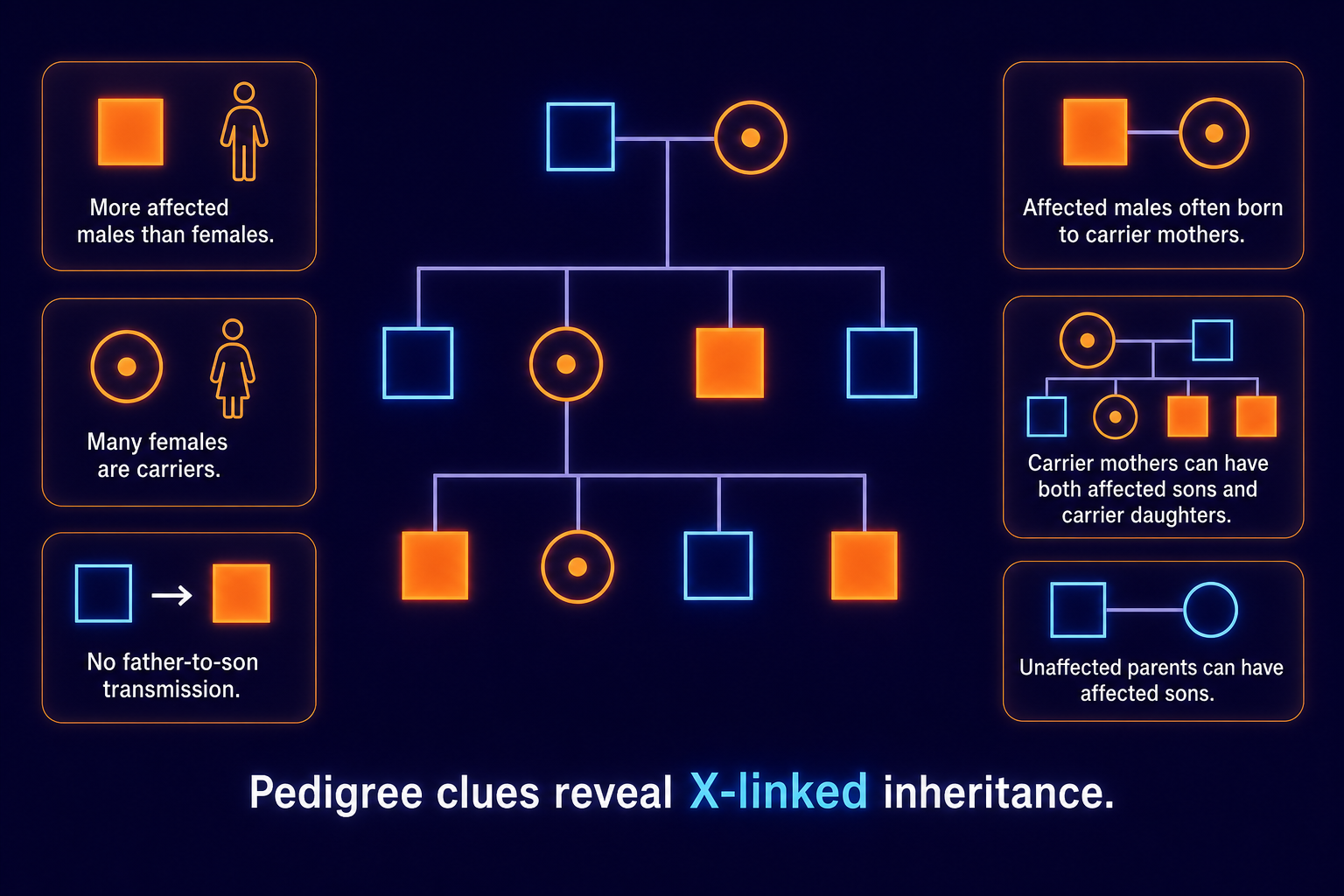
AP Biology may show sex-linked inheritance using a pedigree. X-linked recessive pedigrees often show more affected males than females. Carrier females may have affected sons. Fathers pass their Y chromosome to sons, not their X chromosome, so an affected father does not pass his X-linked allele to his sons.
When you read a pedigree, look for the combination of clues rather than one symbol alone. Affected males connected through unaffected females strongly suggest carrier mothers. If every affected individual is male and the trait never passes directly from father to son, autosomal recessive is less likely. Daughters of affected males are often carriers because they always receive his single X chromosome.
This page covers X-linked pedigree clues briefly. For full pedigree symbols, autosomal patterns, and carrier identification, see the pedigrees AP Biology guide.
Carrier mother with affected son → X-linked recessive clue
Affected father does not pass X-linked allele to sons
Daughters of affected males receive his X chromosome
Trait skips through carrier females
Examples of Sex-Linked Traits
These are educational genetics examples used in biology courses—not medical advice.
- Red-green color blindness is commonly used as an X-linked recessive example. Affected males cannot distinguish certain colors because the recessive allele on their single X chromosome is expressed.
- Hemophilia is commonly used as an X-linked recessive inheritance example in textbooks and FRQs. Carrier females can pass the allele to sons without showing the trait themselves.
- Some traits can be X-linked dominant, but AP Biology often emphasizes X-linked recessive patterns because the male-biased frequency is a clear exam clue.
When a question names a real-world example, translate it into genotype notation first. Identify whether the trait is recessive, confirm it is on the X chromosome, then write parent genotypes before calculating probabilities.
AP Bio Exam Clues for Sex-Linked Traits
“Trait appears more often in males”
→ X-linked recessive
“Carrier female”
→ Heterozygous female
“Affected son”
→ Recessive X came from mother
“Father to son”
→ Not X-linked father-to-son transmission
“Daughters of affected father”
→ Receive his X chromosome
“Use X and Y notation”
→ Sex-linked Punnett square
“Among sons” vs “among all offspring”
→ Check denominator
“Autosomal”
→ Not on sex chromosome
Common Sex-Linked Trait Mistakes
Using A and a without X or Y
Fix: Sex-linked problems must keep alleles attached to sex chromosomes.
Saying fathers pass X-linked traits to sons
Fix: Fathers usually pass Y chromosomes to sons and X chromosomes to daughters.
Confusing carrier and affected
Fix: A carrier female usually has one recessive allele but does not show the recessive phenotype.
Ignoring the denominator
Fix: 25% of all offspring is different from 50% of sons.
Assuming all sex-linked traits are recessive
Fix: AP Biology often tests X-linked recessive traits, but sex-linked traits can have other patterns.
Treating sex-linked inheritance as normal autosomal inheritance
Fix: Track X and Y chromosomes explicitly.
Identify the Sex-Linked Inheritance Clue
Revealed: 0 of 5 scenarios
A recessive trait appears more often in males.
Reveal: Likely X-linked recessive.
A father passes a Y chromosome to his son.
Reveal: He does not pass his X-linked allele to that son.
A female has genotype XᴺXⁿ.
Reveal: Carrier female.
A male has genotype XⁿY.
Reveal: Affected male for an X-linked recessive trait.
A question asks “among sons” instead of “among all offspring.”
Reveal: Use sons only as the denominator.
Sex-Linked Traits Practice Questions
Answer all eight questions. Choices shuffle on reload.
Question 1 of 8
Start
Correct: 0
Answered: 0
Accuracy: 0%
More drills: Unit 5 practice questions or chi-square test for genetics.
Sex-Linked Traits FRQ Practice
Open each card, draft your response, then reveal the rubric and sample answer.
0 of 2 FRQs opened
Prompt
A carrier female for an X-linked recessive trait has children with an unaffected male. Predict the expected offspring genotypes and explain why affected sons are possible.
Scoring rubric
- Carrier female genotype is XᴺXⁿ.
- Unaffected male genotype is XᴺY.
- Possible offspring: XᴺXᴺ, XᴺXⁿ, XᴺY, XⁿY.
- XⁿY sons are affected because males have only one X chromosome.
- Among sons, 50% are expected to be affected; among all offspring, 25% are affected sons.
Sample response
The carrier female is XᴺXⁿ and the unaffected male is XᴺY. The possible offspring are XᴺXᴺ unaffected daughters, XᴺXⁿ carrier daughters, XᴺY unaffected sons, and XⁿY affected sons. Affected sons are possible because a son receives a Y chromosome from his father and one X chromosome from his mother. If he receives the recessive Xⁿ allele, he shows the trait. This gives a 50% chance among sons or 25% among all offspring.
Status: Draft your answer first—then open the rubric or sample.
Prompt
A pedigree shows a recessive trait that appears more often in males than females. Explain why this pattern supports X-linked recessive inheritance rather than simple autosomal recessive inheritance.
Scoring rubric
- X-linked recessive traits appear more often in males.
- Males usually have only one X chromosome.
- One recessive allele on the X chromosome is enough for a male to show the trait.
- Females usually need two recessive alleles to be affected.
- Carrier females can pass the recessive allele to sons.
Sample response
The pattern supports X-linked recessive inheritance because the trait appears more often in males. Males usually have only one X chromosome, so a recessive allele on that X chromosome is expressed. Females usually need two recessive X-linked alleles to show the trait, although heterozygous females can be carriers. Carrier females can pass the recessive X chromosome to sons, which explains why affected males may appear through unaffected carrier mothers.
Status: Draft your answer first—then open the rubric or sample.
Continue the Unit 5 Heredity Path
Sex-Linked Traits FAQs
What are sex-linked traits in AP Biology?
Sex-linked traits are traits controlled by genes on sex chromosomes, especially the X chromosome. In AP Biology, X-linked recessive traits appear more often in males because males usually have only one X chromosome. Females usually need two recessive X-linked alleles to show the trait, but females with one recessive allele can be carriers.
What is an X-linked recessive trait?
An X-linked recessive trait is caused by a recessive allele on the X chromosome. A male with the recessive allele on his X chromosome usually shows the trait because he does not have a second X chromosome to mask it. A female usually shows the trait only if she inherits the recessive allele on both X chromosomes.
Why are X-linked recessive traits more common in males?
Males are more likely to show X-linked recessive traits because they usually have only one X chromosome. If that X chromosome carries the recessive allele, the trait appears. Females usually have two X chromosomes, so a dominant allele on one X can mask a recessive allele on the other X.
What is a carrier female?
A carrier female has one normal allele and one recessive allele on her X chromosomes. She usually does not show an X-linked recessive trait because the normal allele can mask the recessive allele. However, she can pass the recessive allele to sons or daughters.
How do you write sex-linked genotypes?
Use X and Y notation with superscripts for alleles. Common examples include XᴺXᴺ unaffected female, XᴺXⁿ carrier female, XⁿXⁿ affected female, XᴺY unaffected male, and XⁿY affected male.
How do you solve a sex-linked Punnett square?
Write parent genotypes with X and Y notation, list gametes with X or Y chromosomes, combine gametes in a Punnett square, and read offspring genotypes. Track whether the question asks about all offspring or only sons.
Can fathers pass X-linked traits to sons?
Fathers usually pass Y chromosomes to sons, not X chromosomes. So an affected father does not pass his X-linked allele to his sons. He passes his X chromosome to daughters.
What are pedigree clues for X-linked recessive inheritance?
Clues include more affected males than females, carrier mothers with affected sons, traits skipping through carrier females, and affected fathers not passing the trait to sons.
What is the difference between sex-linked and autosomal inheritance?
Sex-linked traits are on sex chromosomes and often use X and Y notation. Autosomal traits are on non-sex chromosomes and use allele letters like A and a. X-linked recessive traits often appear more in males; autosomal traits usually do not show strong male bias.
Are all sex-linked traits recessive?
No. AP Biology often tests X-linked recessive traits, but sex-linked traits can have other patterns, including X-linked dominant inheritance.
What are examples of sex-linked traits?
Red-green color blindness and hemophilia are commonly used as X-linked recessive examples in biology education. Some traits can be X-linked dominant, but AP Biology often emphasizes X-linked recessive patterns.
How should I answer sex-linked traits FRQs?
Write genotypes with X and Y notation, list possible gametes, predict offspring genotypes and phenotypes, explain why males are affected with one recessive allele, and state probabilities with the correct denominator (all offspring vs sons only).