Calling ATP a nucleic acid polymer
Fix: ATP shares parts with nucleotides but is mainly an energy carrier, not a genetic polymer.
AP Biology · Unit 1 · Chemistry of Life
Learn how nucleotides build DNA and RNA polymers that store and transmit genetic information.
AP Biology nucleic acids questions usually test whether you can connect nucleotide structure to phosphodiester backbones, base pairing, and information in sequence. Nucleic acids are built from nucleotides, joined by phosphodiester bonds, and organized as DNA or RNA. This page explains nucleotides, DNA vs RNA, pairing rules, ATP distinction, and AP-style clues—without a full protein synthesis deep dive.
Unit 1 progress
AP Biology · Unit 1
Part of Unit 1: Chemistry of Life · Page 9 of 11
Pair with proteins (previous) and Unit 1 review (next).
Section 1 of 24
Direct answerRead the two-sentence direct answer first, then scan the nucleotide figure and AP tip before deeper sections.
Nucleic acids are macromolecules that store and transmit genetic information. They are built from nucleotide monomers joined by phosphodiester bonds in a sugar-phosphate backbone. In AP Biology, DNA and RNA are the major nucleic acids: DNA usually stores hereditary information, while RNA helps cells use that information.
Nucleic acids AP Biology content completes the four macromolecule set you began on the macromolecules overview. After carbohydrates, lipids, and proteins, nucleic acids answer a different exam question: how do cells store and copy instructions? The answer is not amino acid folding or fatty acid hydrophobicity—it is polymers of nucleotides whose base order encodes information.
This page stays at Unit 1 depth. You will learn nucleotide structure, phosphodiester bonds, DNA versus RNA differences, complementary base pairing, strand direction, and how ATP relates to—but differs from—nucleic acid polymers. Full step-by-step protein synthesis belongs in transcription vs translation; here we only preview how DNA information connects to proteins so the macromolecule story stays coherent.
Phosphorus in phosphate groups links nucleic acids to elements of life and to ATP energy chemistry. Hydrogen bonds between paired bases trace back to water properties. Polymer assembly follows the same dehydration synthesis logic as other macromolecules on dehydration synthesis and hydrolysis and monomers and polymers.
Section 2 of 24
FoundationConnect information storage to evolution, biotechnology, and fast MCQ clue sorting.
Nucleic acids matter because they carry the instructions cells need to build and regulate life. Without DNA, cells could not store hereditary information across generations. Without RNA, cells could not readily use that information for processes such as protein production. AP Biology treats nucleic acids as information macromolecules whose structure supports accurate copying and reading of genetic code.
In Unit 1, the exam tests whether you can describe nucleotide parts, name the bond that builds chains, contrast DNA and RNA, and explain base pairing—not whether you can diagram every enzyme in replication. Those deeper processes appear in later units, but they all assume you understand nucleic acid chemistry first.
Nucleic acids also connect to evolution, biotechnology, and medicine on the full AP course. Mutations change base sequence; changed sequence can change proteins; changed proteins can change phenotype. That logic starts here with structure and pairing, then expands when you study gene expression, regulation, and heredity.
When a multiple-choice stem mentions double helix, phosphodiester bond, uracil, or complementary strand, nucleic acids should rise to the top of your macromolecule list before you consider carbohydrates or lipids. When a stem mentions peptide bonds or active sites, switch back to proteins. Clear clue mapping saves time on test day.
Section 3 of 24
CompositionUse the composition table to lock in elements, monomer, polymer, and phosphodiester bonds.
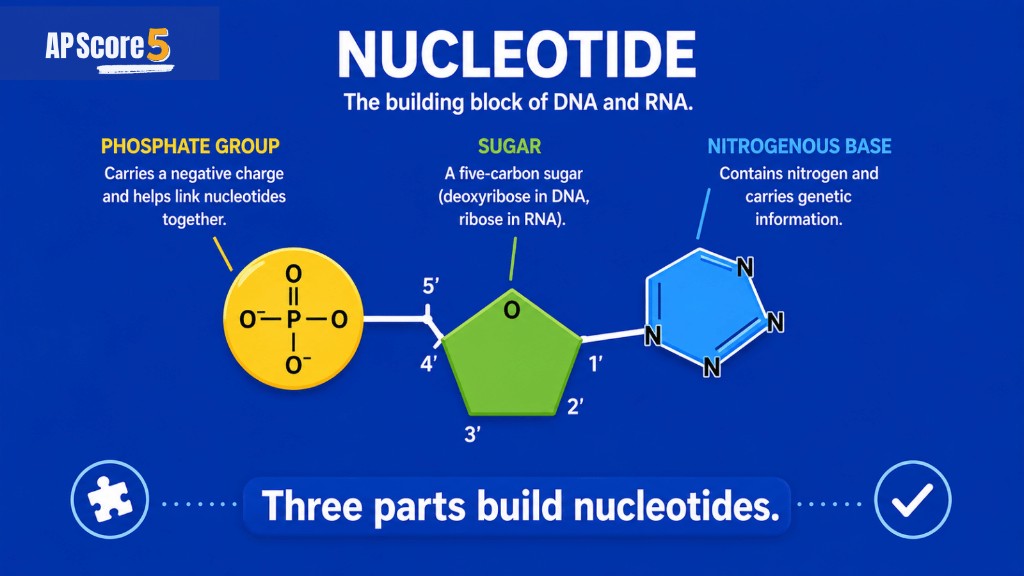
Nucleic acids contain carbon, hydrogen, oxygen, nitrogen, and phosphorus. They are built from nucleotide monomers. Each nucleotide includes a phosphate group, a pentose sugar, and a nitrogenous base. Many nucleotides join through phosphodiester bonds to form a polynucleotide with a sugar-phosphate backbone and projecting bases.
Phosphorus distinguishes nucleic acids from carbohydrates and lipids in many element-composition questions. Nitrogen appears in every nitrogenous base. The phosphate groups make the backbone strongly polar and acidic, which affects how DNA and RNA interact with water and proteins in the nucleus and cytoplasm.
| Feature | Nucleic Acid Pattern | AP Biology Meaning |
|---|---|---|
| Main elements | C, H, O, N, P | Phosphate backbone requires phosphorus |
| Monomer | Nucleotide | Three-part building block |
| Polymer | DNA, RNA (polynucleotide) | Long chain of nucleotides |
| Bond | Phosphodiester bond | Links sugars and phosphates in the backbone |
| Key idea | Base sequence stores information | Order of A, T/U, G, C encodes instructions |
DNA and RNA are both nucleic acids but not identical polymers. They use different sugars, different thymine versus uracil chemistry, and usually different strand counts. Those differences match their roles: DNA for durable storage, RNA for flexible information use.
Section 4 of 24
Building blocksLabel the three nucleotide parts and purine versus pyrimidine bases—high yield for FRQs.
A nucleotide is the monomer of nucleic acids. It has three parts: a phosphate group, a pentose sugar, and a nitrogenous base. The phosphate connects to the 5 prime carbon of the sugar; the base attaches to the 1 prime carbon of the sugar. When nucleotides polymerize, the phosphate of one nucleotide forms a phosphodiester bond with the 3 prime hydroxyl of the next sugar.
Understanding the three parts helps you answer FRQs that ask you to label diagrams or compare ATP to DNA. ATP contains adenine (a nitrogenous base), ribose (a sugar), and three phosphate groups—so it looks like a nucleotide derivative. It is not, however, a long polynucleotide storing genetic code.
Nitrogenous bases come in two families: purines (adenine and guanine, double-ring) and pyrimidines (cytosine, thymine in DNA, uracil in RNA, single-ring). AP exams may ask which bases are purines or pyrimidines, but the highest-value skill is pairing: adenine with thymine or uracil, guanine with cytosine.
| Part | Role | AP Clue |
|---|---|---|
| Phosphate | Links sugars in backbone; acidic | Phosphodiester, phosphorus element |
| Pentose sugar | Deoxyribose in DNA, ribose in RNA | Sugar name distinguishes DNA vs RNA |
| Nitrogenous base | Stores information in sequence | A, T/U, G, C, pairing rules |
Free nucleotides in the cell also include triphosphate forms used as substrates when polymerases build DNA or RNA. That connection previewes energy coupling: breaking phosphate bonds releases energy, while forming phosphodiester bonds costs energy. You are not required to calculate those values in Unit 1, but you should recognize that building nucleic acids is an endergonic polymerization process.
Section 5 of 24
Polymer formationFollow backbone chemistry, strand direction, and the backbone figure before DNA vs RNA.
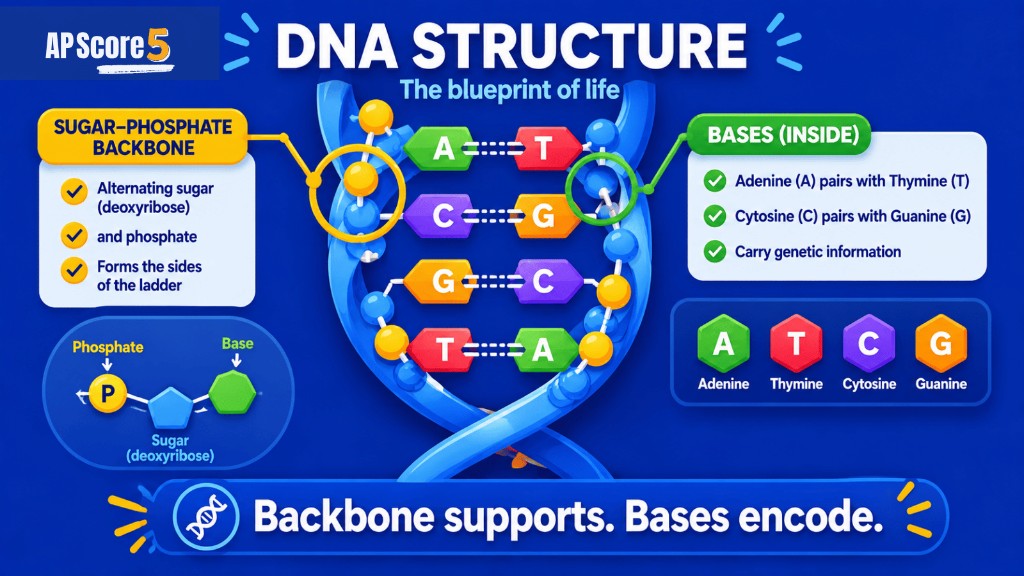
Phosphodiester bonds link the 3 prime carbon of one sugar to the phosphate attached to the 5 prime carbon of the next sugar. Dehydration synthesis removes water as each bond forms, the same polymer logic you practiced for peptide and glycosidic bonds. Hydrolysis breaks phosphodiester bonds and can digest nucleic acids into nucleotides.
The backbone is uniform: repeating sugar-phosphate-sugar-phosphate. The information content lives in the sequence of bases attached to each sugar. AP Biology often shows the backbone as a ribbon or ladder rails with bases as rungs—an accurate metaphor for double-stranded DNA.
Directionality follows from how bonds form. Each strand has a free 5 prime phosphate at one end and a free 3 prime hydroxyl at the other. Strands in double DNA run antiparallel: one strand is 5 prime to 3 prime top to bottom while its partner runs 3 prime to 5 prime. Polymerases add nucleotides only to the 3 prime end, so direction is not decorative labeling—it is mechanistic reality.
Section 6 of 24
CompareMemorize sugar, bases, strand count, and role—then check the comparison table and figure.
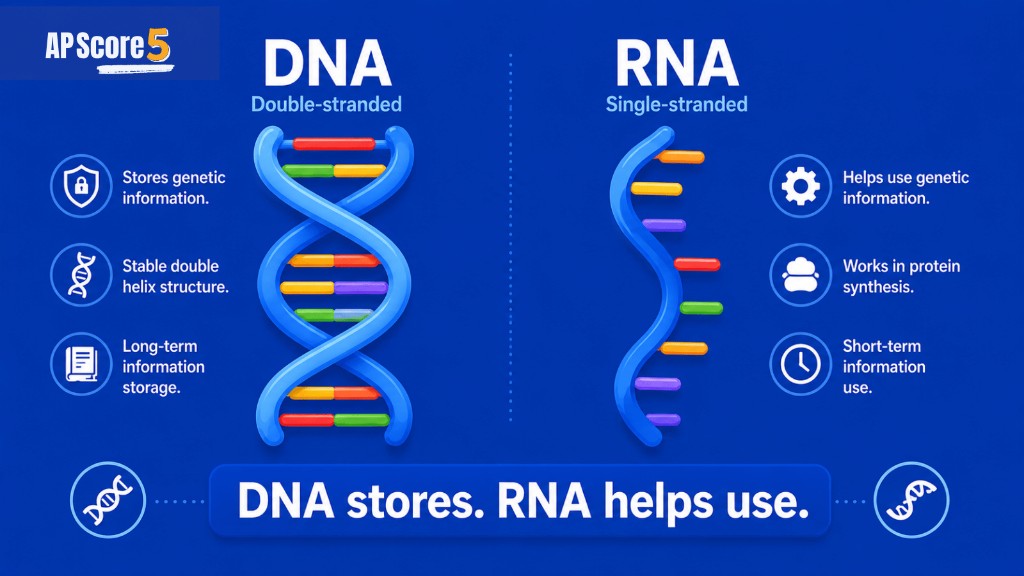
DNA (deoxyribonucleic acid) and RNA (ribonucleic acid) are the two major nucleic acids. DNA uses deoxyribose, includes thymine, and is usually double stranded in cells. RNA uses ribose, includes uracil instead of thymine, and is usually single stranded. Both are polynucleotides with phosphodiester backbones.
| Feature | DNA | RNA |
|---|---|---|
| Sugar | Deoxyribose | Ribose |
| Bases | A, T, G, C | A, U, G, C |
| Usual strands | Double | Single |
| Main role | Long-term information storage | Information use (many types) |
RNA types (mRNA, tRNA, rRNA) appear in later units. For Unit 1, know that RNA is structurally similar to DNA but chemically distinct enough that enzymes can tell them apart. Viruses and lab techniques sometimes use RNA genomes or hybrid molecules, but the default AP comparison is cellular DNA versus RNA.
Some RNA molecules fold back on themselves and form short double-stranded regions with base pairing, like a hairpin. That is still usually one polynucleotide chain base-pairing with itself, not the long, stable double helix of genomic DNA. The exam rewards precise language: double helix for DNA architecture, not for every RNA mention.
Section 7 of 24
StructurePractice A–T/U and G–C rules with antiparallel orientation for replication-style prompts.
Complementary base pairing means each nitrogenous base on one strand hydrogen-bonds to a specific partner on another strand. In DNA, adenine pairs with thymine (two hydrogen bonds) and guanine pairs with cytosine (three hydrogen bonds). In RNA, adenine pairs with uracil when RNA binds DNA or folds on itself.
Pairing explains how DNA can replicate: each strand templates a new complementary strand. It also explains how RNA can be transcribed from a DNA template. Unit 1 stops at the pairing rules; Unit 6 names the enzymes. Here you need the logic: complementary sequence preserves information.
Write complementary sequences carefully on FRQs. If one strand reads 5 prime-ATGC-3 prime, the partner is 3 prime-TACG-5 prime, which we often write 5 prime-GCAT-3 prime on the opposite strand running antiparallel. Losing orientation costs points even when bases are correct.
Section 8 of 24
DistinctionSeparate energy currency from genetic polymers—one of the most common Unit 1 traps.
ATP (adenosine triphosphate) contains adenine, ribose, and three phosphate groups. It resembles a nucleotide with extra phosphates. Cells use ATP primarily as an energy carrier: hydrolysis of phosphate bonds powers work such as active transport, muscle contraction, and polymer synthesis.
DNA and RNA are polynucleotides—long polymers whose base order stores or transmits genetic information. ATP is not a hereditary polymer. Calling ATP a nucleic acid because it contains adenine is a common trap. The correct comparison: ATP shares parts with nucleotides but serves energy transfer; DNA and RNA serve information storage and use.
Phosphorus limitation experiments in ecology and cell biology often mention both ATP and nucleic acids because both need phosphate. That shared element need is real, but the macromolecule classes differ in structure and primary function. On MCQs, match function first: energy currency versus genetic code.
| Molecule | Structure Hint | Primary AP Role |
|---|---|---|
| ATP | Adenine + ribose + 3 phosphates | Energy transfer |
| DNA | Polynucleotide, deoxyribose, thymine | Genetic information storage |
| RNA | Polynucleotide, ribose, uracil | Genetic information use |
Section 9 of 24
FunctionLink base sequence to DNA storage, RNA use, and the central dogma preview.
Genetic information is encoded in the order of nitrogenous bases along a nucleic acid strand. A long DNA molecule can store vast amounts of information because four bases in many positions yield enormous sequence diversity. Cells copy that information when DNA replicates and read it when RNA is made and used.
Unit 1 does not require you to memorize every step of the central dogma, but you should state the relationship clearly: DNA holds instructions, RNA helps carry out those instructions, proteins perform many resulting jobs. The proteins study guide explains how amino acid sequence and folding create function; nucleic acids explain where that sequence instruction originates.
Structure-function for nucleic acids is about faithful information transfer. Backbone chemistry keeps the chain stable; base pairing keeps copying accurate; strand direction keeps polymerases oriented. If any of those features fails, mutations or errors can change the protein products a cell makes.
Biotechnology examples—PCR, sequencing, CRISPR—also rely on base pairing and backbone chemistry. Even if your course does not lab those techniques, AP questions may reference primer binding or complementary sequences. Your Unit 1 pairing skills are the foundation.
Section 10 of 24
OrientationRead 5′ and 3′ labels carefully on diagrams—orientation errors cost FRQ points.
Each nucleic acid strand has directionality defined by the free ends of the sugar-phosphate chain. The 5 prime end has a free phosphate; the 3 prime end has a free hydroxyl on the sugar. DNA polymerases and RNA polymerases add nucleotides to the 3 prime end, so a chain grows 5 prime to 3 prime.
Antiparallel orientation in double DNA means the two strands run opposite directions. Diagrams often label one strand 5 prime at the top and the partner 3 prime at the top. Read labels slowly on exams—students lose points by writing complementary sequences in parallel instead of antiparallel orientation.
Direction also matters for digestion: some nucleases cut from the ends inward. You are not required to name every enzyme in Unit 1, but you should explain why direction labels appear on replication diagrams in textbooks and practice exams.
Section 11 of 24
StrategyRun the clue checklist and figure before MCQs—train pattern recognition, not memorized order.
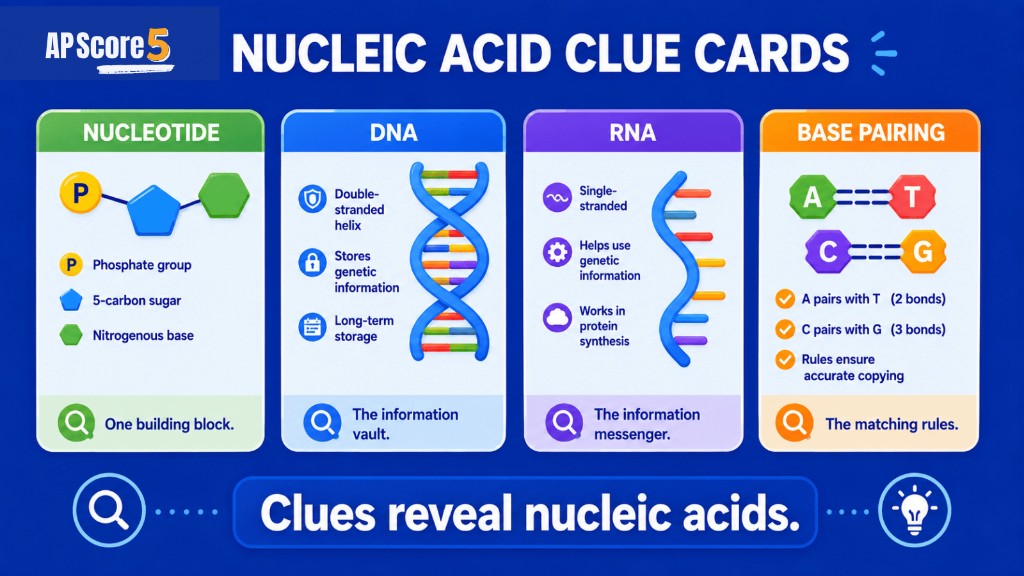
Nucleic acid questions cluster around vocabulary: nucleotide, phosphodiester, backbone, base pairing, DNA, RNA, double helix, uracil, thymine, 5 prime, 3 prime. When you see two or more of those terms, nucleic acids are likely the intended macromolecule class.
Separate nucleic acid structure questions from full protein synthesis narratives. If the stem lists ribosome, codon, or translation factors, you may need Unit 6 context. If it lists only backbone and bases, stay in Unit 1 nucleic acid chemistry.
Use the shuffled MCQs and clue cards below to drill recognition without memorizing letter positions. More practice lives on practice by topic and the AP Biology course page.
Section 12 of 24
Avoid trapsSkim six mistake cards—each pairs a trap with a one-line fix you can reuse on tests.
Fix: ATP shares parts with nucleotides but is mainly an energy carrier, not a genetic polymer.
Fix: DNA: deoxyribose + thymine. RNA: ribose + uracil.
Fix: Phosphodiester bonds link nucleotides; peptide bonds link amino acids.
Fix: AP Biology expects 5 prime to 3 prime orientation for replication and transcription.
Fix: DNA is usually double stranded; RNA is usually single stranded.
Fix: Focus on nucleotide structure, pairing, and information—not every step of translation.
Fix: Phosphate groups in the backbone make phosphorus essential for nucleic acids and ATP.
Fix: In DNA: A-T and G-C. In RNA: A-U and G-C.
Section 13 of 24
InteractiveOpen each clue card, predict the answer, then reveal the explanation—quick active recall.
Open each card to reveal the answer and why the clue fits. Use these before the topic explorer below.
Answer: Nucleotide monomer
Nucleotides are the building blocks of nucleic acids.
Answer: Nucleic acid polymer
Phosphodiester bonds link nucleotides in chains.
Answer: DNA
DNA uses deoxyribose and thymine.
Answer: RNA
RNA uses ribose and uracil.
Answer: DNA structure
DNA is usually double stranded with complementary pairing.
Answer: RNA
RNA is often single stranded for information use.
Answer: Base pairing
Complementary pairing holds strands together.
Answer: Base pairing
Guanine and cytosine pair with three hydrogen bonds.
Answer: Strand direction
Direction matters for replication and transcription.
Answer: ATP
ATP is related to nucleotides but is mainly for energy transfer.
Section 14 of 24
ExploreTap all four topic cards once—progress dock tracks exploration toward Finish topic.
Tap each topic once to open details. Explore all four to unlock the finish button sooner.
Deoxyribose · thymine · usually double stranded · stores genetic information
What it is: Deoxyribonucleic acid, the primary long-term genetic storage molecule in cells
Structure: Two antiparallel strands with complementary base pairing and a sugar-phosphate backbone
AP clue: Double helix, thymine, deoxyribose, hereditary information
Ribose · uracil · usually single stranded · uses genetic information
What it is: Ribonucleic acid, involved in expressing and using genetic information
Structure: Often single stranded with ribose and uracil instead of thymine
AP clue: mRNA, tRNA, rRNA, uracil, ribose, message from DNA
Phosphate + sugar + nitrogenous base · monomer of DNA and RNA
What it is: The building block joined by phosphodiester bonds into polynucleotides
Parts: Phosphate group, pentose sugar (deoxyribose or ribose), nitrogenous base
AP clue: Nucleotide, subunit, three-part monomer
Complementary partners · hydrogen bonds · antiparallel strands
What it is: Specific pairing between nitrogenous bases on opposite strands
Rules: A with T (or U in RNA); G with C
AP clue: Complementary strand, hydrogen bonds, replication template
0 of 4 nucleic acid topics explored · tap each card once
Section 15 of 24
Learning pathSee where nucleic acids sit in the Unit 1 sequence—step 9 of 11 on this hub.
Follow these steps in order. You are on step 9.
Section 16 of 24
Quick reviewPick the card that matches what you missed—each links back to the right section.
Review how subunits join into macromolecules.
Review how phosphodiester and other bonds form.
Compare carbs, lipids, proteins, and nucleic acids.
Review amino acids and how sequence affects function.
Review elements of life.
Base pairing depends on hydrogen bonds from water chemistry.
Preview transcription vs translation in Unit 6.
Return to the Unit 1 hub for full review.
Section 17 of 24
VocabularyScan term-definition cards—use before flashcards if any words feel unfamiliar.
Section 18 of 24
FlashcardsFlip each card for a two-sentence explanation; every 5th card pauses with a short countdown.
Every 5th card shows an ad placeholder with a short countdown. Flip the card to read the definition, then use the arrow for the next card.
Section 19 of 24
PracticeAnswer choices shuffle each load—pick one option, read the explanation, then advance.
Choices shuffle at display time. Tap an answer, read the explanation, then use Next question.
Want more Unit 1 drills? Try daily AP Biology practice or practice by topic.
Section 20 of 24
Free responseOpen one FRQ at a time, write on paper, then reveal rubric and sample—do not skip the checklist.
Click a question to open the full prompt. Write your answer on paper first, then reveal the rubric and a strong sample response.
The molecule is a nucleic acid, most likely DNA. It is built from nucleotide monomers joined by phosphodiester bonds in a sugar-phosphate backbone with nitrogenous bases projecting outward.
DNA stores genetic information in the sequence of bases. That information can later be used to direct protein synthesis through RNA intermediates in gene expression.
Backbone + bases + information role. Name each part in order.
DNA contains deoxyribose, uses thymine with adenine, and is usually double stranded. RNA contains ribose, uses uracil with adenine, and is usually single stranded.
Both are built from nucleotides and phosphodiester bonds, but these differences match their roles: DNA for stable storage, RNA for short-term information use.
Three contrasts: sugar, base, strands. One sentence each.
The complementary strand runs antiparallel: 5 prime-GCAT-3 prime. Adenine pairs with thymine and guanine pairs with cytosine through hydrogen bonds between strands.
Base pairing lets DNA replicate accurately because each strand templates the other. Review directionality on the nucleic acids directionality section when FRQs label 5 prime and 3 prime ends.
Antiparallel + hydrogen bonds. Show both strands' directions.
ATP shares features with nucleotides—adenine, ribose, and phosphates—but it is mainly an energy carrier, not a long polymer encoding genetic information.
DNA is a polynucleotide with a sugar-phosphate backbone and a sequence of bases that stores genetic information. ATP is recycled for cellular work; DNA is copied and inherited.
Similar parts ≠ same macromolecule class. Compare function, not just atoms.
Section 21 of 24
FAQExpand only the questions you still miss—answers match what search engines index on this page.
Nucleic acids are macromolecules, mainly DNA and RNA, that store or transmit genetic information using nucleotide building blocks.
Nucleotides are the monomers. Each has a phosphate group, a pentose sugar, and a nitrogenous base.
Phosphodiester bonds link nucleotides and form the sugar-phosphate backbone.
DNA usually has deoxyribose, thymine, and double strands; RNA usually has ribose, uracil, and single strands.
Bases on one strand hydrogen-bond to specific partners on another, such as A with T (or U in RNA) and G with C.
It is the repeating chain of sugar and phosphate groups that supports nitrogenous bases in DNA and RNA.
Many enzymes add nucleotides only to the 3 prime end, so strand orientation affects replication and transcription.
ATP is related to nucleotides but is mainly an energy carrier, not a genetic information polymer like DNA or RNA.
DNA stores information that cells use to build proteins; RNA helps carry out that process in gene expression.
Clues include nucleotide, phosphodiester bond, nitrogenous base, DNA, RNA, double helix, and base pairing.
ATP transfers energy; DNA and RNA primarily store or use genetic information, not short-term energy currency.
Adenine, thymine, guanine, and cytosine.
Adenine, uracil, guanine, and cytosine.
Explain nucleotide structure, phosphodiester bonds, base pairing, DNA vs RNA differences, and how sequence stores information.
Section 22 of 24
ChecklistCheck off skills you can explain aloud—11+ items help unlock Finish topic in the progress dock.
Check each skill when you can explain it without looking at the page.
0 of 17 skills ready
Section 23 of 24
CelebrateOpen this after Finish topic is ready—celebration panel and links to Unit 1 next steps.
Nice work—you explored all four nucleic acid topics and checked off the review skills. Return to the Unit 1 hub for cumulative review, or open the macromolecules overview to compare all four classes side by side.
Section 24 of 24
Continue learningLast stop: choose your next page—Unit 1 hub, macromolecules compare, or gene expression preview.
You finished the nucleic acids study guide—the last dedicated macromolecule spoke before the full Unit 1 review. Consolidate all four classes or preview gene expression in Unit 6.