MCQ diagnostic
One question at a time, mixed topics, explanations with links back to lessons.
AP Biology · Unit 1 · Chemistry of Life
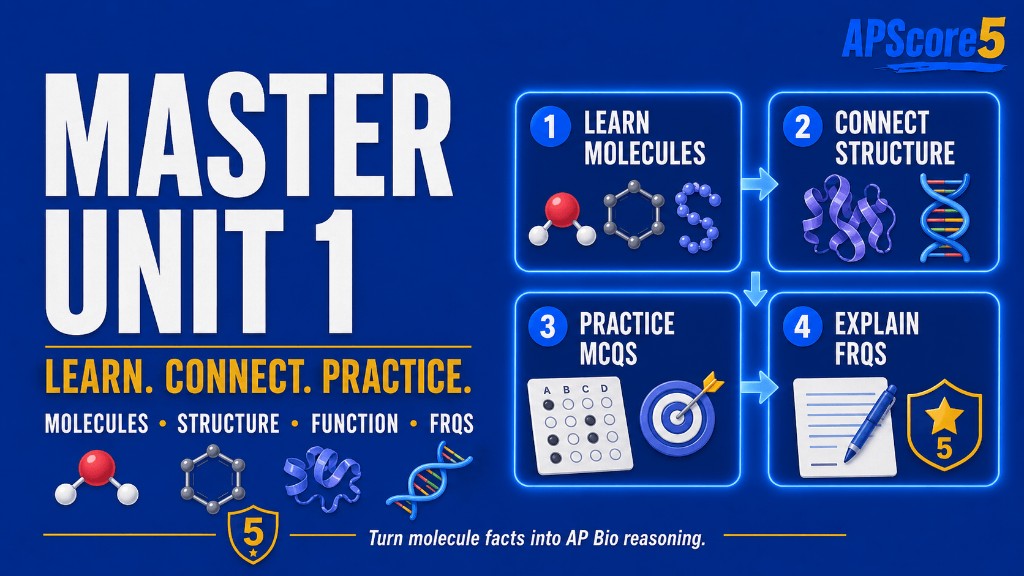
Review Chemistry of Life with summary charts, must-know concepts, weak-area links, a mini MCQ diagnostic, and short FRQ practice.
This page is a review guide with a short diagnostic. For the full 40-question MCQ set and six FRQs, use Unit 1 Practice Questions.
Direct answer
AP Biology Unit 1, Chemistry of Life, covers water properties, elements of life, monomers and polymers, dehydration synthesis and hydrolysis, and biological macromolecules. Students should understand carbohydrates, lipids, proteins, and nucleic acids, including their structures, functions, building blocks, examples, and AP test clues.
Start with the 15 MCQs and 5 mini FRQs at the top of this page (or use the Review Tools links in the left sidebar). Then skim the charts below or continue to full Unit 1 practice questions.
1-minute cram
If any bullet feels weak, use the Review Tools sidebar or the weak-area router below.
Practice first
This review is step 10 in the Unit 1 mini-course. Unlike a notes-only guide, it puts exam-style practice up front: a shuffled 15-question MCQ diagnostic with instant explanations, then 5 mini FRQ prompts with model answers. Your score updates in the ring on the hero and in the sidebar as you work.
One question at a time, mixed topics, explanations with links back to lessons.
Structure-function and comparison prompts with rubric-style model responses.
After practice, open the lesson that matches your misses.
As you answer, write down the topic tag for each missed question. One miss is normal. Two or more misses in the same topic means you should open that topic's review card below before moving to full Unit 1 practice.
0 of 15 answered
Question 1 of 15
Score guide: 13–15 correct: Strong — move to FRQs or full practice. 10–12: Good — review only missed topics. 7–9: Mixed — use the weak-area router. 0–6: Rebuild basics with the Unit 1 Review chart, then retry.
80–100%: open the mini FRQs or full Unit 1 practice. 50–79%: use weak-area links. Below 50%: reread the macromolecule chart, then retake.
Free response
Draft each answer on paper first, then open the model response. Use structure-function vocabulary and cite evidence from the stem—same partial-credit pattern as the real AP Biology exam.
Do FRQs after the 15-question MCQ block so you train both speed (MCQ) and explanation depth (FRQ) in one visit.
Use this formula:
Example: Because water is polar, it forms hydrogen bonds. Those hydrogen bonds create cohesion, allowing water molecules to stick together and move through plant xylem.
Model answer:
Hydrogen bonding between water molecules creates cohesion, which allows water molecules to stick together and contributes to surface tension.
Cohesion supports water transport in plants and helps small organisms use surface tension at air-water interfaces.
Why it scores: One property + hydrogen bonds + biological effect.
Model answer:
Dehydration synthesis joins smaller molecules into larger molecules and releases water. Hydrolysis breaks larger molecules into smaller subunits by using water.
They are opposite because one builds polymers while the other digests them, with opposite roles for water.
Why it scores: Build + release water vs break + use water.
Model answer:
Many macromolecules—such as proteins, nucleic acids, and many carbohydrates—are polymers built from repeating monomers.
Lipids are the major exception because they are not usually long chains of identical repeating subunits; triglycerides and phospholipids assemble from components but do not form typical polymer backbones.
Why it scores: Polymers yes—except lipids.
Model answer:
A change in pH can disrupt ionic and hydrogen interactions that maintain protein folding. If the protein's shape changes, the active site may no longer fit its substrate, reducing or eliminating catalytic function.
Why it scores: Shape change → lost function (denaturation).
Model answer:
Nucleic acids have a sugar-phosphate backbone with nitrogenous bases projecting outward. The backbone provides structural support, while the sequence of bases stores genetic information that cells can copy and use to build proteins.
Why it scores: Backbone + base sequence → information.
Study plan
Recommended order: run the MCQ diagnostic, write at least one mini FRQ on paper, then skim the topic summaries and tables below only for topics you missed. If practice feels easy, go straight to AP Biology Unit 1 practice questions.
This page pulls the unit together—it does not replace every deep-dive lesson. Use the learning-path cards and weak-area links when you need more than a one-paragraph reminder.
MCQs, one FRQ on paper, then open weak-area links for misses.
Must-know table, macromolecule chart, and topic panels you flagged.
Retake the MCQ set a week later and compare your score ring.
Big picture
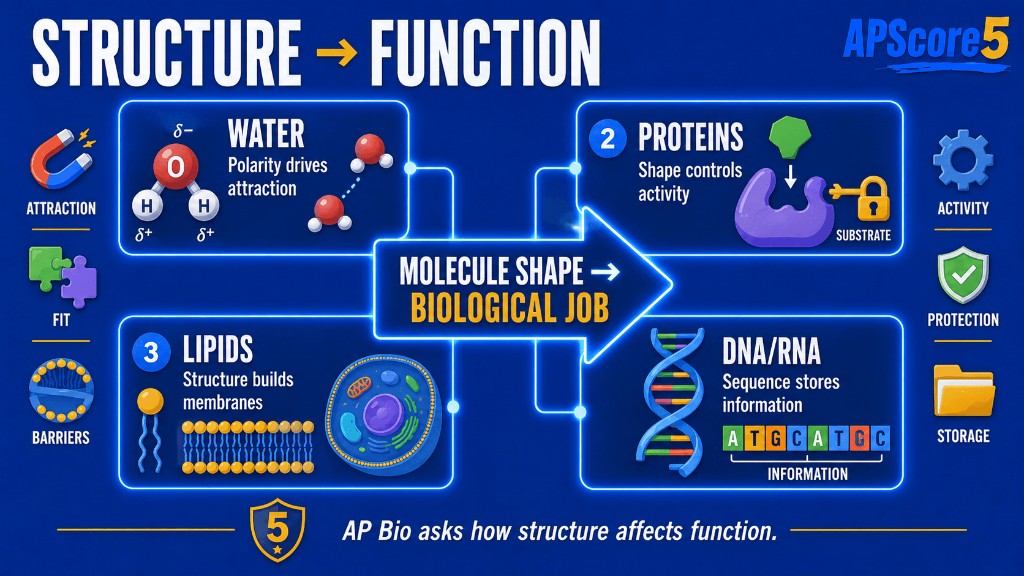
AP Biology Unit 1 is about how chemical structure creates biological function. Water's polarity explains cohesion, adhesion, temperature moderation, and solvent behavior. Carbon's bonding ability explains molecular diversity. Monomers and polymers explain how cells build large molecules from smaller parts. Dehydration synthesis and hydrolysis explain how molecules are built and broken. Macromolecules explain how cells store energy, build membranes, make enzymes, and store genetic information.
Unit 1 prepares you for later units: membranes, enzymes, cellular energetics, and gene expression all assume you can connect molecular structure to biological outcomes. When you review, always ask what a molecule looks like and what job that shape allows in a cell or organism.
Study smarter
AP Biology Unit 1 is mostly about molecular structure, function, and recognition clues. Later units go deeper into enzymes, membranes, energetics, and gene expression.
Mini-course
You are on step 10: the full Unit 1 review. Steps 1–9 are deep-dive lessons; step 11 is the full practice question set.
Cram sheet
Use this table as a cram sheet before quizzes. Each row links to the full lesson when you need more than a one-line reminder.
| Topic | Must-Know Idea | Key Terms | AP Test Clue | Deep-Dive Link |
|---|---|---|---|---|
| Water Properties | Water's polarity and hydrogen bonding support life | polarity, hydrogen bond, cohesion, adhesion, specific heat, solvent | water molecules, surface tension, temperature moderation | Water Properties |
| Elements of Life | CHNOPS build biological molecules | carbon, nitrogen, phosphorus, sulfur | carbon skeleton, phosphate, amino group | Elements of Life |
| Monomers and Polymers | Small units build larger molecules | monomer, polymer, macromolecule | building block, subunit, chain | Monomers and Polymers |
| Dehydration/Hydrolysis | Build vs break molecules using water logic | dehydration synthesis, hydrolysis | water released vs water used | Dehydration/Hydrolysis |
| Macromolecules | Four molecule groups support cell functions | carbohydrates, lipids, proteins, nucleic acids | molecule identification clues | Macromolecules |
| Carbohydrates | Sugars support energy and structure | glucose, starch, glycogen, cellulose | sugar, -ose, polysaccharide | Carbohydrates |
| Lipids | Hydrophobic molecules support membranes/storage | triglyceride, phospholipid, steroid | hydrophobic, fatty acid, bilayer | Lipids |
| Proteins | Shape determines function | amino acid, peptide bond, folding, enzyme | active site, denaturation, receptor | Proteins |
| Nucleic Acids | Base sequence stores information | nucleotide, DNA, RNA, phosphate, base | sugar-phosphate backbone, genetic info | Nucleic Acids |
Topic review
Water is polar because oxygen attracts electrons more strongly than hydrogen, creating partial charges on each molecule. Those partial charges let water molecules form hydrogen bonds with neighbors, which explains many life-supporting properties you will see on AP Biology Unit 1 MCQs and FRQs.
Cohesion means water sticks to water; adhesion means water sticks to other surfaces. Together they help explain surface tension, capillary action in plants, and why water climbs narrow tubes. High specific heat means water resists temperature change, helping organisms and ecosystems stay stable when energy input fluctuates.
Water is an excellent solvent for polar and ionic substances because partial charges orient solutes and keep them dispersed. Ice is less dense than liquid water because hydrogen bonds hold molecules slightly farther apart in the solid, so ice floats—a rare trait that protects aquatic life in winter.
On the exam, always connect a named property to a biological effect: cohesion supports transport and surface tension; adhesion supports wetting of surfaces; solvent behavior supports chemistry in cells and blood plasma. If a stem names specific heat or evaporative cooling, trace the explanation back to hydrogen bonding between water molecules.
Unit 1 water questions often appear alongside macromolecule chemistry because polar water interacts with charged and polar biological molecules. Review cohesion versus adhesion carefully—they are related but not interchangeable on FRQs.
Quick review: Water supports life because its polarity and hydrogen bonding create cohesion, adhesion, high specific heat, solvent properties, and ice behavior that help organisms and ecosystems function.
Go deeper on Water Properties →
Topic review
Living systems rely on CHNOPS: carbon, hydrogen, nitrogen, oxygen, phosphorus, and sulfur. Hydrogen and oxygen appear constantly in water and organic molecules. Carbon is the backbone of organic diversity because it forms four covalent bonds and can build chains, branches, and rings.
Nitrogen is essential in amino groups of amino acids and in nitrogenous bases of nucleotides. Phosphorus appears in phosphate groups of ATP, nucleic acid backbones, and phospholipid heads—so phosphorus questions often tie energy, genetics, and membranes together.
Sulfur can stabilize protein shape through disulfide bridges in some proteins. When an AP question names an element, ask what class of molecule is being built: carbon skeleton for organic diversity, nitrogen for proteins and nucleic acids, phosphorus for ATP and DNA/RNA.
Element-composition items are fast points if you know which elements appear in which macromolecule class. Carbohydrates are rich in C, H, and O; proteins add N (and sometimes S); nucleic acids add P in phosphate groups; lipids are mostly C and H with variable oxygen.
The elements-of-life lesson walks through carbon skeletons and functional groups in more detail than this review summary allows, but the review table below is your cram-sheet for matching element to molecule.
Quick review: CHNOPS elements build the major biological molecules; carbon provides skeletons, nitrogen and phosphorus anchor proteins and nucleic acids, and sulfur can stabilize some proteins.
Go deeper on Elements of Life →
| Element | AP Role | Example |
|---|---|---|
| Carbon | Backbone of organic molecules | glucose, amino acids, DNA bases |
| Hydrogen | Water and organic molecules | water, hydrocarbons |
| Oxygen | Polar groups, water, energy pathways | glucose, water |
| Nitrogen | Proteins and nucleic acids | amino groups, nitrogenous bases |
| Phosphorus | ATP, DNA/RNA, phospholipids | phosphate groups |
| Sulfur | Protein stabilization | disulfide bonds |
Topic review
A monomer is a small molecular building block; a polymer is a larger molecule made of linked monomers. Carbohydrates polymerize from monosaccharides, proteins from amino acids, and nucleic acids from nucleotides. Recognizing monomer-polymer pairs is one of the fastest ways to sort AP Biology Unit 1 questions.
Macromolecule is the umbrella term for large biological molecules. Not every macromolecule is a true polymer with repeating identical subunits—lipids are the famous exception discussed later on this review page.
When a stem says building block, subunit, or chain, think monomer and polymer before you guess a specific functional group. Linking monomers usually involves dehydration synthesis; breaking polymers usually involves hydrolysis.
Polymer length and branching change function even when the monomer is the same sugar. That idea previews why starch, glycogen, and cellulose behave differently despite all involving glucose chemistry.
If you can state monomer, bond type, and polymer name for each class, you are already ahead on many comparison charts and FRQ introductions.
Quick review: Monomers are building blocks; polymers are chains of linked monomers; each macromolecule class has a characteristic monomer except lipids.
Go deeper on Monomers and Polymers →
| Macromolecule | Monomer / building block | Polymer / larger form |
|---|---|---|
| Carbohydrates | monosaccharides | polysaccharides |
| Proteins | amino acids | polypeptides/proteins |
| Nucleic acids | nucleotides | DNA/RNA |
| Lipids | fatty acids/glycerol/other components | triglycerides, phospholipids, steroids; not true repeating polymers |
Topic review
Dehydration synthesis joins smaller molecules into larger ones and releases water as a product. Hydrolysis breaks larger molecules into smaller subunits by using water as a reactant. They are opposite directions of the same chemical logic cells use to build and recycle macromolecules.
Dehydration synthesis forms covalent bonds between monomers—peptide bonds in proteins, glycosidic bonds in carbohydrates, phosphodiester bonds in nucleic acids. Hydrolysis cleaves those bonds during digestion and turnover.
On AP-style questions, first decide whether the molecule is being built or broken, then decide whether water is released or consumed. Mixing these up is one of the most common Unit 1 mistakes.
Digestion narratives in later units still depend on hydrolysis vocabulary from Unit 1. Building a polypeptide in a ribosome depends on dehydration synthesis logic even when enzymes have different names.
Write a one-line rule on your notes: build = release water; break = use water. That single line prevents dozens of lost points.
Quick review: Dehydration synthesis builds polymers and releases water; hydrolysis breaks polymers and uses water.
Go deeper on Dehydration Synthesis and Hydrolysis →
| Feature | Dehydration synthesis | Hydrolysis |
|---|---|---|
| Main action | Builds | Breaks |
| Water role | Water is product | Water is reactant |
| Direction | Monomers to polymers | Polymers to monomers |
| Bond change | Forms bonds | Breaks bonds |
| AP clue | Water released | Water added |
High yield
The four major macromolecule groups in AP Biology Unit 1 are carbohydrates, lipids, proteins, and nucleic acids. Each group has characteristic elements, monomers or components, functions, and vocabulary clues that appear on exams year after year. Carbohydrates emphasize quick energy, storage, and structural polysaccharides. Lipids emphasize hydrophobic energy storage, membranes, and signaling steroids. Proteins emphasize folding, enzymes, and receptors. Nucleic acids emphasize information storage in base sequence. Use the macromolecules comparison chart on this page as a cram sheet before practice. When a question shows a diagram or description, run the fast identification checklist: polarity words point to water; -ose and glycosidic language point to carbohydrates; hydrophobic tails point to lipids; peptide and active site language point to proteins; nucleotide and backbone language point to nucleic acids. This chart should be one of the final things you review before timed practice. Photograph it or rewrite it once by hand—active recall beats passive rereading the night before a quiz.
| Macromolecule | Main Elements | Building Blocks | Main Function | Examples | AP Clues |
|---|---|---|---|---|---|
| Carbohydrates | C, H, O | Monosaccharides | Quick energy, energy storage, structure | glucose, starch, glycogen, cellulose | sugar, -ose, polysaccharide |
| Lipids | C, H, O; sometimes P | Fatty acids/glycerol or other components | Long-term energy, membranes, signaling | triglycerides, phospholipids, steroids | hydrophobic, bilayer, fatty acid, steroid |
| Proteins | C, H, O, N; sometimes S | Amino acids | Enzymes, transport, receptors, structure, signaling | enzymes, hemoglobin, membrane proteins | amino acid, peptide bond, active site, denaturation |
| Nucleic Acids | C, H, O, N, P | Nucleotides | Store and transmit genetic information | DNA, RNA | nucleotide, base, phosphate, sugar-phosphate backbone |
Use this chart when MCQs flag macromolecule confusion—or before you retake the diagnostic.
Macromolecule
Carbohydrates include monosaccharides such as glucose and polysaccharides such as starch, glycogen, and cellulose. They are built from CHO-rich subunits linked by glycosidic bonds formed through dehydration synthesis.
Glucose is a central fuel molecule. Starch stores energy in plants; glycogen stores energy in animals; cellulose provides structural support in plant cell walls. All three can involve glucose, but branching and linkage patterns create different functions—an AP trap worth memorizing with structure-function reasoning.
Carbohydrates also appear in recognition and structure roles on membranes in later units, but Unit 1 focuses on energy and plant wall structure.
Ring versus chain forms of sugars matter less at Unit 1 depth than knowing which polysaccharide matches which organism and job. Label diagrams carefully on FRQs: starch in plants, glycogen in animals, cellulose in plant walls.
If a question mentions glycosidic bonds, you are almost certainly in carbohydrate territory—not peptide or phosphodiester chemistry.
Quick review: Carbohydrates are sugars and polysaccharides for energy, storage, and plant structure; know glucose, starch, glycogen, and cellulose.
Go deeper on Carbohydrates →
Macromolecule
Lipids are mostly hydrophobic molecules that store long-term energy, form membranes, and can act as signaling molecules. Triglycerides store energy; phospholipids form bilayers with hydrophilic heads and hydrophobic tails; steroids such as cholesterol influence membrane fluidity and signaling.
Unlike proteins, nucleic acids, and many carbohydrates, lipids are not usually true polymers made of one repeating monomer type. That exception appears on both MCQs and FRQs—do not claim all macromolecules are polymers.
Membrane questions in Unit 1 and later units depend on phospholipid amphipathic structure: heads interact with water; tails avoid water and create bilayers.
Saturated versus unsaturated fatty acids change membrane fluidity—a preview of why diet and temperature matter for cell membranes. Unit 1 may not require drawing fatty acids, but you should recognize hydrophobic tails in diagrams.
When a stem says nonpolar, long-term energy storage, or bilayer, lipids should be your first macromolecule guess.
Quick review: Lipids are hydrophobic, store energy, form membranes with phospholipids, and are not usually true polymers.
Go deeper on Lipids →
Macromolecule
Proteins are polymers of amino acids linked by peptide bonds. The sequence of amino acids (primary structure) folds into secondary, tertiary, and sometimes quaternary structures that determine function. Enzymes, transport proteins, receptors, and structural proteins all depend on shape.
Denaturation changes protein shape—often from pH or temperature—and can reduce function without necessarily breaking peptide bonds. Hydrolysis, by contrast, breaks proteins into smaller parts. Confusing denaturation with hydrolysis is a common Unit 1 mistake.
The AP reasoning chain is amino acid sequence → folding → shape → function. Active sites of enzymes are shape-specific binding regions; if shape changes, catalysis can stop.
Primary structure is still chemistry of life even when textbooks emphasize higher levels later. A single amino acid change can alter folding and cause disease—structure-function at the molecular scale.
If a question mentions R groups, peptide bonds, or active sites, you are in protein territory—not nucleotide chemistry.
Quick review: Proteins fold from amino acids; shape determines function; denaturation alters shape without necessarily digesting the chain.
Go deeper on Proteins →
Macromolecule
Nucleic acids include DNA and RNA, built from nucleotide monomers. Each nucleotide contains a sugar, a phosphate group, and a nitrogenous base. A sugar-phosphate backbone provides structure; the sequence of bases stores genetic information.
DNA usually stores hereditary information with deoxyribose and thymine; RNA helps use genetic information with ribose and uracil. ATP is nucleotide-related and important for energy transfer but is not a hereditary polymer—another favorite AP distinction.
Nucleic acids are made of nucleotides, not amino acids. Base pairing and complementary strands preview replication and gene expression in later units.
Phosphodiester bonds join nucleotides in the backbone; that vocabulary separates nucleic acids from peptide and glycosidic bond questions on the same test.
When a diagram shows double helix, thymine, or sugar-phosphate rails, nucleic acids are the intended answer even if the question also mentions proteins in the same organism.
Quick review: Nucleotides build DNA and RNA; base sequence stores information; ATP is related but not hereditary storage.
Go deeper on Nucleic Acids →
Exam patterns
High-yield structure-function pairs appear on both MCQs and FRQs. Copy the pattern that matches your miss into your notes.
| Structure | Function | Example | AP reasoning |
|---|---|---|---|
| Water polarity | Hydrogen bonding and solvent behavior | water | Polarity explains life-supporting water properties. |
| Carbon bonding | Molecular diversity | carbon skeletons | Four bonds allow chains, rings, and branches. |
| Carbohydrate branching | Energy access | glycogen | Branching allows quick glucose release. |
| Hydrophobic lipid tails | Membrane organization | phospholipids | Tails avoid water and form bilayers. |
| Amino acid sequence | Protein folding | enzymes | Sequence affects shape and function. |
| Protein active site | Substrate binding | enzymes | Shape-specific binding supports catalysis. |
| Base sequence | Information storage | DNA | Order of bases stores genetic information. |
| Phosphate groups | Backbone/energy transfer | DNA, ATP | Phosphorus supports structure and energy transfer. |
Speed drill
Scan these clue phrases before you pick a letter on a mixed Unit 1 quiz.
Question stem clues
Stem pattern: A substance dissolves easily in water…
Think: Polarity, charged/polar solutes, water as solvent.
Stem pattern: A plant moves water upward…
Think: Cohesion, adhesion, hydrogen bonding.
Stem pattern: A molecule is built and water is released…
Think: Dehydration synthesis.
Stem pattern: A molecule is broken down after water is added…
Think: Hydrolysis.
Stem pattern: A macromolecule is hydrophobic…
Think: Lipids.
Stem pattern: An active site changes shape…
Think: Protein folding, denaturation, enzyme function.
Stem pattern: A sequence stores information…
Think: Nucleic acids and nitrogenous bases.
Stem pattern: A student says all macromolecules are polymers…
Think: Lipids are the exception.
Avoid traps
Walk these traps before test day—they cost more points than vocabulary slips.
Fix: Always explain how structure supports function.
Fix: Dehydration synthesis builds and releases water; hydrolysis breaks and uses water.
Fix: Lipids are not usually true polymers.
Fix: Amino acids build proteins; nucleotides build nucleic acids.
Fix: Starch stores energy in plants, glycogen in animals, cellulose supports plant cell walls.
Fix: Phosphate groups appear in ATP, DNA, RNA, and phospholipids.
Fix: Protein shape is essential for enzymes, receptors, and transport.
Fix: DNA is a nucleic acid; proteins are made from amino acids.
Fix: Water's polarity and hydrogen bonding explain many properties.
Fix: Use precise vocabulary and connect structure to function.
Vocabulary
25 terms you should recognize on sight during Unit 1 review.
Unequal charge distribution in a molecule.
Weak attraction involving hydrogen and electronegative atoms.
Water molecules sticking to each other.
Water sticking to other surfaces.
Amount of heat needed to change temperature.
A substance that dissolves other substances.
Carbon, hydrogen, nitrogen, oxygen, phosphorus, and sulfur.
Carbon chain or ring forming a molecule's backbone.
Small molecular building block.
Large molecule made of linked monomers.
Reaction that builds molecules and releases water.
Reaction that breaks molecules using water.
Sugar-based molecule used for energy, storage, or structure.
Mostly hydrophobic molecule used for energy, membranes, or signaling.
Amino acid-based molecule that folds into functional shapes.
Nucleotide-based molecule that stores or uses genetic information.
Simple sugar.
Carbohydrate polymer.
Protein monomer.
Nucleic acid monomer.
Amphipathic lipid that forms membranes.
Protein that speeds up a chemical reaction.
Protein shape change that can reduce function.
Structural backbone of DNA/RNA.
Nucleotide component that helps store information.
Recall
Expand each card to check your recall. For flip-card practice with shuffle, use the topic lessons or full practice set.
Chemistry of Life: water, elements, monomers, polymers, reactions, and macromolecules.
Unequal sharing of electrons creates partial charges.
Water molecules sticking to other water molecules.
Water sticking to other surfaces.
Carbon, hydrogen, nitrogen, oxygen, phosphorus, and sulfur.
Carbon forms four covalent bonds and diverse molecules.
A small molecular building block.
A large molecule made of linked monomers.
Builds larger molecules and releases water.
Breaks larger molecules using water.
Carbohydrates, lipids, proteins, and nucleic acids.
Monosaccharides.
Stores energy in plants.
Stores energy in animals.
Provides structural support in plant cell walls.
Being hydrophobic and supporting long-term energy, membranes, and signaling.
No. Lipids are the major macromolecule exception.
Cell membrane bilayers.
Amino acids.
Peptide bonds.
Shape determines function.
A change in protein shape that can reduce function.
Nucleotides.
Sugar, phosphate group, and nitrogenous base.
Stores genetic information.
Helps use genetic information.
The sequence of nitrogenous bases.
ATP.
Connecting structure to function.
Practice AP-style MCQs and FRQs.
Fix misses
Click the topic that matches your misses. Each card opens the full Chemistry of Life lesson.
Night before
Before your Unit 1 quiz or test, make sure you can explain each item aloud.
Choose your review mode
Read the 1-minute cram, macromolecule chart, and fast identification checklist.
Do the 15-question MCQ diagnostic, then review missed topic links.
Do the MCQs, write one FRQ, review the macromolecule chart, and open one weak topic.
Complete this review page, write all 5 FRQs, then move to the full Unit 1 Practice Questions page.
Next step
Review shows what you recognize. Practice shows whether you can apply it under AP-style pressure.
Editorial
This AP Biology Unit 1 review is organized around Chemistry of Life concepts students are expected to connect: water chemistry, CHNOPS, monomers and polymers, dehydration synthesis and hydrolysis, and the four major macromolecule groups. Questions are original AP-style practice questions written for review, not official College Board questions.
FAQ
Quick answers for search and exam prep. Visible text matches FAQ schema on this page.
AP Biology Unit 1 is Chemistry of Life. It covers water properties, elements of life, monomers and polymers, dehydration synthesis and hydrolysis, and biological macromolecules.
The main topics are water properties, CHNOPS, monomers and polymers, dehydration synthesis, hydrolysis, carbohydrates, lipids, proteins, and nucleic acids.
The four macromolecules are carbohydrates, lipids, proteins, and nucleic acids.
The most important skill is connecting molecular structure to biological function.
Memorize CHNOPS, water properties, monomer-polymer pairs, dehydration synthesis vs hydrolysis, and the structure and function of the four macromolecules.
Dehydration synthesis builds molecules and releases water, while hydrolysis breaks molecules and uses water.
No. Many macromolecules are polymers, but lipids are not usually true polymers.
Carbohydrates are used for quick energy, energy storage, and structural support.
Lipids are used for long-term energy storage, membranes, insulation, and signaling.
Proteins function as enzymes, transport proteins, receptors, structural molecules, signaling molecules, and more.
Nucleic acids store and help use genetic information. DNA and RNA are the major examples.
Start with the review chart, identify weak areas, revisit the deep-dive pages, then practice AP-style MCQs and FRQs.
Unit 1 can feel vocabulary-heavy, but it becomes easier when you connect each molecule's structure to its function.
After reviewing, complete the full AP Biology Unit 1 Practice Questions page, check answer explanations, and revisit any topic where you missed more than one question.
Start with the macromolecules chart, review water properties and dehydration synthesis versus hydrolysis, then answer MCQs and write at least one short FRQ. Focus on structure-function reasoning instead of rereading every note.
A common mistake is memorizing molecule names without explaining how structure affects function. Another common mistake is reversing dehydration synthesis and hydrolysis.