Dehydration Synthesis and Hydrolysis AP Biology: Building and Breaking Polymers
Learn how cells build polymers by removing water and break polymers by adding water.
AP Biology dehydration synthesis and hydrolysis questions usually test whether you can explain how cells build and break biological molecules. Dehydration synthesis joins monomers and releases water; hydrolysis uses water to split polymers. This page shows the difference, connects both reactions to macromolecules, and gives you AP-style practice.
Updated May 24, 2026Reviewed by APScore5 Editorial Team
Must knowMonomer → polymer pairs for carbs, proteins, nucleic acids, and lipids
Big ideaDehydration synthesis builds; hydrolysis breaks
AP skillConnect subunit → bond → structure → function
What Is the Difference Between Dehydration Synthesis and Hydrolysis?
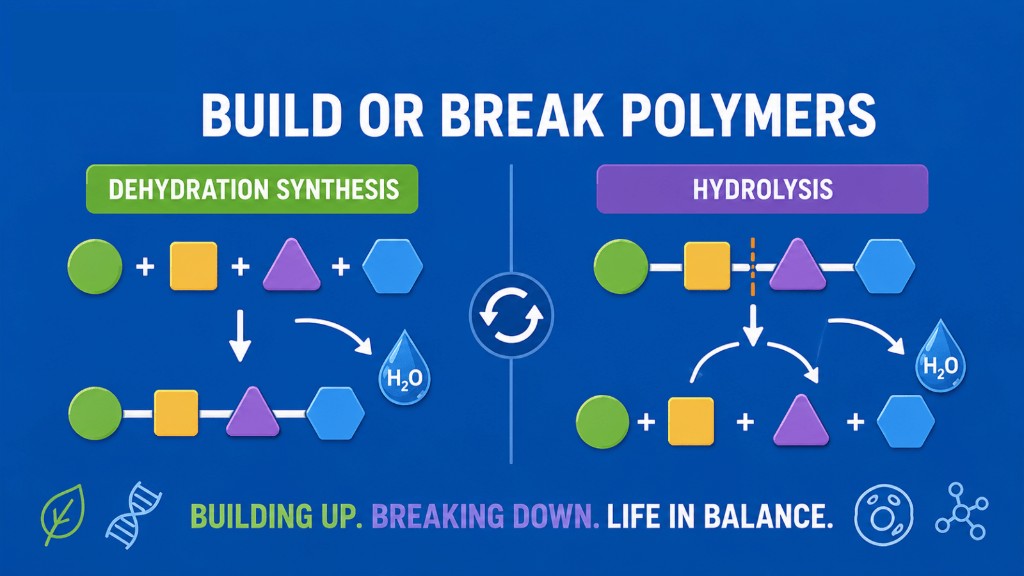
Dehydration synthesis builds larger molecules by joining monomers together and releasing water. Hydrolysis breaks larger molecules apart by adding water. In AP Biology, dehydration synthesis is associated with building polymers, while hydrolysis is associated with digesting or breaking polymers into smaller subunits.
AP tip: Watch water carefully. If water is produced, the reaction is usually dehydration synthesis. If water is used as a reactant to break a bond, the reaction is hydrolysis.
Dehydration synthesis and hydrolysis AP Biology content is really about how cells build and break biological molecules. Dehydration synthesis builds larger molecules by joining smaller subunits and releasing water. Hydrolysis breaks larger molecules apart by using water. These two reactions are opposites, and they explain how monomers become polymers and how polymers can be broken back into smaller subunits. Once you understand which direction the reaction is moving and what happens to water, this topic becomes much easier.
Why Do Dehydration Synthesis and Hydrolysis Matter in AP Biology?
AP Biology Unit 1 is about how chemistry supports life. Monomers and polymers are connected by chemical reactions, not by static labels. Dehydration synthesis builds larger biological molecules; hydrolysis breaks larger biological molecules. Together they explain digestion, macromolecule assembly, and molecular recycling inside cells.
AP Biology Unit 1 becomes much easier when you understand that biological molecules are not just static structures. Cells build them, break them, rearrange them, and recycle their parts. Dehydration synthesis builds larger molecules by joining smaller subunits together. Hydrolysis does the opposite—it breaks larger molecules apart by using water.
In AP Biology, dehydration synthesis and hydrolysis matter because they explain how cells build polymers from monomers and break polymers back into smaller subunits.
This is why the topic sits between Monomers and Polymers and Macromolecules in the learning path. First you learn building blocks; then you learn the reactions that link or split them; then you compare carbohydrates, lipids, proteins, and nucleic acids in detail.
Exam questions often ask you to trace a chain: monomer → reaction → polymer → macromolecule → function. A digestive enzyme breaking starch into glucose is hydrolysis. Ribosomes joining amino acids during translation is dehydration synthesis. Naming the process plus the water role is how you earn partial and full credit on FRQs.
Strong students also connect this topic back to water properties. Water is not only a solvent—it is a reactant or product in these reactions, which is one reason life is so dependent on aqueous chemistry.
Build
What Is Dehydration Synthesis?
Dehydration synthesis is also called a condensation reaction. Dehydration means water is removed or released; synthesis means building. Cells use this pattern to join smaller molecules into larger ones, especially when forming biological polymers.
A simple version is: Monomer + Monomer → Larger Molecule + Water. During the reaction, a covalent bond forms between subunits while –OH from one partner and –H from another combine to form H₂O.
Monosaccharides can join into disaccharides or polysaccharides (glycosidic bonds). Amino acids join into polypeptides (peptide bonds). Nucleotides join into DNA or RNA (phosphodiester bonds). Each class uses the same big idea: build by releasing water.
AP warning: Do not say dehydration synthesis uses water to build polymers. It releases water as a product while forming a new bond.
Translation at ribosomes is a high-yield example: each new peptide bond between amino acids is dehydration synthesis. Polymer length and sequence then determine folding and function—structure-function reasoning starts at the bond-forming step.
Energy and enzymes matter too. Building polymers is often anabolic and enzyme-driven. The College Board may describe a scenario with two small molecules and a water molecule leaving; that diagram is almost always dehydration synthesis.
Break
What Is Hydrolysis?
Hydro means water; lysis means splitting or breaking. Hydrolysis breaks a larger molecule into smaller subunits by adding water to cleave a covalent bond.
A simple version is: Polymer + Water → Smaller Subunits. Water is a reactant here—the opposite water role from dehydration synthesis.
Polysaccharides can be broken into monosaccharides. Proteins can be broken into amino acids. Nucleic acids can be broken into nucleotides. Digestion and intracellular recycling both depend on hydrolysis so cells can absorb or reuse parts.
AP warning: Do not say hydrolysis releases water. Hydrolysis uses water to break a bond.
Salivary amylase beginning starch breakdown in the mouth is a relatable example. AP passages may instead describe a lysosomal enzyme or an intestinal protease—the logic is the same: add water, break the polymer linkage, release subunits.
ATP → ADP + Pᵢ is often discussed alongside hydrolysis vocabulary because a phosphate bond is broken with water’s help, coupling chemistry to energy transfer. Keep polymer digestion and ATP hydrolysis separate in your notes, but recognize the shared “water used to break” theme.
Compare
Dehydration Synthesis vs Hydrolysis: Comparison Table
Use this table when a stem shows a reaction arrow and a water molecule—match direction and water role before you pick an answer.
Figure - Dehydration Synthesis Vs Hydrolysis Water
Feature
Dehydration Synthesis
Hydrolysis
AP Biology Test Clue
Main action
Builds larger molecules
Breaks larger molecules
Build vs break
Water’s role
Water released as product
Water used as reactant
Product vs reactant
Bond change
Forms a covalent bond
Breaks a covalent bond
Bond forms vs breaks
Direction
Monomers → polymers
Polymers → monomers
Smaller → larger vs larger → smaller
Common context
Building macromolecules
Digestion or recycling
Synthesis vs digestion
Simple equation
Monomer + monomer → polymer + water
Polymer + water → monomers
Track water and direction
AP example
Amino acids → polypeptide
Protein → amino acids
Assembly vs digestion
The fastest AP Biology strategy is to ask two questions: Is the molecule being built or broken? Is water being released or used? If it is being built and water is released, think dehydration synthesis. If it is being broken and water is used, think hydrolysis.
Connect
How Do These Reactions Connect to Macromolecules?
These reactions are the chemical logic behind the four macromolecule families. Dehydration synthesis explains assembly; hydrolysis explains breakdown and recycling.
Macromolecule Group
Building Reaction
Breaking Reaction
Subunits Involved
AP Example
Carbohydrates
Dehydration synthesis joins monosaccharides
Hydrolysis breaks polysaccharides
Monosaccharides
Glucose → starch; starch → glucose
Proteins
Dehydration synthesis joins amino acids
Hydrolysis breaks polypeptides
Amino acids
Amino acids → polypeptide; protein → amino acids
Nucleic acids
Dehydration synthesis joins nucleotides
Hydrolysis breaks nucleic acids
Nucleotides
Nucleotides → DNA/RNA; nucleic acid → nucleotides
Lipids
Some lipid formation involves dehydration-like bond formation
Hydrolysis can break some lipid bonds
Fatty acids, glycerol, phosphate groups
Triglyceride formation and breakdown
Carbohydrates, proteins, and nucleic acids follow the monomer-polymer pattern most clearly. Lipids are different because they are not always true polymers, but dehydration and hydrolysis reactions can still be involved in forming and breaking some lipid molecules.
For carbohydrates, dehydration synthesis can join monosaccharides into disaccharides or polysaccharides; hydrolysis can break larger carbohydrates into smaller sugars. For proteins, dehydration synthesis joins amino acids; hydrolysis breaks peptide bonds. For nucleic acids, nucleotides polymerize into DNA or RNA; hydrolysis can release nucleotides when bonds in the backbone are cleaved.
What Is Water’s Role in Building and Breaking Molecules?
This topic connects directly to water properties. Water is not just the liquid surrounding cells—it participates in bond-forming and bond-breaking chemistry.
In dehydration synthesis, water is produced as smaller molecules join. In hydrolysis, water is used to split larger molecules apart. That dual role is one reason water is central to life beyond its solvent behavior.
On AP-style questions, tracking water is often the fastest discriminator. A diagram with H₂O leaving while two subunits connect points to dehydration synthesis. A diagram with H₂O added before a polymer splits points to hydrolysis.
Hydrogen bonding between water molecules (cohesion, adhesion, high specific heat) explains macroscopic water behavior; dehydration and hydrolysis explain how water molecules enter or leave chemical reactions during polymer chemistry. Keep both layers in your Unit 1 notes.
Interactive
Explore Build vs Break Reactions
Tap each reaction card once to open details. Explore both to unlock the finish button faster.
+
Dehydration Synthesis
Joins monomers · releases H₂O · forms covalent bonds
Equation: Monomer + Monomer → Polymer + Water
AP examples: Peptide bond formation, glycosidic linkages, phosphodiester bonds in DNA/RNA.
Fix: Here, dehydration means water is released during bond formation.
Thinking hydrolysis builds polymers
Fix: Hydrolysis breaks polymers into smaller subunits.
Forgetting bond change
Fix: Dehydration synthesis forms bonds; hydrolysis breaks bonds.
Ignoring direction
Fix: Monomers → polymer usually means dehydration synthesis; polymer → monomers usually means hydrolysis.
Forcing lipids into the polymer template
Fix: Lipids are not always true polymers, but some lipid reactions still involve water and covalent bonds.
The most common mistake is reversing water’s role. The second is answering with vocabulary only—always state build or break and whether water is added or released.
Mini FRQ Practice on Dehydration Synthesis and Hydrolysis
FRQ 1
Prompt: A cell joins many amino acids together to form a polypeptide. Identify the type of reaction involved and describe the role of water in the reaction.
Expected: The reaction is dehydration synthesis. It joins amino acids together by forming covalent bonds, and water is released as a product.
Scoring: 1 point: dehydration synthesis; 1 point: amino acids joining or bond formation; 1 point: water released as product.
FRQ 2
Prompt: An enzyme breaks a polysaccharide into smaller sugar subunits. Identify the type of reaction involved and explain why water is required.
Expected: The reaction is hydrolysis. Water is required because hydrolysis uses water to break covalent bonds between sugar subunits.
Scoring: 1 point: hydrolysis; 1 point: polysaccharide broken into smaller sugars; 1 point: water used to break bonds.
FRQ 3
Prompt: Explain how dehydration synthesis and hydrolysis are opposite processes and why both are important in cells.
Expected: Dehydration synthesis builds larger molecules from smaller subunits and releases water, while hydrolysis breaks larger molecules into smaller subunits using water. Both are important because cells must build macromolecules for structure and function and break molecules down for digestion, recycling, and energy use.
Scoring: 1 point: dehydration synthesis described; 1 point: hydrolysis described; 1 point: why both matter in cells.
FAQ
Frequently Asked Questions About Dehydration Synthesis and Hydrolysis
What is dehydration synthesis in AP Biology?
Dehydration synthesis joins smaller molecules into a larger molecule and releases water as a product. Ribosomes use this pattern when linking amino acids into polypeptides during translation.
What is hydrolysis in AP Biology?
Hydrolysis breaks larger molecules into smaller subunits by using water as a reactant. Salivary amylase hydrolyzing starch in your mouth is the same bond-breaking logic AP Bio names on FRQs.
What is the difference between dehydration synthesis and hydrolysis?
Dehydration synthesis builds molecules and releases water; hydrolysis breaks molecules and uses water. Ask whether the diagram shows monomers joining or a polymer splitting—that direction beats memorizing labels alone.
Does dehydration synthesis build or break polymers?
Dehydration synthesis builds polymers by joining monomers together. Glucose units forming starch or amino acids forming a polypeptide are classic AP examples.
Does hydrolysis build or break polymers?
Hydrolysis breaks polymers into smaller subunits by using water. Digestive enzymes breaking proteins into amino acids is a high-frequency exam scenario.
Is water a reactant or product in dehydration synthesis?
Water is a product in dehydration synthesis because it is released when smaller molecules join. Do not say dehydration synthesis uses water to build—that reverses the roles.
Is water a reactant or product in hydrolysis?
Water is a reactant in hydrolysis because it is used to break a covalent bond. Hydrolysis does not primarily release water; it consumes water to split subunits.
What is an example of dehydration synthesis in AP Biology?
Amino acids joining to form a polypeptide is dehydration synthesis, as is linking glucose monomers into maltose or starch. Each case forms a new covalent bond and releases H₂O.
What is an example of hydrolysis in AP Biology?
A protein breaking into amino acids or a polysaccharide breaking into monosaccharides is hydrolysis. ATP hydrolysis to ADP + Pᵢ is related vocabulary about using water to break a high-energy bond.
Are dehydration synthesis and hydrolysis opposites?
Yes—dehydration synthesis builds larger molecules and releases water, while hydrolysis breaks larger molecules and uses water. Cells need both directions to assemble macromolecules and recycle or digest them.
How does this topic connect to monomers and polymers?
Dehydration synthesis joins monomers into polymers; hydrolysis breaks polymers into monomers or smaller subunits. Review the monomer-polymer pairs first, then return here for the reaction mechanism.
What should I know for AP Biology FRQs about dehydration synthesis and hydrolysis?
State whether the molecule is being built or broken, whether water is used or released, and name a real macromolecule example (starch, polypeptide, DNA). Partial credit often goes to correct water role even when bond names are imperfect.
Checklist
Final Review Checklist
Check each skill when you can explain it without looking at the page.
0 of 8 skills ready
You finished Dehydration Synthesis and Hydrolysis
Nice work—you explored both reaction directions and checked off the review skills. Continue to the macromolecules overview to compare carbohydrates, lipids, proteins, and nucleic acids.
You just learned how cells build and break biological molecules. Next, zoom out and compare the four major macromolecule groups: carbohydrates, lipids, proteins, and nucleic acids.