Thinking all carbs are only for energy
Fix: Cellulose provides structure; not every carbohydrate is a fuel.
AP Biology · Unit 1 · Chemistry of Life
Learn how sugars and polysaccharides support energy, storage, and structure in cells.
AP Biology carbohydrates questions usually test whether you can connect sugar structure to biological function. Carbohydrates include simple sugars like glucose and larger polysaccharides like starch, glycogen, and cellulose. This page explains monosaccharides, disaccharides, polysaccharides, glycosidic bonds, energy storage, structural support, and the AP-style clues that help you identify carbohydrates fast.
Unit 1 progress
AP Biology · Unit 1
Part of Unit 1: Chemistry of Life · Page 5 of 11
Pair with macromolecules overview (previous) and lipids (next).
Carbohydrates in AP Biology are sugars and sugar-based molecules made mainly of carbon, hydrogen, and oxygen. They include monosaccharides such as glucose, disaccharides such as sucrose, and polysaccharides such as starch, glycogen, and cellulose. Cells use them for quick energy, energy storage, and structural support.
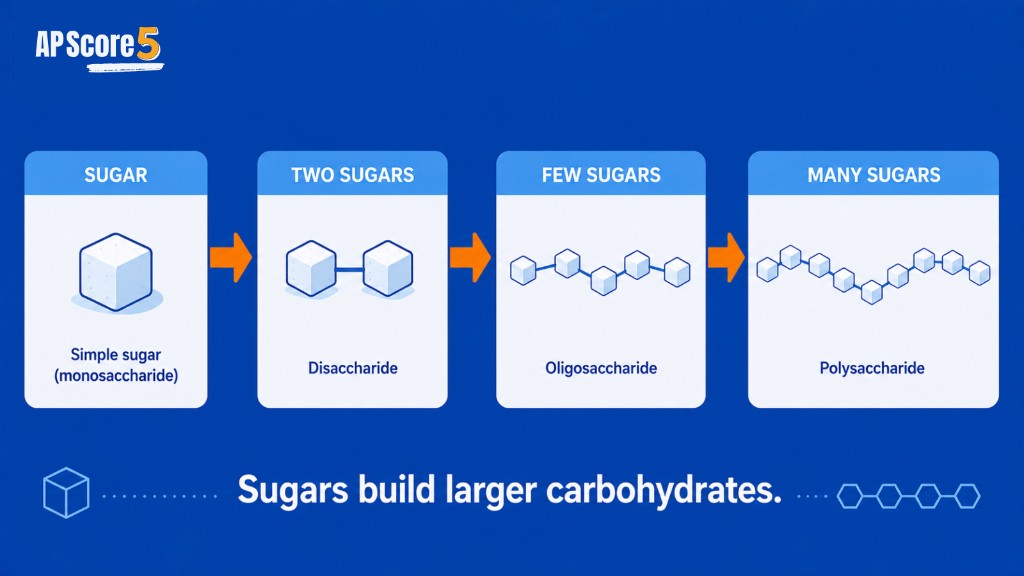
Carbohydrates AP Biology content sits at the center of Unit 1 because sugars connect chemistry to cell work. A single glucose molecule can enter glycolysis within minutes. A starch granule in a potato can hold thousands of glucose units until the plant needs fuel. Cellulose fibers in a tree trunk never serve as snack food for humans, yet they keep plant cells upright against gravity. Those differences are not random labels—they follow structure-function logic that the AP exam returns to again and again.
If you have not reviewed how small units join into polymers, start with monomers and polymers and dehydration synthesis and hydrolysis, then return here for the full carbohydrate deep dive. You can also place this page in the broader macromolecules comparison when you need to contrast carbs with lipids, proteins, and nucleic acids.
AP Biology Unit 1 connects atomic structure to living systems. Carbohydrates are among the first macromolecules students encounter because they are relatively straightforward in composition—mostly carbon, hydrogen, and oxygen—yet surprisingly diverse in function. A monosaccharide fuels a sprint. A polysaccharide stockpiles energy for winter. Another polysaccharide builds a cell wall that can stand for centuries. The exam expects you to explain those roles using structure, not just vocabulary.
In AP Biology, carbohydrates matter because their structure helps explain energy storage, quick energy use, and structural support.
Carbohydrates also bridge earlier Unit 1 topics. The carbon backbones you studied on the elements of life page appear here as sugar rings and chains. The dehydration and hydrolysis reactions you practiced elsewhere explain exactly how monosaccharides become disaccharides and polysaccharides. Water's polarity matters too: many carbohydrates dissolve because hydroxyl groups interact with water, a theme that connects back to water properties.
Strong AP answers trace a clear chain: element composition → monomer identity → bond type → polymer structure → biological function → cell process. When a free-response prompt mentions starch granules in a leaf, glycogen in liver tissue, or cellulose in a plant cell wall, the grader wants you to name the carbohydrate class, describe relevant structure, and explain why that structure fits the job.
Carbohydrates also appear outside Unit 1. Cell membranes include carbohydrate tags (glycoproteins and glycolipids) that help cells recognize each other. Cellular respiration begins when glucose is broken down to produce ATP. Photosynthesis builds glucose from carbon dioxide and water. Understanding carbohydrate chemistry at the Unit 1 level makes those later processes easier to follow.
Most carbohydrates contain carbon, hydrogen, and oxygen. Simple sugars often follow a 1:2:1 ratio of C:H:O, which is why early chemists called them "hydrates of carbon." That ratio is a helpful shortcut on multiple-choice questions, but AP Biology goes further: you should recognize functional groups such as hydroxyl (-OH) and carbonyl (C=O) groups that give sugars their chemical personality.
Monosaccharides are the monomers. Disaccharides contain two monosaccharides linked by a glycosidic bond. Polysaccharides contain many monosaccharides in long or branched chains. The same three elements repeat throughout, but arrangement and bonding create very different biological outcomes.
| Class | Size | Main Elements | Building Block | Bond Type | AP Examples | Main Function |
|---|---|---|---|---|---|---|
| Monosaccharide | 1 unit | C, H, O | Single sugar | None (monomer) | Glucose, fructose, galactose | Quick energy, building block |
| Disaccharide | 2 units | C, H, O | Two monosaccharides | One glycosidic bond | Sucrose, lactose, maltose | Transport or digestible double sugar |
| Polysaccharide | Many units | C, H, O | Many monosaccharides | Many glycosidic bonds | Starch, glycogen, cellulose | Storage or structure |
Glucose (C6H12O6) is the carbohydrate poster child. Fructose shares the same formula but arranges atoms differently—a reminder that formula alone does not determine function. Galactose is another six-carbon sugar found in lactose. When two of these monomers join, the product is no longer a monosaccharide; it is a disaccharide with new properties.
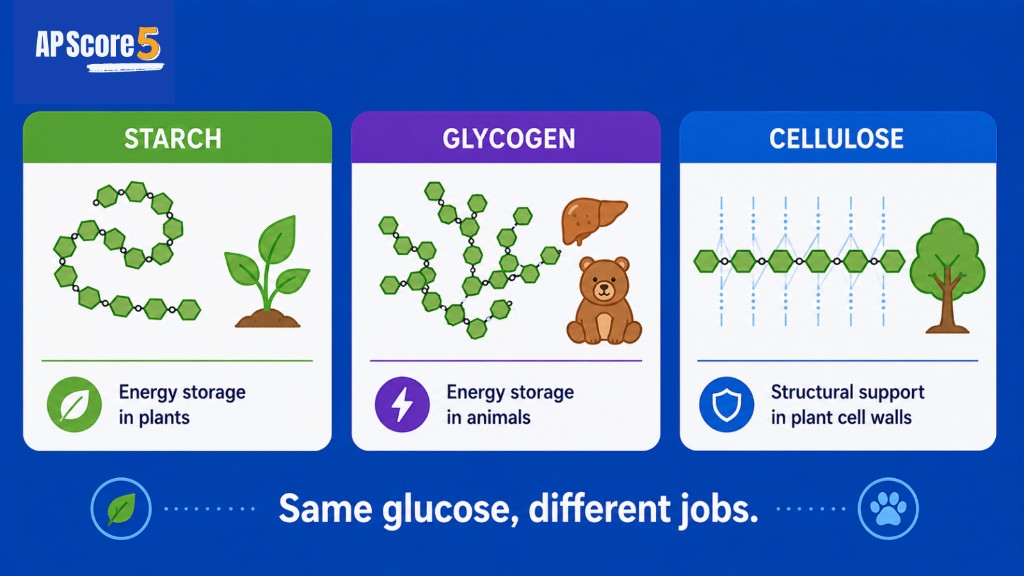
Polysaccharides scale that logic up. Starch, glycogen, and cellulose all use glucose as the monomer, yet one stores energy in plants, one stores energy in animals, and one reinforces cell walls. The monomer is identical; the linkage geometry and branching pattern are not. That is classic AP structure-function reasoning, and it is why this topic rewards careful study instead of flash-memorization.
AP Biology organizes carbohydrates by size because size strongly predicts function. Monosaccharides are ready-to-use fuel and versatile building blocks. Disaccharides are doubled monomers optimized for transport or digestion. Polysaccharides are long-chain polymers specialized for bulk storage or mechanical support.
Monosaccharides include glucose, fructose, and galactose. Glucose is the primary sugar cells oxidize during cellular respiration to produce ATP. Blood glucose levels are tightly regulated in animals because so many pathways depend on a steady supply. Fructose tastes sweet and appears in fruit and honey. Galactose combines with glucose to form lactose in milk.
Disaccharides form when two monosaccharides undergo dehydration synthesis. Sucrose (table sugar) links glucose and fructose. Lactose links glucose and galactose; humans need lactase enzyme to hydrolyze lactose during digestion. Maltose consists of two glucose units and appears when starch breaks down. Each disaccharide must be split into monomers before cells can absorb and use the sugars—a detail that appears in digestion and nutrition questions.
Polysaccharides include starch, glycogen, and cellulose. Starch stores energy in plants as amylose (relatively unbranched) and amylopectin (branched). Glycogen stores energy in animals, especially in liver and muscle tissue; its heavy branching allows rapid mobilization. Cellulose forms straight, hydrogen-bonded chains that weave into tough plant cell walls. Chitin, another polysaccharide with a nitrogen-containing monomer, provides structural support in fungal cell walls and arthropod exoskeletons—useful bonus knowledge when comparison questions widen the scope.
When you compare these classes on the exam, ask three questions: How many monomers? What bond joins them? What function does the final structure support? Those three questions separate confident answers from vague ones.
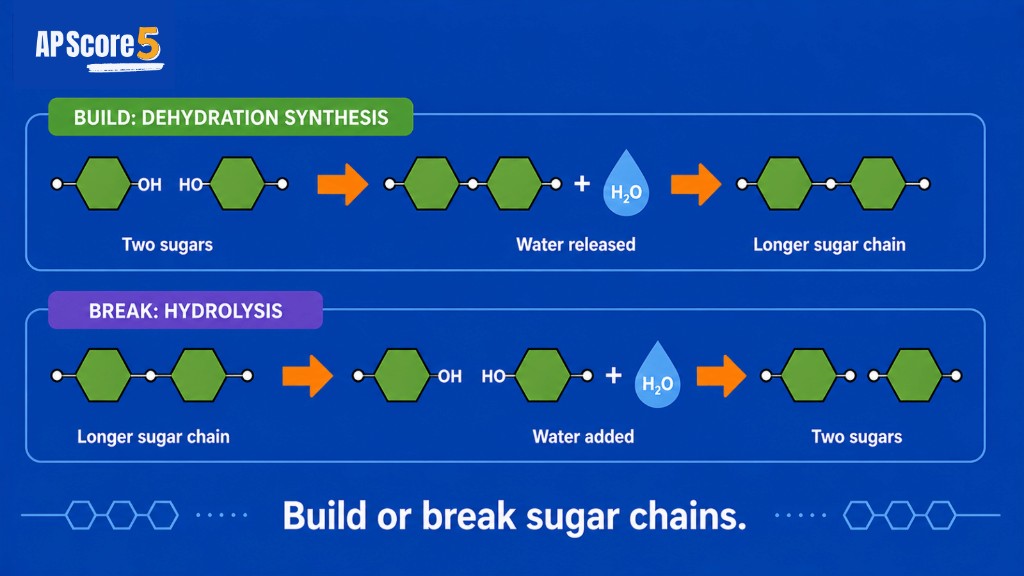
Carbohydrates follow the same polymer logic you learned on the dehydration synthesis and hydrolysis page. Monomers join when a hydroxyl group from one sugar and a hydrogen from another combine to release a water molecule. The remaining oxygen bridge is a glycosidic bond. Repeat the process and a disaccharide becomes the start of a polysaccharide chain.
Dehydration synthesis is anabolic—it builds larger molecules. Plant cells link glucose into starch during photosynthesis when energy is abundant. Animal cells assemble glycogen in liver cells after a meal when glucose is plentiful. In both cases, cells store fuel in polymer form rather than letting high concentrations of free glucose disturb osmotic balance.
Hydrolysis reverses the process by adding water to cleave glycosidic bonds. Digestive enzymes hydrolyze starch into maltose and eventually glucose so intestinal cells can absorb the monomers. Muscle cells hydrolyze glycogen when exercise demands rapid ATP. Hydrolysis is catabolic—it breaks polymers into pieces cells can use or transport.
The direction of reaction depends on cellular needs, not on different bond chemistry. The same glycosidic bond forms during synthesis and breaks during hydrolysis. AP questions sometimes describe an enzyme adding water to a polysaccharide; that wording signals hydrolysis even if the prompt never uses the word.
Linking this section to monomers and polymers keeps your Unit 1 story coherent: monosaccharides are monomers, polysaccharides are polymers, and dehydration synthesis / hydrolysis are the two fundamental tools cells use to interconvert them.
Starch, glycogen, and cellulose are the three polysaccharides AP Biology mentions most often. All three are built from glucose, so students sometimes assume they are interchangeable. They are not. Linkage type, chain shape, branching, and location determine whether a polysaccharide stores energy or builds structure.
| Polysaccharide | Organism | Linkage Type | Branching | Location | Function |
|---|---|---|---|---|---|
| Starch | Plants | Alpha glycosidic | Amylose linear; amylopectin branched | Plastids (chloroplasts, amyloplasts) | Energy storage |
| Glycogen | Animals | Alpha glycosidic | Highly branched | Liver and muscle cells | Energy storage with rapid release |
| Cellulose | Plants | Beta glycosidic | Linear chains cross-linked by H bonds | Cell wall | Structural support |
Starch is how plants bank glucose. When photosynthesis outpaces immediate need, glucose units polymerize into starch granules. Animals that eat plants access that stored energy when digestive enzymes hydrolyze starch into maltose and glucose. Glycogen plays the parallel role in animals. After you eat, liver cells convert excess glucose to glycogen; during fasting or exercise, glycogen hydrolysis raises blood glucose or feeds muscle fibers.
Cellulose follows different rules. Beta linkages flip alternating glucose units, producing straight chains that stack into microfibrils through hydrogen bonding. The resulting fibers resist the digestive enzymes humans use for starch. Cellulose therefore passes through the human gut largely intact, providing dietary fiber while plants use it for rigid walls. Cows and termites host symbiotic microbes that can hydrolyze cellulose—a favorite comparison prompt that tests whether you understand enzyme specificity, not just vocabulary.
When a question stem says " glucose polymer with alpha linkages in plastids," think starch. "Highly branched glucose storage in liver" points to glycogen. "Beta-linked glucose in cell walls" signals cellulose. Matching clue to structure before you look at answer choices saves time and reduces trap selections.
Structure-function reasoning is the scoring language of AP Biology. For carbohydrates, the exam wants you to connect size, bonding, branching, and solubility to energy timing and mechanical role. Memorizing that "glucose is energy" earns partial credit at best; explaining how monomer availability, branching, or beta linkages create that outcome earns full credit.
| Pattern | Structure | Function | Example |
|---|---|---|---|
| Single sugar unit | Small, soluble monosaccharide | Fast entry into glycolysis | Glucose in blood |
| Alpha glycosidic chains | Coiled or branched polymers | Compact energy storage | Starch, glycogen |
| Heavy branching | Many free ends on polymer | Rapid hydrolysis and glucose release | Glycogen in muscle |
| Beta glycosidic chains | Straight, H-bonded fibers | Rigidity and tensile strength | Cellulose in cell walls |
| Hydroxyl groups on sugars | Polar side groups | Water solubility and hydrogen bonding | Many mono- and disaccharides |
Branching is a favorite FRQ theme because it is easy to diagram yet rich in explanation. Each branch point creates an additional non-reducing end where glycogen phosphorylase or similar enzymes can begin cleaving glucose units. More ends mean faster mobilization—critical when a muscle cell switches from rest to intense activity.
Linkage geometry is equally important. Alpha linkages allow starch and glycogen to coil into accessible granules that enzymes can digest. Beta linkages force cellulose into extended strands that aggregate into cable-like microfibrils. Humans lack cellulase, so cellulose remains structural rather than nutritional for us—a clear example of how structure dictates biological fate.
Practice translating structures into verbs: store, release, digest, support, transport. If your FRQ answer uses only nouns ("glucose," "starch," "cell wall") add a verb that states what the cell accomplishes with that structure.
Carbohydrate questions rarely announce themselves with the word "carbohydrate." Instead they describe molecules, locations, or processes. Train yourself to recognize vocabulary clusters and map each cluster to mono-, di-, or polysaccharide logic before you read answer choices.
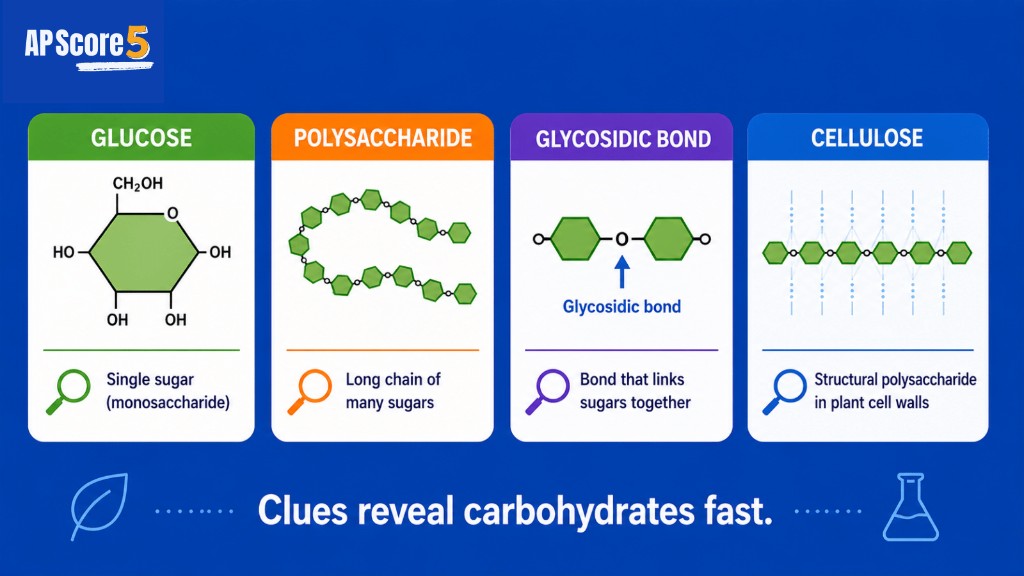
Context clues matter as much as molecule names. A molecule "stored in plastids after photosynthesis" is probably starch. A polymer "mobilized during exercise from muscle tissue" is probably glycogen. A fibrous molecule "surrounding plant cells" is probably cellulose. Pair the clue with structure and you can often eliminate two distractors immediately.
When a question compares carbohydrates to other macromolecules, return to the macromolecules overview mentally: lipids mention hydrophobic tails, proteins mention amino acids and folding, nucleic acids mention nucleotides and bases. If none of those appear, carbohydrates move to the top of your list.
Practice this checklist with the shuffled MCQs below—letter positions change each load, so you must think in concepts, not memorized answer keys.
Fix: Cellulose provides structure; not every carbohydrate is a fuel.
Fix: Starch is plant storage; glycogen is animal storage.
Fix: Cellulose is a glucose polymer with different linkages than starch.
Fix: Sucrose = glucose + fructose; lactose = glucose + galactose; maltose = glucose + glucose.
Fix: Alpha vs beta glycosidic linkages explain digestibility and function.
Fix: Polysaccharides form when monosaccharides join and release water.
Fix: Name the carbohydrate, describe structure, then connect to a specific cell function.
Open each card to reveal the answer and why the clue fits. Use these before the polysaccharide explorer below.
Answer: Monosaccharide / carbohydrate
Single sugar unit used for quick energy.
Answer: Disaccharide
Two monosaccharides joined by a glycosidic bond.
Answer: Plant storage polysaccharide
Glucose polymer stored in plants.
Answer: Animal storage polysaccharide
Highly branched glucose polymer in animals.
Answer: Structural polysaccharide
Beta-linked glucose chains for support.
Answer: Carbohydrate linkage
Bond that joins sugar units into polymers.
Answer: Breaking carbohydrates
Water added to split glycosidic bonds.
Answer: Carbohydrate elements
Most carbs are hydrates of carbon.
Tap each carbohydrate type once to open details. Explore all four to enable the finish button sooner.
Monosaccharide · quick energy · cellular respiration
Type: Monosaccharide (C6H12O6)
Function: Primary fuel for ATP production
AP clue: Blood sugar, glycolysis, respiration
Plant polysaccharide · energy storage · amylose and amylopectin
Monomer: Glucose with alpha linkages
Location: Plastids in plant cells
AP clue: Potato, grain, plant storage
Animal polysaccharide · highly branched · liver and muscle
Monomer: Glucose with alpha linkages
Function: Rapid energy release when needed
AP clue: Animal storage, more branching than starch
Structural polysaccharide · beta linkages · plant cell walls
Monomer: Glucose with beta linkages
Function: Rigidity and wall support
AP clue: Fiber, cell wall, not digestible by humans
0 of 4 carbohydrate types explored · tap each card once
Follow these steps in order. You are on step 6.
Review how building blocks join.
Study dehydration synthesis and hydrolysis.
Compare carbs, lipids, proteins, and nucleic acids.
Review elements of life.
Review water properties.
Continue to membranes and hydrophobic molecules.
Every 5th card shows an ad placeholder with a short countdown. Flip the card to read the definition, then use the arrow for the next card.
Choices shuffle at display time. Tap an answer, read the explanation, then use Next question.
Want more Unit 1 drills? Try daily AP Biology practice or practice by topic.
Click a question to open the full prompt. Write your answer on paper first, then reveal the rubric and a strong sample response.
Glucose is a monosaccharide—a single sugar unit that cells can take up and use quickly in cellular respiration to make ATP. Starch is a polysaccharide: many glucose units linked into a larger polymer stored in plastids such as chloroplasts or amyloplasts.
Because starch is a polymer, plants can pack many glucose units into a compact storage form without flooding the cell with free sugar. When energy is needed, hydrolysis releases glucose from starch. Same subunit, different size and role—structure supports function.
Same monomer, different polymer size—link size to energy timing.
Starch and glycogen are both polysaccharides made of glucose, but glycogen is more highly branched. Branch points create many non-reducing ends where enzymes can attach.
More branching means glycogen can be broken down quickly when muscle or liver cells need glucose fast. Starch still stores energy efficiently in plants, but glycogen's branching pattern fits the rapid energy demands of animal metabolism—structure supports release rate.
Branching = more enzyme access points, not just 'stores energy.'
Cellulose is a structural polysaccharide in plant cell walls. Unlike starch, cellulose uses beta-glycosidic linkages between glucose units, producing straight chains that hydrogen-bond into strong microfibrils.
These fibers resist easy hydrolysis by most animal enzymes, so cellulose provides durable wall support instead of serving as a quick energy source. Same glucose monomer, different linkage geometry—structure determines whether the molecule stores energy or reinforces the cell wall.
Beta linkages → straight chains → strong walls, not digestible starch.
Two monosaccharides join by dehydration synthesis: a hydroxyl group from one sugar and a hydrogen from another combine to release water while forming a glycosidic bond. The product maltose is a disaccharide of two glucose units.
Starch formation uses the same bond chemistry at a larger scale—many glucose units linked by glycosidic bonds into a polysaccharide. The difference is chain length and branching pattern, not the basic monomer-joining mechanism you learned on the dehydration synthesis page.
Maltose = one glycosidic bond; starch = many of the same bond type.
Carbohydrates are sugars and sugar-based molecules made mainly of carbon, hydrogen, and oxygen. In AP Biology, they support quick energy, energy storage, and structural support. Common examples include glucose, starch, glycogen, and cellulose.
Monosaccharides are single sugar units such as glucose. Disaccharides are two monosaccharides joined by a glycosidic bond, such as sucrose. Polysaccharides are long chains of many monosaccharides, such as starch, glycogen, and cellulose.
Glucose is a primary fuel for cellular respiration. Cells break down glucose to produce ATP, which powers metabolism, transport, and other cell processes.
Starch is a plant polysaccharide that stores energy. It is made of glucose units and includes forms such as amylose and amylopectin. Plants store starch in structures such as roots and seeds.
Glycogen is an animal polysaccharide that stores energy, mainly in liver and muscle cells. It is highly branched, which helps enzymes release glucose quickly when the body needs energy.
Cellulose is a structural polysaccharide in plant cell walls. It is made of glucose units linked by beta-glycosidic bonds, forming strong fibers that support plant cells.
Humans have enzymes that break alpha-glycosidic linkages in starch. Cellulose has beta-glycosidic linkages that human digestive enzymes cannot cleave efficiently, so cellulose acts mainly as dietary fiber.
A glycosidic bond is a covalent bond that links monosaccharides together. These bonds form during dehydration synthesis and break during hydrolysis.
Dehydration synthesis joins monosaccharides into disaccharides and polysaccharides by forming glycosidic bonds and releasing water. Hydrolysis adds water to break those bonds and release monosaccharides.
Most carbohydrates contain carbon, hydrogen, and oxygen. Simple sugars often follow a 1:2:1 ratio of C:H:O, which is why the name carbohydrate reflects hydrated carbon.
Look for glucose, fructose, sucrose, lactose, starch, glycogen, cellulose, polysaccharide, or glycosidic bond. Match the clue to size (mono, di, poly) and function (energy vs structure).
Starch stores energy in plants. Glycogen stores energy in animals. Both are built from glucose, but branching patterns and location differ.
Be ready to name the carbohydrate type, describe its structure (including linkage or branching), and explain how that structure supports a biological function such as quick ATP production, storage, or cell-wall support.
Carbohydrates link to elements of life (C, H, O), monomers and polymers, dehydration synthesis and hydrolysis, and the broader macromolecules comparison with lipids, proteins, and nucleic acids.
Check each skill when you can explain it without looking at the page.
0 of 15 skills ready
Nice work—you explored all four carbohydrate types and checked off the review skills. Continue to lipids for membranes and hydrophobic molecules, or return to the macromolecules overview to compare all four classes.
You just finished the carbohydrates deep dive. Next, study lipids for membranes and long-term energy storage, or review the full macromolecules comparison.