Calling all macromolecules true polymers
Fix: Lipids are macromolecules but triglycerides are not repeating monomer chains.
AP Biology · Unit 1 · Chemistry of Life
Learn how hydrophobic molecules support membranes, energy storage, and signaling.
AP Biology lipids questions usually test whether you can connect hydrophobic structure to biological function. Lipids include triglycerides, phospholipids, and steroids. They are used for long-term energy storage, cell membranes, insulation, and signaling. This page explains why lipids do not mix well with water, why phospholipids form bilayers, how saturated and unsaturated fats differ, and why lipids are not usually true polymers.
Unit 1 progress
AP Biology · Unit 1
Part of Unit 1: Chemistry of Life · Page 7 of 11
Pair with carbohydrates (previous) and proteins (next).
Lipids in AP Biology are mostly hydrophobic biological molecules built mainly from carbon and hydrogen. They include triglycerides for long-term energy storage, phospholipids that form cell membranes, and steroids such as cholesterol and hormones. Their nonpolar structure helps explain why cells store energy as fat and why membranes form bilayers in water.
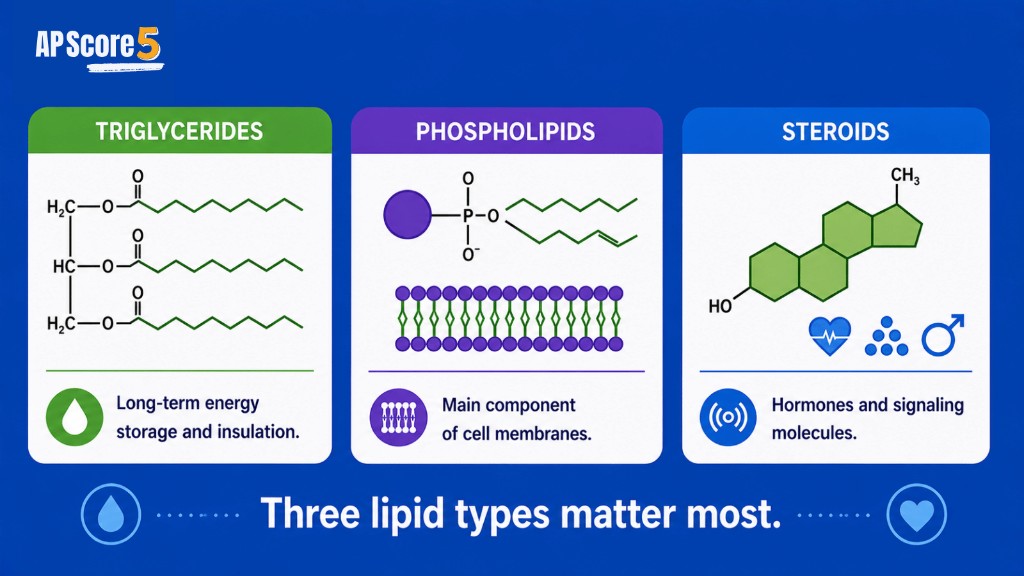
Lipids AP Biology content sits in the middle of the Unit 1 macromolecule sequence because lipids break the tidy monomer-polymer pattern students learn for carbohydrates, proteins, and nucleic acids. A triglyceride in adipose tissue can hold far more energy per gram than glycogen in a liver cell, yet it will not dissolve in the aqueous cytosol. A phospholipid in a membrane has one end that loves water and two tails that avoid it—a combination that literally shapes every cell boundary. Those patterns follow chemistry you already started on the water properties page: polar water excludes nonpolar substances, and amphipathic molecules self-organize at interfaces.
If you have not reviewed how macromolecules compare as a group, open the macromolecules overview first, then return here for the full lipid study guide. You should also know how small units join through dehydration synthesis and hydrolysis because ester bond formation in triglycerides uses the same build logic as peptide and glycosidic bonds—just with different monomers.
AP Biology Unit 1 asks you to connect atomic structure to living systems. Lipids are essential to that story because they show how nonpolar chemistry solves problems polar molecules cannot. Cells live in water, yet they must store large energy reserves, seal compartments, and send signals—all jobs where lipids excel. The exam expects you to explain those roles using structure, not just vocabulary lists.
In AP Biology, lipids matter because their hydrophobic structure helps explain energy storage, membrane formation, and cell signaling.
Lipids also bridge earlier Unit 1 topics. The carbon backbones and hydrocarbon chains you met on the elements of life page appear here as fatty acid tails rich in C-H bonds. The monomer-polymer framework from monomers and polymers still applies conceptually, but lipids remind you that not every macromolecule is a true repeating polymer. Compare that idea with carbohydrates, which follow classic polymer logic with glucose monomers, or with proteins and nucleic acids, which have clear repeating subunits.
Strong AP answers trace a clear chain: element composition → molecular regions (polar vs nonpolar) → bond type → three-dimensional arrangement → biological function → cell process. When a free-response prompt mentions adipose tissue, a phospholipid bilayer, or a steroid hormone, the grader wants you to name the lipid class, describe relevant structure, and explain why that structure fits the job in the cell environment.
Lipids also appear beyond Unit 1. Membrane transport, cell recognition, and hormone signaling in later units all assume you understand phospholipid bilayers and hydrophobic interiors. The Unit 2 cell structure course picks up exactly where phospholipid chemistry leaves off, so time spent here pays off on organelle and membrane FRQs later in the year.
Most lipids contain carbon, hydrogen, and oxygen. Phospholipids also contain phosphorus in the polar head group. Unlike carbohydrates with their roughly 1:2:1 C:H:O pattern in simple sugars, lipids are defined less by a fixed ratio and more by chemical behavior: they are largely nonpolar and do not dissolve readily in water. That hydrophobic character comes from long hydrocarbon chains and regions with many carbon-hydrogen bonds, which share electrons relatively evenly and cannot form the strong hydrogen bonds that keep glucose dissolved in cytosol.
AP Biology groups several structurally different molecules under the lipid label. Triglycerides are built from glycerol and three fatty acids. Phospholipids resemble triglycerides but replace one fatty acid with a phosphate-containing group, creating an amphipathic molecule. Steroids use a four-ring carbon skeleton rather than long fatty acid tails. Waxes and other lipid variants appear occasionally, but triglycerides, phospholipids, and steroids cover the vast majority of exam references.
| Lipid Class | Key Components | Polarity Pattern | Main Elements | AP Examples | Primary Function |
|---|---|---|---|---|---|
| Triglyceride | Glycerol + 3 fatty acids | Mostly nonpolar | C, H, O | Animal fat, vegetable oil | Long-term energy storage |
| Phospholipid | Glycerol + 2 fatty acids + phosphate group | Amphipathic | C, H, O, P | Membrane phospholipids | Membrane bilayer formation |
| Steroid | Four fused carbon rings | Mostly nonpolar (small polar groups possible) | C, H, O | Cholesterol, testosterone, estrogen | Membrane stability, signaling |
| Fatty acid (component) | Hydrocarbon chain + carboxyl group | Carboxyl polar; tail nonpolar | C, H, O | Palmitic acid, oleic acid | Building block of larger lipids |
Fatty acids are not usually listed as a fourth macromolecule class on their own, but they are the repeating structural motif students must recognize. A carboxyl group at one end makes the head slightly polar; the rest of the chain is a nonpolar hydrocarbon tail. Saturated fatty acids contain only single bonds between carbons, while unsaturated fatty acids contain one or more double bonds that can introduce bends. Those small structural differences change how tightly lipids pack together and whether a fat is solid or liquid at room temperature—classic structure-function reasoning you will apply again when comparing saturated and unsaturated fats.
When a question asks which elements appear in a membrane lipid, remember phosphorus. When a question asks which elements dominate energy-storage fat, think carbon and hydrogen in long tails. Element clues narrow answer choices quickly on multiple-choice items and give you vocabulary for FRQ introductions.
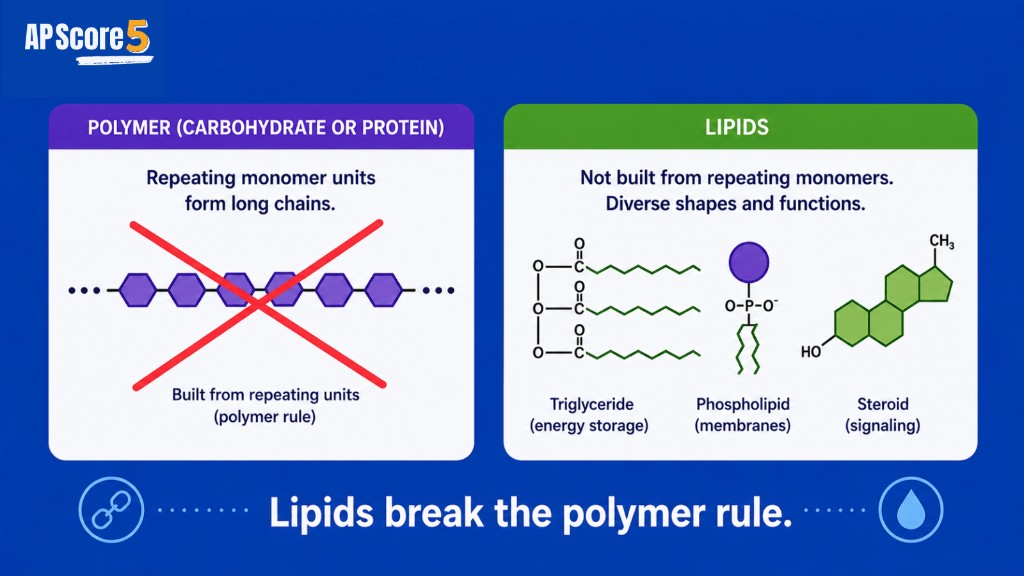
Triglycerides are the primary long-term energy storage lipids in both plants and animals. Structurally, a triglyceride contains one glycerol molecule attached to three fatty acids through ester bonds. Those ester linkages form when dehydration synthesis removes water between the carboxyl group of a fatty acid and a hydroxyl group on glycerol—the same reaction family you practiced when linking monomers on the dehydration synthesis page, even though lipids are not true polymers.
Plants store energy as oils (liquid triglycerides at room temperature) in seeds; animals store energy as fats in adipose tissue. Both forms pack carbon-hydrogen bonds that release large amounts of energy when oxidized during cellular respiration. Because triglycerides are hydrophobic, they coalesce into lipid droplets rather than mixing with cytosol, which lets cells stockpile energy without disrupting water-based chemistry inside the cell.
Compare triglycerides with carbohydrates such as glycogen. Glycogen provides rapid-access storage but holds less energy per gram and binds water; triglycerides store more than twice the energy per gram in a compact hydrophobic package. That trade-off explains why AP prompts contrast short-term sugar fuels with long-term fat reserves.
On exams, triglyceride clues include adipose tissue, fat droplets, ester bonds, three fatty acids, or questions about energy density. If a stem describes a molecule that is entirely hydrophobic and stored for later metabolism, triglycerides should top your list before you even read all four answer choices.
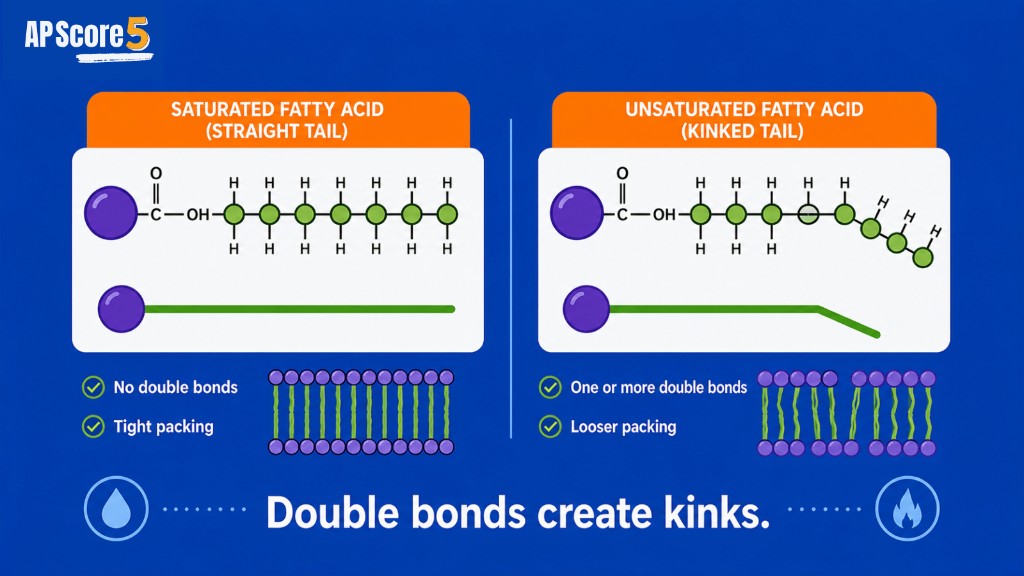
Fatty acid structure determines whether a triglyceride is solid or liquid, how it packs in membranes, and how it affects health-related discussion questions that appear in AP-style contexts. A saturated fatty acid has no carbon-carbon double bonds; every carbon in the chain binds as many hydrogens as possible. An unsaturated fatty acid has one or more double bonds, and each double bond can create a bend in the tail.
| Feature | Saturated Fatty Acid | Unsaturated Fatty Acid |
|---|---|---|
| Double bonds | None | One or more (mono- or polyunsaturated) |
| Chain shape | Straight, flexible chain | Bent at double-bond sites |
| Packing | Tight packing between molecules | Looser packing because of kinks |
| Typical state at room temperature | Often solid (animal fats) | Often liquid (many plant oils) |
| AP exam focus | Structure and melting point reasoning | Membrane fluidity and packing |
Saturated fats like those in butter pack tightly because straight tails align closely, increasing intermolecular forces and melting point. Unsaturated fats like olive oil contain kinks that prevent tight alignment, keeping the material liquid at room temperature. AP Biology may ask you to explain that difference without requiring nutrition debate—focus on bond structure, chain shape, and physical consequences.
In membranes, unsaturated fatty acid tails in phospholipids increase fluidity because kinks prevent overly tight packing. That detail connects lipid chemistry to functional membrane behavior you will revisit in Unit 2. When you see a question pairing "more double bonds" with "more fluid membrane," you are applying saturated versus unsaturated logic in a new context.
Energy storage is not only about which molecule class you name—it is about bond chemistry and packaging. Carbohydrates such as glucose already contain oxygen in proportions that make them partially oxidized. Fatty acid tails, by contrast, are rich in reduced carbon-hydrogen bonds that release substantial energy when converted to carbon dioxide and water during respiration. Per gram, lipids store roughly twice the metabolic energy of carbohydrates. Cells still use carbohydrates for fast access: glycogen hydrolyzes quickly to glucose, while lipids trade speed for capacity. Link this comparison to carbohydrates when a prompt lists all four macromolecule classes and asks which best fits long-term storage in adipose tissue or a desert seed.
Phospholipids are the structural stars of AP Biology lipids. Each phospholipid contains a glycerol backbone, two fatty acid tails, and a phosphate-containing head group. The head is polar and interacts with water; the tails are nonpolar hydrocarbon chains. A single molecule therefore has two distinct personalities: hydrophilic at one end, hydrophobic at the other. Biologists call that amphipathic property.
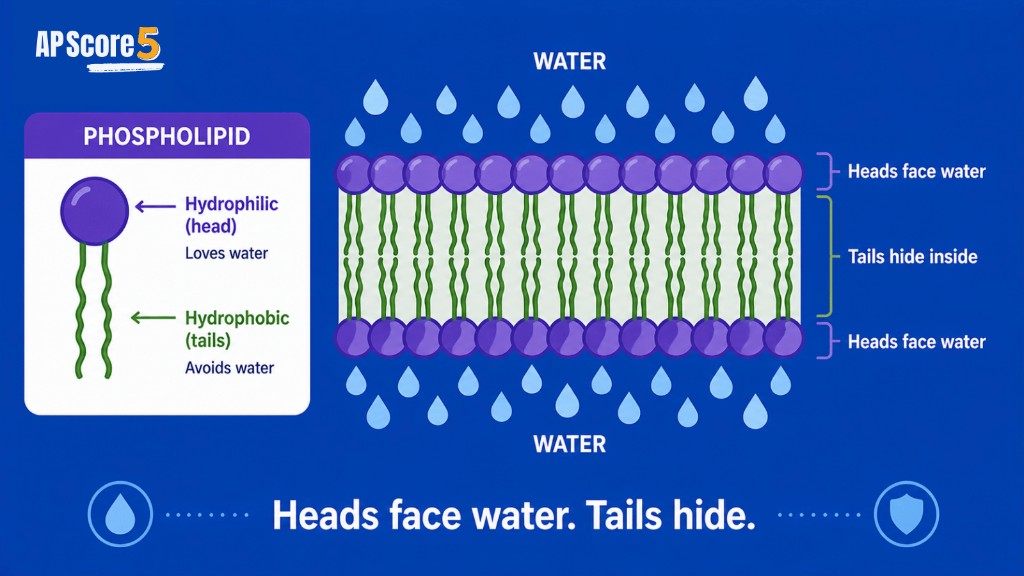
When phospholipids contact water, they spontaneously orient into a bilayer: heads face outward toward aqueous environments on both sides, tails point inward away from water. This arrangement is not random—it minimizes unfavorable contacts between nonpolar tails and water, a consequence of the hydrophobic effect you first studied with water properties. The bilayer becomes the basic fabric of cell membranes and many organelle membranes.
Membranes are more than pure phospholipid sheets. Cholesterol, a steroid, nestles among phospholipids and modulates fluidity. Membrane proteins span or sit on the bilayer to transport molecules, receive signals, and anchor cell structures. Still, the phospholipid layout provides the waterproof barrier that defines "inside" versus "outside." Free-response questions frequently show a cross-section diagram and ask you to label polar regions, explain orientation, or predict what happens when tails are shortened or saturated.
If a prompt mentions "hydrophilic heads oriented toward cytoplasm and extracellular fluid," you should visualize the bilayer immediately and connect it to amphipathic structure. That one linkage appears in Unit 1 macromolecule items and again in Unit 2 membrane topics, so learning it well here saves time later.
Structure-function reasoning is the scoring language of AP Biology. For lipids, the exam wants you to connect polarity patterns, tail saturation, and ring geometry to storage, barrier formation, and signaling. Memorizing that "lipids store energy" earns partial credit at best; explaining how hydrocarbon tails pack hydrophobically or how amphipathic phospholipids orient in water earns full credit.
Steroids are lipids built from four fused carbon rings. Cholesterol inserts among phospholipids and stabilizes membrane fluidity across temperature changes. Other steroids function as hormones—chemical signals that travel through the bloodstream and affect target cells. Sex hormones such as testosterone and estrogen are steroid examples. Because steroids are nonpolar, they can pass through phospholipid bilayers and bind receptors inside cells, a detail that contrasts with many polar signaling molecules that bind surface receptors. If a question mentions fused rings or cholesterol, think steroid backbones rather than fatty acid tails.
| Pattern | Structure | Function | Example |
|---|---|---|---|
| Long hydrocarbon tails | Nonpolar C-H rich chains | Dense long-term energy storage | Triglyceride in adipose tissue |
| Ester-linked fatty acids on glycerol | Compact hydrophobic molecule | Storage without mixing in cytosol | Fat droplet in cell |
| Amphipathic phospholipid | Polar head, two nonpolar tails | Self-assembled membrane bilayer | Cell membrane |
| Double bonds in tails | Kinked unsaturated chains | Increased membrane fluidity | Phospholipid in fluid membrane |
| Four-ring steroid core | Flat hydrophobic rings | Membrane stability and hormone signaling | Cholesterol, sex hormones |
The lipid macromolecule exception is itself a testable pattern. Carbohydrates, proteins, and nucleic acids usually form true polymers of repeating monomers; triglycerides do not repeat a single monomer dozens of times. AP multiple-choice items love asking which class breaks the polymer rule. When you see that wording, lipids are the intended answer unless the question specifies a different exception context.
Practice translating structures into verbs: store, seal, signal, insulate, pack, orient. If your FRQ answer uses only nouns ("triglyceride," "membrane," "hormone"), add a verb that states what the cell accomplishes with that structure. That habit aligns your writing with official scoring guidelines.
Lipid questions rarely announce themselves with the word "lipid." Instead they describe hydrophobic behavior, membrane diagrams, or energy storage locations. Train yourself to recognize vocabulary clusters and map each cluster to triglyceride, phospholipid, or steroid logic before you read answer choices.
Context clues matter as much as molecule names. A molecule "stored in fat cells for winter energy" is probably a triglyceride. A component "forming a barrier between cytoplasm and extracellular fluid" is probably a phospholipid bilayer. A regulatory molecule "derived from cholesterol with ring structure" is probably a steroid hormone. Pair the clue with structure and you can often eliminate two distractors immediately.
When a question compares lipids to other macromolecules, return to the macromolecules overview mentally: carbohydrates mention glucose and polysaccharides, proteins mention amino acids and folding, nucleic acids mention nucleotides and bases. If the stem highlights bilayers or hydrophobic tails, lipids move to the top of your list.
Practice this checklist with the shuffled MCQs below—letter positions change each load, so you must think in concepts, not memorized answer keys. Additional drills live on practice by topic and daily AP Biology practice.
Fix: Lipids are macromolecules but triglycerides are not repeating monomer chains.
Fix: Phospholipids have two tails and a phosphate head for membranes; triglycerides store energy.
Fix: Bilayer formation depends on polar heads and nonpolar tails, not just 'lipids hate water.'
Fix: Saturated = no double bonds; unsaturated = one or more double bonds with possible kinks.
Fix: Fatty acids attach to glycerol by ester linkages formed during dehydration synthesis.
Fix: Phospholipids build membranes; steroids can signal; lipids are not one-function molecules.
Fix: Nonpolar regions cluster away from water—this drives membrane orientation and fat droplets.
Fix: Name the lipid, describe structure, then connect to storage, membrane, or signaling in the prompt context.
Open each card to reveal the answer and why the clue fits. Use these before the lipid type explorer below.
Answer: Triglyceride / lipid storage
Long hydrocarbon tails store dense energy away from water.
Answer: Phospholipid
Polar head and two tails form cell membranes.
Answer: Saturated fatty acid
Straight chains pack tightly and melt at higher temperatures.
Answer: Unsaturated fatty acid
Bends reduce packing and keep oils liquid at room temperature.
Answer: Steroid
Ring structure supports membranes and signaling.
Answer: Triglyceride formation
Dehydration synthesis joins fatty acids to glycerol.
Answer: Lipid classification
Lipids are grouped by hydrophobic properties, not repeating monomers.
Answer: Lipid elements
Phospholipids include phosphorus in the polar head group.
Tap each lipid type once to open details. Explore all three to enable the finish button sooner.
Energy storage · glycerol + 3 fatty acids · ester bonds
Structure: Glycerol backbone with three ester-linked fatty acid tails
Function: Long-term energy storage in fats and oils
AP clue: Adipose tissue, hydrocarbon tails, hydrophobic
Membrane lipid · amphipathic · bilayer former
Structure: Phosphate head plus two fatty acid tails
Function: Forms the core of cell and organelle membranes
AP clue: Bilayer, hydrophilic head, hydrophobic tails
Four fused rings · cholesterol · hormones
Structure: Four fused carbon rings (distinct from fatty acid chains)
Function: Membrane stability and chemical signaling
AP clue: Cholesterol, hormone, ring structure
0 of 3 lipid types explored · tap each card once
Follow these steps in order. You are on step 7.
Review hydrogen bonding and the hydrophobic effect.
Review building blocks and the lipid exception.
Compare carbs, lipids, proteins, and nucleic acids.
Contrast quick sugar energy with lipid storage.
Connect bilayers to cell structure.
Try daily drills or topic MCQs.
Every 5th card shows an ad placeholder with a short countdown. Flip the card to read the definition, then use the arrow for the next card.
Choices shuffle at display time. Tap an answer, read the explanation, then use Next question.
Want more Unit 1 drills? Try daily AP Biology practice or practice by topic.
Click a question to open the full prompt. Write your answer on paper first, then reveal the rubric and a strong sample response.
A triglyceride contains glycerol joined by ester bonds to three fatty acid tails. Those tails are long hydrocarbon chains with many nonpolar C-H bonds.
Because the tails are hydrophobic, triglycerides cluster away from water and pack tightly in adipose cells. That compact, nonpolar storage holds more energy per gram than polar sugars, which fits long-term energy banking rather than immediate glycolysis.
Energy storage = hydrocarbon-rich, hydrophobic tails—not just 'fats store energy.'
Phospholipids are amphipathic: the phosphate-containing head is polar and interacts with water, while the two fatty acid tails are nonpolar.
In water, heads face the aqueous environment on both sides of the membrane while tails hide in the interior. This arrangement minimizes unfavorable contact between nonpolar regions and water—a classic structure-function link tested in Unit 1 and Unit 2 membranes.
Bilayer stability = hydrophobic effect + amphipathic shape, not random stacking.
Saturated fatty acids lack carbon-carbon double bonds, so straight tails pack tightly and melt at higher temperatures—think solid animal fat. Unsaturated fatty acids contain double bonds that bend the chain.
Those kinks prevent tight packing, weakening intermolecular forces and lowering melting point. That is why plant oils with more unsaturated tails stay liquid at room temperature—structure predicts physical properties you can justify on an FRQ.
Double bonds → kinks → packing → melting point. Draw the logic chain.
A true polymer is a long chain of repeating monomers—like amino acids in a polypeptide. A triglyceride is one glycerol molecule joined to three fatty acids by ester bonds; it does not repeat the same monomer dozens of times.
Lipids belong in the four macromolecule groups because they are large and biologically critical, but classification emphasizes hydrophobic behavior. That exception appears often on the macromolecules comparison page.
Triglyceride ≠ repeating chain. Lipids = macromolecule exception.
Lipids are mostly hydrophobic biological molecules rich in carbon and hydrogen. In AP Biology, they support long-term energy storage, membrane structure, insulation, and signaling.
Triglycerides are glycerol plus three fatty acids used mainly for energy storage. Phospholipids have a phosphate head and two fatty acid tails and form the basic fabric of cell membranes.
A fatty acid is a hydrocarbon chain with a carboxyl group at one end. The long tail is mostly nonpolar, which contributes to lipid hydrophobic behavior.
Saturated fatty acids have no carbon-carbon double bonds and pack tightly. Unsaturated fatty acids have one or more double bonds, often creating bends that change fluidity and melting point.
Phospholipids are amphipathic: hydrophilic heads interact with water while hydrophobic tails cluster away from water. This orientation forms a stable bilayer that separates aqueous compartments.
Lipids are grouped as macromolecules but are not usually true polymers of repeating identical monomers. A triglyceride is built from glycerol and three fatty acids rather than a long repeating chain.
An ester bond links a fatty acid to glycerol in a triglyceride. It forms when dehydration synthesis removes water while joining the carboxyl group of a fatty acid to a hydroxyl on glycerol.
Steroids are lipids built from four fused carbon rings. Cholesterol helps stabilize membranes, and other steroids such as sex hormones act as signaling molecules.
Fatty acid tails contain many energy-rich carbon-hydrogen bonds and lack the extra oxygen that makes carbohydrates more oxidized per carbon. That chemistry allows dense long-term energy storage.
Look for hydrophobic, nonpolar, fatty acid tails, triglyceride, phospholipid bilayer, ester bond, cholesterol, or steroid hormone. Match the clue to storage, membrane, or signaling function.
Lipids link to water properties (hydrophobic effect), monomers and polymers (lipid exception), dehydration synthesis (ester bond formation), and the macromolecules comparison with carbohydrates, proteins, and nucleic acids.
Be ready to name the lipid type, describe hydrophobic or amphipathic structure, and explain how that structure supports energy storage, membrane formation, or signaling in a specific cell context.
Check each skill when you can explain it without looking at the page.
0 of 15 skills ready
Nice work—you explored all three lipid types and checked off the review skills. Continue to proteins for amino acid chains and enzyme folding, or return to the macromolecules overview to compare all four classes.
You just finished the lipids study guide. Next, study proteins for peptide bonds and folding, or review the full macromolecules comparison.