Energy enters the ecosystem
Most ecosystems begin with sunlight captured by producers.
AP Biology · Unit 8 Ecology
Energy flow through ecosystems explains how energy enters through producers, moves through consumers, and is lost as heat at each trophic transfer. In AP Biology Unit 8, the key idea is simple: energy flows in one direction, while matter cycles through ecosystems.
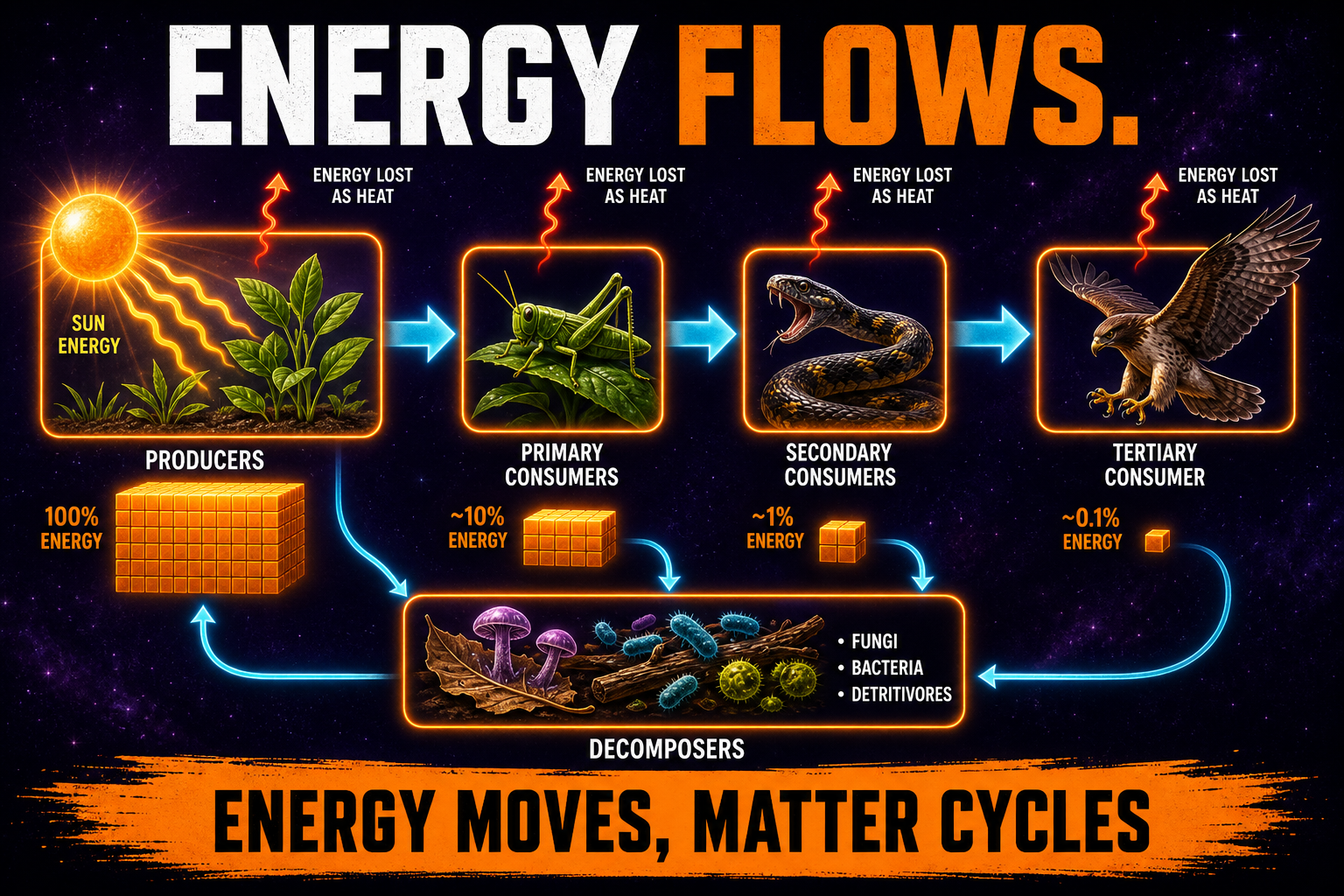
Energy flows through ecosystems from the sun or chemical sources to producers, then to consumers and decomposers. At each trophic transfer, much energy is lost as heat, so less usable energy is available at higher trophic levels.
Energy flows one way. Matter cycles.
Energy enters ecosystems through producers, moves through trophic levels, and decreases as heat is lost at each transfer.
Most ecosystems begin with sunlight captured by producers.
Photosynthesis converts light energy into chemical energy in organic molecules.
Consumers gain energy by eating producers or other consumers.
Cellular respiration and metabolism release heat at each transfer.
Higher trophic levels support less biomass and fewer organisms.
Decomposers break down dead material, but they do not recycle energy.
Direct answer: Producers are organisms that make organic molecules from sunlight or chemical energy.
Review photosynthesis overview to see how producers capture light energy.
Direct answer: Consumers are organisms that get energy by eating other organisms.
Consumer populations tie to population ecology when a prompt asks how feeding changes abundance.
Direct answer: Decomposers break down dead organisms and wastes, returning matter to the ecosystem.
AP trap: Do not say decomposers recycle energy. They recycle matter.
Direct answer: Trophic levels are feeding levels in an ecosystem.
| Trophic Level | Role | Example | Energy Pattern |
|---|---|---|---|
| Producer | captures energy | grass, algae | most available energy |
| Primary consumer | eats producers | rabbit, zooplankton | less energy |
| Secondary consumer | eats primary consumers | snake, small fish | less energy |
| Tertiary consumer | eats secondary consumers | hawk, large fish | least energy |
| Decomposer | breaks down dead matter | fungi, bacteria | recycles matter |
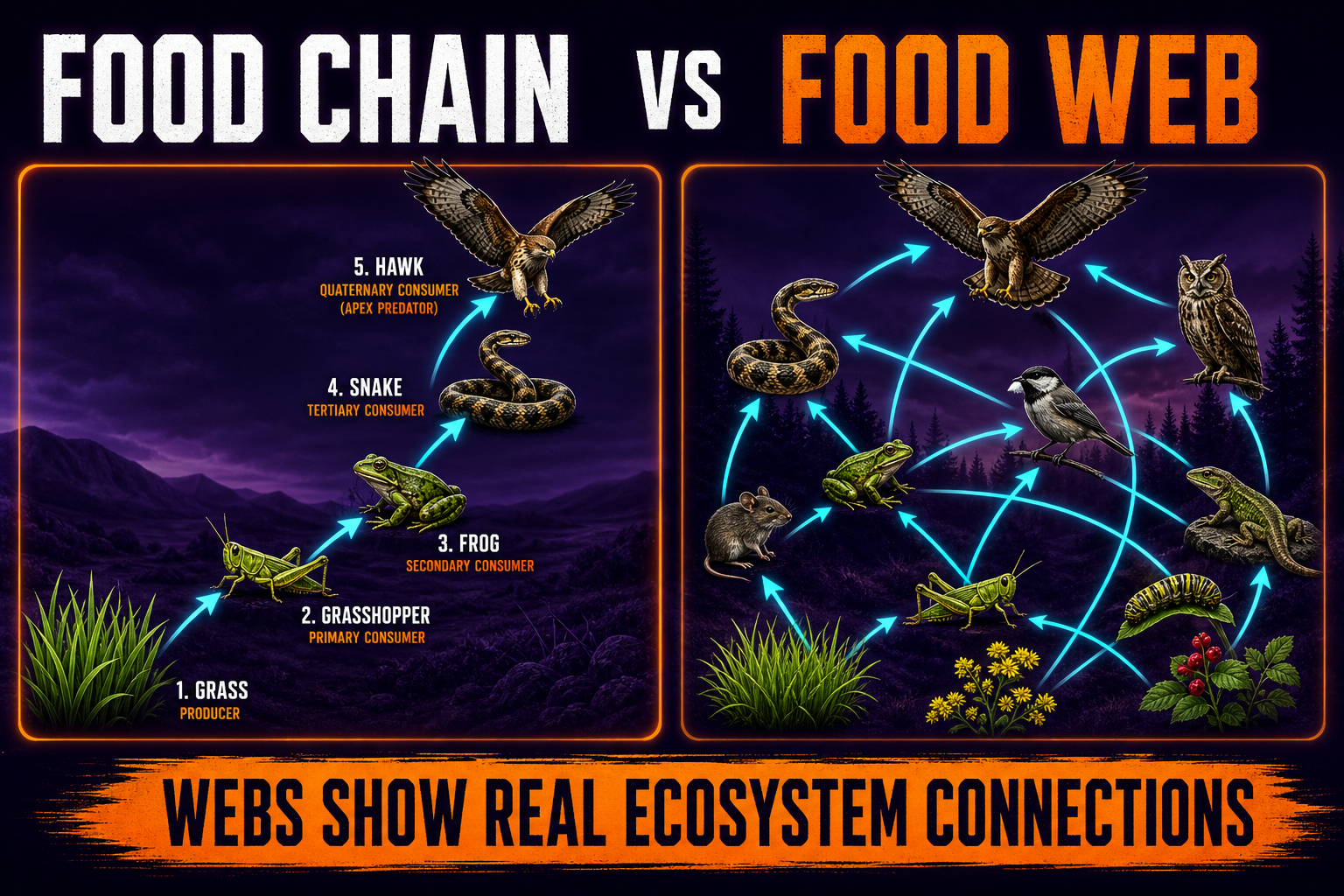
Direct answer: A food chain shows one pathway of energy flow through organisms.
Example: grass → grasshopper → frog → snake → hawk
AP trap: Do not reverse arrows. Arrows show where energy goes.
Direct answer: A food web shows many connected feeding relationships in an ecosystem.
See community ecology for how species interactions shape food webs.
| Feature | Food Chain | Food Web |
|---|---|---|
| Meaning | One linear feeding pathway | Many connected feeding relationships |
| Complexity | Simple | Complex and realistic |
| Best used for | Basic models and introductions | Predicting ecosystem effects |
| AP exam clue | Arrows show energy direction | One species can affect many others |
| Example | grass → grasshopper → frog → snake | Multiple prey and predator links |
Direct answer: A food chain shows one energy pathway, while a food web shows multiple connected feeding relationships.
Direct answer: The 10% rule is a simplified model stating that about 10% of energy at one trophic level is transferred to the next trophic level.
If producers contain 10,000 kcal of energy:
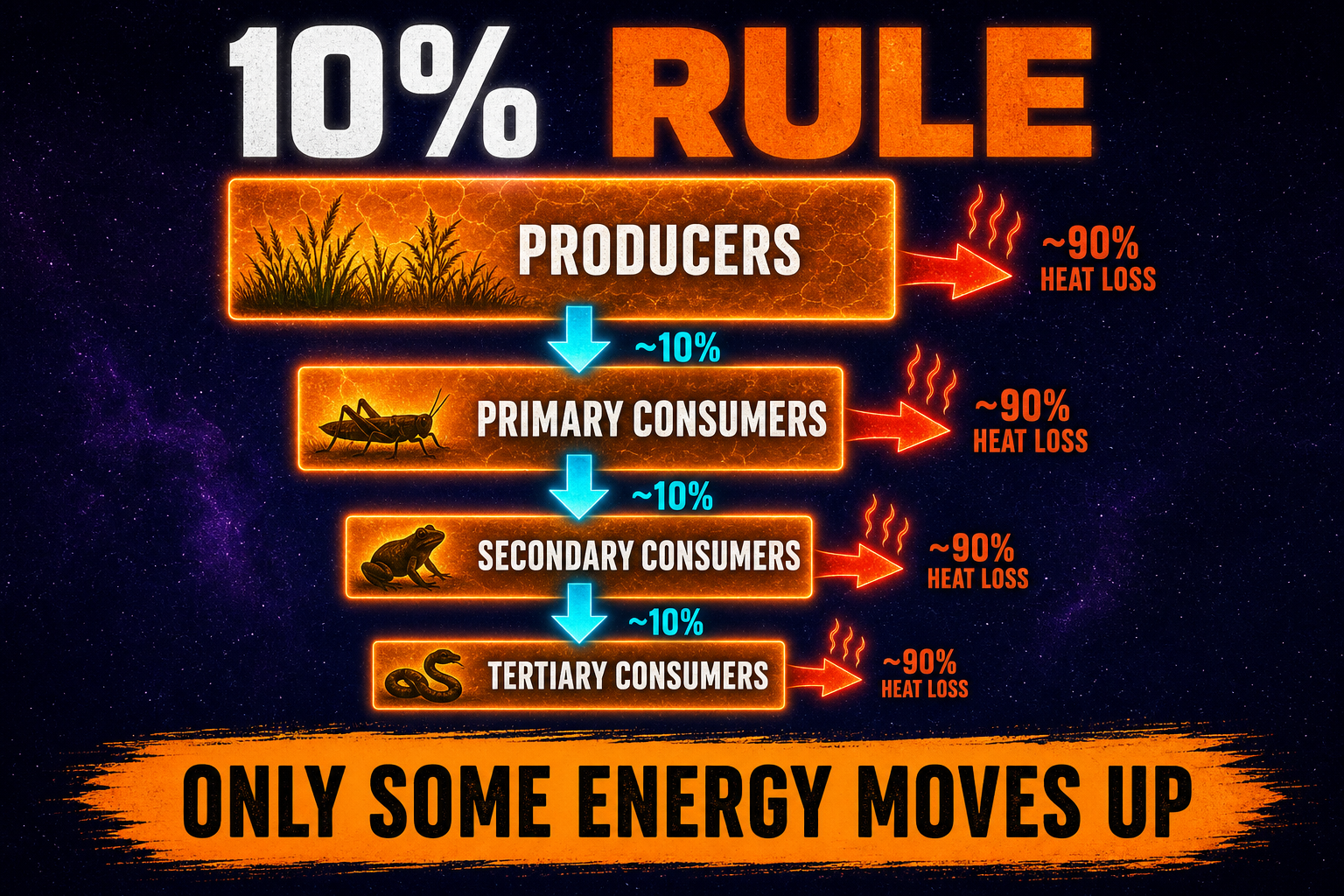
Direct answer: Energy is lost between trophic levels because organisms use energy for metabolism, movement, growth, reproduction, and cellular respiration, and much energy leaves as heat.
Connect heat loss to cellular respiration overview when a prompt asks where energy goes.
Direct answer: Ecological pyramids show patterns in energy, biomass, or number of organisms across trophic levels.
| Pyramid Type | What It Shows | AP Exam Clue |
|---|---|---|
| Energy pyramid | energy available at each trophic level | always decreases upward |
| Biomass pyramid | total biomass at each level | usually decreases upward |
| Numbers pyramid | number of organisms at each level | can vary by ecosystem |
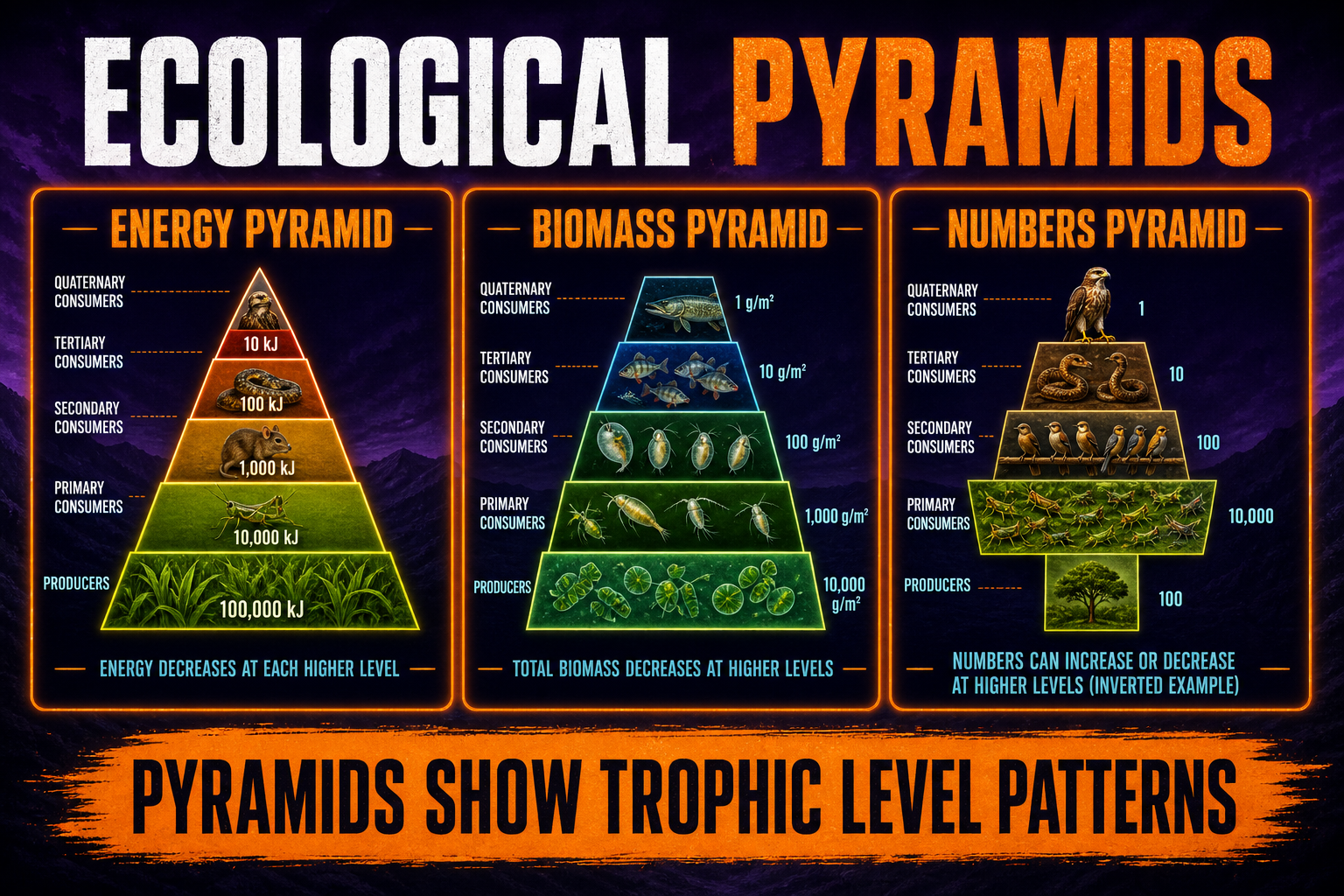
Direct answer: An energy pyramid shows how energy decreases at higher trophic levels.
Direct answer: A biomass pyramid shows the total mass of living material at each trophic level.
Direct answer: A numbers pyramid shows the number of individual organisms at each trophic level.
Direct answer: Energy flows through ecosystems and is lost as heat, while matter cycles through organisms and the environment.
| Feature | Energy | Matter |
|---|---|---|
| Movement | Flows one way through trophic levels | Cycles through organisms and environment |
| Recycled? | No — lost as heat | Yes — nutrients return to soil and water |
| Examples | Sunlight → producers → consumers | Carbon, nitrogen, phosphorus cycles |
| Role of decomposers | Release energy as heat | Return nutrients to the ecosystem |
| AP exam clue | Energy is not recycled | Matter is recycled |
AP trap: Energy is not recycled through decomposers. Matter is recycled.
Direct answer: Changes in one population can alter energy flow by increasing or decreasing food availability for other trophic levels.
Link to ecological relationships for predation and competition effects, and biodiversity and ecosystem stability when a web change alters resilience.
Population shifts after web changes connect to population growth models and density-dependent and density-independent factors.
What to do: Explain energy loss as heat and low transfer efficiency.
What to do: Connect to low energy availability at high trophic levels.
What to do: Predict less energy available to consumers.
What to do: Follow arrow direction from food source to consumer.
What to do: Consider rapid producer turnover, especially in aquatic ecosystems.
What to do: Predict slower matter recycling, not energy recycling.
Which statement best summarizes energy and matter in ecosystems?
Fix: Energy flows; matter cycles.
Fix: Decomposers recycle matter and release energy as heat.
Fix: Arrows show the direction energy moves.
Fix: The 10% rule is a simplified model.
Fix: Top trophic levels have the least available energy.
Fix: Biomass is total living mass, not organism count.
Direct answer: For energy flow FRQs, trace the energy source, follow trophic transfers and arrows, explain heat loss at each step, connect lower energy to biomass or population patterns, and distinguish energy flow from matter cycling.
More practice: Unit 8 FRQ practice and Unit 8 practice questions.
An ecosystem has 20,000 kcal of energy available in producers. Assume approximately 10% of energy is transferred to each higher trophic level.
Common mistake: Do not say energy disappears. It is transformed and released as heat.
Every fifth card advance triggers an ad placeholder with a three-second countdown before the next card appears.
Energy enters ecosystems when producers capture sunlight or chemical energy and store it in organic molecules. That energy then passes to consumers and decomposers, but much is lost as heat at each trophic transfer, so less usable energy remains at higher levels.
A producer is an autotroph that builds organic molecules from inorganic sources through photosynthesis or chemosynthesis. Producers form the base of most food webs because they are the primary entry point for energy into the ecosystem.
A consumer is a heterotroph that obtains energy by eating plants, animals, or other organisms. Consumers cannot make their own food from sunlight and must rely on energy stored in the tissues of other living things.
Decomposers break down dead organisms and waste products into simpler inorganic nutrients. They return those nutrients to soil and water so producers can use them again, but they release stored energy as heat rather than recycling it.
Trophic levels are the feeding positions in an ecosystem, such as producers, primary consumers, and higher-level consumers. Each level receives less usable energy than the level below it because organisms use most incoming energy for life processes and lose the rest as heat.
The 10% rule is a simplified model estimating that roughly 10% of energy at one trophic level becomes biomass at the next. Real ecosystems vary, but the model helps you predict why energy pyramids narrow sharply toward the top.
Organisms spend much of their energy on cellular respiration, movement, maintenance, and growth rather than passing it to the next consumer. Each transfer is inefficient, so a large fraction always leaves the system as heat.
An energy pyramid diagrams how much energy is available at each trophic level in an ecosystem. The base is always widest because producers capture the most energy, and each higher band is smaller because heat loss limits what can move upward.
A food chain traces one linear path of energy from a producer through a few consumers. A food web shows the many overlapping feeding links in a real community, which better reflects how species actually interact.
No—decomposers break down dead matter and return nutrients to the environment, but they do not send energy back up the food web. During decomposition, stored chemical energy is released as heat and is no longer available to support new biomass at higher trophic levels.
Energy flows in one direction through trophic levels and eventually exits ecosystems mainly as heat. Matter, by contrast, cycles repeatedly between living organisms, decomposers, and abiotic reservoirs such as soil, water, and air.
Start by naming the energy source, then follow food-web arrows from producers through each consumer level named in the prompt. Explain where energy is lost as heat and how that lower availability limits biomass, population size, or pyramid shape at higher trophic levels.
Only a small fraction of energy transfers between trophic levels, so little usable energy remains after a few steps. Most ecosystems support only three to five trophic levels because heat loss makes longer chains energetically unsustainable.
An energy pyramid measures usable energy at each trophic level and always narrows toward the top. A biomass pyramid shows total living mass at each level; it is usually upright, but fast-growing producers in aquatic systems can sometimes create an inverted biomass pyramid even when energy still decreases upward.