Identify the disturbance or starting condition
Is the habitat newly formed or disturbed?
AP Biology · Unit 8 Ecology
Ecological succession describes how community composition changes over time after new habitat forms or after a disturbance. In AP Biology Unit 8, the key distinction is primary succession begins without soil, while secondary succession begins where soil remains after disturbance.
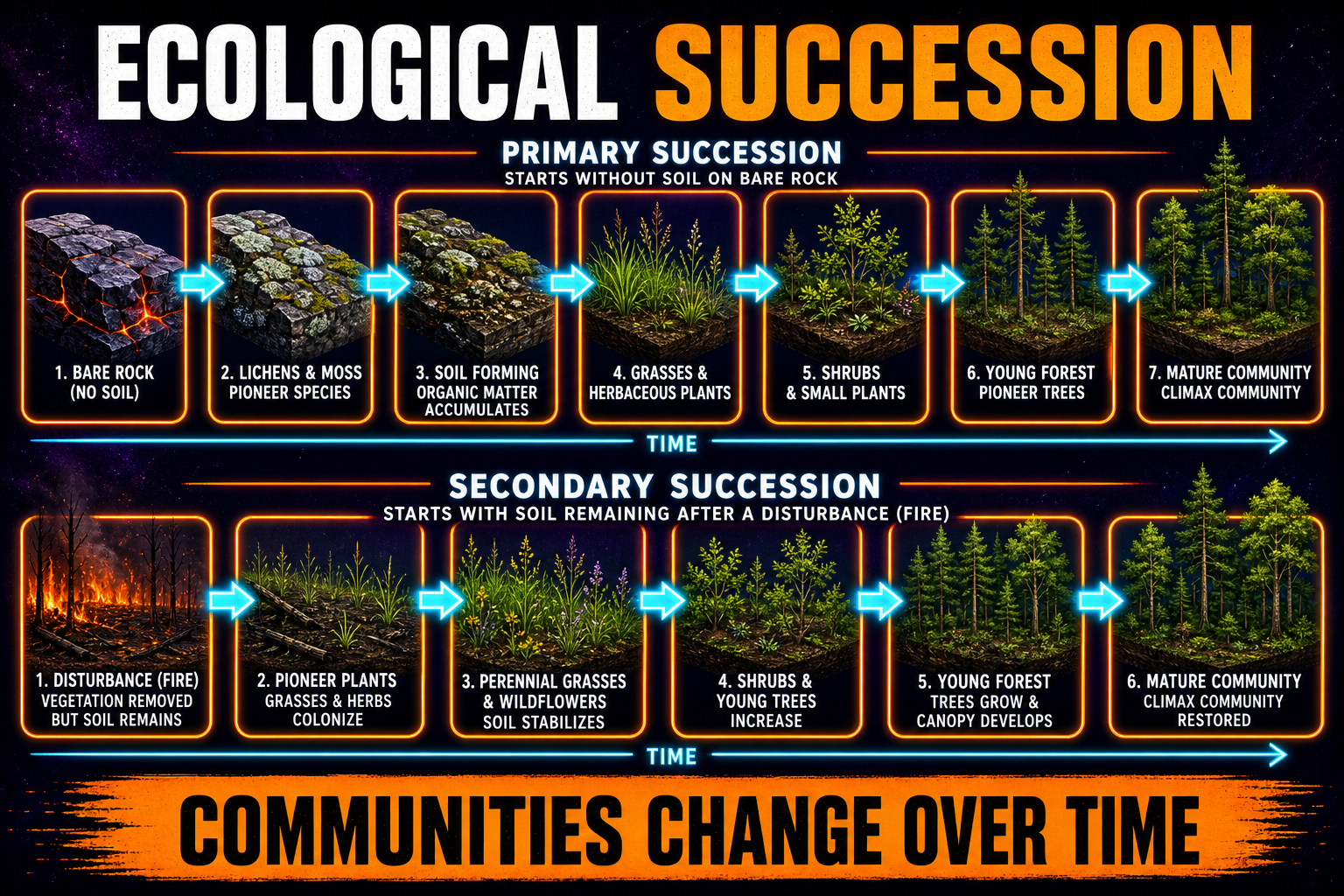
Ecological succession is the gradual change in community composition over time after new habitat forms or after a disturbance. Primary succession begins without soil, while secondary succession begins where soil remains.
Ecological succession = communities changing over time. Primary = no soil. Secondary = soil remains.
Is the habitat newly formed or disturbed?
No soil suggests primary succession; soil remaining suggests secondary succession.
Which organisms colonize first?
Which species replace earlier species over time?
How do richness, structure, or resilience change?
Will recovery be slow or fast based on soil, seed banks, and disturbance severity?
Direct answer: Ecological succession is the process by which the species composition of a community changes over time.
Course context: AP Biology and Unit 8 Ecology.
Direct answer: Primary succession begins in an area where no soil exists.
Examples: new volcanic island, cooled lava flow, land exposed by retreating glaciers, bare rock after major geological change.
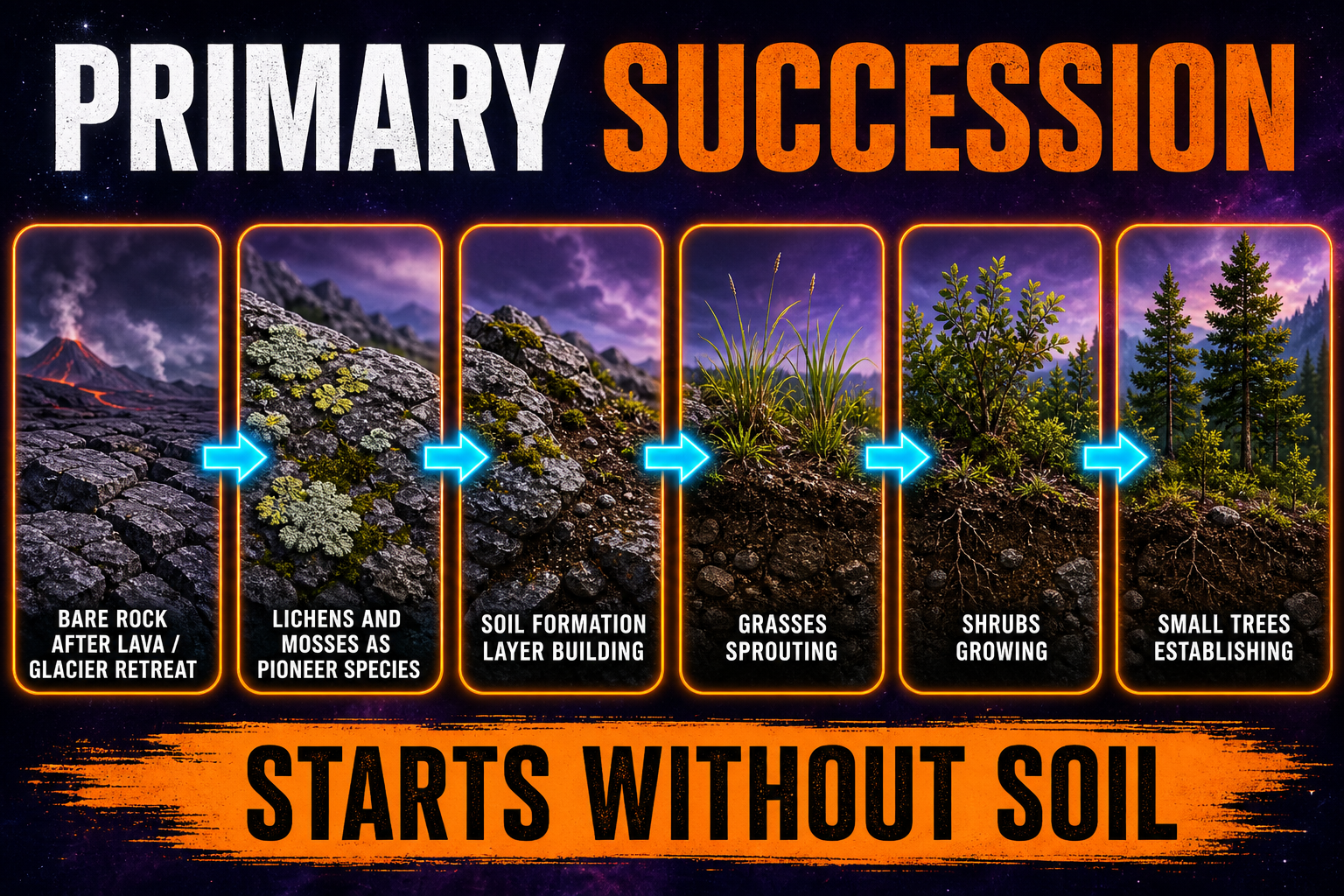
Direct answer: Pioneer species are the first organisms to colonize an area during succession.
Direct answer: Soil is important because it provides nutrients, water-holding capacity, and a place for plant roots to grow.
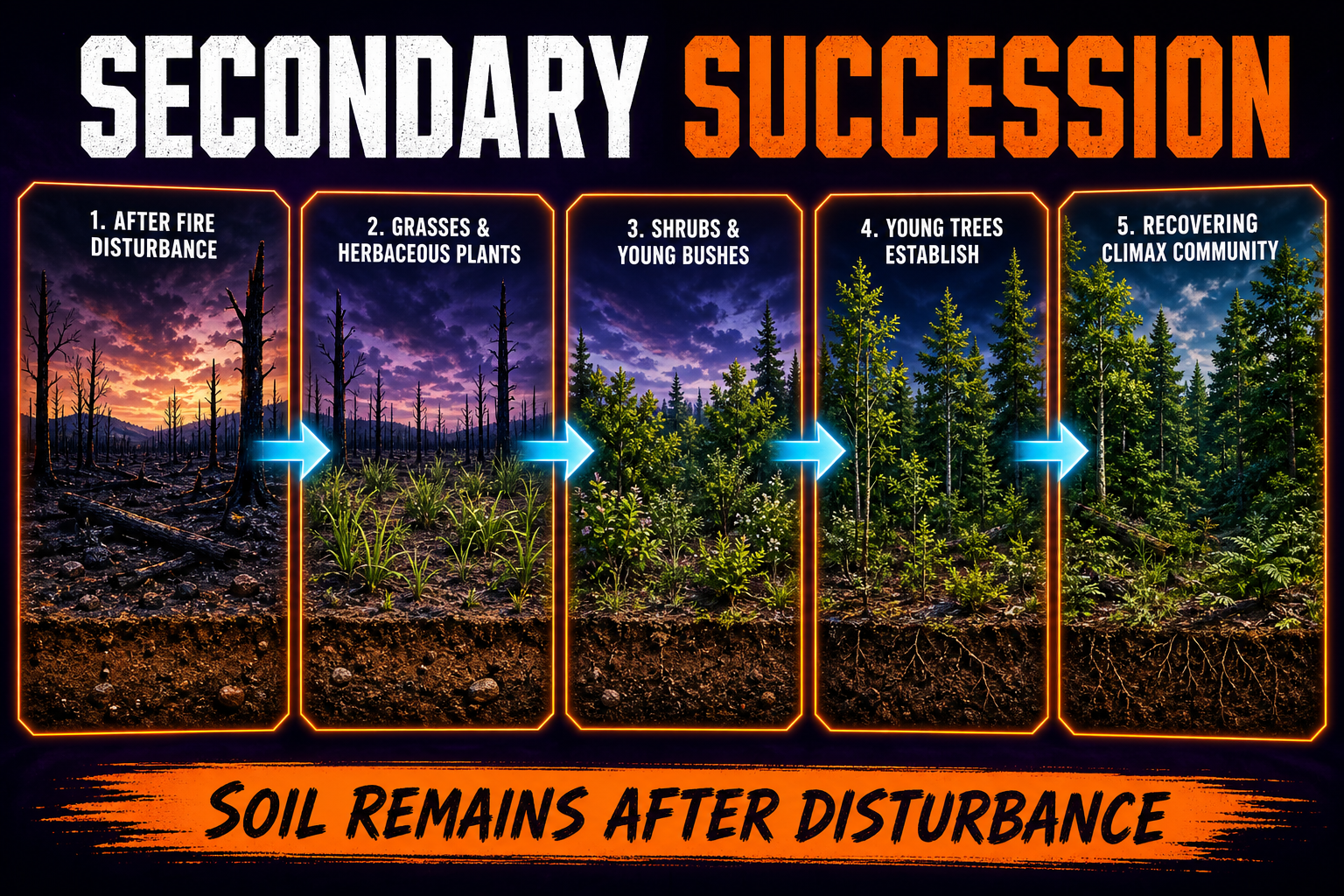
Direct answer: Secondary succession begins after a disturbance in an area where soil remains.
Examples: forest regrowth after fire, abandoned farmland, recovery after hurricane, grassland after grazing disturbance.
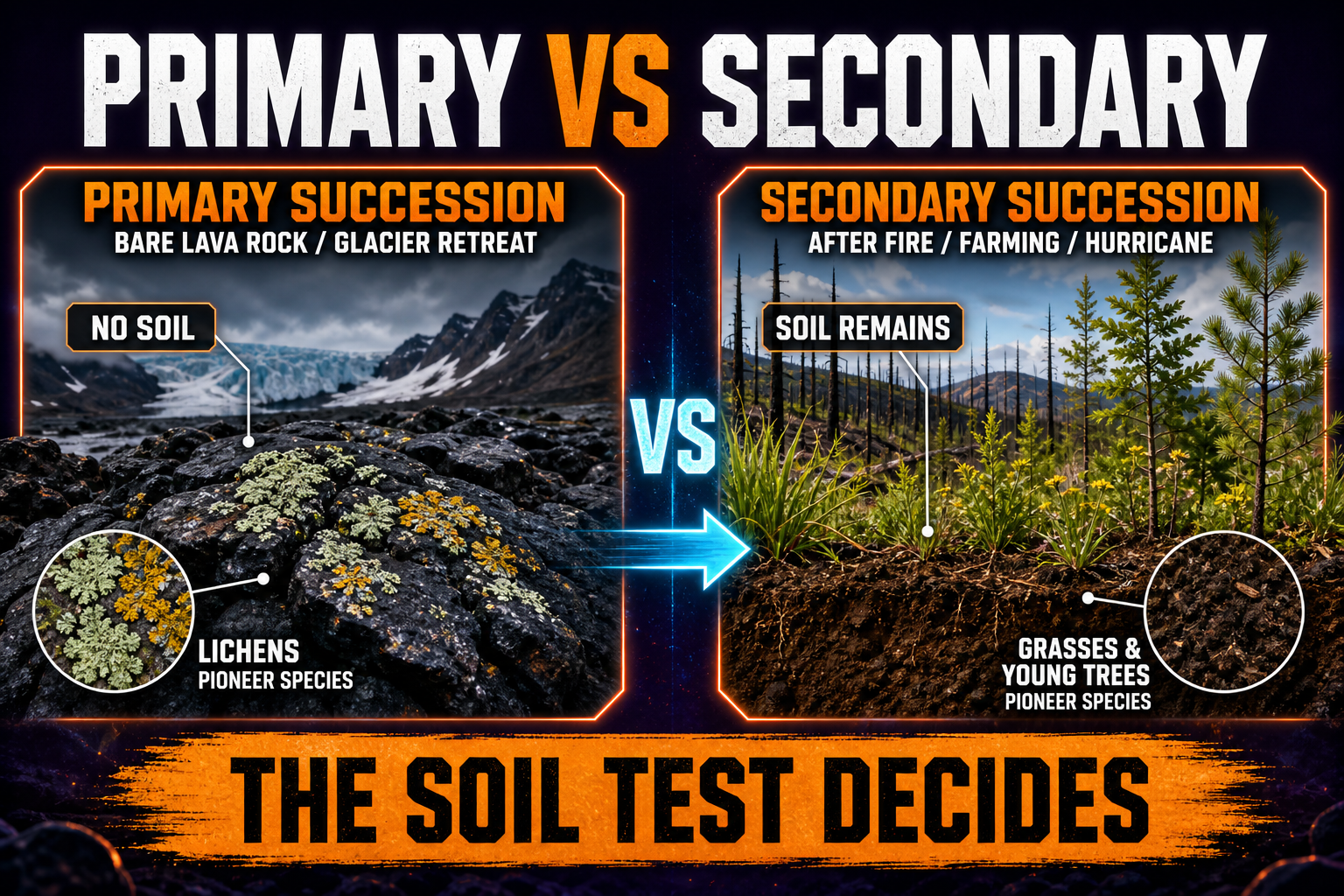
Direct answer: Primary succession begins without soil, while secondary succession begins with soil already present.
| Feature | Primary Succession | Secondary Succession |
|---|---|---|
| Starting condition | New habitat without soil | Disturbed habitat with soil remaining |
| Soil present? | No | Yes |
| Common pioneer species | Lichens, mosses | Grasses, weeds, fast-growing plants |
| Speed | Usually slow | Usually faster |
| Examples | Lava flow, glacial retreat, bare rock | Fire, farming, hurricane, logging |
| AP clue | Ask: is there soil? | Soil + seeds/roots speed recovery |
Direct answer: Disturbance can reset or alter a community, creating conditions for succession.
Population limits: density-dependent and density-independent factors.
Direct answer: Communities change during succession as species colonize, compete, modify the environment, and are replaced by later species.
Direct answer: Biodiversity often increases during succession as more species colonize and more niches become available.
Direct answer: Succession can affect ecosystem stability by changing biodiversity, food webs, soil quality, and community structure over time.
Direct answer: Succession is a community ecology process because it involves changes in multiple species and their interactions over time.
Direct answer: Species interactions can influence succession by helping, harming, or replacing species over time.
Direct answer: Facilitation, inhibition, and tolerance are models that explain how species interactions influence succession.
| Model | Meaning | AP Clue | Example |
|---|---|---|---|
| Facilitation | Early species help later species colonize | Early species improve habitat | Lichens help build soil |
| Inhibition | Early species prevent or slow later species | Early species block replacement | Dense shrubs reduce tree seedlings |
| Tolerance | Later species tolerate conditions and eventually dominate | Species replace others without direct help | Shade-tolerant trees grow under canopy |
Scenario: A lava flow cools into bare rock. Lichens colonize the rock, break it down slowly, and add organic material when they die. Over time, mosses, grasses, shrubs, and eventually trees can grow.
Scenario: A forest fire removes many trees but leaves soil, roots, seeds, and microbes. Grasses and small plants grow first, followed by shrubs and young trees. Over time, the forest community may recover.
What to do: Identify primary succession.
What to do: Identify secondary succession.
What to do: Connect succession to biodiversity change.
What to do: Explain pioneer species and organic matter buildup.
What to do: Explain community change and species replacement.
What to do: Explain why secondary succession is faster.
A glacier retreats and exposes bare rock with no soil. Lichens begin growing on the rock. Which process is occurring?
Fix: Use the soil test: no soil = primary; soil remains = secondary.
Fix: Succession is community composition changing over time.
Fix: Secondary succession starts after disturbance where soil remains.
Fix: Pioneer species colonize early and can change conditions for later species.
Fix: Succession depends on climate, soil, species, disturbance, and interactions.
Fix: Many disturbances leave soil, causing secondary succession.
Direct answer: For ecological succession FRQs, identify the starting condition, determine whether soil is present, classify primary or secondary succession, and explain how community composition changes over time.
More practice: Unit 8 FRQ practice and Unit 8 practice questions.
Two sites are studied after disturbance. Site A is a cooled lava field with no soil. Site B is a burned forest where soil, roots, and some seeds remain.
Common mistake: Do not classify Site B as primary succession just because a fire occurred.
Every fifth card advance triggers an ad placeholder with a three-second countdown before the next card appears.
Ecological succession is the gradual change in community composition over time after new habitat forms or after a disturbance. On the AP Biology exam, succession questions usually ask you to classify primary versus secondary succession and explain how the community changes.
Primary succession begins in an area where no soil exists, such as bare rock after a lava flow or land exposed by glacier retreat. Pioneer species like lichens and mosses often arrive first and help soil form slowly over time.
Secondary succession begins after a disturbance in an area where soil remains, such as after a forest fire or abandoned farmland. Because soil, seeds, roots, and microbes may survive, recovery is usually faster than primary succession.
Primary succession starts without soil, while secondary succession starts where soil is already present after disturbance. The fastest AP Biology shortcut is the soil test: no soil means primary; soil remaining means secondary.
Pioneer species are the first organisms to colonize an area during succession. They often tolerate harsh conditions and can modify the environment—lichens break down rock and add organic matter, making later colonization easier.
Soil provides nutrients, water-holding capacity, and anchorage for plant roots. Primary succession is slow largely because soil must form first; once soil develops, grasses, shrubs, and trees can colonize more readily.
Secondary succession is faster because soil, seed banks, surviving roots, and soil microbes often remain after disturbance. Primary succession must build soil from bare rock or exposed surfaces, which takes much longer.
Succession occurs when new habitat forms or when disturbance resets or alters a community. Colonizing species compete, modify the environment, and are eventually replaced by later species as conditions change.
Biodiversity often increases during succession as more species colonize and more niches become available. Early stages may have fewer species; middle stages often gain richness; later stages may have more complex interactions.
Succession affects ecosystem stability by changing biodiversity, food webs, soil quality, and community structure over time. Recovery after disturbance depends on resilience factors like soil retention, seed banks, and remaining species.
Facilitation means early species improve conditions for later species; inhibition means early species block or slow later colonizers; tolerance means later species endure conditions and eventually replace earlier ones. AP Biology may ask which model fits a given scenario.
Identify the starting condition, state whether soil is present, classify primary or secondary succession, name pioneer species if relevant, and explain how community composition changes over time using evidence from the prompt.