Answer without notes
Treat the first attempt like a mini diagnostic.
AP Biology · Unit 8 Practice
Practice AP Biology Unit 8 Ecology with AP-style multiple-choice questions covering responses to the environment, energy flow, population ecology, population growth, limiting factors, ecological relationships, community ecology, biodiversity, ecosystem stability, and succession. Use the explanations to find weak spots before moving to FRQ practice.
Teacher tip: For Unit 8 MCQs, always identify the ecological level first: organism, population, community, ecosystem, or biosphere. Then use the data, graph, or scenario to explain the effect on survival, reproduction, population size, biodiversity, or stability.
This AP Biology Unit 8 practice questions page gives students AP-style ecology MCQs with answers and explanations. The questions cover responses to the environment, energy flow, population ecology, population growth, limiting factors, species interactions, community ecology, biodiversity, ecosystem stability, and ecological succession.
This AP Biology Unit 8 practice questions page gives students AP-style ecology MCQs with answers and explanations covering the full Unit 8 ecology cluster.
Use this page to practice Unit 8 MCQs, check explanations, and find weak ecology topics.
Use this page within AP Biology and the Unit 8 Ecology cluster. After MCQs, try Unit 8 FRQ practice or browse practice by course.
Treat the first attempt like a mini diagnostic.
Do not only check the letter. Read why the correct answer works.
Connect each miss to a Unit 8 topic page.
Use the linked study guide for the weak area.
Practice until the reasoning becomes automatic.
After MCQs, practice explaining ecology data in writing.
Short review before you start the full practice set.
| Topic | What to know | Review link |
|---|---|---|
| Responses to the Environment | stimulus, behavioral response, physiological response, homeostasis | Review → |
| Energy Flow | producers, consumers, decomposers, trophic levels, 10% rule | Review → |
| Population Ecology | size, density, dispersion, sampling | Review → |
| Population Growth Models | exponential, logistic, carrying capacity | Review → |
| Limiting Factors | density-dependent and density-independent factors | Review → |
| Ecological Relationships | mutualism, commensalism, parasitism, predation, competition | Review → |
| Community Ecology | niches, keystone species, invasive species, food webs | Review → |
| Biodiversity and Stability | richness, diversity, resilience, resistance | Review → |
| Ecological Succession | primary, secondary, pioneer species, disturbance recovery | Review → |
Question: Which statement best summarizes energy and matter in ecosystems?
Answer 30 AP-style questions across Unit 8 ecology. Filter by topic or run the full mixed set.
Question 1 of 30
Quick tip: Press A–D or 1–4 to answer · Enter for next
Complete all 30 MCQs to see your score, percentage, performance band, and topic breakdown above in the practice panel.
| Score | Performance band |
|---|---|
| 0–14 | Review the Unit 8 basics. |
| 15–21 | Good start; review weak topics. |
| 22–26 | Strong Unit 8 readiness. |
| 27–30 | Excellent ecology MCQ readiness. |

Missed questions here usually mean stimulus–response vocabulary needs review.
Review this topic →Review trophic levels and the 10% rule if energy transfer questions feel shaky.
Review this topic →Density, dispersion, and population change formulas show up often on Unit 8 MCQs.
Review this topic →Practice telling exponential and logistic curves apart using shape and context.
Review this topic →Ask whether crowding changes the factor's effect before you classify it.
Review this topic →Use +/− signs to classify mutualism, competition, predation, and commensalism.
Review this topic →Keystone species, niches, and invasive species are common community-level traps.
Review this topic →Richness, evenness, resilience, and resistance are tested separately on the exam.
Review this topic →Use the soil test to decide primary versus secondary succession quickly.
Review this topic →Common trap
Fix: Energy flows; matter cycles.
Common trap
Fix: Density includes area or volume.
Common trap
Fix: Logistic growth levels off near carrying capacity.
Common trap
Fix: Ask whether crowding changes the effect.
Common trap
Fix: Mutualism benefits both; commensalism benefits one without clear effect on the other.
Common trap
Fix: Diversity includes richness and evenness.
Common trap
Fix: Use the soil test.
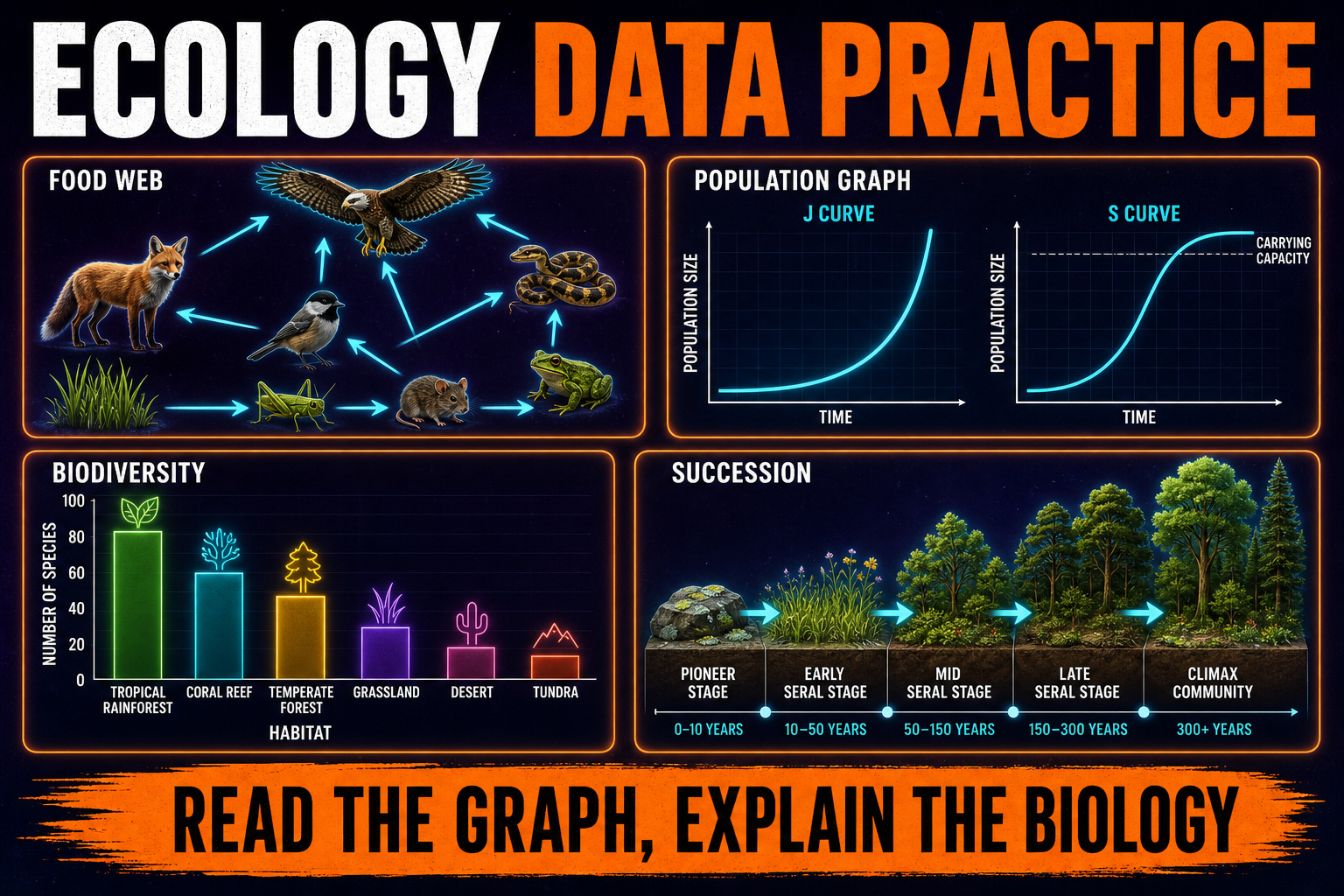
For Unit 8 MCQs, identify the ecological level, read the graph or scenario carefully, classify the relationship or pattern, and explain the biological reason before choosing an answer.
Once students can answer MCQs, they should practice writing explanations using data.
Unit 8 practice questions cover responses to the environment, energy flow, population ecology, population growth models, limiting factors, ecological relationships, community ecology, biodiversity, ecosystem stability, and ecological succession. Expect mixed MCQs that combine vocabulary with graphs, food webs, and data scenarios.
Complete all 30 questions on this page at least once, then revisit topics you missed using the review links under each explanation. Add Unit 8 FRQs when your score is consistently above 22 out of 30.
Both appear on the exam, and this set mirrors that mix with scenario, graph, and calculation-style items. Strong answers connect the data pattern to a biological mechanism such as carrying capacity, trophic transfer, or succession type.
Many students struggle with graph interpretation, density-dependent versus density-independent factors, species interaction signs, and distinguishing richness from diversity. Identifying the ecological level first usually simplifies multi-step questions.
State that energy enters through producers, decreases at higher trophic levels, and is lost as heat while matter cycles. Practice the 10% rule and remember decomposers recycle matter but not usable energy back to producers.
Separate population size from density, know dispersion patterns, and practice the births + immigration − deaths − emigration formula. Data questions often ask you to calculate density or predict population change from a table.
Classify interactions with +/− signs and name who benefits or is harmed. Predator–prey graphs and competition scenarios are common; explain the mechanism, not just the label.
Richness counts species; diversity includes evenness. Resilience is recovery speed after disturbance, while resistance is the ability to withstand change without collapsing.
Use the soil test: primary succession starts without soil, secondary succession begins when soil, seeds, or roots remain. Pioneer species alter conditions so later species can colonize.
Scores of 22–26 out of 30 show strong Unit 8 readiness, while 27–30 suggests excellent ecology MCQ preparation. Below 15, review the linked study guides before retaking the full set.
Yes—MCQs build fast recognition of ecology patterns, while FRQs test whether you can explain mechanisms with evidence from graphs and scenarios. Alternate both formats in the week before the exam.
Read the explanation, click the review link for that topic, and study the matching Unit 8 guide before retrying filtered or full practice. Tag each miss by topic so your weak-area list stays accurate.