Identify the community
Which species are present in the same area?
AP Biology · Unit 8 Ecology
Community ecology studies how different species interact in the same area. In AP Biology Unit 8, community ecology connects species interactions, niches, food webs, keystone species, invasive species, biodiversity, and ecosystem stability.
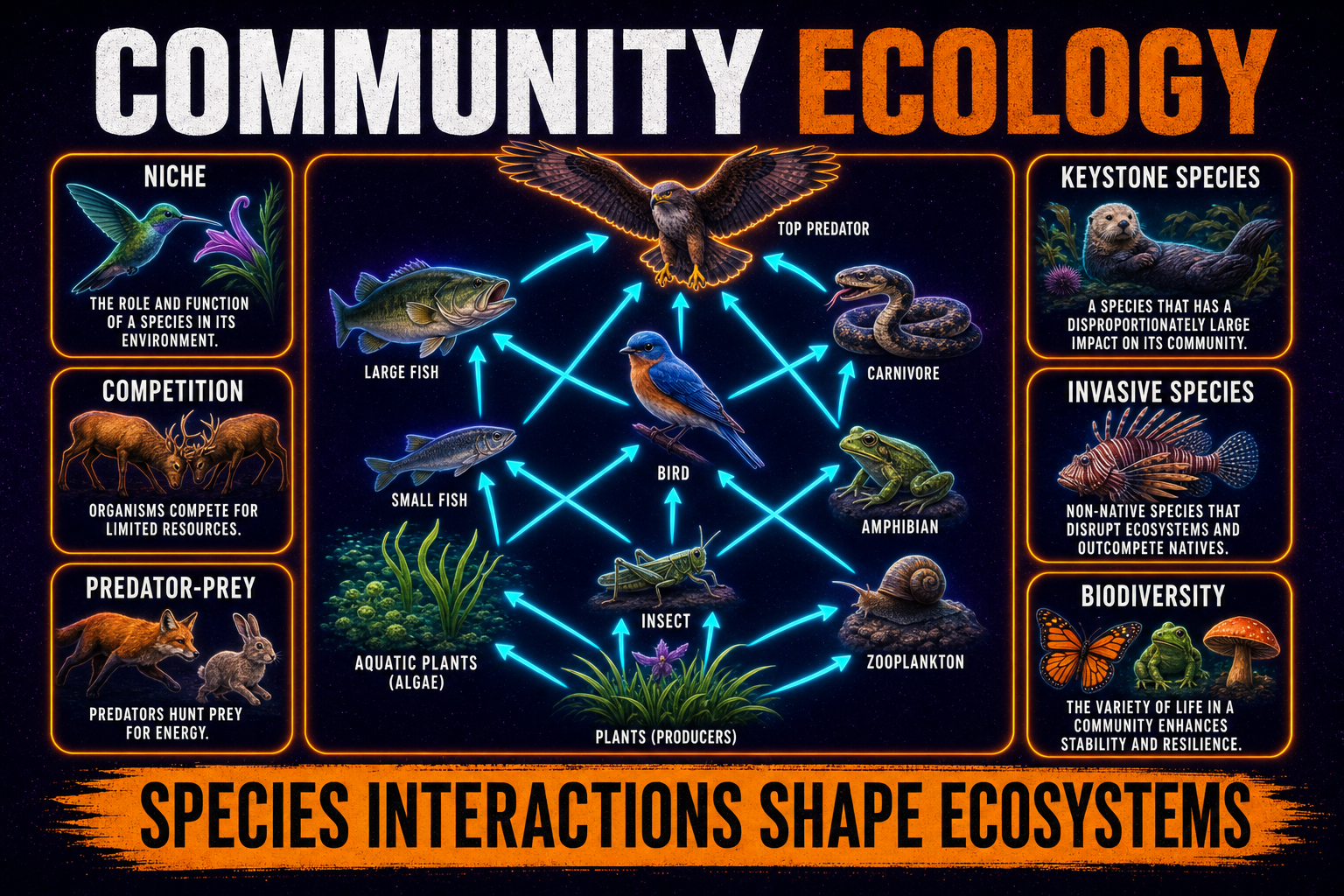
Community ecology is the study of interactions among different species living in the same area. In AP Biology, community ecology explains how species interactions, niches, food webs, keystone species, invasive species, and biodiversity shape community structure.
Community ecology = how different species interact and shape community structure.
Which species are present in the same area?
Are species competing, feeding, cooperating, or disrupting each other?
What resource, role, or habitat is involved?
Which populations increase, decrease, or remain stable?
How does the interaction affect food webs, diversity, or structure?
Does the community become more stable, less stable, or more vulnerable?
Direct answer: A biological community includes all populations of different species living and interacting in the same area.
Course context: AP Biology and Unit 8 Ecology.
Direct answer: Population ecology studies one species, while community ecology studies interactions among multiple species.
| Feature | Population Ecology | Community Ecology |
|---|---|---|
| Main focus | One species in an area | Multiple interacting species |
| Number of species | Single species | Many species |
| Common data | Size, density, dispersion | Interactions, niches, food webs |
| Common questions | How does this population change? | How do species affect each other? |
| AP exam clue | One species named | Multiple species and interactions |
| Example | Grasshopper density in a meadow | Predators, prey, and plants in a tide pool |
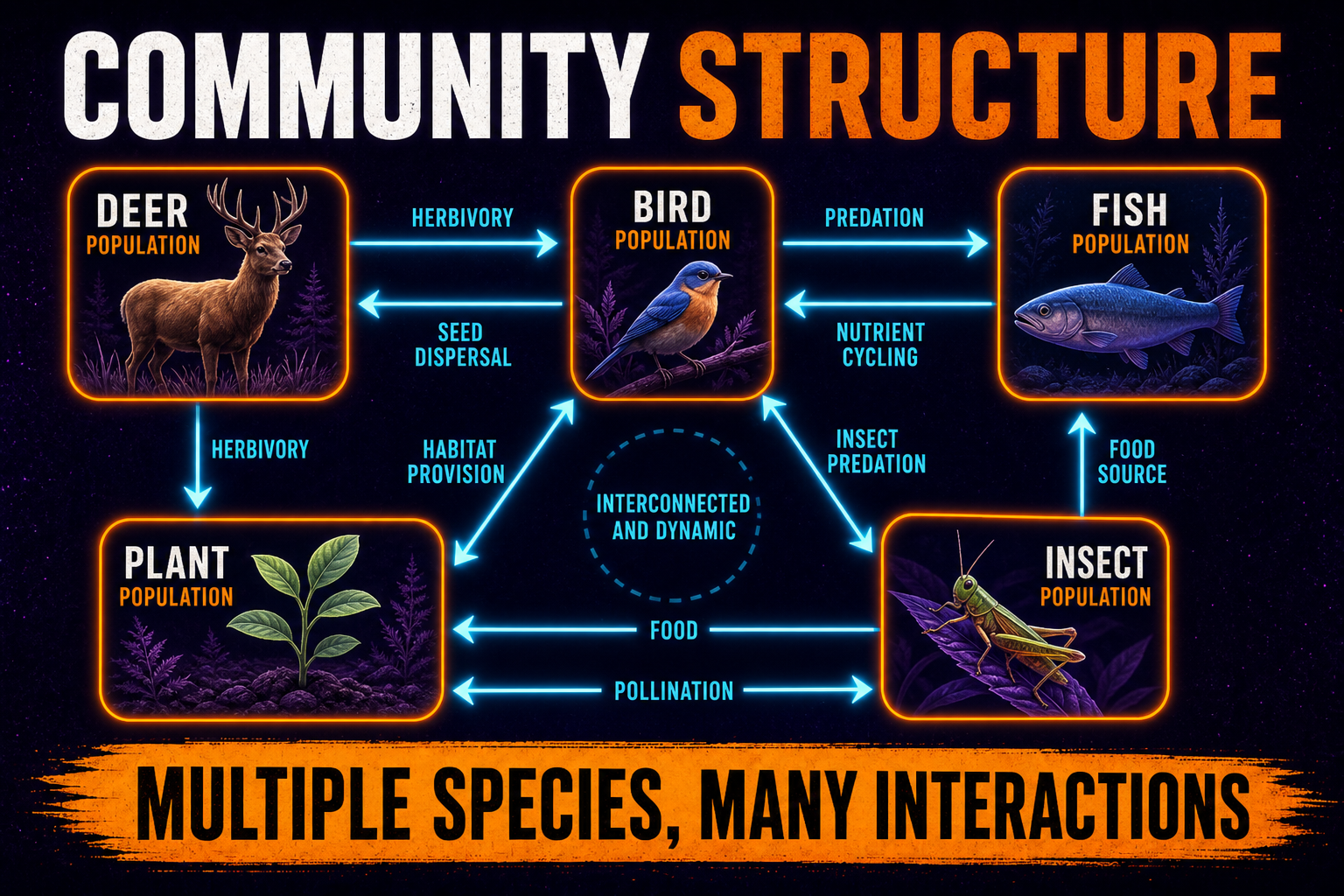
Direct answer: Community structure describes which species are present, how abundant they are, and how they interact.
Direct answer: A niche is a species role in its environment, including how it uses resources and interacts with other species.
Evolution link: natural selection and evolutionary fitness.
Direct answer: A fundamental niche is the full range of conditions a species could use, while a realized niche is the actual range it uses after competition and other interactions.
| Feature | Fundamental Niche | Realized Niche |
|---|---|---|
| Meaning | Full range of conditions a species could use | Actual range used after interactions |
| Role of competition | Not yet limited by competitors | Competition narrows the niche |
| Size | Larger potential range | Smaller actual range |
| AP clue | Theoretical maximum habitat | Observed habitat after competition |
| Example | A bird could feed anywhere in a forest | Competition limits feeding to tree tops only |
Direct answer: Species interactions shape communities by changing survival, reproduction, resource use, population size, and food web structure.
Direct answer: Competition affects communities when species use the same limited resources, reducing success for both species.
Limiting factors: density-dependent and density-independent factors.
Direct answer: Resource partitioning occurs when species reduce competition by using resources in different ways, places, or times.
Direct answer: Predation can shape communities by reducing prey abundance and indirectly affecting other species in the food web.
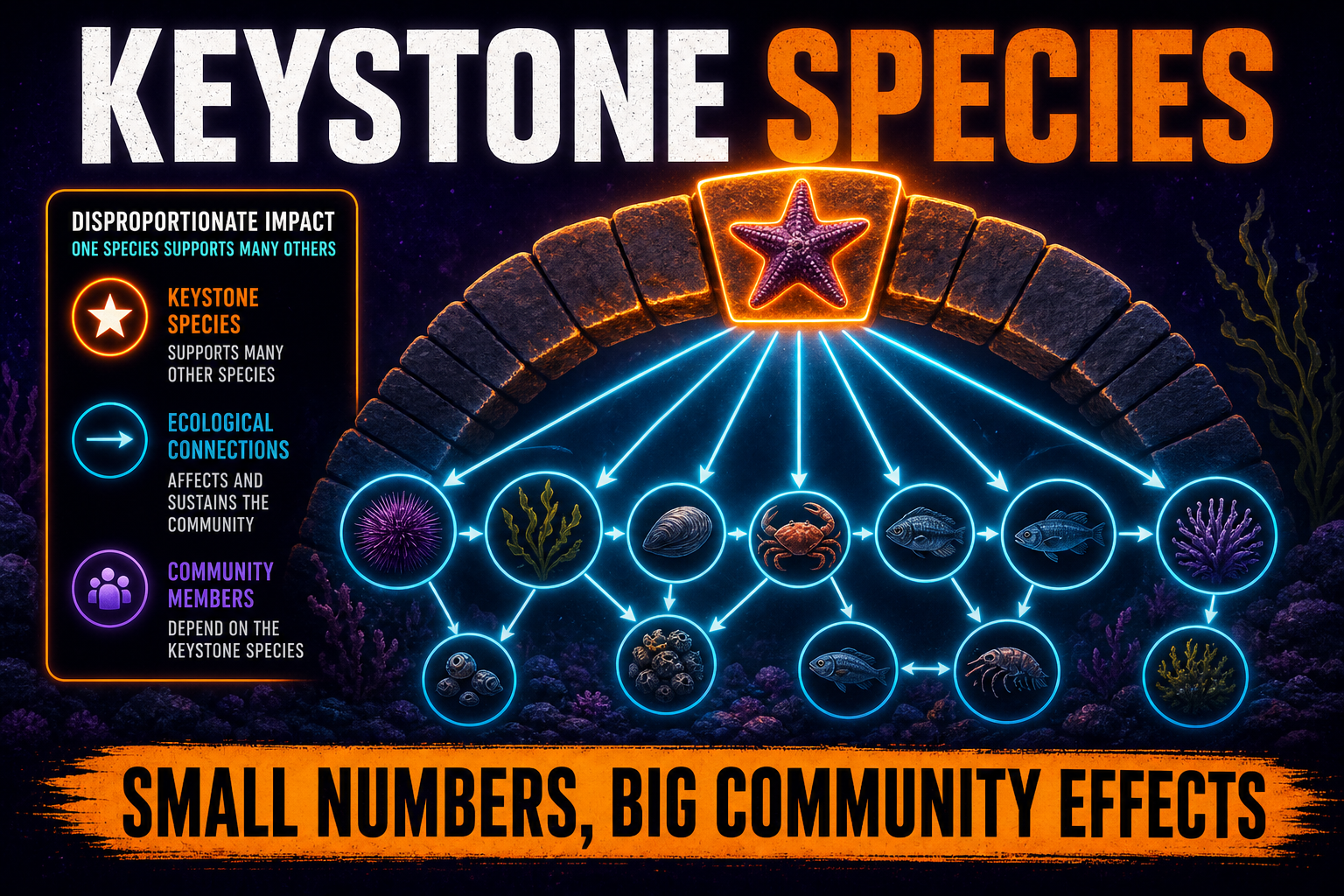
Direct answer: A keystone species has a disproportionately large effect on community structure compared with its abundance.
Direct answer: A trophic cascade occurs when a change at one trophic level causes indirect effects across other trophic levels.
Example: Removing a predator can increase herbivore populations, which can reduce plant biomass.
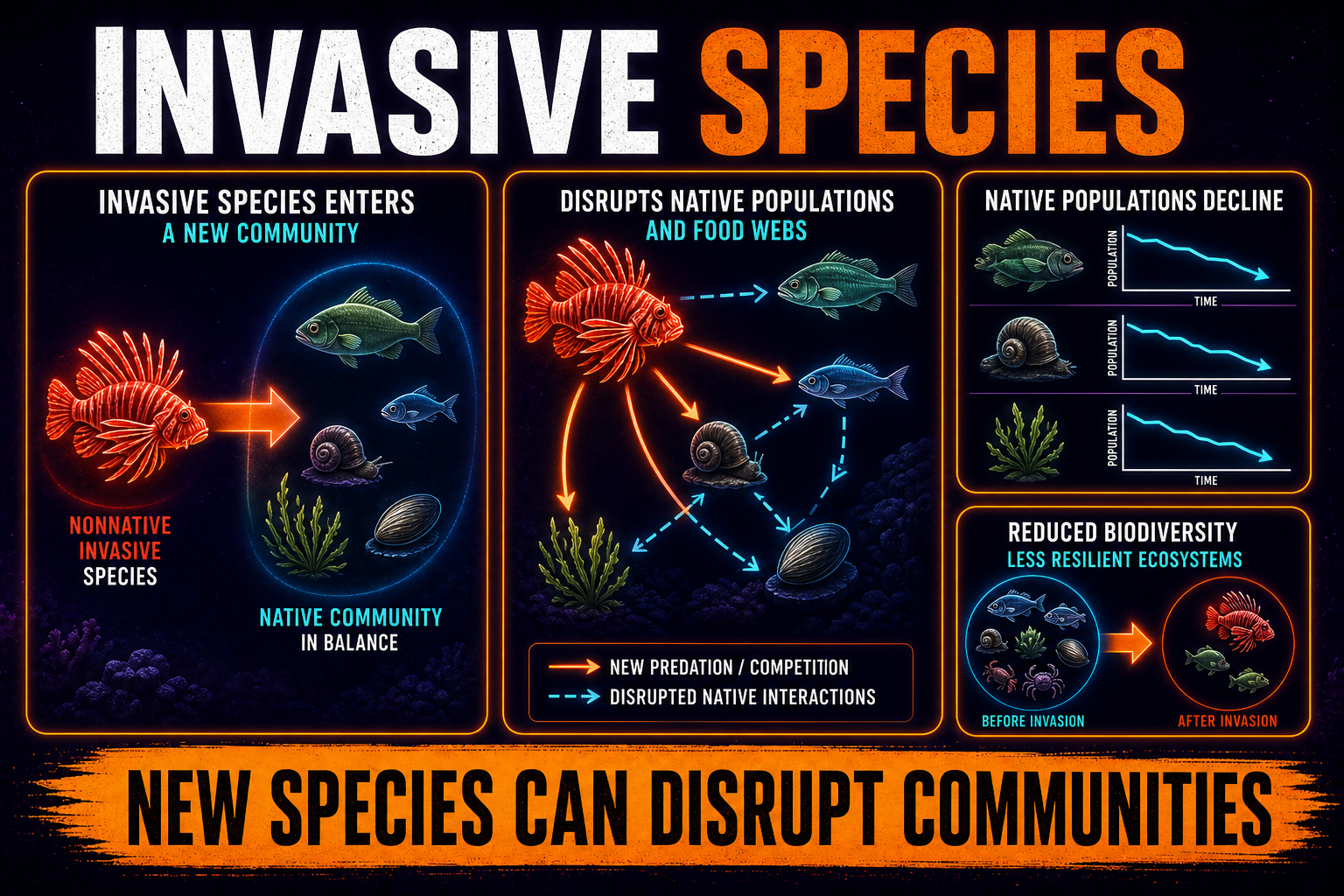
Direct answer: Invasive species are nonnative species that spread and disrupt communities.
Direct answer: Species richness is the number of species in a community, while species diversity includes both species number and relative abundance.
| Feature | Species Richness | Species Diversity |
|---|---|---|
| Meaning | Number of species in a community | Species number plus relative abundance |
| Uses abundance? | No — counts species only | Yes — considers how common each species is |
| What it tells you | How many species exist | How evenly species are represented |
| AP exam clue | Species count given | One species dominates despite high count |
| Example | 10 bird species in a forest | 10 species but one makes up 80% of individuals |
Direct answer: Community ecology connects to biodiversity because species interactions can increase, decrease, or maintain species richness and diversity.
Direct answer: Food webs show community structure by mapping feeding relationships among species.
What to do: Identify the scenario as community ecology.
What to do: Consider keystone species or trophic cascade.
What to do: Identify invasive species effects.
What to do: Identify resource partitioning.
What to do: Distinguish richness from diversity.
What to do: Trace energy flow and predict community changes.
A sea star species is removed from a tide pool community. After removal, one mussel species becomes dominant and several other species decline. Which concept best explains the sea star's role?
Fix: Population means one species; community means multiple species.
Fix: Richness counts species; diversity also considers abundance.
Fix: One species change can affect many other species.
Fix: Keystone species have disproportionately large community effects.
Fix: Invasive species often reduce native biodiversity.
Fix: Explain how abundance, niches, food webs, or diversity change.
Direct answer: For community ecology FRQs, identify the species involved, describe the interaction or community change, use data from the prompt, and explain how the change affects community structure, food webs, biodiversity, or stability.
More practice: Unit 8 FRQ practice and Unit 8 practice questions.
A rocky shore community includes sea stars, mussels, algae, limpets, and small fish. When sea stars are removed, mussels increase rapidly and occupy most available rock surface. Algae and limpet populations decline.
Common mistake: Do not only say the mussel population changed. Explain effects across the community.
Every fifth card advance triggers an ad placeholder with a three-second countdown before the next card appears.
Community ecology is the study of interactions among different species living in the same area. On the AP Biology exam, community ecology questions often ask how species interactions change abundance, niches, food webs, or biodiversity.
A biological community includes all populations of different species living and interacting in the same area. AP Biology distinguishes a community from a population, which includes only one species.
Population ecology studies one species, while community ecology studies interactions among multiple species. If a prompt names several species and asks how they affect each other, think community ecology.
Community structure describes which species are present, how abundant they are, and how they interact. AP questions may ask you to predict how an interaction changes species composition or relative abundance.
A niche is a species role in its environment, including how it uses resources and interacts with other species. If a question asks how species use food, habitat, or timing, think niche.
A fundamental niche is the full range of conditions a species could use, while a realized niche is the actual range it uses after competition and other interactions. Competition often shrinks the realized niche.
A keystone species has a disproportionately large effect on community structure compared with its abundance. Removing a keystone species can strongly change species diversity and food web structure.
A trophic cascade occurs when a change at one trophic level causes indirect effects across other trophic levels. For example, removing a predator can increase herbivores and reduce plant biomass.
Invasive species are nonnative species that spread and disrupt communities. They may outcompete natives, alter food webs, and reduce biodiversity.
Species richness is the number of species in a community, while species diversity includes both species number and relative abundance. A community can have high richness but low diversity if one species dominates.
Food webs show community structure by mapping feeding relationships among species. Arrows reveal direct and indirect effects when one species is added or removed.
Identify the species involved, describe the interaction or community change, and use data from the prompt. Then explain effects on community structure, food webs, biodiversity, or stability across multiple species.