Identify population size
How many individuals are in the population?
AP Biology · Unit 8 Ecology
Population growth models help explain how populations change over time. In AP Biology Unit 8, the two big patterns are exponential growth, which produces a J-shaped curve under ideal conditions, and logistic growth, which produces an S-shaped curve as limiting factors slow growth near carrying capacity.
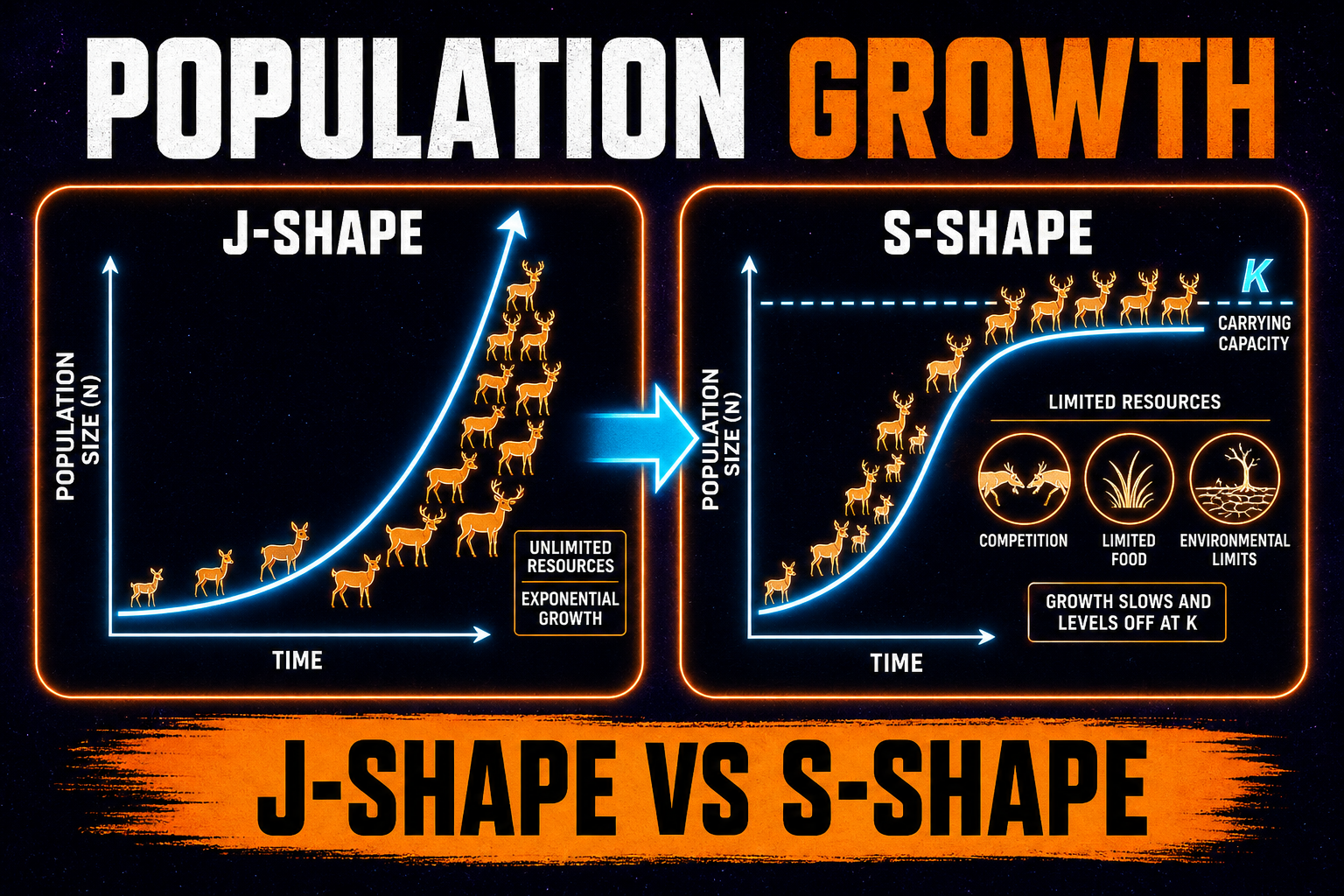
Population growth models are graphs and equations that show how population size changes over time. In AP Biology, exponential growth creates a J-shaped curve under ideal conditions, while logistic growth creates an S-shaped curve as limiting factors slow growth near carrying capacity.
Exponential growth = J-shaped curve. Logistic growth = S-shaped curve with carrying capacity.
Population growth models help predict how populations increase, slow, level off, or decline based on resources and limiting factors.
How many individuals are in the population?
Is it J-shaped, S-shaped, leveling off, or declining?
Are resources abundant or limited?
Competition, disease, predation, food, space, or disturbance may affect growth.
Is the population below, near, or above K?
Growth may increase, slow, stabilize, overshoot, or decline.
Direct answer: Population size changes through births, deaths, immigration, and emigration.
Broader population patterns are covered in population ecology.
Direct answer: Exponential growth occurs when a population increases rapidly under ideal conditions with abundant resources and little environmental resistance.
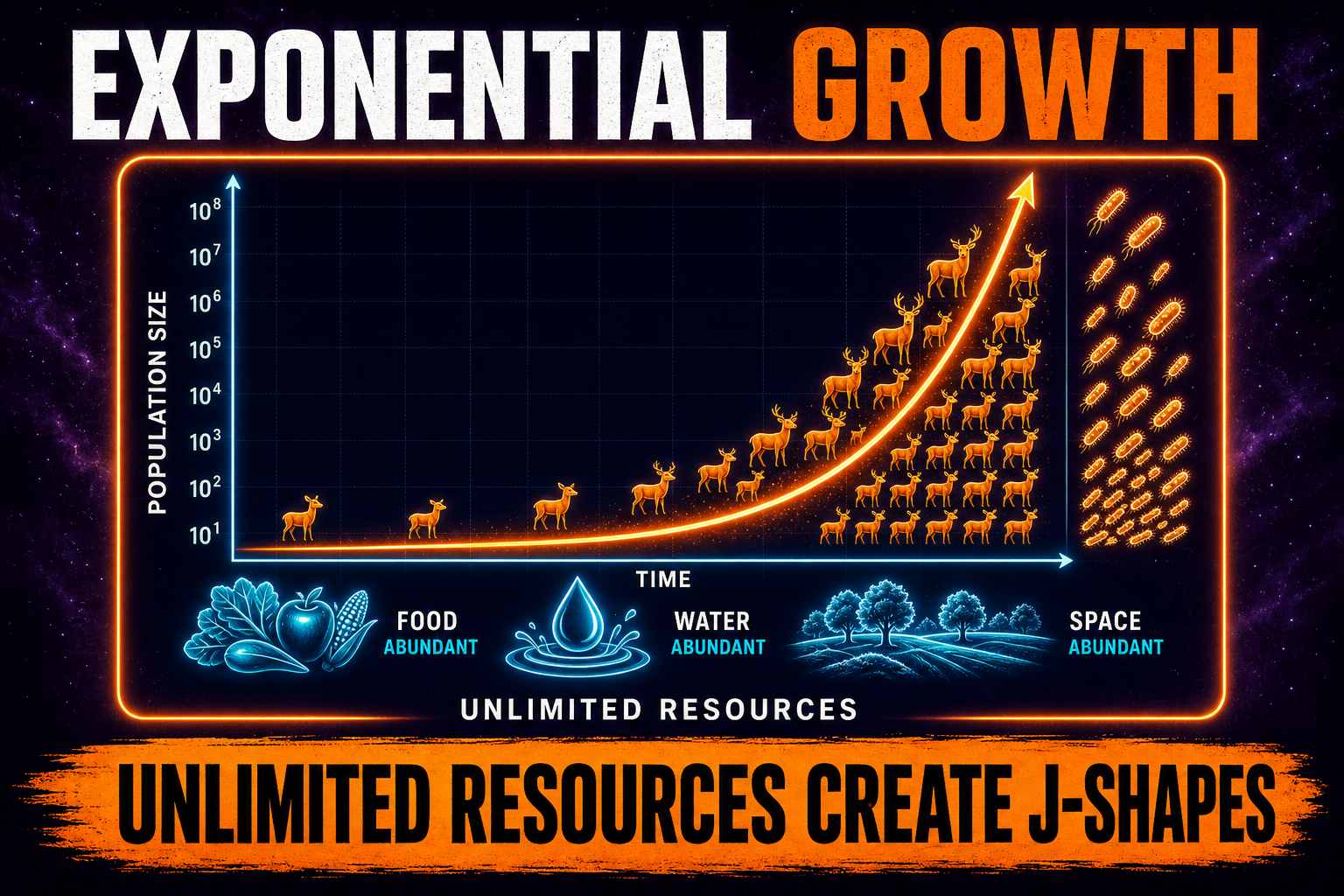
Example: A small bacterial population enters a nutrient-rich environment. With abundant food and space, the population doubles repeatedly over a short time.
Direct answer: Logistic growth occurs when a population grows rapidly at first, then slows and levels off near carrying capacity.
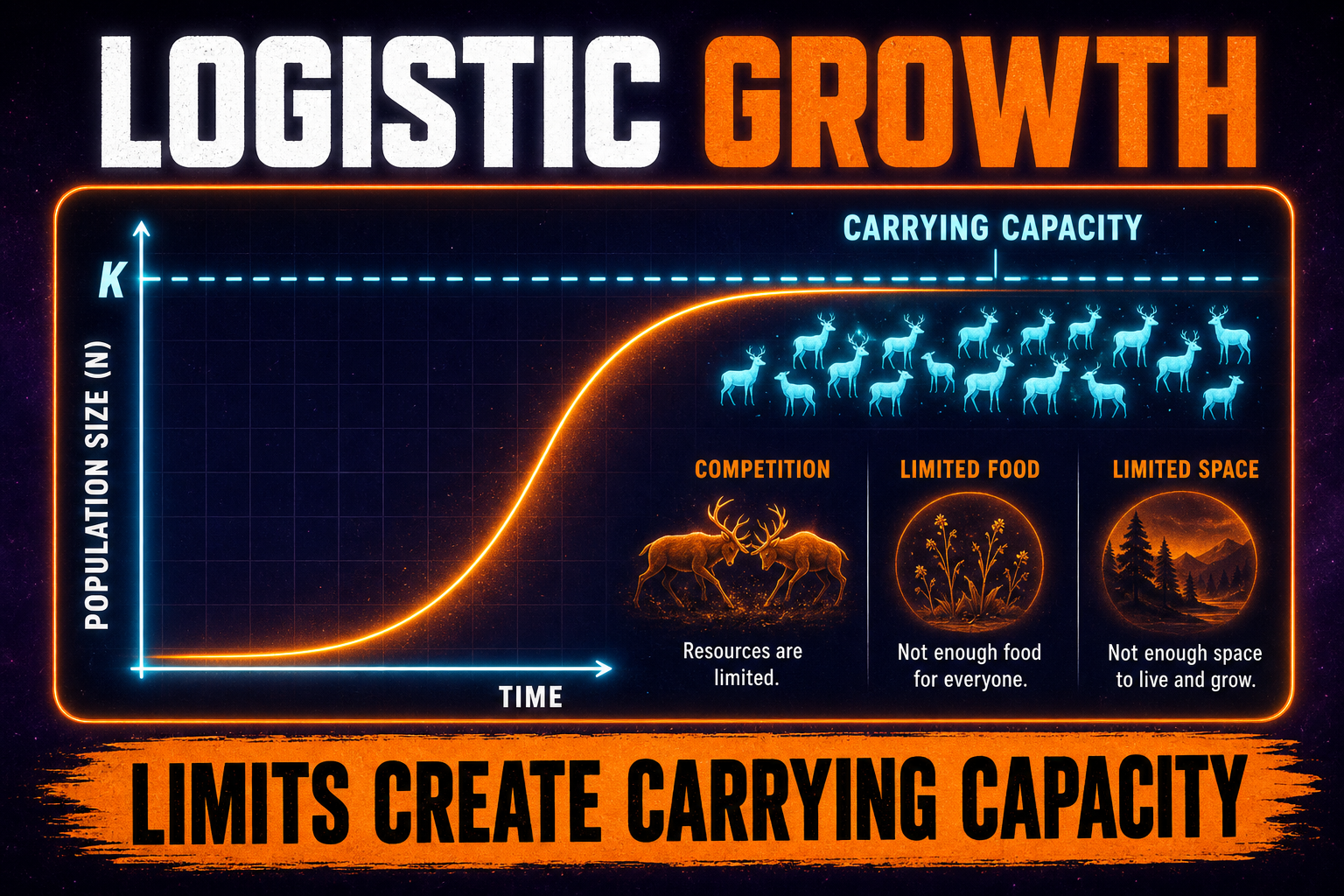
Direct answer: Carrying capacity is the maximum population size an environment can support over time.
AP trap: Carrying capacity is not fixed forever. It can change when resources or conditions change.
| Feature | Exponential Growth | Logistic Growth |
|---|---|---|
| Curve shape | J-shaped | S-shaped |
| Resource availability | Abundant | Becomes limited |
| Limiting factors | Minimal | Increase with density |
| Carrying capacity | Not reached in the model | Levels off near K |
| Long-term realism | Short-term ideal conditions | More realistic for most populations |
| AP graph clue | J-shaped = exponential | S-shaped = logistic |
| Example | Bacteria in nutrient-rich medium | Deer in a finite habitat |
Direct answer: Exponential growth is rapid J-shaped growth under ideal conditions, while logistic growth is S-shaped growth that slows near carrying capacity.
Direct answer: Environmental resistance is the combined effect of limiting factors that slow population growth.
See density-dependent and density-independent factors for the full factor breakdown.
Direct answer: Limiting factors slow population growth by reducing birth rates, increasing death rates, or causing individuals to leave.
Keep factor types concise here — the dedicated guide is density-dependent and density-independent factors.
Direct answer: Overshoot occurs when a population exceeds carrying capacity, and dieback occurs when the population declines after resources are depleted.
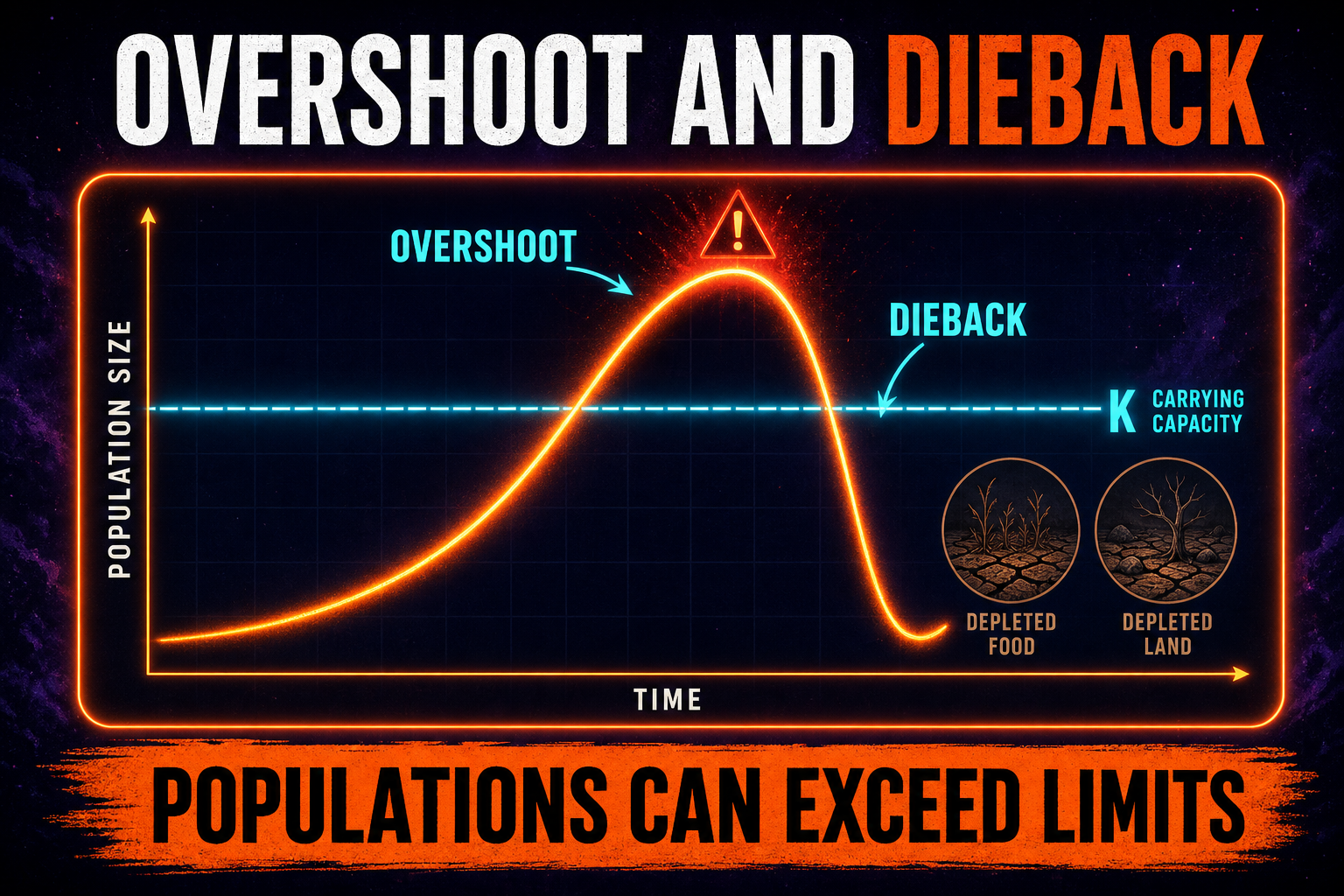
Read the axes — identify what is plotted (population size vs time).
Identify the curve shape — J-shaped, S-shaped, plateau, or decline.
Find steep growth or slowing growth along the curve.
Look for a carrying capacity line or plateau near K.
Identify overshoot or decline if the curve rises above K then drops.
Explain using resources and limiting factors, not just the shape.
AP trap: Do not describe only the graph shape. Explain the ecological reason.
Direct answer: Population growth can affect natural selection because competition for limited resources can create selection pressures.
Review natural selection and population genetics when a prompt links ecology to allele frequency change.
What to do: Identify exponential growth and abundant resources.
What to do: Identify logistic growth and carrying capacity.
What to do: Explain limiting factors and K.
What to do: Identify overshoot.
What to do: Identify dieback due to resource depletion.
What to do: Explain environmental change, resource change, or disturbance.
A population grows rapidly at first, then slows and levels off as food and space become limited. Which model best describes this pattern?
Fix: Exponential growth is J-shaped and does not level off.
Fix: Logistic growth levels off near K.
Fix: K can change when resources or conditions change.
Fix: Populations may fluctuate around carrying capacity.
Fix: Overshoot means the population exceeds carrying capacity.
Fix: Always connect growth patterns to limiting factors.
Direct answer: For population growth FRQs, identify the curve shape, describe the trend, connect the trend to resources or limiting factors, and explain what happens near carrying capacity.
More practice: Unit 8 FRQ practice and Unit 8 practice questions.
A deer population increases from 100 to 850 individuals over several years. After reaching about 900 individuals, the population fluctuates between 850 and 950 for the next decade.
Common mistake: Do not say the population stops changing completely at carrying capacity.
Every fifth card advance triggers an ad placeholder with a three-second countdown before the next card appears.
Population growth models are graphs and equations that show how population size changes over time, including exponential J-shaped growth and logistic S-shaped growth near carrying capacity.
Exponential growth is rapid population increase under ideal conditions with abundant resources, producing a J-shaped curve.
Logistic growth is population increase that starts rapidly, then slows and levels off near carrying capacity, producing an S-shaped curve.
Exponential growth continues steeply without leveling off under ideal conditions; logistic growth slows as limiting factors increase and approaches carrying capacity.
Carrying capacity is the maximum population size an environment can support over time, often represented as K.
K is the symbol for carrying capacity, the maximum sustainable population size in a given environment.
Limiting factors such as food, space, competition, disease, and predation slow growth as the population approaches carrying capacity.
Environmental resistance is the combined effect of limiting factors that slow population growth.
Limiting factors are conditions that reduce birth rates, increase death rates, or cause emigration, slowing population growth.
Overshoot occurs when a population grows beyond carrying capacity before resources become scarce.
Dieback is a population decline that follows overshoot when resources are depleted or limiting factors intensify.
Identify the curve shape, describe the trend, connect it to resources or limiting factors, and explain what happens near carrying capacity.