Identify the population
Same species, same area, same time period.
AP Biology · Unit 8 Ecology
Population ecology studies how populations are measured, distributed, and changed over time. In AP Biology Unit 8, population ecology focuses on population size, density, dispersion, births, deaths, immigration, emigration, survivorship, sampling, and how these data connect to growth models and limiting factors.
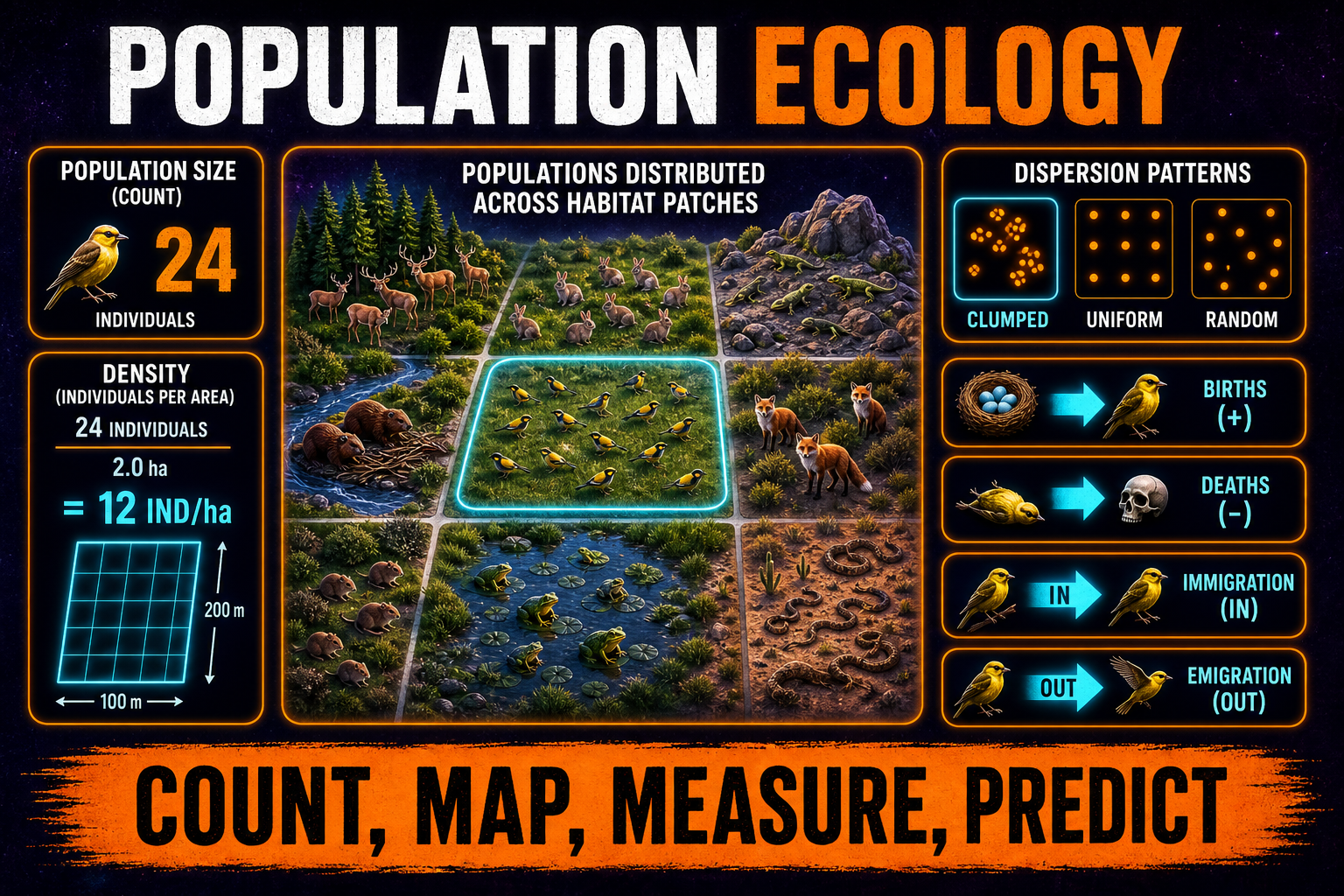
Population ecology is the study of how populations are measured, distributed, and changed over time. In AP Biology, population ecology includes population size, density, dispersion, births, deaths, immigration, emigration, sampling methods, survivorship, and population change.
Population ecology = how populations are counted, mapped, measured, and changed.
Same species, same area, same time period.
Size, density, dispersion, age structure, survivorship, or change.
Use counts, area, graph trends, or sampling results.
Density = individuals ÷ area; population change = births + immigration − deaths − emigration.
Resources, predation, disease, disturbance, or movement may explain the pattern.
Population size may increase, decrease, stabilize, or shift distribution.
Direct answer: A population is a group of individuals of the same species living in the same area at the same time.
Course context: AP Biology and Unit 8 Ecology.
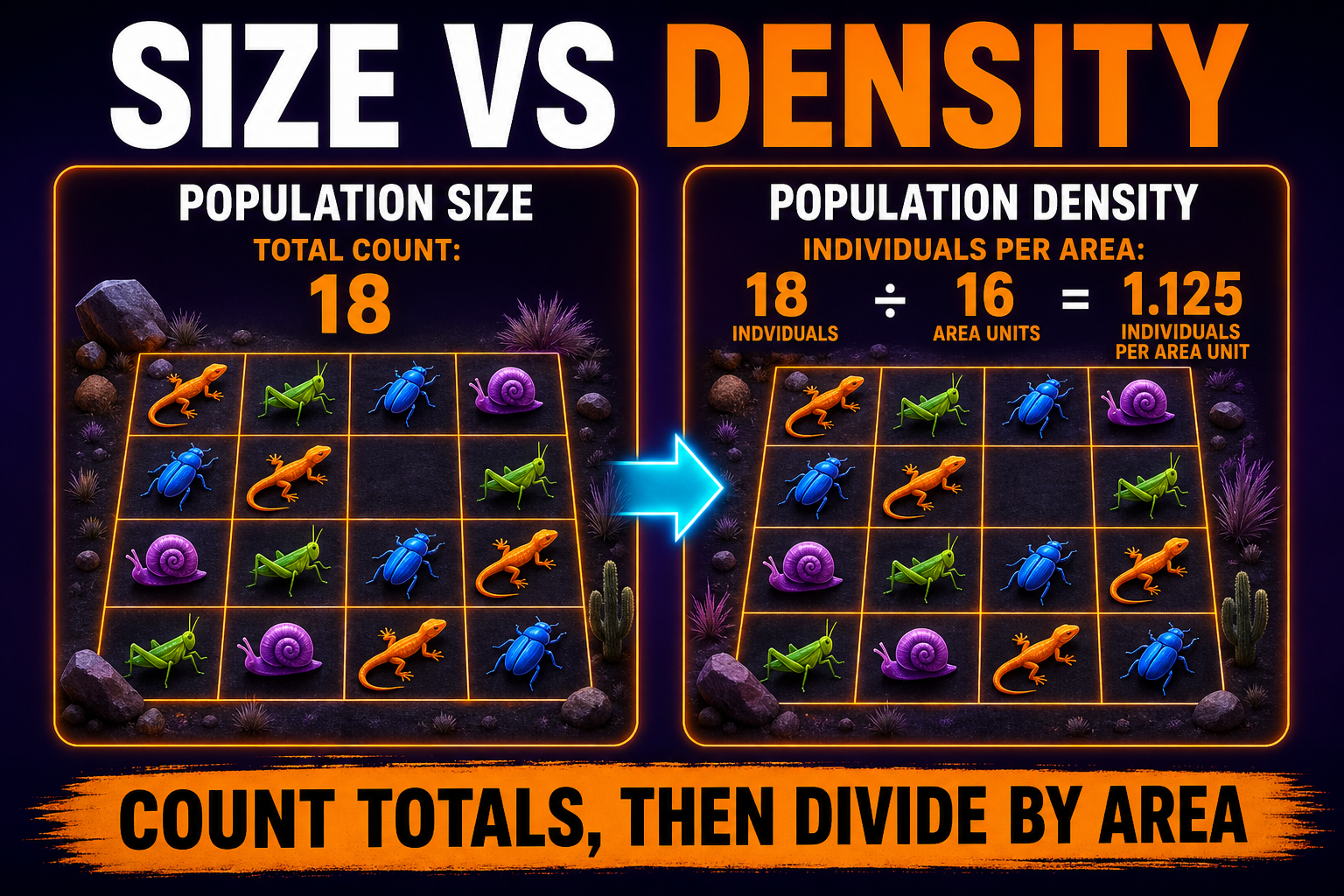
Direct answer: Population size is the total number of individuals in a population.
Direct answer: Population density is the number of individuals per unit area or volume.
Example: If 200 plants are found in 50 square meters, density = 4 plants per square meter.
Direct answer: Population size tells the total count, while population density tells how crowded the population is within a given area.
| Feature | Population Size | Population Density |
|---|---|---|
| Meaning | Total count of individuals | Individuals per unit area or volume |
| Units | Individuals (count) | Individuals per m², km², or volume |
| What it tells you | How many organisms exist | How crowded the population is |
| Example | 300 grasshoppers in a meadow | 2 grasshoppers per square meter |
| AP exam clue | Total count given | Area or volume included in the prompt |
Direct answer: Population dispersion describes how individuals are spaced within a population.
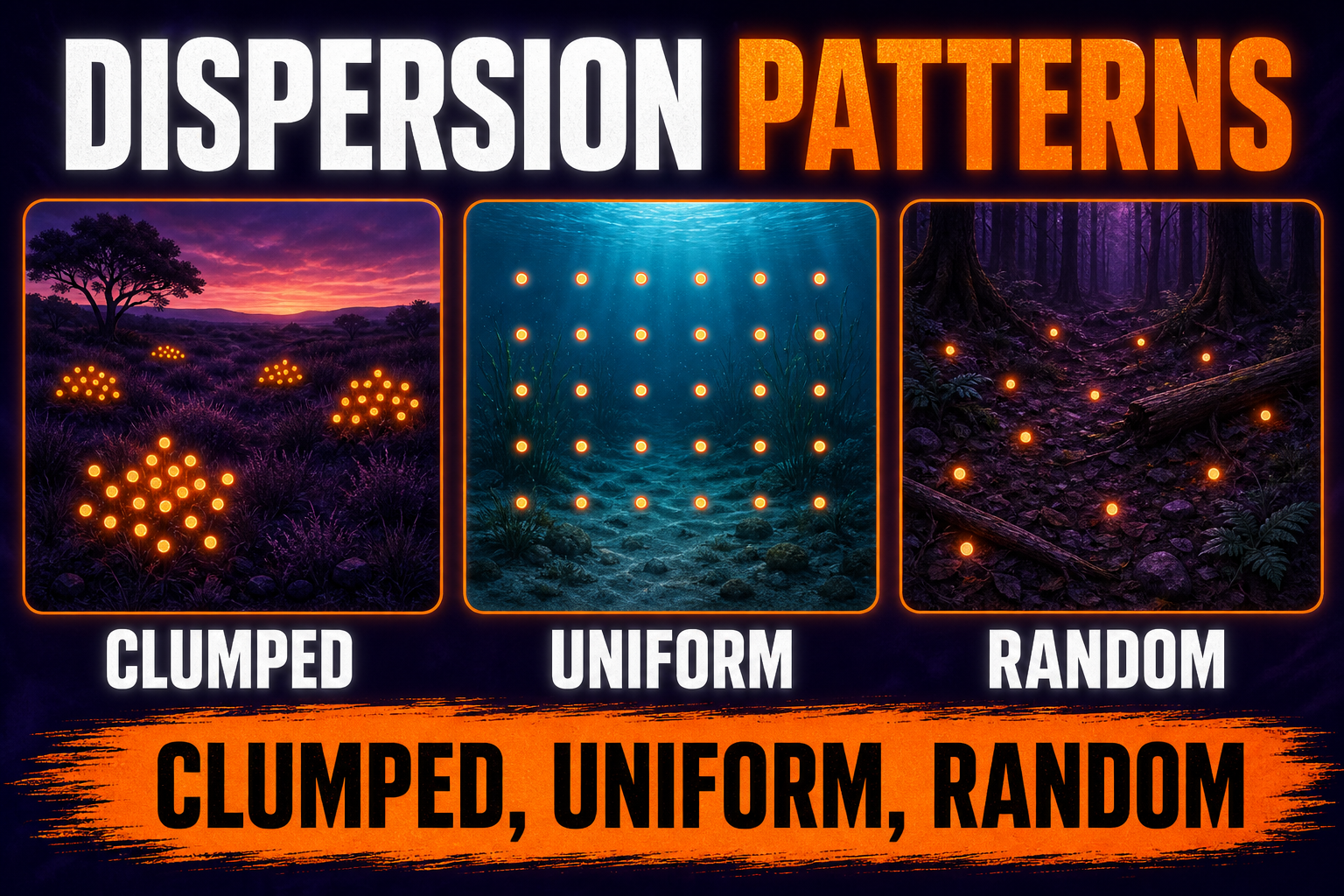
Direct answer: Clumped dispersion occurs when individuals are grouped together.
Direct answer: Uniform dispersion occurs when individuals are evenly spaced.
Direct answer: Random dispersion occurs when individuals are spaced unpredictably with no clear pattern.
Direct answer: Population size changes when individuals enter or leave the population through births, deaths, immigration, and emigration.
Worked example: A population has 120 births, 40 deaths, 30 immigrants, and 10 emigrants. Population change = 120 + 30 − 40 − 10 = +100 individuals.
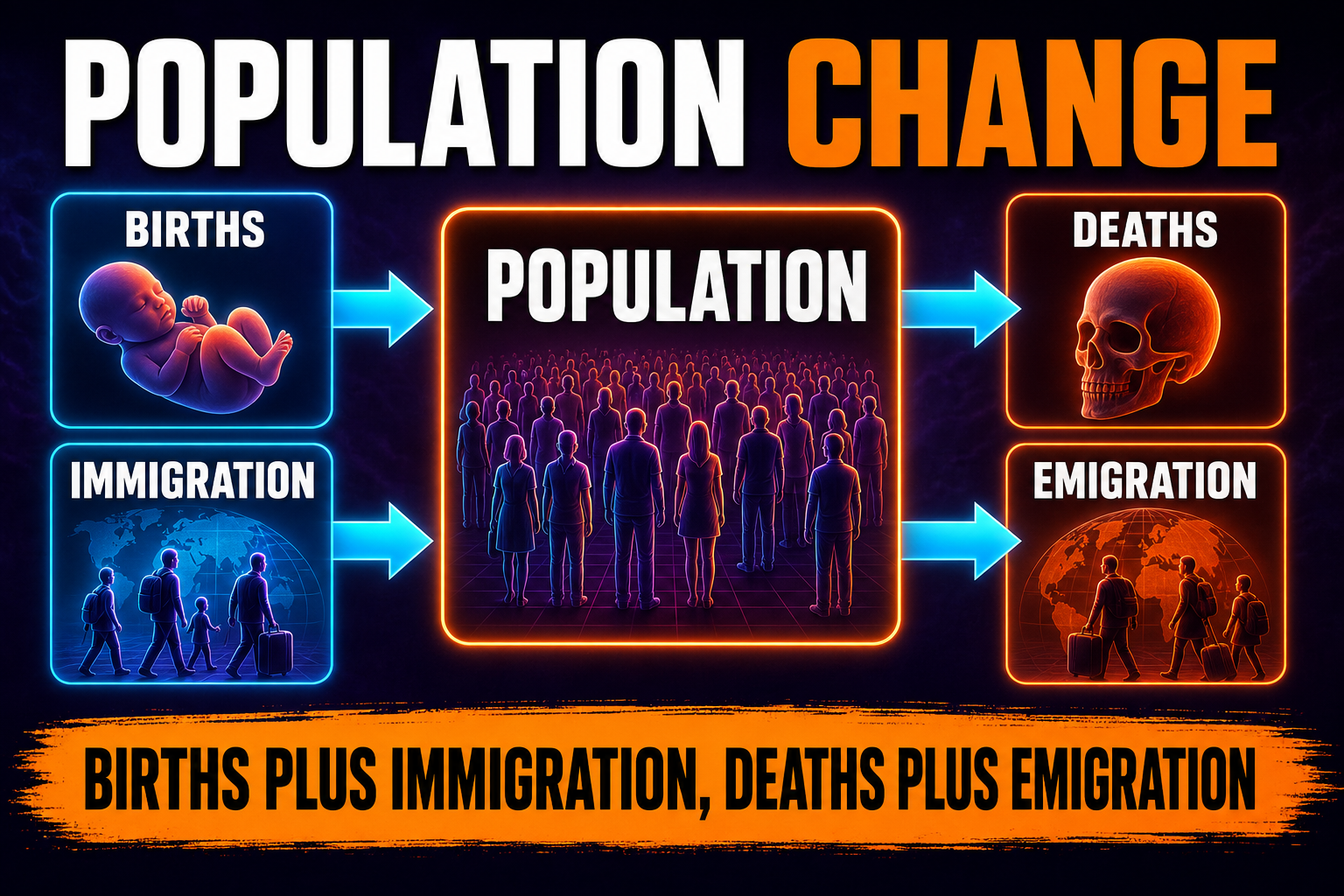
Direct answer: Birth rate increases population size, while death rate decreases population size.
Direct answer: Immigration adds individuals to a population, while emigration removes individuals from a population.
Gene flow connections appear in population genetics.
Direct answer: Ecologists sample populations because counting every individual is often impossible or impractical.
Direct answer: Mark-recapture is a sampling method used to estimate population size for mobile organisms.
Worked example: If 50 animals are marked, 40 are captured later, and 10 are recaptured marked: N = (50 × 40) ÷ 10 = 200 animals.
AP trap: Mark-recapture assumes marked individuals mix back into the population and that marks do not affect survival or recapture.
Direct answer: Age structure describes the proportion of individuals in different age groups within a population.
Direct answer: Survivorship curves show the proportion of individuals surviving at each age.
| Curve Type | Pattern | Example | AP Clue |
|---|---|---|---|
| Type I | High survival early, death later | Humans, large mammals | Parental care |
| Type II | Constant mortality rate | Some birds, reptiles | Steady risk |
| Type III | High early mortality, few survive | Fish, plants, many invertebrates | Many offspring, little care |
Direct answer: Population ecology provides the data used to model population growth over time.
Direct answer: Limiting factors affect population size, density, survival, reproduction, and distribution.
What to do: Identify population size change.
What to do: Identify population density.
What to do: Identify clumped dispersion.
What to do: Identify uniform dispersion.
What to do: Predict population increase.
What to do: Use N = (M × C) ÷ R.
A field contains 300 grasshoppers in an area of 150 square meters. What is the population density?
Fix: Size is total count; density is count per area.
Fix: Divide individuals by area or volume.
Fix: Clumped means grouped around resources or social behavior.
Fix: Immigration enters; emigration exits.
Fix: Sampling estimates population size or density.
Fix: Marked individuals must mix back into the population.
Direct answer: For population ecology FRQs, identify what is being measured, use the correct equation or data pattern, and explain how births, deaths, immigration, emigration, resources, or limiting factors affect the population.
More practice: Unit 8 FRQ practice and Unit 8 practice questions.
Researchers survey a meadow and find 240 beetles in a 60-square-meter area. The next year, the same meadow has 300 beetles. During that year, 90 beetles were born, 30 died, 20 immigrated, and 20 emigrated.
Common mistake: Do not report total population size as density. Density must include area.
Every fifth card advance triggers an ad placeholder with a three-second countdown before the next card appears.
Population ecology is the study of how populations are measured, distributed, and changed over time. AP Biology questions often use data about size, density, dispersion, births, deaths, immigration, emigration, or sampling.
A population is a group of individuals of the same species living in the same area at the same time. Ecology data questions usually measure populations, not single individuals, so population-level reasoning is essential on the exam.
Population size is the total number of individuals in a population. Size can change through births, deaths, immigration, and emigration.
Population density is the number of individuals per unit area or volume. Calculate density by dividing the number of individuals by the area or volume they occupy.
Population size is the total count of individuals, while population density describes how crowded those individuals are in a specific area. Two populations can have the same size but different densities if they occupy different amounts of space.
Dispersion patterns describe how individuals are spaced within a population. AP Biology questions may show maps, dot plots, or field data that require you to identify clumped, uniform, or random dispersion.
Clumped dispersion is a pattern where individuals are grouped together in patches. It often happens when resources are patchy or organisms gather for protection, mating, or social behavior.
Uniform dispersion is a pattern where individuals are evenly spaced across an area. It often results from territorial behavior, competition, or direct interactions that push individuals apart.
Random dispersion is a pattern where individuals have no clear spacing pattern. It can occur when resources are evenly available and individuals do not strongly attract or repel each other.
Population size changes through births, deaths, immigration, and emigration. Use the formula: population change = births + immigration − deaths − emigration.
Mark-recapture is a sampling method used to estimate the size of mobile animal populations. The method assumes marked individuals mix back into the population and that marking does not change survival or recapture probability.
First identify what the data measure, such as size, density, dispersion, survivorship, or population change. A strong FRQ answer uses the correct calculation or pattern and connects the result to births, deaths, immigration, emigration, resources, or limiting factors.