What is on the AP Biology Unit 8 FRQ practice page?
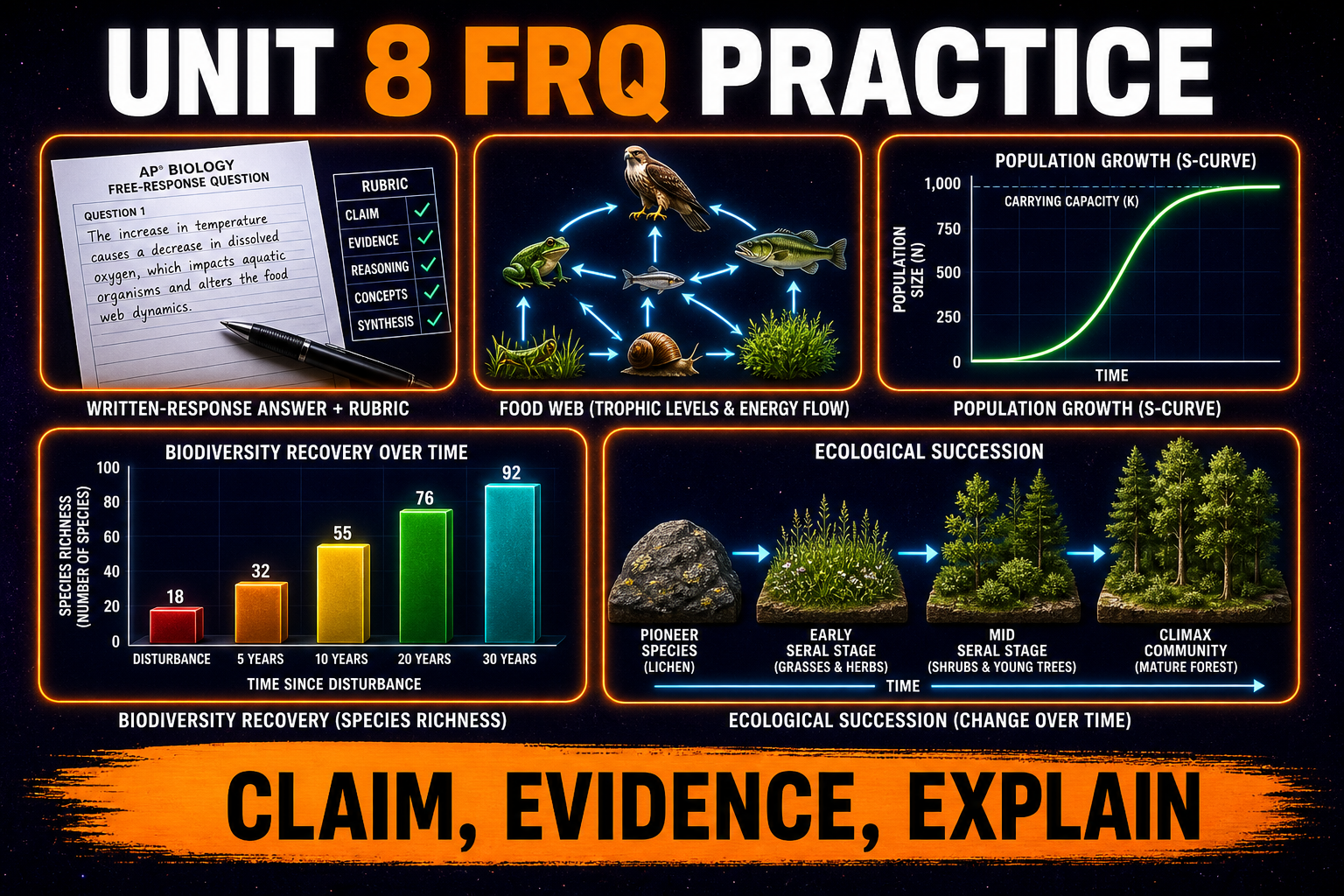
This AP Biology Unit 8 FRQ practice page gives students ecology free-response prompts with scoring rubrics, model answers, and writing strategies. The FRQs cover environmental responses, energy flow, population growth, limiting factors, species interactions, biodiversity, stability, and succession.
Say it fast
Use this page to practice writing Unit 8 ecology explanations with data, evidence, and scoring rubrics.
AP Biology Unit 8 FRQ Key Takeaways
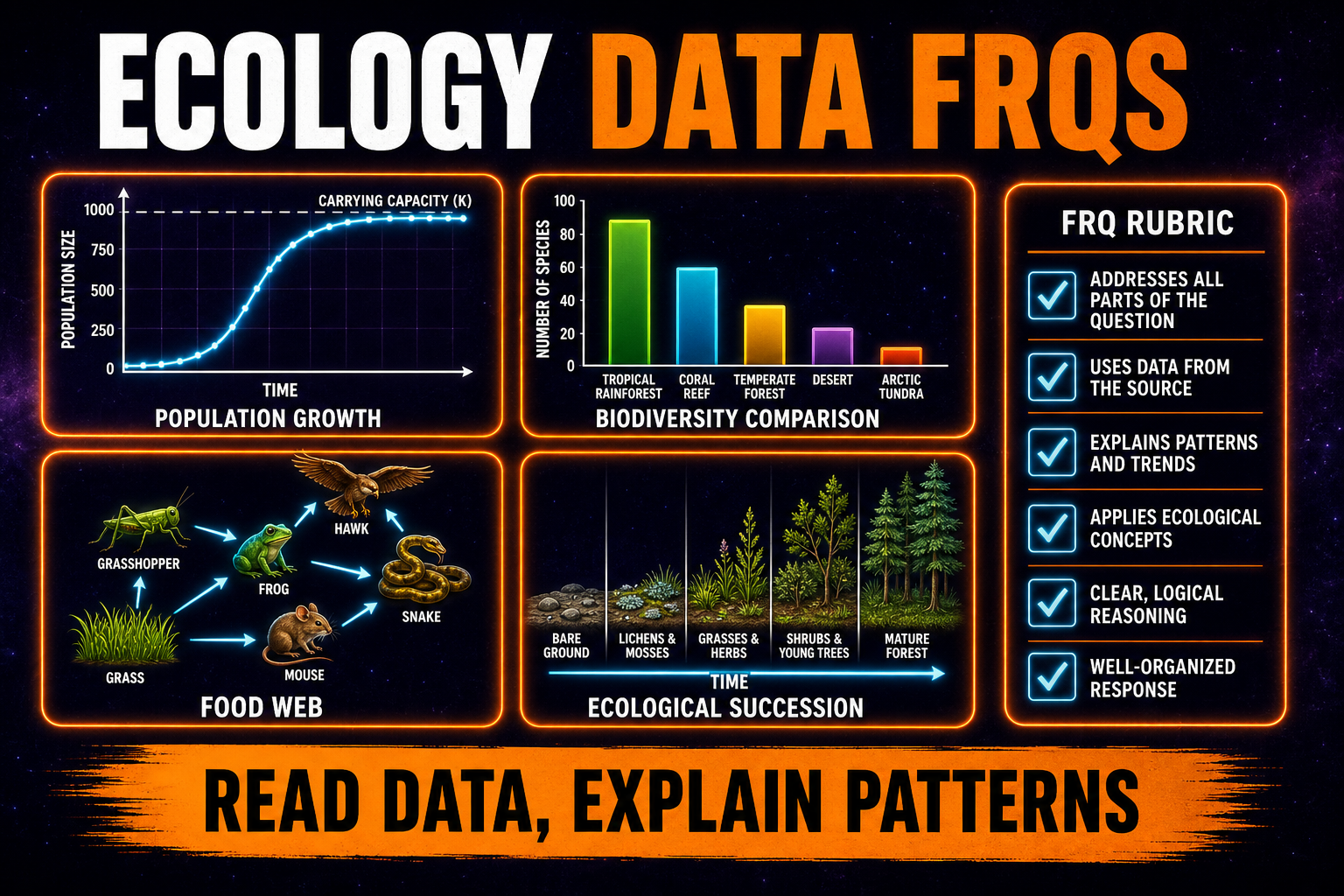
- Unit 8 FRQs often ask students to explain ecological data.
- Strong answers identify the concept, use evidence, and explain the mechanism.
- Energy flow FRQs require energy transfer and heat loss explanations.
- Population FRQs often involve density, growth curves, carrying capacity, or limiting factors.
- Community FRQs often involve food webs, species interactions, keystone species, or invasive species.
- Biodiversity and succession FRQs require explaining stability, recovery, disturbance, and community change.
Unit 8 FRQ Shortcut
- Identify the ecological level first.
- Use data from the prompt.
- Name the concept precisely.
- Explain the biological mechanism.
- Connect to survival, reproduction, population size, biodiversity, or stability.
- Do not write vague answers like "it helps the ecosystem."
AP exam clue: Every Unit 8 FRQ answer should connect evidence to an ecological cause or effect.
AP Biology Ecology FRQ Writing Ladder
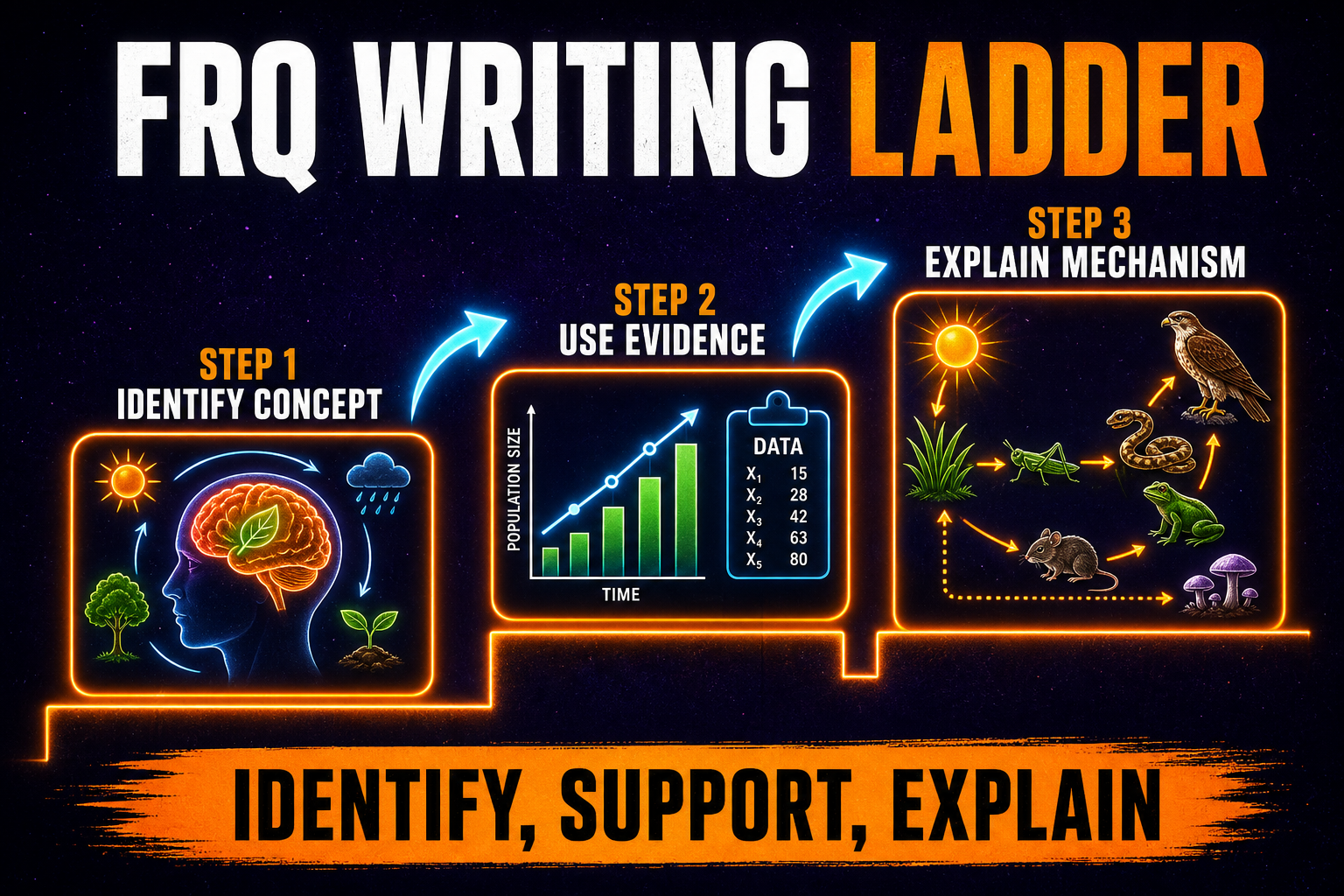
Identify the ecology concept.
Use specific evidence.
Explain the mechanism.
Connect to outcome.
Check for scoring points.
AP exam clue: "Explain" means give a cause-and-effect mechanism, not just a definition.
AP Biology FRQ Command Verbs for Unit 8
| Command Verb | What It Means | Unit 8 Example | Writing Tip |
|---|---|---|---|
| Identify | name the concept or pattern | identify logistic growth | short answer is enough |
| Describe | state what is happening | describe population trend | mention direction or pattern |
| Explain | give biological reason | explain why growth slows | include mechanism |
| Predict | state expected outcome | predict effect of removing predator | connect to food web |
| Justify | support with evidence | justify which ecosystem is more resilient | cite data |
| Calculate | use numbers | calculate density or energy transfer | show setup and units |
What Unit 8 topics appear in ecology FRQs?
| Topic | Common FRQ task | Review link |
|---|---|---|
| Responses to the Environment | explain stimulus-response benefit | Review → |
| Energy Flow | explain trophic transfer and heat loss | Review → |
| Population Ecology | calculate density or population change | Review → |
| Population Growth | interpret exponential, logistic, carrying capacity | Review → |
| Limiting Factors | classify density-dependent or independent | Review → |
| Ecological Relationships | classify interaction and explain effect | Review → |
| Community Ecology | explain keystone species, niches, food webs | Review → |
| Biodiversity and Stability | compare richness, diversity, resilience, resistance | Review → |
| Ecological Succession | distinguish primary and secondary succession | Review → |
Quick FRQ Diagnostic
Prompt
A population of rabbits grows rapidly at first, then levels off as food and space become limited.
Question: Identify the growth model and explain why the population levels off.
Student answer checklist
- Identifies logistic growth.
- Mentions carrying capacity.
- Explains limiting factors such as food or space.
- Connects limited resources to slower growth.
Model answer
The population shows logistic growth because it grows rapidly at first and then levels off. The population levels off near carrying capacity because limiting factors such as food and space reduce growth as population density increases.
AP Biology Unit 8 FRQ Practice Set
6FRQ prompts
~30Estimated points
9Ecology topics
4Self-check tools
0 of 6 FRQs started — click a prompt below to begin
FRQ 1: Energy Flow and Food Webs
Time: 12–15 min
Skills: Trophic levels, 10% rule, food web prediction
Energy Flow
FRQ 2: Population Growth and Carrying Capacity
Time: 12–15 min
Skills: Logistic growth, carrying capacity, drought effects
Population Growth
FRQ 3: Population Ecology and Limiting Factors
Time: 12–15 min
Skills: Density calculation, density-dependent disease, sampling
Population Ecology
FRQ 4: Species Interactions and Community Ecology
Time: 12–15 min
Skills: Competition, resource partitioning, coexistence
Community Ecology
FRQ 5: Biodiversity and Ecosystem Stability
Time: 12–15 min
Skills: Richness vs diversity, resilience, invasive species
Biodiversity
FRQ 6: Ecological Succession and Disturbance
Time: 12–15 min
Skills: Primary vs secondary succession, pioneer species
Succession
AP Biology Unit 8 FRQ Practice Prompts
Answer each AP Biology ecology FRQ practice prompt in your own words before opening the scoring rubric or model answer. These free-response questions cover energy flow, population growth, limiting factors, species interactions, biodiversity, and ecological succession.
Scenario
A pond ecosystem contains algae, zooplankton, small fish, large fish, and decomposers. Algae contain 20,000 kJ of energy. A disease reduces the small fish population by 60%.
- (a) Identify the producer in the pond ecosystem. ~5 points
- (b) Calculate the approximate energy available to zooplankton using the 10% rule. ~5 points
- (c) Explain why less energy is available at higher trophic levels. ~5 points
- (d) Predict one effect of the small fish decline on large fish. ~5 points
- (e) Explain the role of decomposers in this ecosystem. ~5 points
Scoring rubric
- Algae identified as producer.
- 2,000 kJ calculated for zooplankton (10% of 20,000 kJ).
- Energy loss explained through metabolism, cellular respiration, or heat.
- Large fish may decline due to reduced food availability.
- Decomposers recycle matter/nutrients; energy is lost as heat.
Model answer
- (a) Algae are the producer because they capture light energy through photosynthesis.
- (b) Using the 10% rule, zooplankton receive about 10% of 20,000 kJ, so approximately 2,000 kJ is available.
- (c) Less energy is available at higher trophic levels because organisms use most energy for metabolism and cellular respiration, releasing much of it as heat rather than transferring it to the next consumer.
- (d) Large fish may decline because they depend on small fish as a food source, and a 60% reduction in small fish reduces energy available to large fish.
- (e) Decomposers break down dead organic matter and return nutrients to the ecosystem, but energy is lost as heat and is not recycled back to producers.
Common mistake
Do not say decomposers recycle energy. They recycle matter and release energy as heat.
Self-check
Review: Energy Flow Through Ecosystems
Scenario
A deer population increases from 120 to 900 individuals over several years. After reaching about 950 individuals, the population fluctuates between 880 and 970. During a drought, the population decreases to 700.
- (a) Identify the growth model shown before the drought. ~5 points
- (b) Estimate the carrying capacity. ~5 points
- (c) Explain why the population fluctuates near carrying capacity. ~5 points
- (d) Predict how the drought affects carrying capacity. ~5 points
- (e) Explain whether drought is usually density-dependent or density-independent. ~5 points
Scoring rubric
- Logistic growth identified.
- Carrying capacity estimated around 900–950.
- Limiting factors cause fluctuation near K.
- Drought can lower carrying capacity by reducing resources.
- Drought is density-independent because it affects populations regardless of density.
Model answer
- (a) The population shows logistic growth because it increases rapidly at first and then levels off near a maximum size.
- (b) The carrying capacity is approximately 900–950 individuals, where the population stabilizes before the drought.
- (c) Near carrying capacity, limiting factors such as food, space, and competition intensify, causing birth and death rates to balance and population size to fluctuate around K.
- (d) Drought can lower carrying capacity by reducing water and food availability, so the environment supports fewer individuals.
- (e) Drought is density-independent because it affects the population regardless of how crowded it is.
Common mistake
Do not say carrying capacity is permanent. It can change when resources or conditions change.
Self-check
Review: Population Growth Models · Density-Dependent and Density-Independent Factors
Scenario
Researchers count 300 grasshoppers in a 150-square-meter field. The next year, they count 420 grasshoppers in the same field. Disease spreads more rapidly in the second year because grasshoppers are more crowded.
- (a) Calculate the population density in the first year. ~5 points
- (b) Calculate the population density in the second year. ~5 points
- (c) Explain why disease is density-dependent in this scenario. ~5 points
- (d) Predict one effect of increased disease on population growth. ~5 points
- (e) Describe one sampling method ecologists could use to estimate grasshopper density. ~5 points
Scoring rubric
- First-year density = 2 grasshoppers per square meter.
- Second-year density = 2.8 grasshoppers per square meter.
- Disease effect increases with crowding.
- Disease may increase death rate or reduce reproduction.
- Quadrat or transect sampling described appropriately.
Model answer
- (a) First-year density = 300 ÷ 150 = 2 grasshoppers per square meter.
- (b) Second-year density = 420 ÷ 150 = 2.8 grasshoppers per square meter.
- (c) Disease is density-dependent because transmission increases when individuals are more crowded, so contact rates rise as density increases.
- (d) Increased disease may raise the death rate or lower reproduction, slowing population growth.
- (e) Ecologists could use quadrat sampling by counting grasshoppers in randomly placed square plots and averaging density across the field.
Common mistake
Do not report total number as density. Density must include area or volume.
Self-check
Review: Population Ecology · Density-Dependent and Density-Independent Factors
Scenario
Two lizard species live in the same forest and eat similar insects. When both species are present, each species has lower growth and reproductive success. Over time, one species feeds mostly near the forest floor, while the other feeds mostly on higher branches.
- (a) Identify the ecological relationship between the lizard species before resource partitioning. ~5 points
- (b) Explain why the relationship affects both species negatively. ~5 points
- (c) Describe how resource partitioning may reduce competition. ~5 points
- (d) Predict how resource partitioning could affect long-term coexistence. ~5 points
- (e) Explain why this is a community ecology scenario. ~5 points
Scoring rubric
- Competition identified.
- Both species use same limited resource.
- Resource partitioning reduces niche overlap.
- Coexistence may increase because competition decreases.
- Scenario involves multiple species interacting in same community.
Model answer
- (a) The relationship is competition because both lizard species use the same limited food resource.
- (b) Both species are negatively affected because they reduce each other's access to insects, lowering growth and reproductive success.
- (c) Resource partitioning reduces competition when each species uses a different part of the habitat, such as forest floor versus higher branches, decreasing niche overlap.
- (d) Long-term coexistence may increase because reduced competition allows both species to persist in the same community.
- (e) This is community ecology because it involves interactions among multiple species living in the same area.
Common mistake
Do not call this mutualism just because both species live in the same habitat.
Self-check
Review: Ecological Relationships · Community Ecology
Scenario
Researchers compare two grassland ecosystems after a drought. Ecosystem A contains 18 plant species with similar abundance. Ecosystem B contains 18 plant species, but one grass species makes up 80% of all individuals. After drought, Ecosystem A returns to its original biomass within two years, while Ecosystem B remains below its original biomass.
- (a) Identify which ecosystem has higher species diversity. ~5 points
- (b) Explain why the ecosystems do not have the same species diversity even though they have the same species richness. ~5 points
- (c) Identify which ecosystem shows greater resilience. ~5 points
- (d) Explain how biodiversity may contribute to recovery after disturbance. ~5 points
- (e) Predict how an invasive species could affect stability. ~5 points
Scoring rubric
- Ecosystem A has higher species diversity.
- A has greater evenness despite same richness.
- A shows greater resilience.
- Biodiversity supports redundancy/alternative roles/recovery.
- Invasive species may reduce native biodiversity and stability.
Model answer
- (a) Ecosystem A has higher species diversity because species abundances are more even.
- (b) Both ecosystems have the same species richness (18 species), but Ecosystem B has low evenness because one species dominates, lowering overall diversity.
- (c) Ecosystem A shows greater resilience because it recovered to its original biomass within two years after drought.
- (d) Higher biodiversity can increase recovery because multiple species may perform similar roles, so the community can function even if some species decline.
- (e) An invasive species could outcompete natives, reduce biodiversity, and lower ecosystem stability and recovery speed.
Common mistake
Do not say the ecosystems have the same diversity just because they have the same number of species.
Self-check
Scenario
Two sites are studied after disturbance. Site A is a cooled lava field with no soil. Site B is a burned forest where soil, roots, and some seeds remain.
- (a) Identify the type of succession occurring at Site A. ~5 points
- (b) Identify the type of succession occurring at Site B. ~5 points
- (c) Explain why succession is likely faster at Site B. ~5 points
- (d) Describe one role pioneer species may play at Site A. ~5 points
- (e) Explain how succession can change biodiversity over time. ~5 points
Scoring rubric
- Site A = primary succession.
- Site B = secondary succession.
- Site B is faster because soil, roots, seeds, and microbes remain.
- Pioneer species help form soil or change habitat conditions.
- Biodiversity may increase as more species colonize and niches develop.
Model answer
- (a) Site A shows primary succession because there is no soil after the lava flow.
- (b) Site B shows secondary succession because soil, roots, and seeds remain after the fire.
- (c) Succession is faster at Site B because existing soil, organic matter, roots, seeds, and soil microbes allow faster colonization and growth.
- (d) Pioneer species at Site A may break down rock, add organic matter, or retain moisture, helping form soil for later species.
- (e) As succession proceeds, more species colonize, niches develop, and community composition changes, often increasing biodiversity over time.
Common mistake
Do not classify Site B as primary succession just because a fire occurred.
Self-check
Review: Ecological Succession
How to Score Your Unit 8 FRQ Answers
- Did I answer the exact command verb?
- Did I identify the correct ecology concept?
- Did I use evidence from the prompt?
- Did I include a biological mechanism?
- Did I connect to population size, survival, reproduction, biodiversity, stability, or recovery?
- Did I avoid vague phrases like "it helps the ecosystem"?
- Did I include units for calculations?
- Did I distinguish energy flow from matter cycling?
- Did I distinguish primary from secondary succession using soil?
Common AP Biology Unit 8 FRQ Mistakes
Mistake: Naming the concept without explanation.
Fix: Add a mechanism and outcome.
Mistake: Ignoring data in the prompt.
Fix: Use a number, trend, graph shape, or species detail.
Mistake: Saying energy cycles.
Fix: Energy flows and matter cycles.
Mistake: Confusing density-dependent and density-independent.
Fix: Ask whether crowding changes the effect.
Mistake: Confusing species richness and diversity.
Fix: Diversity includes richness and evenness.
Mistake: Confusing primary and secondary succession.
Fix: Use the soil test.
Mistake: Writing too generally about stability.
Fix: Use resistance, resilience, redundancy, or recovery.
AP Biology Unit 8 FRQ Sentence Starters
Energy flow
"Energy decreases at higher trophic levels because…"
Population growth
"The population shows logistic growth because…"
Limiting factors
"This factor is density-dependent because…"
Species interactions
"This relationship is classified as ____ because species 1 ____ and species 2 ____."
Biodiversity
"This ecosystem has higher species diversity because…"
Succession
"This is primary/secondary succession because…"
Data justification
"The data support this claim because…"
Review Before Retrying FRQs
Responses to the Environment
FRQs often ask how stimulus-response behaviors improve survival or reproduction.
Energy Flow Through Ecosystems
Review trophic levels and why energy decreases at higher levels.
Population Ecology
Practice density calculations and population change reasoning.
Population Growth Models
Master exponential vs logistic curves and carrying capacity.
Density-Dependent and Density-Independent Factors
Learn when crowding changes the strength of a limiting factor.
Ecological Relationships
Classify interactions and explain effects on each species.
Community Ecology
Review food webs, keystone species, and niche concepts.
Biodiversity and Ecosystem Stability
Connect richness, evenness, resilience, and resistance.
Ecological Succession
Use the soil test for primary vs secondary succession.
Unit 8 Practice Questions
Build fast recognition before longer FRQ explanations.
Ready for Mixed Unit 8 Practice?
Students should move between MCQs and FRQs to strengthen both recognition and explanation. Use daily practice, practice by course, or practice by topic for mixed review.
AP Biology Unit 8 FRQ Practice FAQ
What topics are on AP Biology Unit 8 FRQs?
Unit 8 FRQs commonly test environmental responses, energy flow, population ecology, population growth, limiting factors, species interactions, community ecology, biodiversity, ecosystem stability, and ecological succession. Exam prompts often combine vocabulary with graphs, food webs, or ecological scenarios that require mechanism-based explanations.
How should I write AP Biology ecology FRQ answers?
Identify the ecological concept first, cite specific evidence from the prompt, and explain the biological mechanism that connects them. Strong answers explain cause and effect rather than listing terms without showing how population size, energy flow, biodiversity, or community structure changes.
Are Unit 8 FRQs mostly graphs and data?
Many Unit 8 FRQs include graphs, tables, food webs, or population scenarios, but you must still explain biological mechanisms behind the patterns. Reading the trend is only the first step; scoring points require connecting data to ecology concepts like carrying capacity, trophic transfer, or succession type.
What is the best strategy for ecology FRQs?
Read every command verb carefully, name the ecology level you are discussing, and write one clear mechanism for each part of the prompt. Self-score with the rubric before moving to the next FRQ so you catch missing evidence or vague explanations early.
How do I explain energy flow on an FRQ?
State that energy decreases at higher trophic levels because only about 10% of energy transfers between levels while the rest is lost as heat through metabolism. Decomposers recycle matter but do not recycle usable energy back to producers.
How do I explain population growth on an FRQ?
Identify whether the curve shows exponential or logistic growth based on shape and context. Explain that logistic populations level off near carrying capacity because limiting factors such as food, space, or competition reduce growth as density increases.
How do I explain density-dependent factors on an FRQ?
A factor is density-dependent when its effect becomes stronger as population density increases, such as disease spreading faster in crowded populations. Contrast this with density-independent factors like drought or storms that can affect populations regardless of density.
How do I explain species interactions on an FRQ?
Classify the interaction by its effect on each species (+/+, +/−, −/−, or 0) and explain how shared or limited resources drive the outcome. Resource partitioning can reduce competition and allow coexistence when species use different niches.
How do I explain biodiversity and stability on an FRQ?
Species diversity includes both richness and evenness, so two communities with the same number of species can differ in stability. Higher diversity often increases resilience because multiple species can perform overlapping roles if one species declines after disturbance.
How do I explain ecological succession on an FRQ?
Use the soil test: primary succession starts without soil, while secondary succession begins when soil, roots, seeds, or microbes remain after disturbance. Pioneer species alter conditions so later species can colonize and biodiversity may increase over time.
Should I practice MCQs before FRQs?
Yes—Unit 8 MCQs build fast recognition of ecology vocabulary and graph patterns, while FRQs test whether you can explain mechanisms with evidence. Alternating between both formats usually improves exam-day confidence.
How do I self-score AP Biology Unit 8 FRQs?
Compare each part of your answer to the rubric and check whether you identified the concept, used prompt evidence, explained a mechanism, and avoided vague phrases. Rewrite any section that names a term without connecting it to population change, energy flow, biodiversity, or stability.