Linked genes
Genes close together on a chromosome may be inherited together.
AP Biology · Unit 5 Heredity
A dihybrid cross tracks two genes at the same time. In AP Biology Unit 5, dihybrid crosses connect Punnett square logic with independent assortment. The classic cross is AaBb × AaBb, which produces four gamete types from each parent and a 9:3:3:1 phenotype ratio when both genes assort independently and show complete dominance.
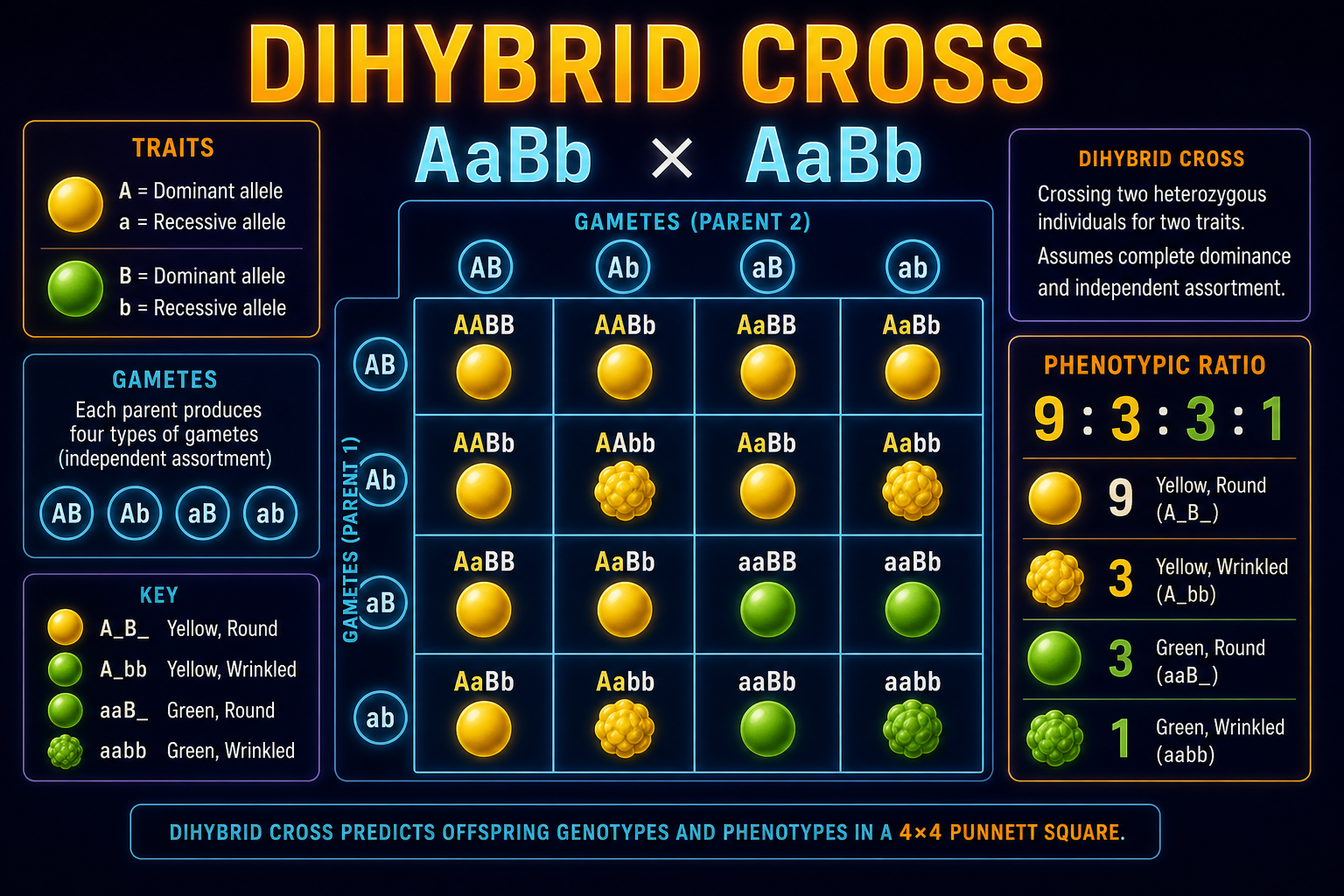
A dihybrid cross is a genetics cross that tracks two genes at the same time. In the classic AaBb × AaBb cross, each parent can make four gametes: AB, Ab, aB, and ab. If both genes assort independently and show complete dominance, the expected phenotype ratio is 9:3:3:1.
Dihybrid means two genes, four gametes, sixteen boxes.
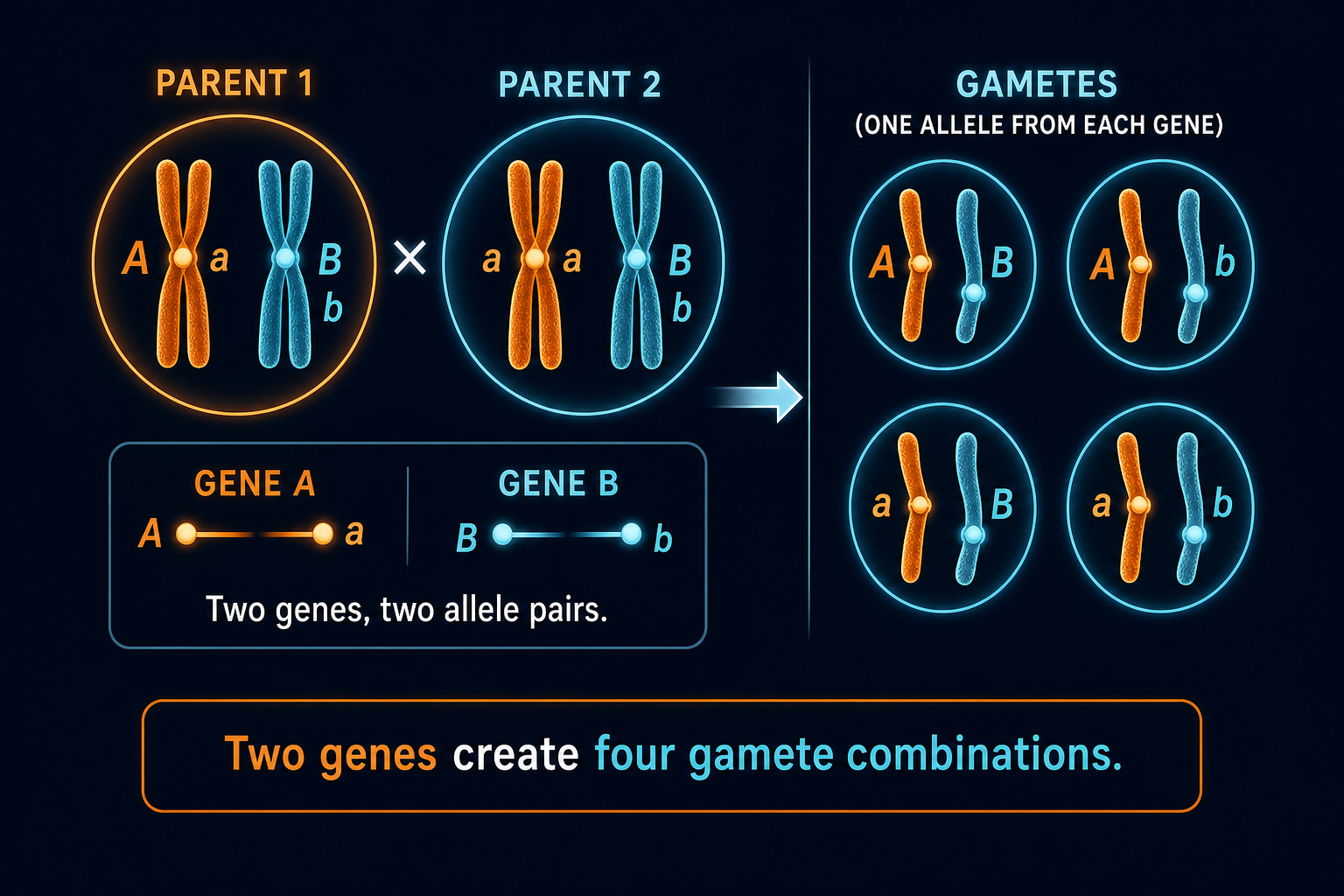
A dihybrid cross follows two genes at the same time. For example, AaBb includes one gene represented by A/a and another gene represented by B/b. Each gamete must receive one allele from the A gene and one allele from the B gene.
Review Monohybrid Crosses for one-gene crosses and 3:1 ratios. For general square setup, see Punnett Squares.
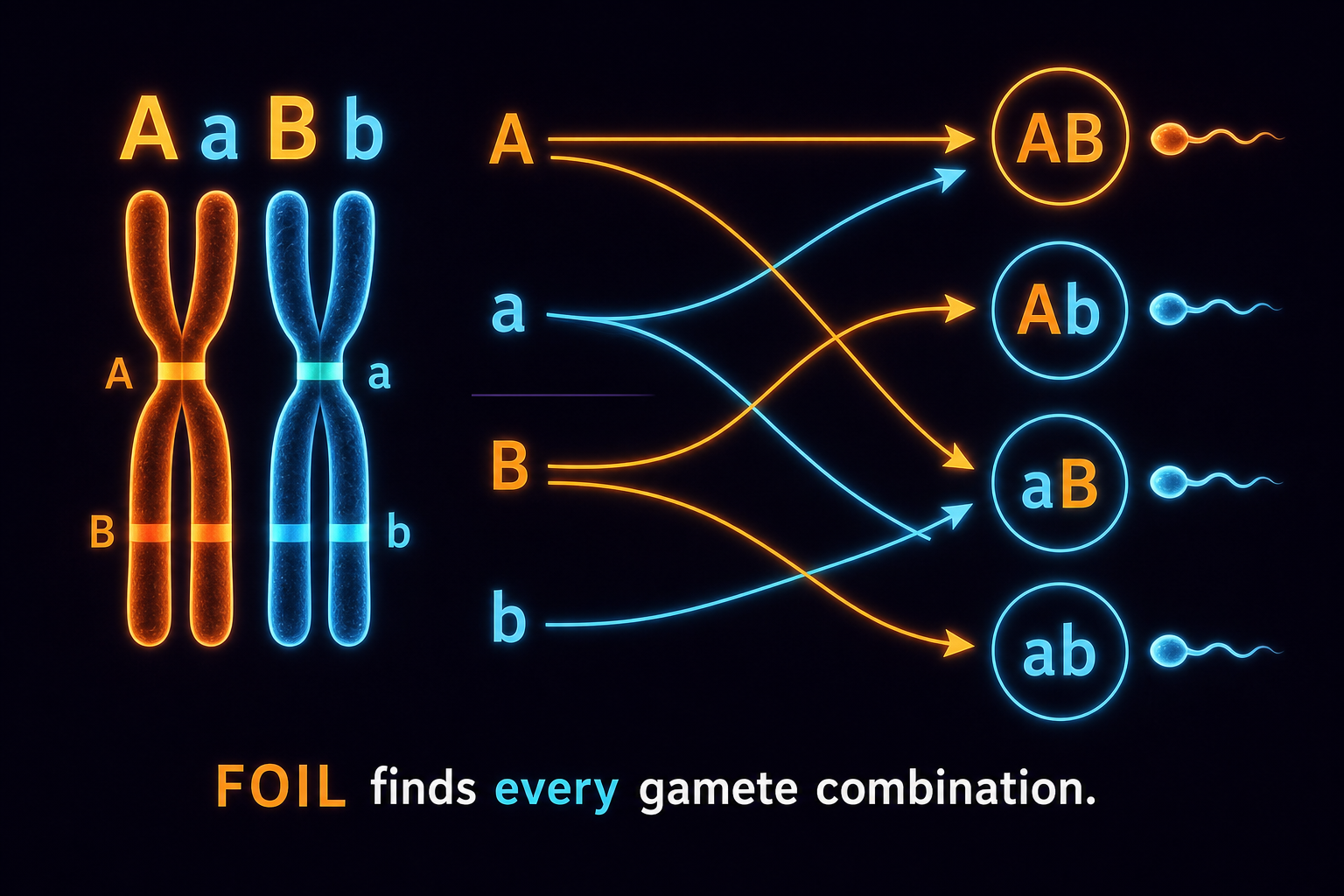
The hardest part of a dihybrid cross is often finding the gametes. For AaBb, use FOIL to combine one allele from each gene.
Result: AaBb can produce AB, Ab, aB, and ab gametes.
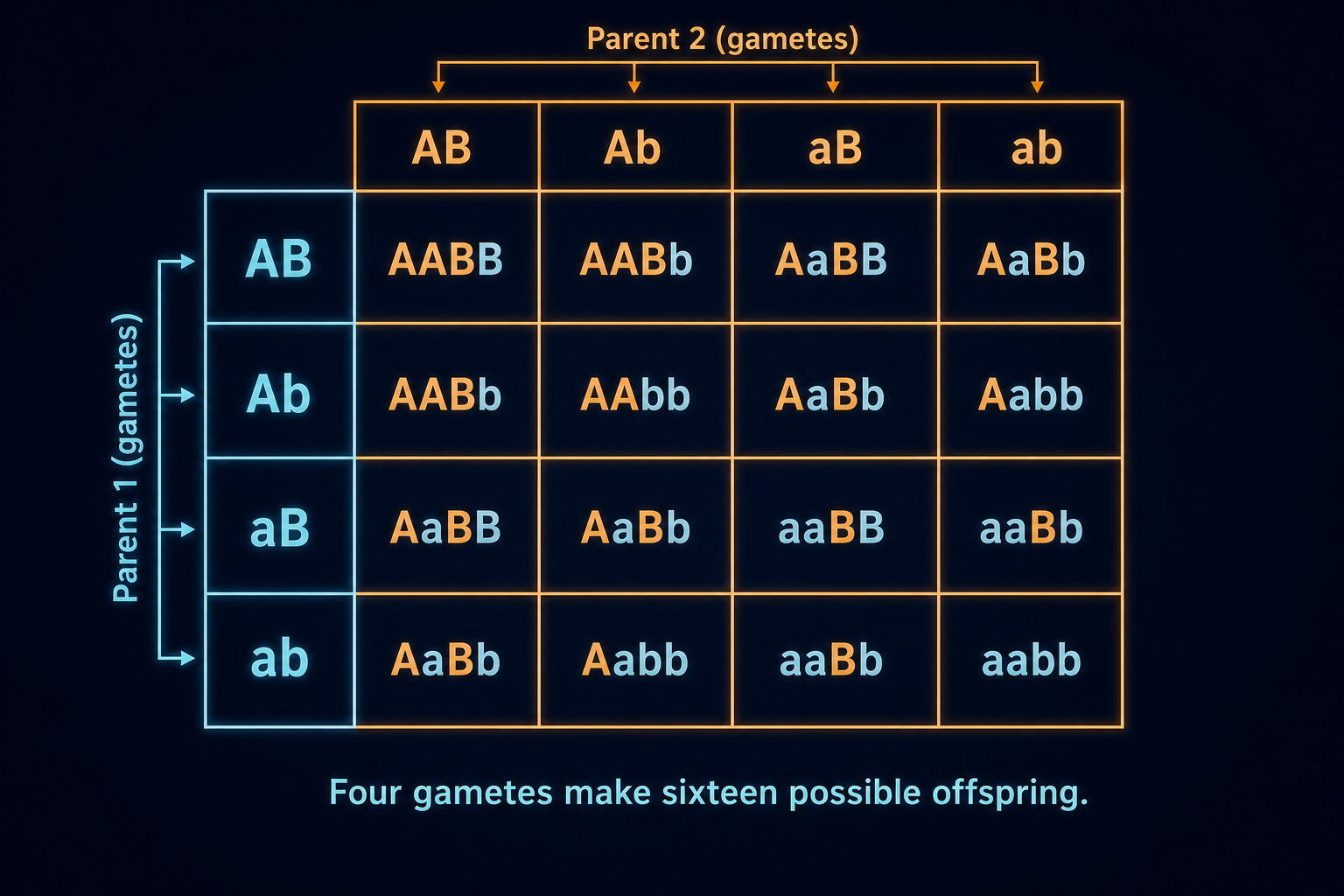
Because each AaBb parent can make four gametes, the Punnett square has four gametes across the top and four along the side. That creates 16 possible offspring genotype boxes.
| Parent gametes | AB | Ab | aB | ab |
|---|---|---|---|---|
| AB | AABB | AABb | AaBB | AaBb |
| Ab | AABb | AAbb | AaBb | Aabb |
| aB | AaBB | AaBb | aaBB | aaBb |
| ab | AaBb | Aabb | aaBb | aabb |
Under complete dominance and independent assortment, AaBb × AaBb produces four phenotype categories.
Notation: The underscore means the second allele can be either dominant or recessive.
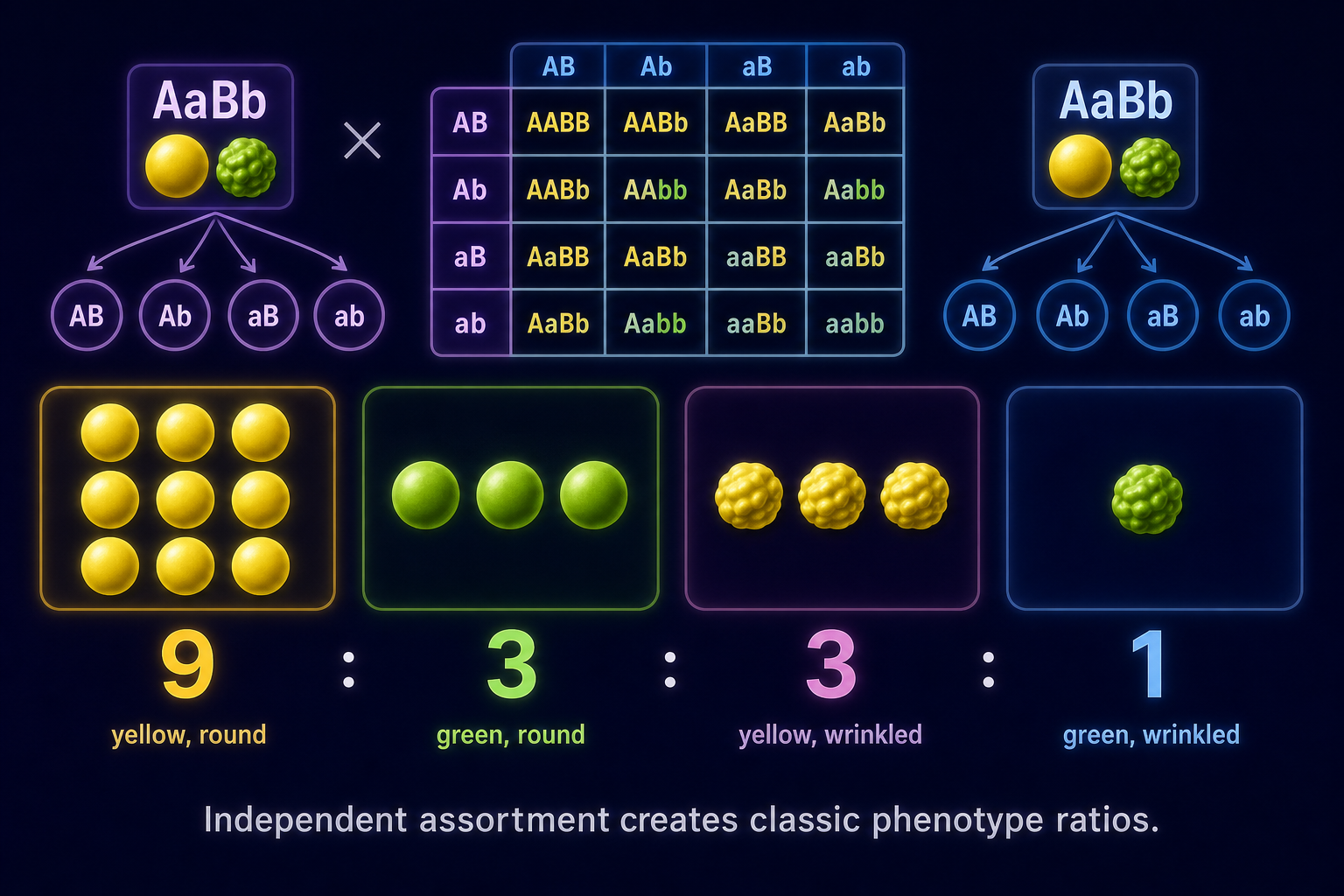
Dihybrid crosses depend on independent assortment. During meiosis I, homologous chromosome pairs line up randomly, which allows alleles of different genes to enter gametes in different combinations. If the genes are linked, the classic 9:3:3:1 ratio may not appear.
Review Independent Assortment for the full meiosis explanation. During meiosis, gametes receive one allele per gene, which makes FOIL gamete listing possible.
You do not always need to draw a full 4×4 square. You can solve each gene separately and multiply probabilities.
Example: For AaBb × AaBb:
Other probabilities:
| Feature | Monohybrid Cross | Dihybrid Cross |
|---|---|---|
| Genes tracked | One gene | Two genes |
| Example | Aa × Aa | AaBb × AaBb |
| Gametes per heterozygous parent | A or a | AB, Ab, aB, ab |
| Punnett square | 2×2 | 4×4 |
| Classic phenotype ratio | 3:1 | 9:3:3:1 |
| AP clue | One trait | Two traits |
See Monohybrid Crosses for one-gene practice and Mendelian Genetics for allele rules behind both cross types.
The classic 9:3:3:1 ratio depends on independent assortment and complete dominance. The ratio can change if genes are linked, traits are non-Mendelian, sample size is small, or observed data differ from expected data.
Genes close together on a chromosome may be inherited together.
Incomplete dominance, codominance, or multiple alleles can change phenotype categories.
Observed counts may not perfectly match expected ratios.
Used to test whether observed data fit expected ratios.
→ dihybrid cross
→ find four gametes
→ 9:3:3:1 under complete dominance
→ AB, Ab, aB, ab
→ 16 boxes
→ genes sort into gametes separately
→ expected ratio may change
→ chi-square may be needed
→ multiply independent probabilities
Fix: Each gamete gets one allele from each gene, such as AB or Ab, not Aa or Bb.
Fix: AaBb produces AB, Ab, aB, and ab.
Fix: A full AaBb × AaBb dihybrid Punnett square is 4×4.
Fix: It only applies with independent assortment and complete dominance.
Fix: 9:3:3:1 is a phenotype ratio, not a full genotype ratio.
Fix: Linked genes may not assort independently, so expected ratios can change.
Fix: For independent genes, calculate each gene separately and multiply.
Revealed: 0 of 5 scenarios
The prompt tracks seed shape and seed color.
Reveal: This is a dihybrid cross because two traits are tracked.
The genotype is AaBb.
Reveal: Possible gametes are AB, Ab, aB, and ab.
The cross is AaBb × AaBb with independent assortment and complete dominance.
Reveal: Expected phenotype ratio is 9:3:3:1.
A student writes Aa and Bb as gametes.
Reveal: Incorrect. Gametes should carry one allele from each gene, such as AB or ab.
Observed offspring do not fit 9:3:3:1.
Reveal: Possible explanations include linked genes, non-Mendelian inheritance, small sample size, or chance variation tested with chi-square.
Answer all eight questions. Choices shuffle on reload.
More drills: Unit 5 practice questions or genetic variation.
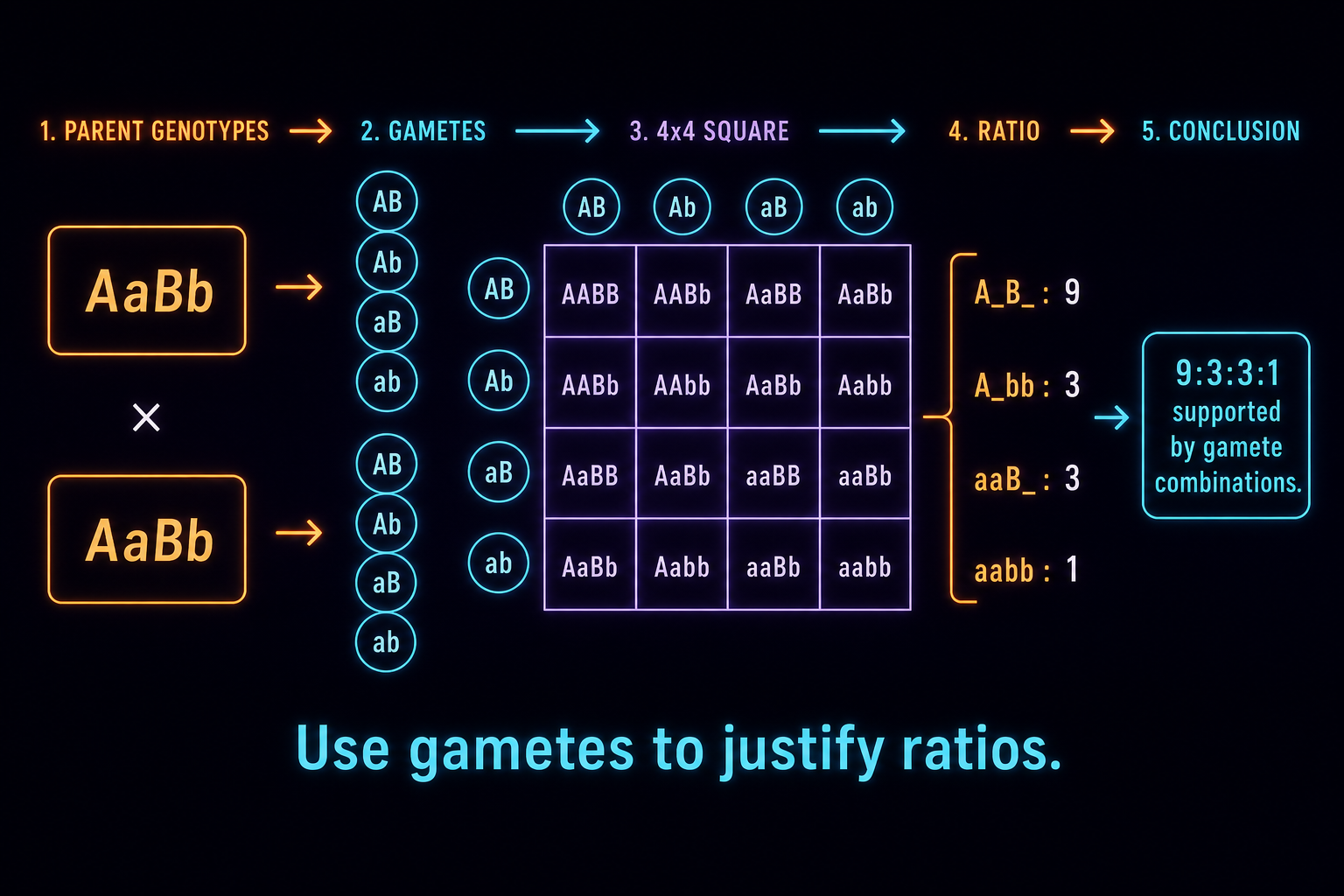
Open each card, draft your response, then reveal the rubric and sample answer.
Two organisms with genotype AaBb are crossed. The genes assort independently and both traits show complete dominance. Identify the possible gametes from each parent and predict the expected phenotype ratio.
Each AaBb parent can produce four gamete types: AB, Ab, aB, and ab. These gametes form because each gamete receives one allele from the A gene and one allele from the B gene. Since the genes assort independently and both traits show complete dominance, a 4×4 Punnett square produces a 9:3:3:1 phenotype ratio. The largest category shows both dominant phenotypes, while the smallest category shows both recessive phenotypes.
Status: Draft your answer first—then open the rubric or sample.
A student expects a 9:3:3:1 ratio from a dihybrid cross, but the observed offspring counts do not fit the expected ratio well. Give two biological or statistical explanations and describe how the student could test whether the difference is significant.
One explanation is that the genes may be linked, so they do not assort independently and the 9:3:3:1 ratio would not be expected. Another explanation is that the traits may not follow complete dominance, which could change the phenotype categories. Chance variation or small sample size could also affect observed counts. The student could use a chi-square test to compare observed counts with expected 9:3:3:1 counts and determine whether the difference is statistically significant.
Status: Draft your answer first—then open the rubric or sample.
A dihybrid cross is a genetics cross that tracks two genes at the same time. In the classic AaBb × AaBb cross, each parent can make four gametes: AB, Ab, aB, and ab. If both genes assort independently and show complete dominance, the expected phenotype ratio is 9:3:3:1.
Dihybrid means two genes. In AP Biology, a dihybrid cross follows two allele pairs at once, such as A/a and B/b in genotype AaBb.
Identify parent genotypes, list gametes from each parent using FOIL for heterozygotes, fill a 4×4 Punnett square, count genotype combinations, and convert to phenotype ratios under complete dominance.
AaBb produces four gamete types: AB, Ab, aB, and ab. Each gamete carries one allele from the A gene and one allele from the B gene.
Under complete dominance and independent assortment, AaBb × AaBb produces a 9:3:3:1 phenotype ratio.
Independent assortment creates four gamete combinations from each parent. When combined in a 4×4 square, complete dominance groups offspring into four phenotype categories with probabilities 9/16, 3/16, 3/16, and 1/16.
FOIL helps find all gamete combinations from AaBb: First (AB), Outer (Ab), Inner (aB), and Last (ab). It ensures you list every possible one-allele-from-each-gene combination.
A monohybrid cross tracks one gene and often uses a 2×2 square with a 3:1 phenotype ratio. A dihybrid cross tracks two genes and often uses a 4×4 square with a 9:3:3:1 phenotype ratio.
The 9:3:3:1 ratio applies when both genes assort independently and both traits follow complete dominance.
Linked genes, non-Mendelian inheritance, small sample size, or chance variation can cause observed ratios to differ from 9:3:3:1.
Independent assortment allows alleles of different genes to enter gametes in different combinations during meiosis I. That is why AaBb can produce AB, Ab, aB, and ab gametes.
Identify parent genotypes, list gametes, explain independent assortment if relevant, predict the phenotype ratio, and connect gamete logic to the ratio. If observed data differ, mention linked genes, non-Mendelian patterns, or chi-square testing.