Identify affected individuals.
Look for shaded symbols first.
AP Biology · Unit 5 Heredity
Pedigrees are family-tree diagrams that show how traits pass through generations. In AP Biology Unit 5, pedigree questions ask you to identify inheritance patterns, infer genotypes, find carriers, and support a claim using evidence from affected and unaffected family members.
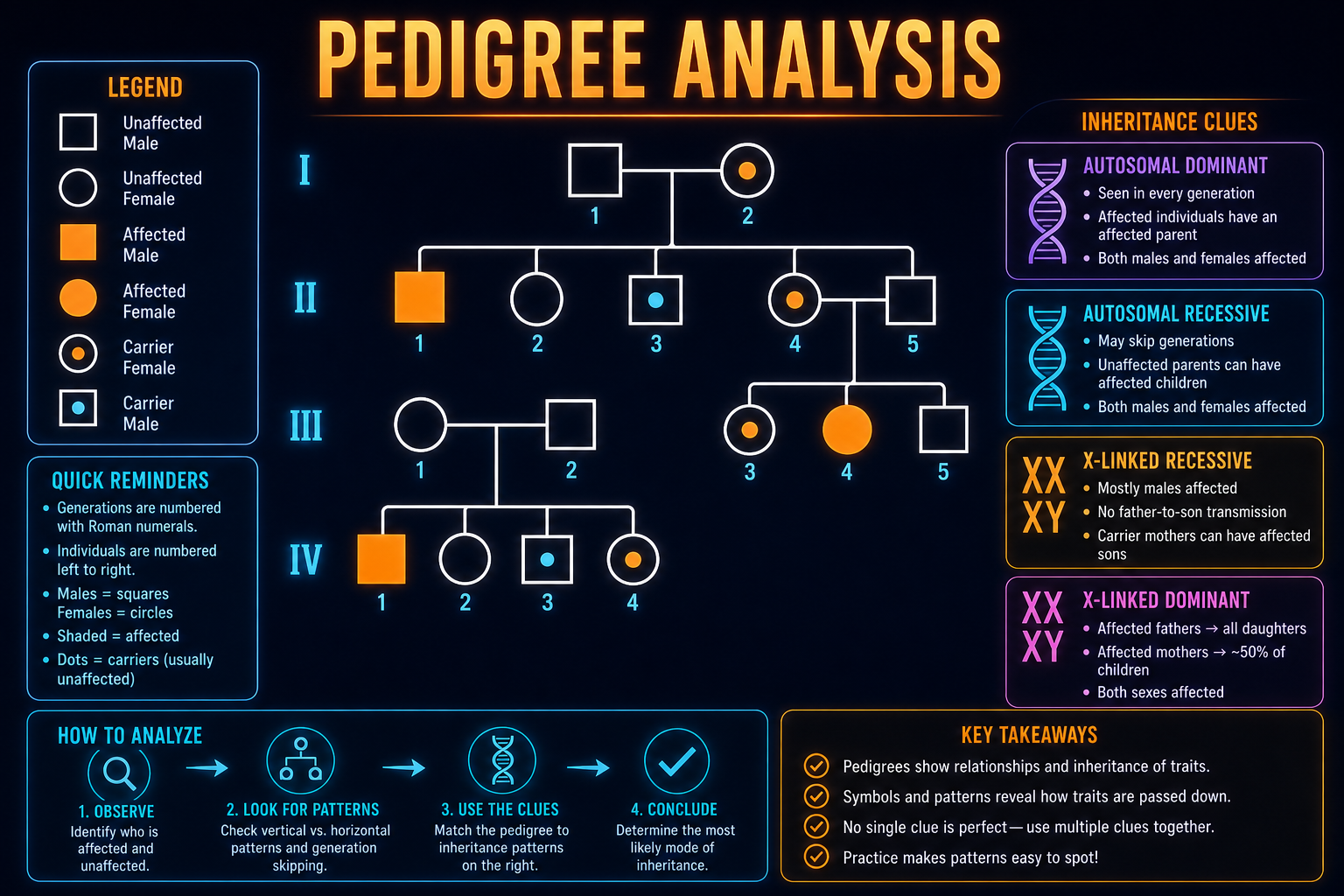
A pedigree is a family tree used to track how a trait is inherited across generations. In AP Biology, pedigrees help identify inheritance patterns such as autosomal dominant, autosomal recessive, and X-linked recessive by showing which family members are affected, unaffected, or carriers.
Pedigrees use family patterns to infer inheritance.
Pedigrees use simple symbols to show sex, trait status, and relationships. AP Biology questions often expect you to read symbols quickly before analyzing inheritance.
| Symbol | Meaning |
|---|---|
| Square | Male |
| Circle | Female |
| Shaded symbol | Affected individual |
| Unshaded symbol | Unaffected individual |
| Half-shaded symbol | Carrier, if shown |
| Horizontal line | Mating / parents |
| Vertical line | Offspring |
| Roman numerals | Generation |
| Arabic numerals | Individual within a generation |
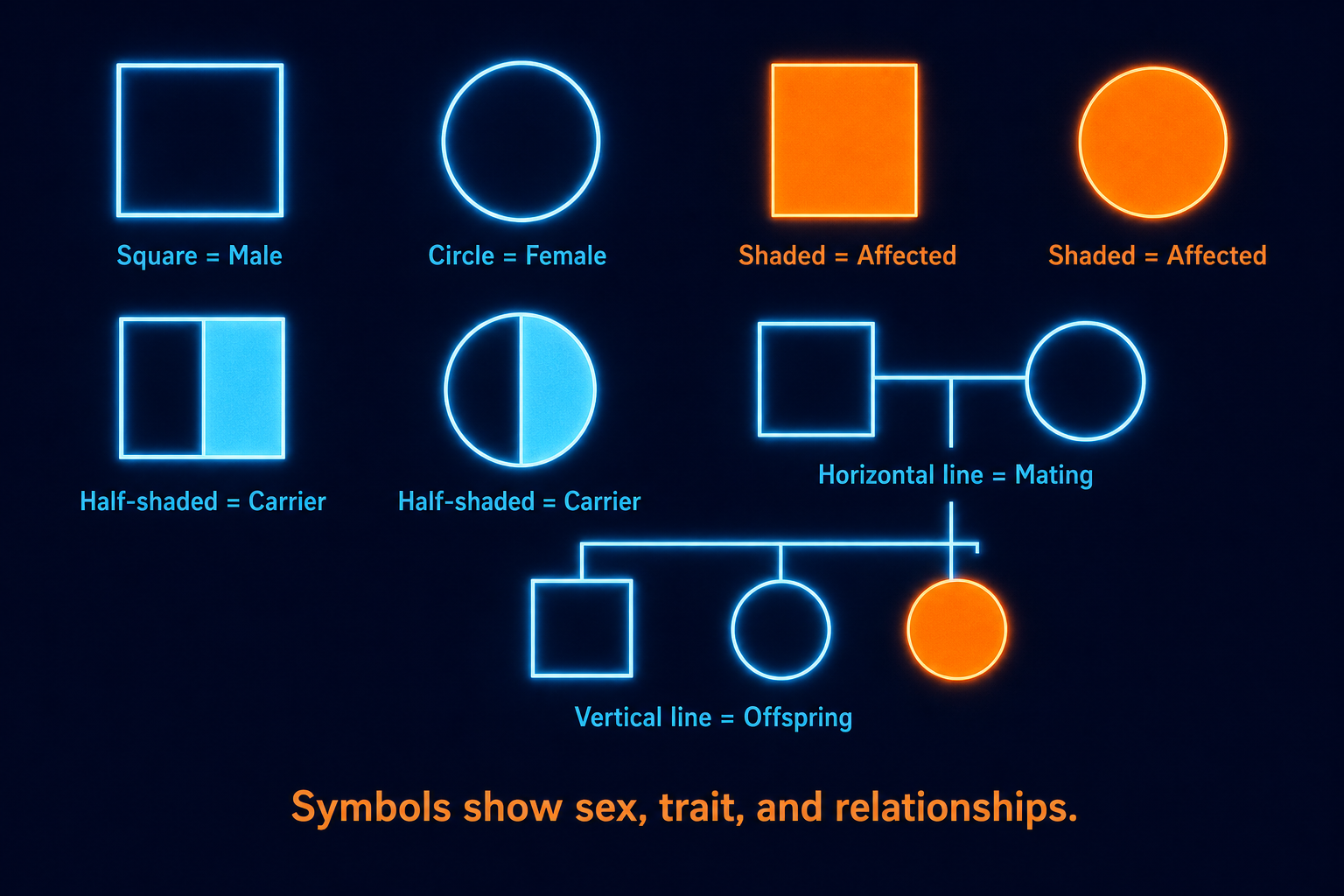
Look for shaded symbols first.
Skipping generations often suggests recessive inheritance.
A strong male bias may suggest X-linked recessive inheritance.
This strongly suggests recessive inheritance.
This can suggest dominant inheritance.
Assign possible genotypes and test whether the pattern works.
Before analyzing patterns, review Mendelian genetics for dominant and recessive allele logic.
| Feature | Autosomal Dominant | Autosomal Recessive |
|---|---|---|
| Generation pattern | Often appears every generation | Can skip generations |
| Affected parents | Often have affected children | Unaffected carriers can have affected children |
| Carrier idea | Usually not hidden in the same way | Carriers can be unaffected |
| Sex pattern | Usually similar in males and females | Usually similar in males and females |
| AP clue | Affected child often has affected parent | Affected child can have unaffected parents |
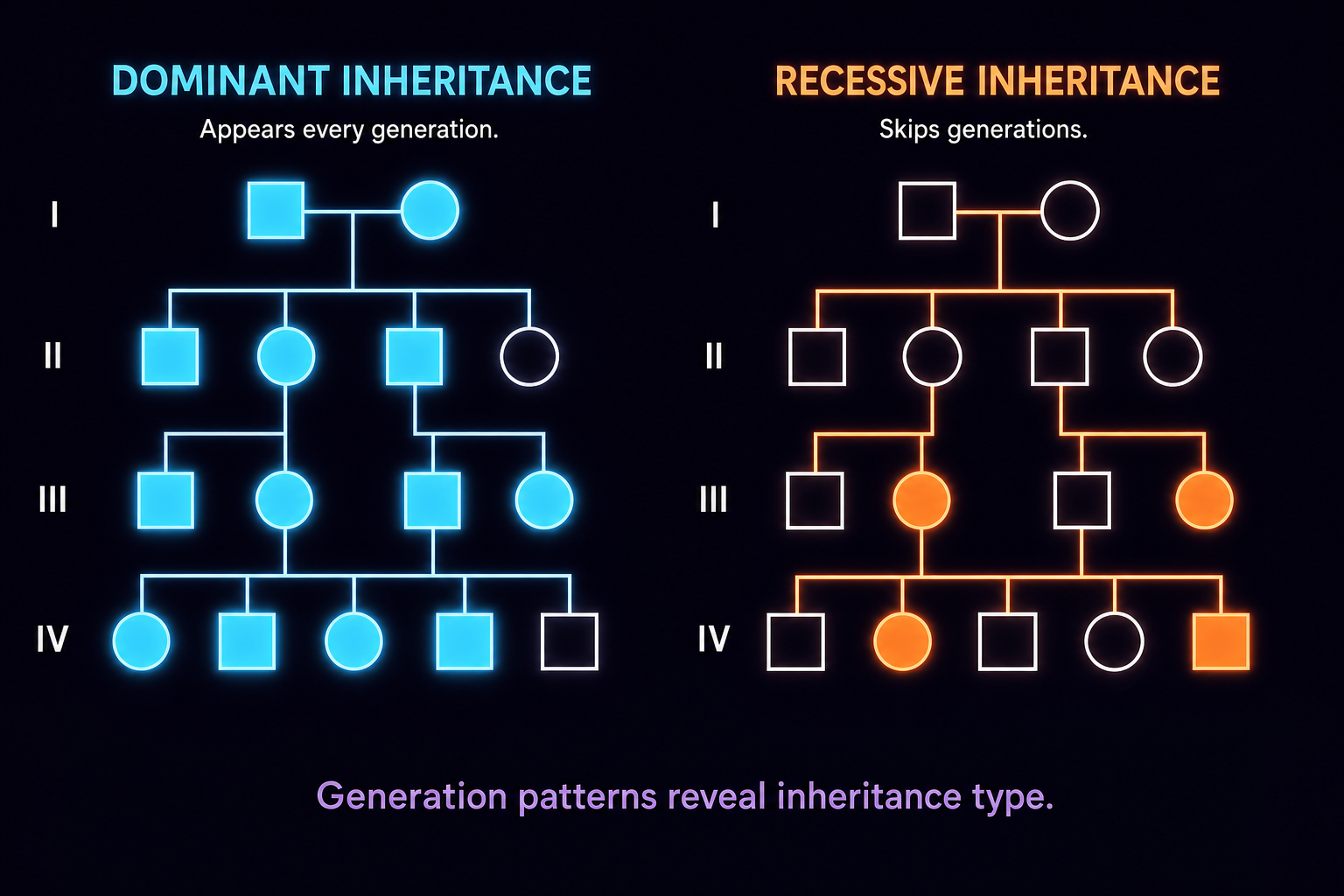
An autosomal dominant trait is controlled by a dominant allele on a non-sex chromosome. Affected individuals usually have at least one affected parent. The trait often appears in every generation, although small family size can make patterns less obvious.
Notation:
An autosomal recessive trait appears only when an individual inherits two recessive alleles. Unaffected parents can have an affected child if both parents are carriers. This is why autosomal recessive traits can skip generations.
Notation:
Some recessive patterns overlap with topics in non-Mendelian genetics, but classic autosomal recessive pedigrees follow simple Mendelian ratios.
An X-linked recessive trait is caused by a recessive allele on the X chromosome. These traits often appear more often in males because males usually have only one X chromosome. Carrier females can pass the recessive allele to sons.
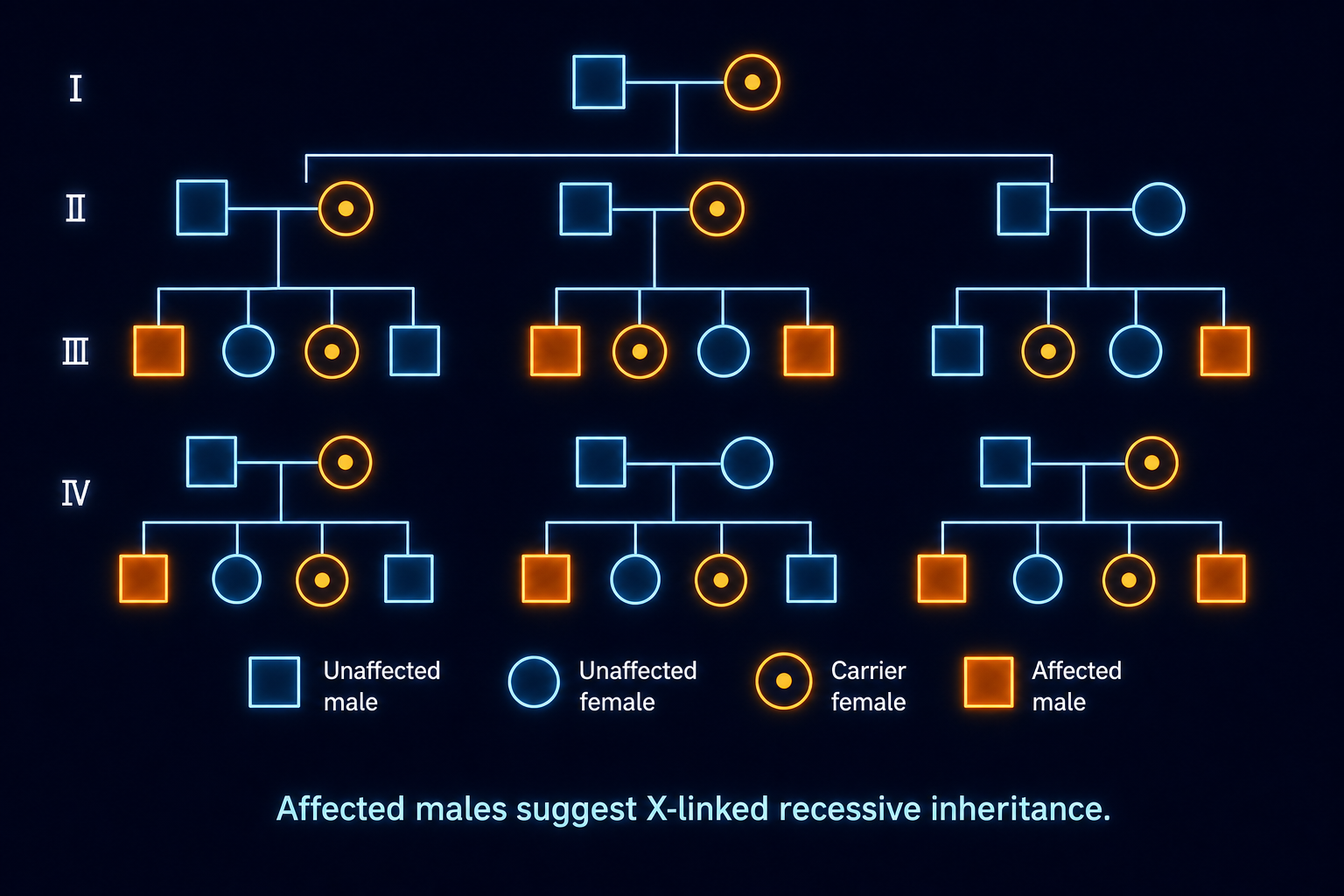
Review Sex-Linked Traits for full X-linked Punnett square method and carrier female reasoning.
A carrier has one recessive allele but does not show the recessive phenotype. In autosomal recessive pedigrees, unaffected parents of an affected child must usually be carriers. In X-linked recessive pedigrees, unaffected mothers of affected sons may be carriers.
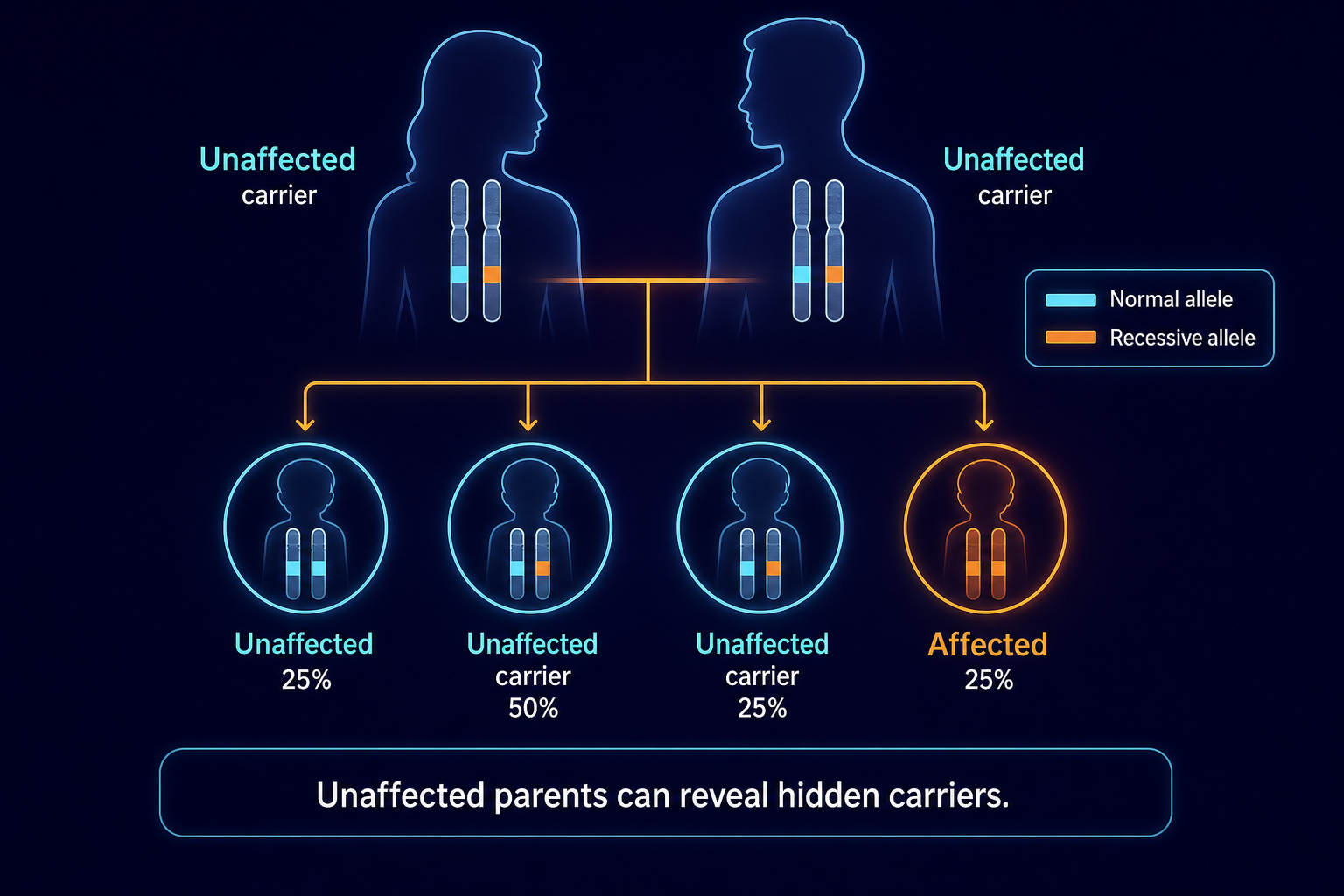
Some AP Biology pedigree questions ask for the probability that a child will inherit a trait. First infer the likely genotypes from the pedigree, then use Punnett square logic.
Example: If two carrier parents for an autosomal recessive trait are crossed (Aa × Aa monohybrid cross):
Expected offspring:
Conclusion: There is a 25% chance of an affected child.
Review Punnett Squares for step-by-step probability calculations.
| Tool | What It Shows | Best Use |
|---|---|---|
| Pedigree | Family inheritance across generations | Identify inheritance pattern |
| Punnett square | Possible offspring genotypes from known parents | Calculate probabilities |
| Chi-square | Observed vs expected counts | Test whether data fit expected ratios |
Punnett Squares · Chi-Square Test Genetics
During meiosis, gametes receive one allele per gene, which is why carrier parents can produce affected offspring when both pass recessive alleles.
→ recessive clue
→ autosomal recessive clue
→ dominant clue
→ X-linked recessive clue
→ X-linked clue
→ X-linked or autosomal recessive context
→ likely autosomal
→ infer genotypes, then use Punnett logic
Fix: Use multiple generations and family relationships.
Fix: Autosomal recessive traits can also skip generations.
Fix: Unaffected people can carry recessive alleles.
Fix: Check sex bias and father-to-son inheritance.
Fix: A probability among sons is different from probability among all children.
Fix: Small families can make patterns incomplete. Use the best-supported pattern.
Revealed: 0 of 5 scenarios
Two unaffected parents have an affected child.
Reveal: This strongly suggests recessive inheritance. For autosomal recessive, both parents are likely carriers.
A trait appears in every generation and affected children usually have affected parents.
Reveal: This suggests autosomal dominant inheritance.
A recessive trait appears more often in males.
Reveal: This suggests X-linked recessive inheritance.
An affected father has unaffected sons but all daughters receive his X chromosome.
Reveal: This supports X-linked reasoning.
Males and females are affected at similar rates, and the trait skips generations.
Reveal: This suggests autosomal recessive inheritance.
Answer all eight questions. Choices shuffle on reload.
More drills: Unit 5 practice questions or genetic variation.
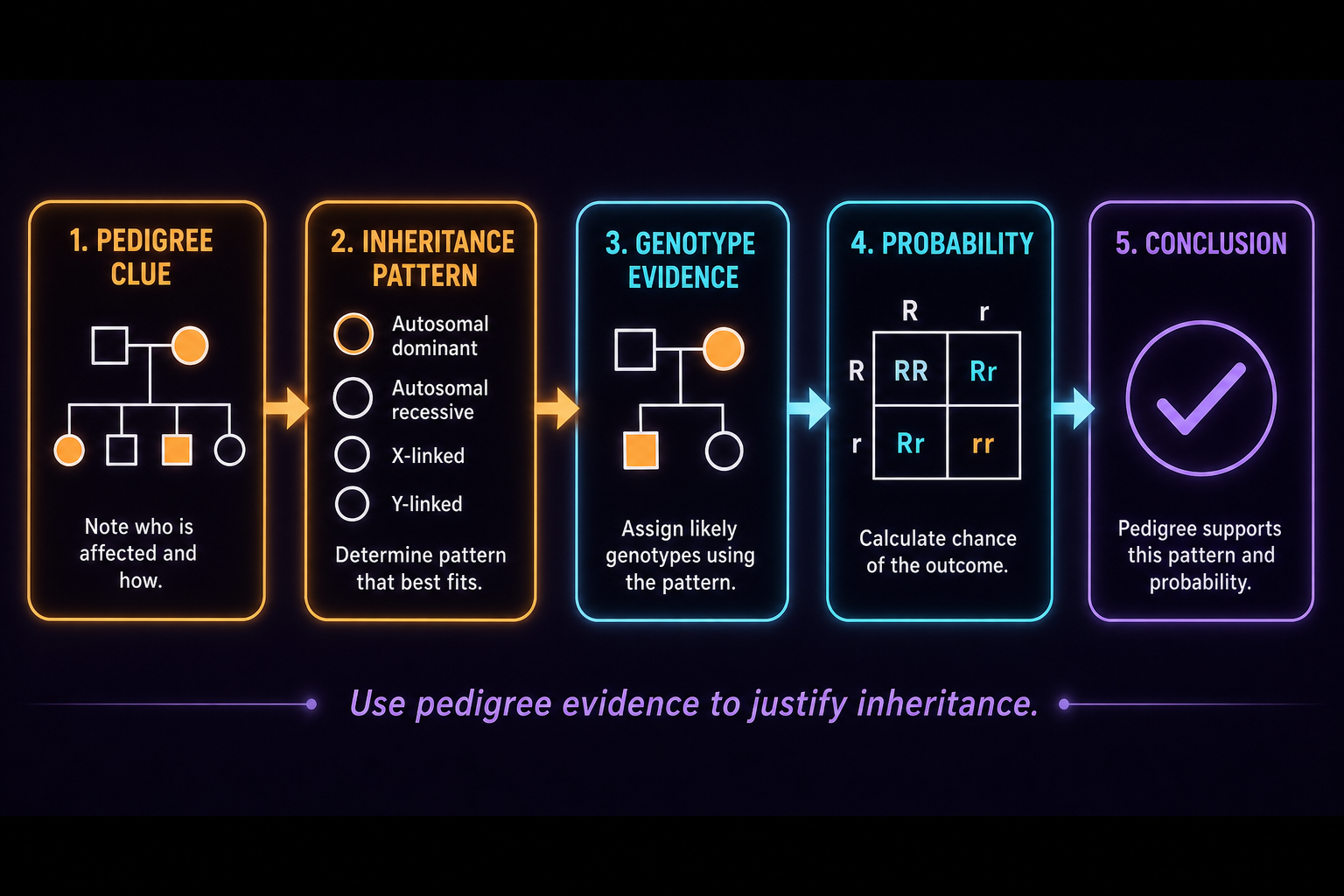
Open each card, draft your response, then reveal the rubric and sample answer.
A pedigree shows two unaffected parents with an affected child. The trait appears in both males and females. Explain which inheritance pattern is most likely and justify your answer.
The most likely pattern is autosomal recessive inheritance. Two unaffected parents having an affected child suggests that both parents are carriers of a recessive allele. Because the trait appears in both males and females, it is more likely autosomal than sex-linked. If both parents are Aa, they can produce an aa child who shows the recessive phenotype.
Status: Draft your answer first—then open the rubric or sample.
A pedigree shows a recessive trait appearing more often in males than females. An affected son has an unaffected mother. Explain why this pattern supports X-linked recessive inheritance.
The pattern supports X-linked recessive inheritance because recessive X-linked traits often appear more often in males. A male usually has only one X chromosome, so if that X chromosome carries the recessive allele, he shows the trait. The affected son's mother can be unaffected if she is a carrier, because her other X chromosome has the dominant allele. The son likely inherited the recessive X chromosome from his mother.
Status: Draft your answer first—then open the rubric or sample.
A pedigree is a family tree used to track how a trait is inherited across generations. In AP Biology, pedigrees help identify inheritance patterns such as autosomal dominant, autosomal recessive, and X-linked recessive by showing which family members are affected, unaffected, or carriers.
Start by identifying affected individuals, then check whether the trait skips generations, compare males and females, look for affected children with unaffected parents, and test whether every affected child has an affected parent. Use genotype logic to see which inheritance pattern best fits the family evidence.
Squares usually represent males, circles represent females, shaded symbols show affected individuals, unshaded symbols show unaffected individuals, and half-shaded symbols may show carriers. Horizontal lines connect mates and vertical lines connect parents to offspring.
Autosomal dominant pedigrees often show the trait in every generation, affected children usually have at least one affected parent, and males and females are affected at similar rates. Two unaffected parents usually do not have affected children.
Autosomal recessive pedigrees often show skipped generations, unaffected parents can have affected children, and males and females are affected at similar rates. Carriers are usually unaffected heterozygotes.
X-linked recessive pedigrees often show more affected males than females, carrier mothers can have affected sons, and affected fathers do not pass the trait to sons. The trait may appear to pass through unaffected carrier females.
Autosomal traits are on non-sex chromosomes and usually affect males and females at similar rates. X-linked recessive traits often affect more males, can pass through carrier females, and usually do not show father-to-son transmission because fathers pass Y chromosomes to sons.
For autosomal recessive traits, unaffected parents of an affected child are usually carriers. For X-linked recessive traits, unaffected mothers of affected sons may be carriers. Only label someone a carrier when the pedigree evidence supports it.
A skipped generation often suggests recessive inheritance, because unaffected carriers can pass a recessive allele without showing the trait themselves. Both autosomal recessive and X-linked recessive patterns can skip generations.
A pedigree shows family inheritance across generations and helps identify the inheritance pattern. A Punnett square predicts offspring genotypes and probabilities from known parent genotypes. Pedigrees show evidence; Punnett squares calculate expected ratios.
Small family trees may not show every clue clearly. Different inheritance patterns can look similar when only a few individuals are shown. AP Biology answers should choose the best-supported pattern and cite specific pedigree evidence.
Common mistakes include guessing from one affected person, assuming all skipped traits are X-linked, forgetting carriers, confusing autosomal and sex-linked patterns, ignoring the correct probability denominator, and treating pedigree clues as absolute rules.
State the most likely inheritance pattern, cite specific pedigree evidence such as affected parents or sex bias, explain genotypes when helpful, and connect the pattern to Mendelian or sex-linked reasoning. Use evidence from the family tree before giving a conclusion.