AP Human Geography · Unit 2Migration causes22 flashcards16 AP-style questionsFRQ-ready examples
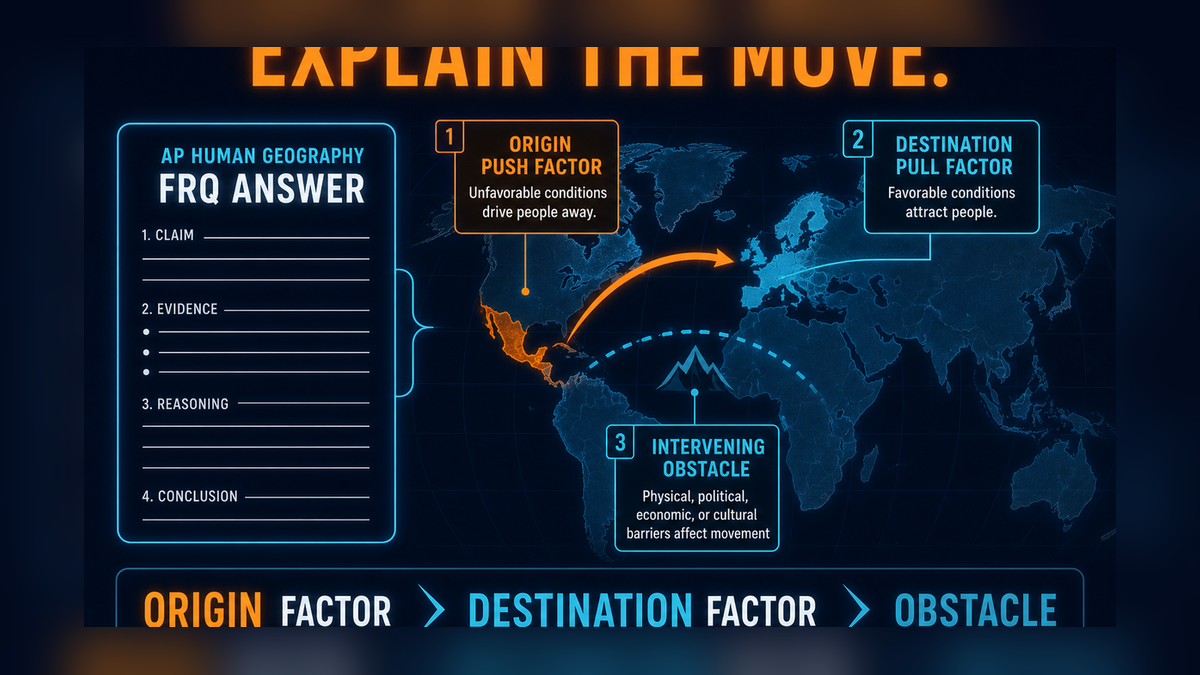
Push factors drive people away from an origin, while pull factors attract people toward a destination.
Push and pull factors AP Human Geography explain migration by separating origin problems from destination attractions on AP maps and scenarios. Push factors make people leave, while pull factors draw people toward a destination, and intervening obstacles shape whether the move actually happens.
Quick answer
What Are Push and Pull Factors in AP Human Geography?
Push and pull factors explain why people migrate. A push factor is a negative condition at the origin that encourages or forces people to leave. A pull factor is an attractive condition at the destination that encourages people to move there. In AP Human Geography, push and pull factors help explain voluntary migration, forced migration, refugee flows, labor migration, rural-to-urban migration, and international migration.
Key Takeaways
Push factors make people leave a place.
Pull factors attract people to a new place.
Migration decisions often involve both push and pull factors.
Push and pull factors can be economic, political, social, or environmental.
Intervening obstacles such as distance, borders, cost, and laws can limit migration.
Strong AP answers connect the factor to a specific migration outcome.
Memory Shortcut
Push = problems at origin.Pull = opportunities at destination.
Start Here: How to Use This Push and Pull Factors Guide
Learn the difference between push and pull factors.
Study economic, political, social, and environmental examples.
Connect push/pull factors to voluntary and forced migration.
Add intervening obstacles and distance decay.
Practice with MCQs, flashcards, and an FRQ.
Definitions
Push and Pull Factors Definitions
A push factor is a condition that pushes people away from an origin. A pull factor is a condition that attracts people toward a destination. These two forces help geographers explain the causes of migration and the direction of migration flows. For the bigger unit context, return to the Unit 2 Population and Migration hub.
Push Factor
A negative condition at the origin that encourages or forces people to leave.
Pull Factor
A positive condition at the destination that attracts people.
Origin
The place a migrant leaves.
Destination
The place a migrant moves toward.
Migration
A long-term or permanent move from one place to another.
Voluntary Migration
Migration based mainly on choice, even if difficult conditions influence the decision.
Forced Migration
Migration in which people are compelled to move because of danger, coercion, or survival needs.
Intervening Obstacle
A barrier that makes migration harder, such as distance, cost, borders, laws, terrain, or risk.
Origin pressure
Push Factors of Migration
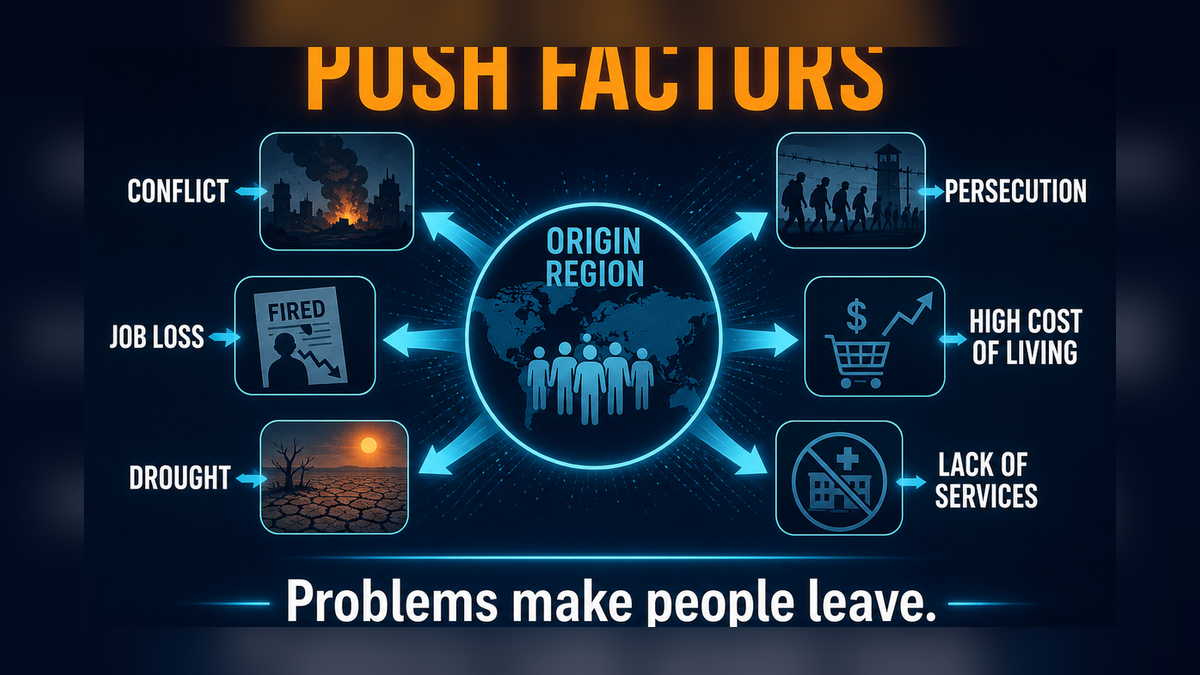
Push factors are negative conditions at the origin that encourage or force people to leave.
Push factors are negative conditions that make people want or need to leave a place. They usually operate at the origin. Some push factors create voluntary migration, while others create forced migration. When resource pressure builds, Malthusian Theory can help explain why food, land, or job scarcity becomes a migration pressure.
Economic Push Factors
unemployment
low wages
poverty
lack of farmland
high cost of living
limited economic opportunity
Political Push Factors
war
persecution
authoritarian rule
lack of rights
political instability
ethnic conflict
Environmental Push Factors
drought
flooding
famine
natural disasters
desertification
climate stress
Social Push Factors
poor schools
lack of healthcare
discrimination
crime
family separation
weak social services
AP Exam Tip: A strong answer does not just say “bad conditions.” It names the specific condition and explains how it pushes people away from the origin.
Destination attraction
Pull Factors of Migration
Pull factors are attractive conditions at a destination that encourage people to move there.
Pull factors are attractive conditions that make a destination appealing. They usually operate at the destination and help explain why migrants choose one place over another. Those choices often show up in population data, so connect this page to population pyramids when migration changes age structure or labor supply.
Economic Pull Factors
jobs
higher wages
business opportunities
better farmland
lower cost of living
access to markets
Political Pull Factors
safety
peace
political freedom
stable government
legal protections
asylum opportunities
Environmental Pull Factors
reliable water
fertile land
safer climate
fewer natural hazards
better living conditions
Social Pull Factors
family networks
better schools
healthcare
cultural community
religious freedom
quality of life
AP Exam Tip: Pull factors explain why migrants choose a destination, not just why they leave the origin.
Compare
Push vs Pull Factors
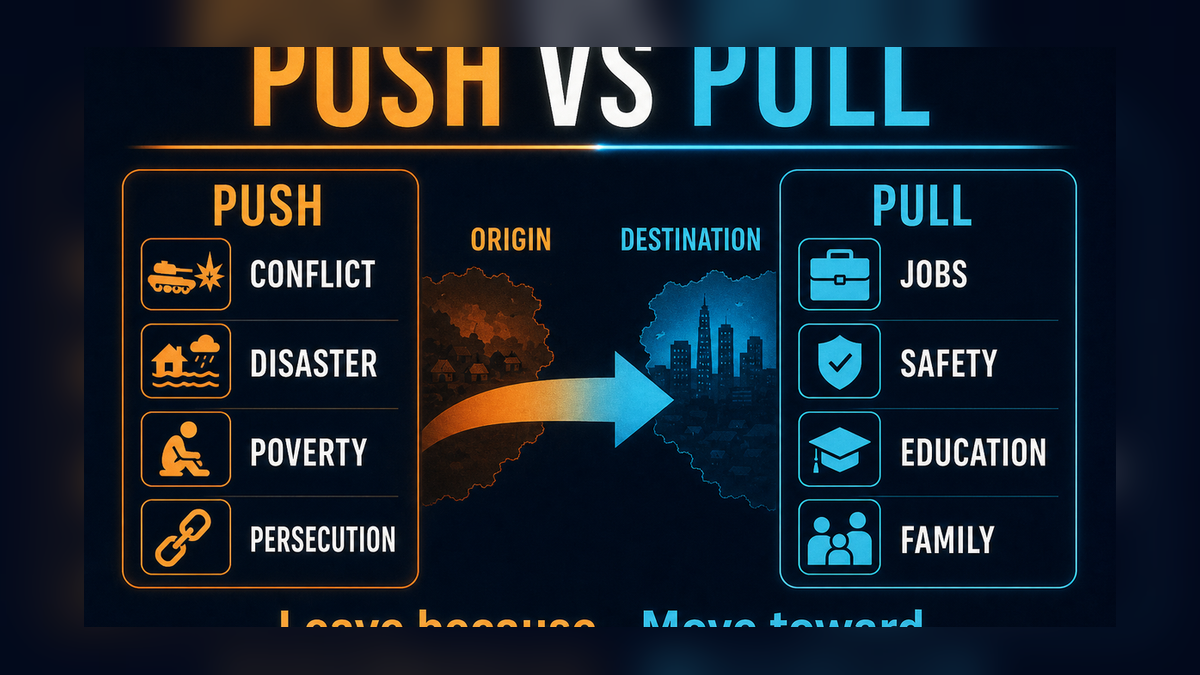
Push factors explain why people leave, while pull factors explain why people choose a destination.
Push and pull factors work together. A person may leave because of unemployment but choose a specific destination because of jobs, family networks, or safety. For AP Human Geography, the best answer separates the origin problem from the destination attraction, then explains the migration outcome.
Category
Push Factor
Pull Factor
Migration Example
Economic
Low wages or unemployment
Jobs or higher wages
A worker leaves a rural region for a city.
Political
War or persecution
Safety or asylum
A refugee flees conflict and seeks protection.
Environmental
Drought or disaster
Reliable water or safer climate
Farmers leave drought-prone land.
Social
Poor schools or healthcare
Better education or healthcare
A family migrates for services.
Common Mistake: Do not call every cause a push factor. If it attracts people to a destination, it is a pull factor.
Classify
Economic, Political, Social, and Environmental Factors
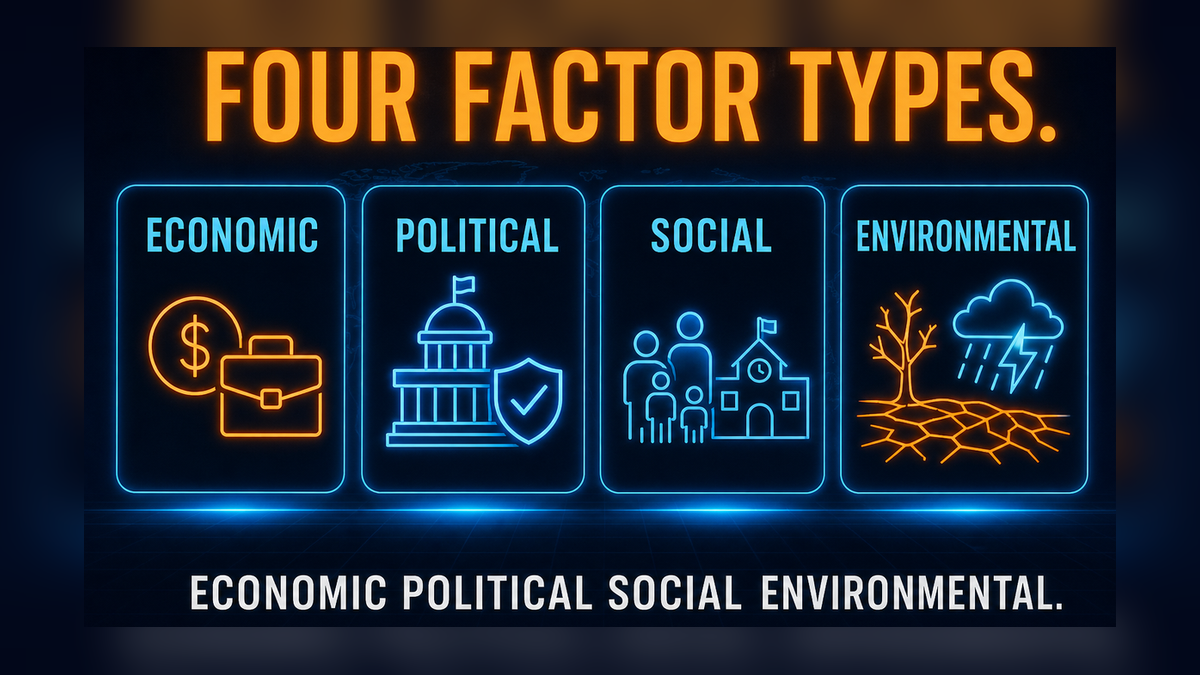
Push and pull factors can be economic, political, social, or environmental.
AP Human Geography questions often ask students to classify push and pull factors. The most common categories are economic, political, social, and environmental. Classification gets easier when you name the domain first, then explain the origin or destination effect.
Factor Type
Push Example
Pull Example
AP Clue
Economic
No jobs
More jobs
Work, wages, income, opportunity.
Political
Conflict
Safety
War, rights, asylum, persecution.
Social
Poor services
Better schools or healthcare
Family, education, healthcare, culture.
Environmental
Drought
Reliable water
Climate, hazards, land, resources.
AP Exam Tip: If a question asks for two different causes of migration, choose factors from different categories when possible.
Route barriers
Intervening Obstacles and Migration Decisions
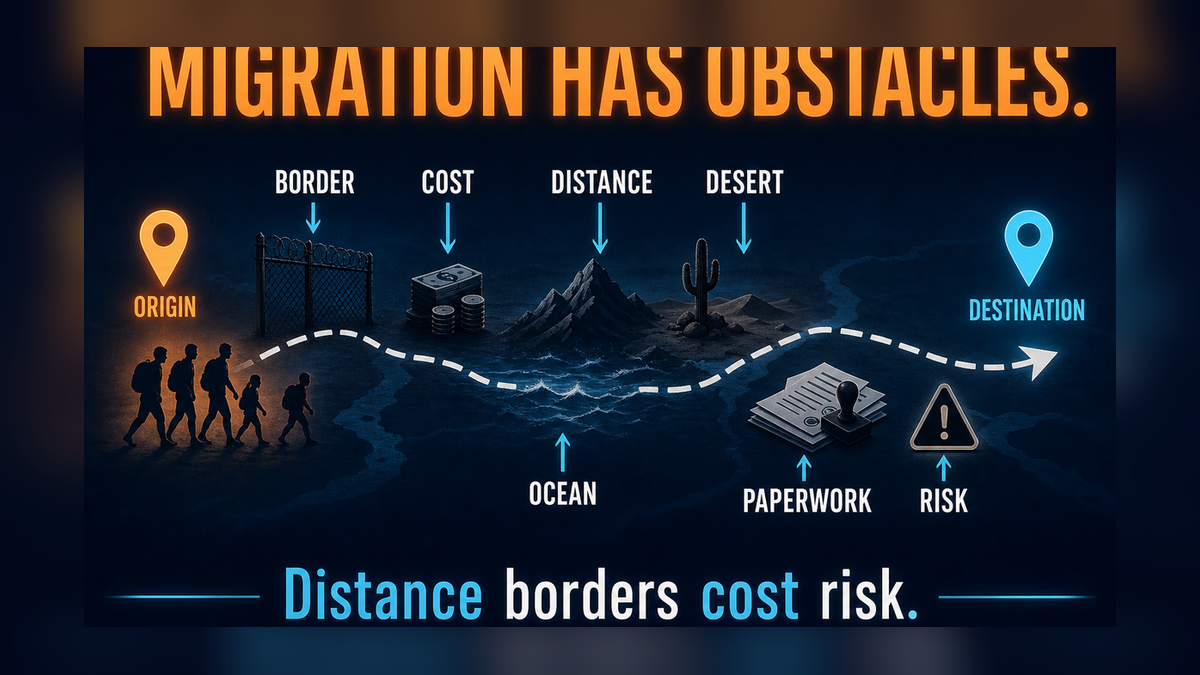
Intervening obstacles can slow, redirect, or stop migration even when push and pull factors are strong.
Even when push and pull factors are strong, migration may not happen. Intervening obstacles can slow, redirect, or stop migration. These obstacles help explain why not everyone moves to the same destination. Use distance decay, relative location, and scale of analysis to explain why distance, information, and political context change migration flows.
Distance
Longer distances increase cost, time, and uncertainty.
Cost
Transportation, housing, paperwork, and legal fees can limit migration.
Borders
Political boundaries and immigration laws can restrict movement.
Physical Barriers
Mountains, deserts, oceans, and dangerous terrain can make migration harder.
Legal Barriers
Visas, asylum rules, and documentation requirements can block movement.
Social Barriers
Language, discrimination, or lack of networks can reduce migration.
Push and Pull Factors in Forced and Voluntary Migration
Push and pull factors appear in both voluntary and forced migration, but the balance is different. Voluntary migration usually includes choice, while forced migration involves danger, coercion, or survival pressure. Use the full forced vs voluntary migration guide when a prompt asks whether pressure, danger, or opportunity shaped the move. Use the refugees, IDPs, and asylum seekers guide when a prompt asks whether legal status or border crossing changes the migration term.
Migration Type
Main Driver
Example
AP Note
Voluntary Migration
Choice influenced by opportunities or conditions.
A student moves to another country for university.
Pull factors are often visible.
Forced Migration
Compulsion, danger, or survival.
A refugee flees war or persecution.
Strong push factors dominate.
Push factor
Common in both.
Unemployment, war, disaster, persecution.
Explain the origin pressure.
Pull factor
More visible in voluntary migration, but still matters for destination choice.
Safety, jobs, asylum, family.
Explain why that destination.
Obstacle
Can shape both types.
Border rules, cost, housing, distance.
Explain limits on movement.
AP Exam Tip: Refugees are usually linked to forced migration, but they may still choose among destinations based on pull factors such as safety, family, or asylum policy.
AP examples
Push and Pull Factors Examples
Use these examples to practice AP-style explanation. A strong example names the push factor, names the pull factor, and describes the spatial outcome at the origin or destination.
Rural-to-Urban Migration
Push: Limited rural jobs or farmland. Pull: Urban jobs, schools, healthcare, and services. Outcome: Population growth in cities.
International Labor Migration
Push: Low wages or unemployment. Pull: Higher wages and job openings abroad. Outcome: Remittances and transnational networks.
Refugee Migration
Push: War, persecution, violence, or disaster. Pull: Safety, asylum, and humanitarian aid. Outcome: Refugee camps, border pressure, and resettlement.
Environmental Migration
Push: Drought, sea-level rise, flooding, or crop failure. Pull: Safer land, water access, or jobs. Outcome: Internal displacement or international migration.
Family Reunification
Push: Family separation. Pull: Existing relatives and social networks. Outcome: Chain migration.
FRQ strategy
How to Write About Push and Pull Factors on the AP Exam
Strong migration FRQs identify a push factor, a pull factor, and an obstacle or process that shapes the migration decision.
Strong AP answers do more than list causes. They connect each factor to a migration decision and explain the spatial outcome.
Origin Push Factor→Destination Pull Factor→Obstacle or Network→Migration Outcome
Sentence Starters
A push factor at the origin is...
This factor encourages migration because...
A pull factor at the destination is...
This destination attracts migrants because...
An intervening obstacle that may affect the migration flow is...
The result is a migration pattern in which...
Strong answer example
A lack of jobs in a rural area can act as an economic push factor because people may not be able to earn enough income. Higher wages and more employment opportunities in a nearby city can act as a pull factor. However, distance, housing cost, and transportation expenses may limit who is able to migrate.
Mistakes
Common Push and Pull Factors Mistakes
Mistake
Fix
Calling every cause a push factor.
If the factor attracts people to a destination, it is a pull factor.
Only listing factors without explaining them.
Explain how the factor causes migration.
Ignoring intervening obstacles.
Mention borders, cost, distance, laws, or terrain when relevant.
Assuming all migration is voluntary.
Some migration is forced by war, persecution, disaster, or survival needs.
Using vague words like “better life.”
Name the exact pull factor: jobs, safety, education, healthcare, family, or rights.
Forgetting scale.
Push and pull factors can operate locally, nationally, or internationally.
Quick check
Quick Check
A family leaves a drought-prone farming region and moves to a city with more jobs. Which pairing is correct?
FRQ lab
Push and Pull Factors FRQ Practice
Draft your response, then reveal the rubric and sample answer. The goal is not just to name push and pull factors; it is to explain how each factor changes migration behavior.
Prompt
A rural region experiences crop failure, unemployment, and limited access to schools. Many young adults migrate to a nearby city with factory jobs, universities, hospitals, and existing family networks.
A. Define push factor.
B. Define pull factor.
C. Explain one push factor in the scenario.
D. Explain one pull factor in the scenario.
E. Describe one intervening obstacle that could affect this migration flow.
Tip: Use one sentence per part, then add cause-and-effect language for C, D, and E.
Rubric
A: Must define push factor as a condition at the origin that encourages or forces people to leave.
B: Must define pull factor as a condition at the destination that attracts people.
C: Must explain one push factor from the scenario, not just name it.
D: Must explain one pull factor from the scenario, not just name it.
E: Must describe an obstacle such as cost, distance, border rules, housing, transportation, language, or legal status.
Suggested answer
A. A push factor is a negative condition at the origin that encourages or forces people to leave.
B. A pull factor is an attractive condition at the destination that encourages people to move there.
C. Crop failure is an environmental push factor because it reduces farm income and food security, making people more likely to leave the rural region.
D. Factory jobs are an economic pull factor because they attract migrants seeking income and employment in the city.
E. Transportation cost could be an intervening obstacle because migrants may not have enough money to travel or secure housing in the destination city.
Status: Draft first, then compare your answer with the rubric.
Practice
Push and Pull Factors Practice Questions
16 AP-style MCQs. Choices shuffle on load. Tap an answer for an explanation and AP clue.
Question 1
Which statement best defines a push factor in migration?
AP exam clue: Watch for origin language such as leaves, flees, or departs.
Question 2
Which statement best defines a pull factor?
AP exam clue: Destination words such as jobs, safety, schools, or family usually signal pull.
Question 3
Which scenario is the clearest economic push factor?
AP exam clue: Economic push factors usually involve wages, jobs, land, or cost of living at the origin.
Question 4
Which example is a political push factor?
AP exam clue: Political push factors involve war, persecution, rights, instability, or government coercion.
Question 5
Which example is an environmental push factor?
AP exam clue: Environmental push clues include drought, flood, disaster, famine, climate stress, and land degradation.
Quick pause: review the explanation before the next set.
Question 6
Which option is a social pull factor?
AP exam clue: Social pull factors often involve relatives, schools, healthcare, community, culture, or quality of life.
Question 7
A person leaves a place because wages are too low and moves to a city because wages are higher. Which pairing is correct?
AP exam clue: Separate the reason for leaving from the reason for choosing the destination.
Question 8
Rural-to-urban migration often occurs when people leave farms with limited income and move to cities with factories. What is the best interpretation?
AP exam clue: Rural-to-urban prompts usually test origin conditions, urban opportunities, and scale.
Question 9
A refugee fleeing war is most directly responding to which type of factor?
AP exam clue: Refugee questions usually begin with strong push factors but still may ask about destination choice.
Question 10
Which situation is an intervening obstacle?
AP exam clue: Obstacles are barriers along the route or in the migration process.
Quick pause: review the explanation before the next set.
Question 11
How does distance decay help explain migration?
AP exam clue: Distance decay questions connect cost, information, networks, and distance.
Question 12
Why do family networks often increase migration to a destination?
AP exam clue: Network terms often point to chain migration and family reunification.
Question 13
Which comparison between forced and voluntary migration is most accurate?
AP exam clue: Do not assume voluntary means easy or forced means there are no destination choices.
Question 14
A national labor shortage attracts international migrants, while local housing costs limit who can move. Which scales are involved?
AP exam clue: Scale questions ask where the factor operates: local, regional, national, or international.
Question 15
In an FRQ, which sentence best explains a push factor rather than merely naming it?
AP exam clue: FRQs reward cause-and-effect explanation, not isolated vocabulary.
Quick pause: review the explanation before the next set.
Question 16
A family leaves a drought-prone farming region and moves to a city with more jobs. Which pairing is correct?
AP exam clue: Identify origin problem first, then destination attraction.
Flashcards
Push and Pull Factors Flashcards
Use these 22 cards for terms, definitions, and AP exam clues. Tap the card to flip from term to explanation.
Card 1 of 22Tap card to flip
Quick pause: say the definition aloud before the next card unlocks.
Forced vs Voluntary MigrationRefugees, IDPs, and Asylum SeekersInternal vs International MigrationRavenstein’s Laws of MigrationRemittancesBrain Drain
FAQs
FAQs About Push and Pull Factors in AP Human Geography
What are push and pull factors in AP Human Geography?
Push and pull factors explain why people migrate. Push factors are negative conditions at the origin that encourage or force people to leave, while pull factors are attractive conditions at the destination that encourage people to move there.
What is a push factor?
A push factor is a condition at the origin that pushes people away from a place, such as unemployment, war, drought, persecution, poverty, or lack of services.
What is a pull factor?
A pull factor is a condition at the destination that attracts people, such as jobs, safety, education, healthcare, family networks, political freedom, or better living conditions.
What is the difference between push and pull factors?
Push factors explain why people leave an origin, while pull factors explain why people choose a destination.
What are examples of economic push and pull factors?
Economic push factors include unemployment, poverty, and low wages. Economic pull factors include jobs, higher wages, and business opportunities.
What are examples of political push and pull factors?
Political push factors include war, persecution, and instability. Political pull factors include safety, asylum, rights, and political freedom.
What are examples of environmental push and pull factors?
Environmental push factors include drought, flooding, famine, disasters, and climate stress. Environmental pull factors include reliable water, fertile land, and safer living conditions.
How do push and pull factors affect migration?
Push factors create pressure to leave, while pull factors help determine where migrants go. Together they shape migration flows and destination choices.
Can the same migration have both push and pull factors?
Yes. Most migration decisions involve both. For example, a person may leave because of unemployment and move to a city because of job opportunities.
How do intervening obstacles affect push and pull factors?
Intervening obstacles such as distance, cost, borders, laws, terrain, and risk can slow, redirect, or stop migration even when push and pull factors are strong.
Are refugees caused by push or pull factors?
Refugee migration is usually driven by strong push factors such as war, persecution, violence, or disaster, but pull factors such as safety and asylum still affect destination choice.
How should students write about push and pull factors in an FRQ?
Students should identify a push factor at the origin, identify a pull factor at the destination, explain how each affects migration, and mention an obstacle or network if relevant.
Final review
Push and Pull Factors: Final Review
Push factors explain why people leave an origin.
Pull factors explain why people choose a destination.
Most migration decisions include both origin pressure and destination attraction.
Economic, political, social, and environmental factors can be push or pull depending on where they operate.
Intervening obstacles such as distance, cost, borders, laws, and risk shape actual movement.
AP exam answers should connect the factor to a migration outcome at the correct scale.