Core concepts and definitions
How is the Demographic Transition Model defined?
The Demographic Transition Model (DTM) is a framework geographers use to describe how populations shift from high birth and death rates toward lower rates as societies industrialize and urbanize. It is not a law of nature; it is a model built from historical cases in Europe and later applied comparatively to other world regions. On the AP Human Geography exam, you explain stages, link trends to policy and migration, and connect the model to population pyramids and epidemiological change.
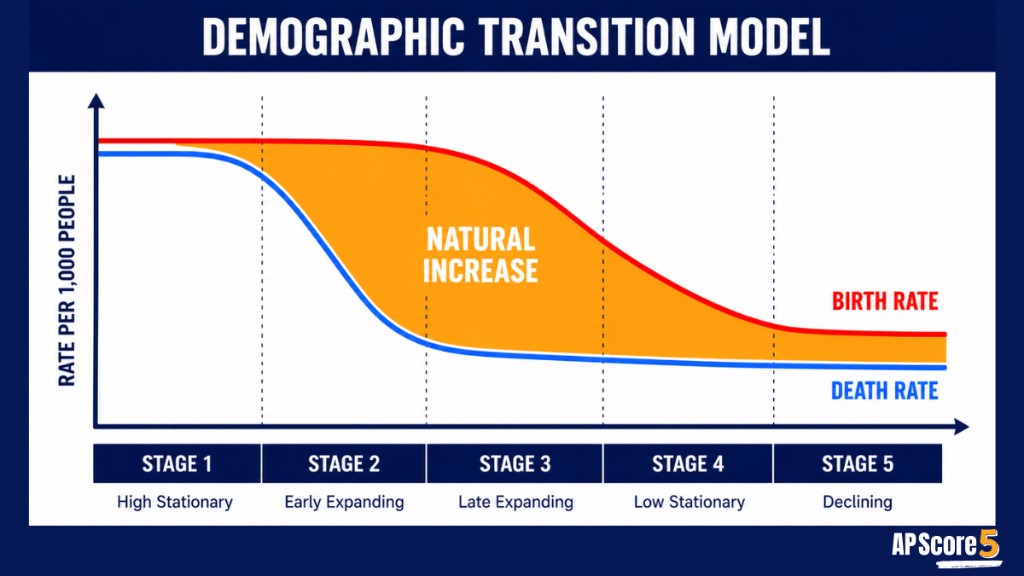
Warren Thompson and Frank Notestein helped formalize stage thinking in the twentieth century. Their work summarized patterns seen during the Industrial Revolution: first death rates fell with better food and medicine, then birth rates declined with urban jobs, education, and family planning. Students should treat the DTM as a sequence of typical changes, while noting that timing, culture, and government action can speed up or slow each transition.
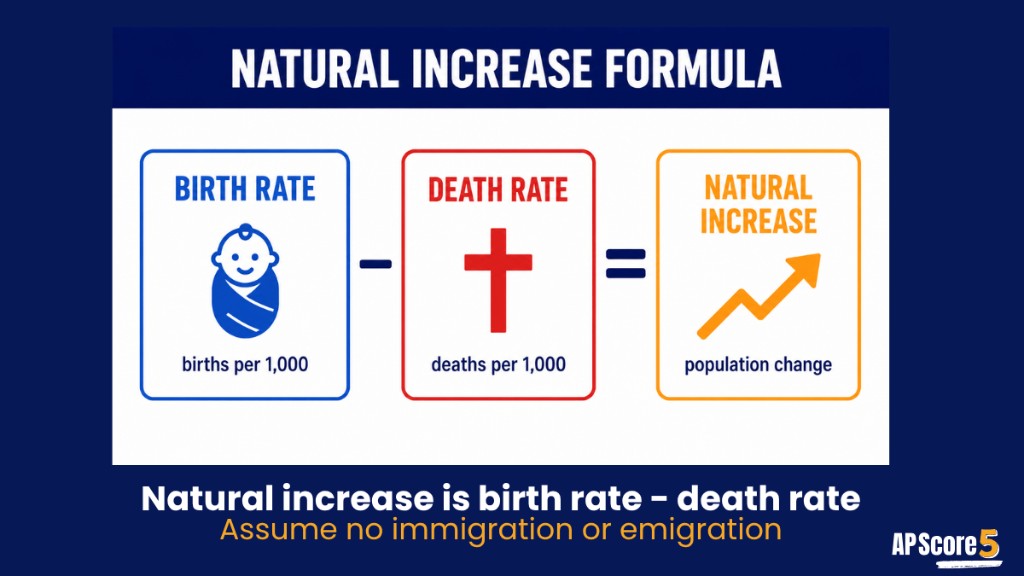
Crude birth rate (CBR) and crude death rate (CDR) are usually expressed per 1,000 people per year. Natural increase equals CBR minus CDR (before migration). When CDR drops before CBR, population grows quickly—Stage 2. When both fall, growth slows—Stage 3. Near-stable or slow growth with aging appears in Stage 4, and some textbooks add Stage 5 with very low birth rates and possible decline.
Who created the DTM and why does it matter?
Warren Thompson and Frank Notestein helped formalize stage thinking in the twentieth century. Their work summarized patterns seen during the Industrial Revolution: first death rates fell with better food and medicine, then birth rates declined with urban jobs, education, and family planning.
On the exam, the DTM matters because it links development, health, and population policy in one framework. You are not reciting a single inventor’s name—you are explaining why rates change and what that means for growth, pyramids, and government choices.
How do crude birth and death rates work?
Crude birth rate (CBR) and crude death rate (CDR) count births and deaths per 1,000 people per year. They are “crude” because they use the whole population, not just women of childbearing age. Natural increase equals CBR minus CDR before migration is added.
When CDR drops before CBR, the gap widens and population grows fastest—Stage 2. When both rates fall but CBR stays above CDR, growth continues but slows—Stage 3. Near-stable growth with aging appears in Stage 4; some courses add Stage 5 when birth rates fall very low and natural decrease is possible.
What is natural increase and how is it calculated?
Natural increase (NI) equals crude birth rate minus crude death rate, usually scaled per 1,000 residents. Positive NI means the population grows from births and deaths alone before migration. During Stage 2, NI spikes because CDR falls faster than CBR.
Geographers pair NI with doubling time estimates. Rule of 70 helps: divide 70 by the annual growth rate percent to approximate years to double. High NI with a youthful pyramid signals schools and job markets will face pressure within one generation.
Migration can mask NI trends. A country may show positive NI but still lose people through out-migration, or show near-zero NI while growing through in-migration—as seen in several Stage 4 economies with guest worker programs.
How does the DTM connect to population pyramids?
Population pyramids visualize age-sex structure; each DTM stage produces a distinct silhouette. Stage 2 pyramids have a very wide base; Stage 4 pyramids look more rectangular. Practice interpreting pyramids alongside rates in our population pyramids guide.
When the base narrows faster than the middle bulge ages, you are watching Stage 3 dynamics. When the top widens with a pinched base, consider Stage 5 discussions and dependency burdens.
Exam FRQs often supply a pyramid image: label the stage, predict one economic effect, and suggest one policy response (family planning, pronatalist incentives, or immigration reform).
What role does total fertility rate play?
Total fertility rate (TFR) estimates lifetime births per woman using current age-specific rates. TFR near 2.1 is often called replacement level in wealthy countries with low mortality. Link rate trends to stage placement with our total fertility rate notes.
CBR can stay moderate while TFR falls if the population has fewer women of childbearing age—always check both rate types on data tables.
Anti-natalist policies (China’s historic one-child era) and pronatalist subsidies (Sweden’s parental leave) aim to move TFR, but cultural preferences and housing costs mediate outcomes.
How does the DTM differ from the epidemiological transition model?
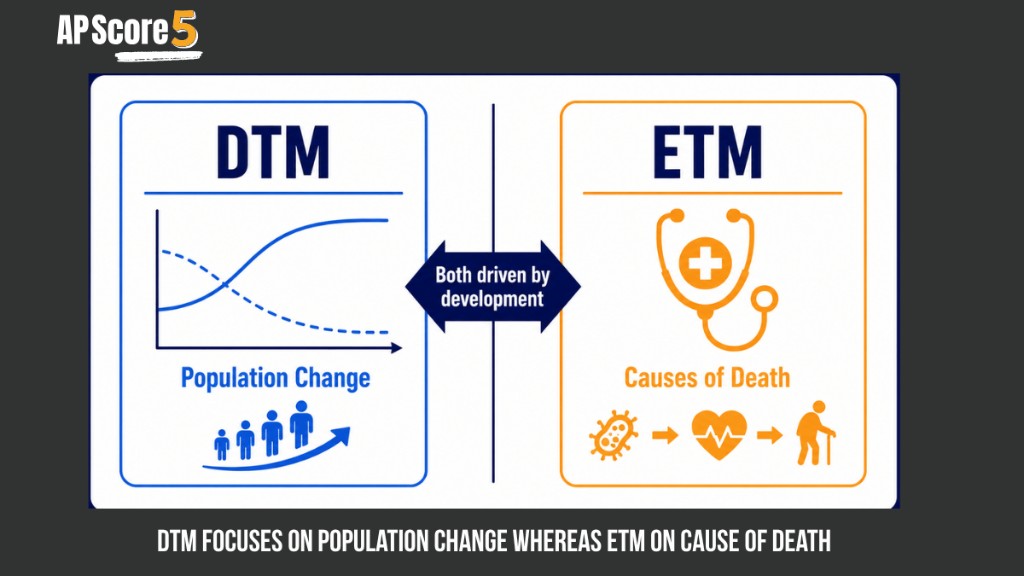
The DTM tracks population change through birth and death rates by stage. The epidemiological transition model (ETM) tracks causes of death as societies develop—from infectious disease to chronic and lifestyle disease. Both models are driven by development, but they answer different exam questions.
Exam preparation and review
Identify the stage from a graph or pyramid → explain why CBR and CDR look that way → predict one economic or social effect → name one policy (family planning, pronatalist incentives, or immigration).
What happens in DTM Stage 1?
Stage 1 (high stationary) fits pre-industrial societies where both birth and death rates are high, so natural increase stays near zero. Families often have many children because infant mortality is high and children help with subsistence work. Disease, famine, and limited medical care keep CDR elevated alongside CBR.
Historic examples include much of humanity before 1750 in Europe and many regions before modern public health. AP prompts may ask you to justify why a country cannot return to Stage 1 permanently once medical infrastructure exists—even if birth rates rise again, death rates rarely return to pre-modern highs.
What happens in DTM Stage 2?
Stage 2 (early expanding) begins when death rates fall while birth rates remain high. The gap creates rapid natural increase—sometimes called the population explosion. Improvements include sanitation, germ theory, vaccines, and more reliable food supply.
Much of Sub-Saharan Africa, parts of South Asia, and Guatemala historically showed Stage 2 patterns in the late twentieth century. Exam answers should name a mechanism (clean water, antibiotics) and a consequence (youthful age structure, pressure on schools). See the Stage 2 card for traps and a Niger rapid-growth example.
Document-based style prompts may give graphs of CBR/CDR over time. Practice reading crossover points: the first crossover when death drops below birth marks explosive growth; the second when birth approaches death marks maturing growth. Label axes and units to earn partial credit.
What happens in DTM Stage 3?
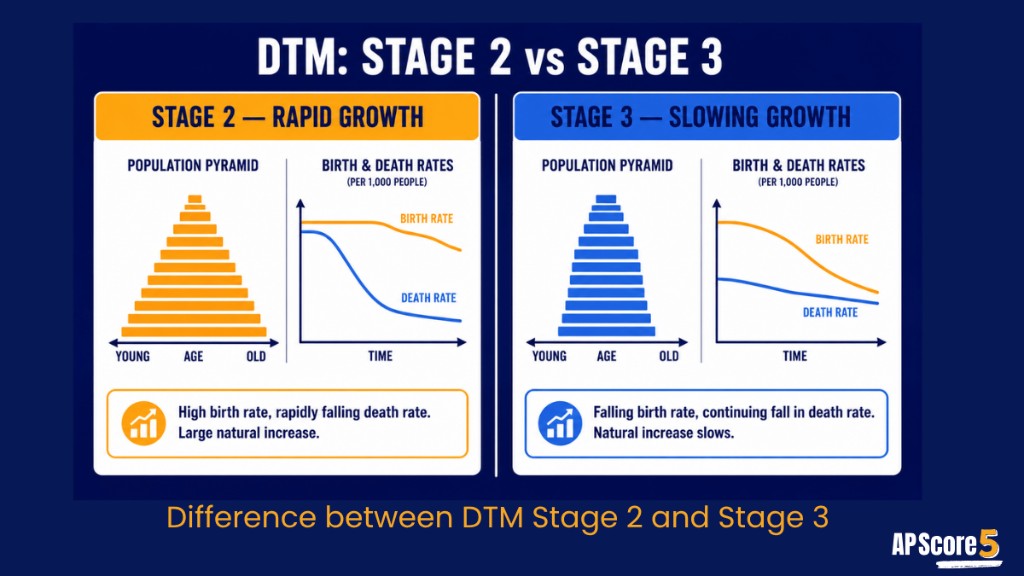
Stage 3 (late expanding) shows falling birth rates while death rates stay low. Urbanization, female education, contraception access, and shifting economic roles for children reduce fertility. Growth continues but at a decelerating pace.
Brazil, Mexico, and Indonesia moved through Stage 3 during late industrialization. Compare with Stage 2 by noting both CBR and CDR are lower, but the critical gap is shrinking because births fall—not because deaths rise.
What happens in DTM Stage 4?
Stage 4 (low stationary) has low CBR and low CDR, producing near-zero natural increase. Populations age, dependency ratios shift toward elders, and migration may matter more for total population change than natural increase.
The United States, France, and Japan spent decades in Stage 4. Policy debates include retirement funding, healthcare costs, and pronatalist incentives. Link to population pyramids with relatively straight sides and a narrowing base.
What happens in DTM Stage 5?
Stage 5 (declining) is debated in textbooks: birth rates may fall below death rates, leading to natural decrease unless immigration offsets losses. Causes include delayed marriage, high cost of childrearing, and cultural preferences for smaller families.
Germany, Italy, and South Korea illustrate low fertility with aging populations. On FRQs, distinguish natural decrease from out-migration; both shrink growth but imply different policy tools.
What are the five DTM stages in summary?
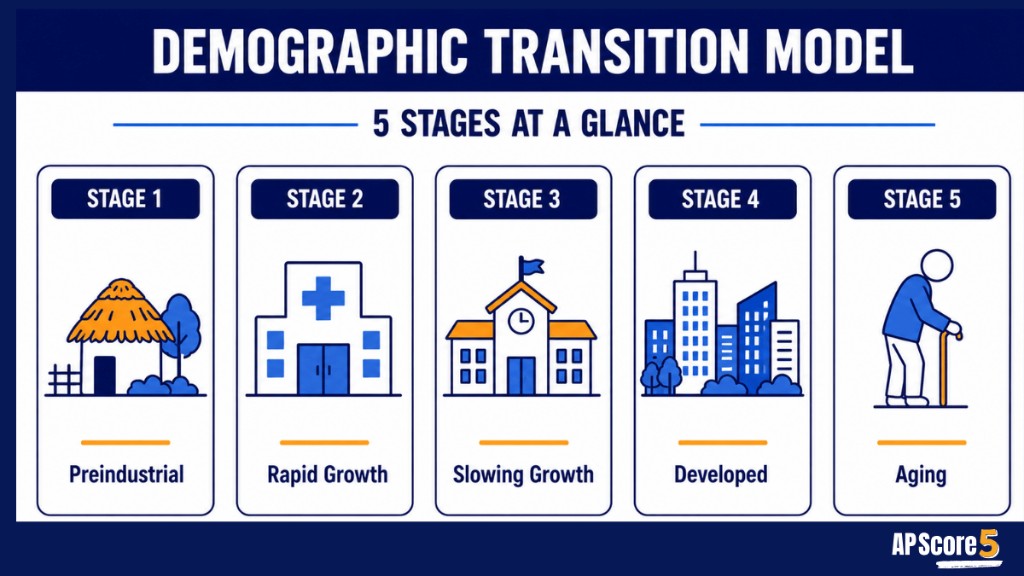
| Stage | CBR / CDR | Natural increase | Population pyramid | Example regions |
|---|---|---|---|---|
| 1 — High stationary | High / high | Near zero | Wide base, narrow top | Pre-1750 Europe; historic global norm |
| 2 — Early expanding | High / falling | Rapid | Very wide base | Niger; Afghanistan (patterns vary by year) |
| 3 — Late expanding | Falling / low | Moderate, slowing | Base narrows | India; Egypt (transitioning) |
| 4 — Low stationary | Low / low | Near zero | Column-like | United States; China (post-reform era trends) |
| 5 — Declining? | Very low / low | Negative possible | Inverted or constricted base | Japan; Bulgaria |
Which countries illustrate each stage today?
Assignments change by data year, but exam prep focuses on mechanisms. Niger and Somalia often illustrate Stage 2 high growth; Japan and Italy illustrate very low fertility; the United States mixes Stage 4 with migration-driven growth.
Avoid memorizing a single country per stage without context—College Board expects reasoning. Compare two countries in the same stage by noting policy, religion, or war disruption. For eleven FRQ-ready country write-ups on a world map, use the DTM real-world country examples guide.
How should you practice DTM for the AP exam?
Start with the DTM stages guide (main stage-by-stage reference), then study real-world country examples before you attempt 20 practice MCQs with explanations. Return to the Unit 2 hub for migration and policy ties.
Pair DTM study with epidemiological change via the epidemiological transition model page when prompts mention disease or life expectancy.
Time yourself: two minutes per MCQ, ten minutes per FRQ outline with thesis, two pieces of evidence, and one example.
What are common DTM misconceptions?
Can a country return to Stage 1 death rates?
Usually no—modern medicine and sanitation keep CDR low even if CBR rises again.
What is the fastest-growth stage?
Stage 2, when CDR has fallen but CBR remains high.
Stage 2 vs Stage 3 in one line?
Stage 2: high CBR, falling CDR. Stage 3: falling CBR, low CDR.
How does migration modify DTM predictions?
The DTM describes natural increase (births minus deaths). Migration can raise or lower total population even when CBR and CDR suggest slow or negative natural growth—common in Stage 4 and 5 economies with guest workers or return migration.
The United States often shows Stage 4 rate patterns but still grows through in-migration. Germany and Italy may show natural decrease offset partly by immigration. On FRQs, state whether you mean natural increase or total population change before discussing policy.
Demographic Transition Model slide walkthrough
Frequently asked questions
What is the Demographic Transition Model in AP Human Geography?
The Demographic Transition Model (DTM) is a population model that shows how a country's birth rate and death rate change over time as it develops, usually through five stages from high-high rates to low-low rates.
What is the simple definition of the Demographic Transition Model?
The DTM tracks how birth rates, death rates, and population growth shift as societies gain better health, education, and economic development.
Why is the Demographic Transition Model important?
It explains why some countries grow quickly, why pyramids change shape, and how development links to fertility and mortality—core Unit 2 ideas on the AP Human Geography exam.
What are the 5 stages of the Demographic Transition Model?
Stage 1: high birth and death rates; Stage 2: high birth, falling death; Stage 3: falling birth, low death; Stage 4: low birth and death; Stage 5: very low birth and possible decline.
What is an example of the Demographic Transition Model?
A country moving from Stage 2 rapid growth (high birth, falling death) toward Stage 3 (falling birth, low death) as urbanization and women's education spread illustrates the model.
How does the DTM connect to development?
Industrialization, improved sanitation, healthcare, and education tend to lower death rates first, then birth rates, linking economic and social development to demographic change.
What is the difference between Stage 2 and Stage 3?
Stage 2 keeps birth rates high while death rates fall, so growth is fastest. Stage 3 shows falling birth rates with low death rates, so growth slows.
Is Stage 5 always included in the DTM?
Not every textbook lists Stage 5, but AP Human Geography often includes it for countries where birth rates fall below death rates and populations age or decline.