Forced vs Voluntary Migration in AP Human Geography
Learn how geographers distinguish migration caused by danger, coercion, or survival pressure from migration shaped by choice, opportunity, and push-pull factors.
Updated June 12, 2026 · Reviewed by APScore5 Editorial Team
AP Human Geography · Unit 2Migration types22 flashcards16 AP-style questionsFRQ-ready examples
Danger or coercion vs choice and opportunity.
Forced vs voluntary migration AP Human Geography compares movement caused by danger, coercion, or survival pressure with movement shaped by more personal choice. The strongest AP answers classify the migration type, identify push and pull factors, and explain why pressure and choice can overlap.
Quick answer
What Is the Difference Between Forced and Voluntary Migration?
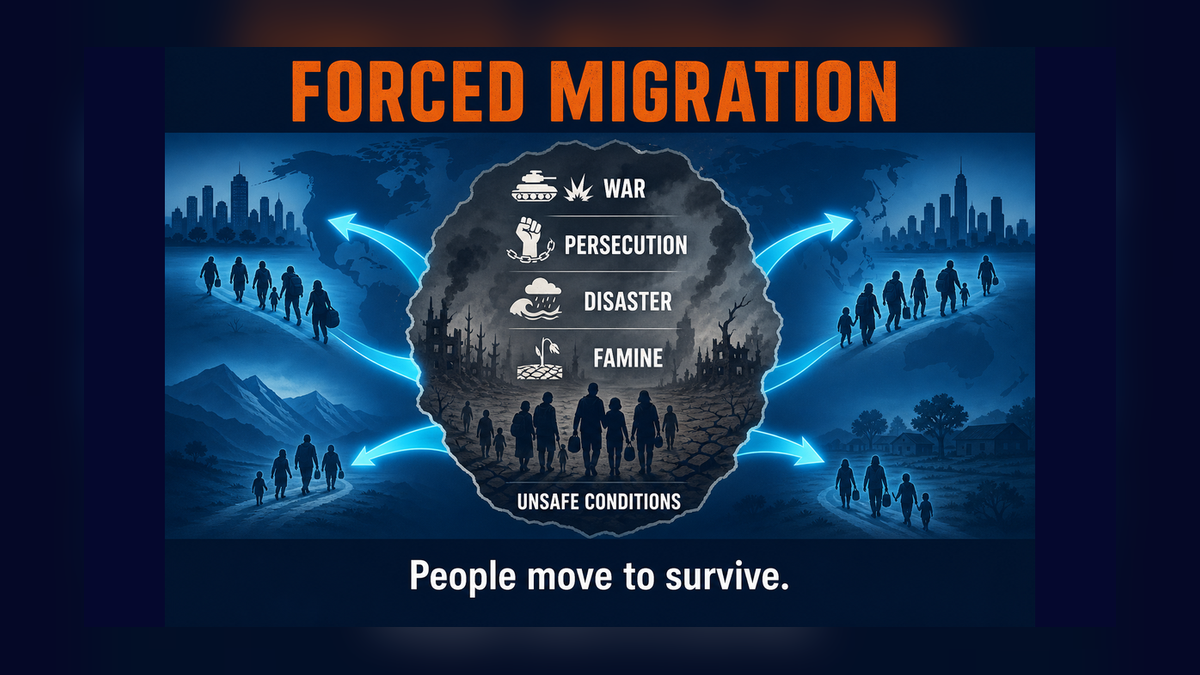
Forced migration occurs when people are compelled to move because of danger, coercion, persecution, conflict, disaster, famine, or survival pressure. Voluntary migration occurs when people choose to move, usually because of economic opportunity, education, family networks, quality of life, or other pull factors. In AP Human Geography, the key is to explain whether the migrant had meaningful choice and what conditions shaped the movement.
Key Takeaways
Forced migration happens when people are compelled to move.
Voluntary migration involves more personal choice.
Forced migration is often caused by war, persecution, disaster, famine, or violence.
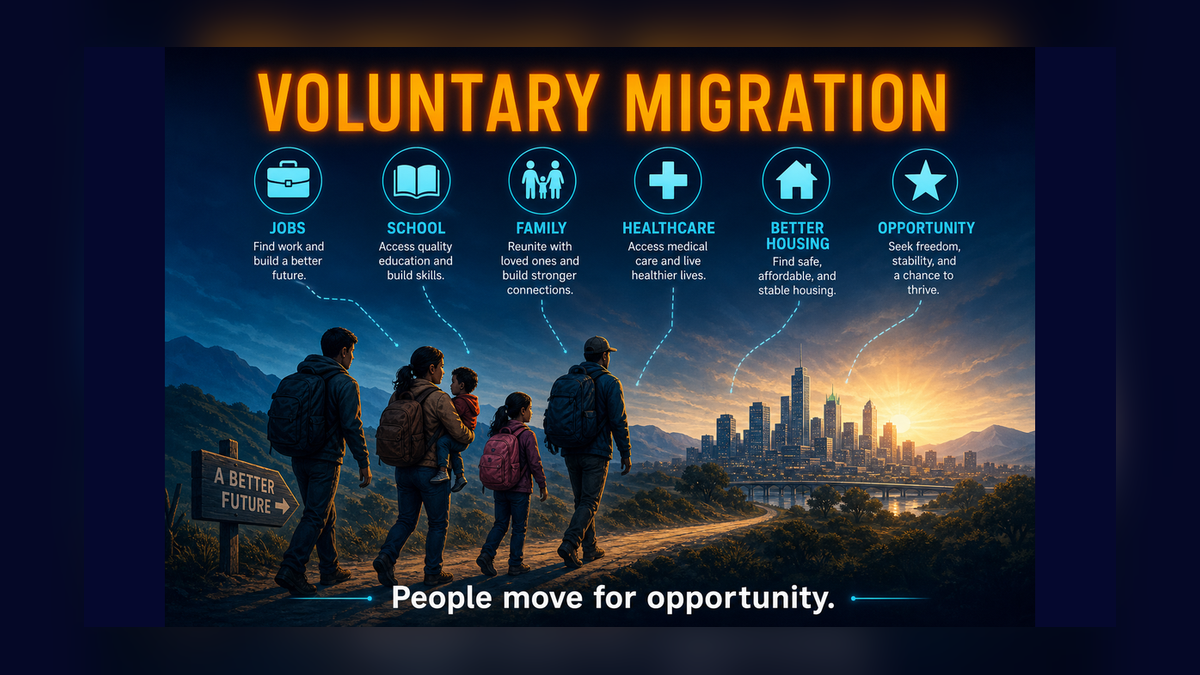
Voluntary migration is often caused by jobs, education, family networks, or better services.
The line between forced and voluntary can be blurry.
Strong AP answers classify the migration type and explain the cause.
Memory Shortcut
Forced = must move.Voluntary = choose to move.
Start Here: How to Use This Forced vs Voluntary Migration Guide
Learn the definitions of forced and voluntary migration.
Compare pressure-based movement with choice-based movement.
Study refugees, IDPs, labor migration, and student migration.
Migration means a long-term or permanent move from one place to another. The difference between forced and voluntary migration depends on how much choice the migrant has. For the broader course path, use the Unit 2 Population and Migration hub.
Migration
A long-term or permanent move from one place to another.
Forced Migration
Movement in which people are compelled to leave because of danger, coercion, disaster, persecution, or survival needs.
Voluntary Migration
Movement based mainly on choice, usually because a person expects better opportunities or living conditions elsewhere.
Migrant
A person who moves from one place to another.
Refugee
A person forced to leave their country because of persecution, war, or violence.
Internally Displaced Person
A person forced to move within their own country.
Asylum Seeker
A person who requests protection in another country.
Push Factor
A negative condition that encourages or forces people to leave an origin.
Pull Factor
A positive condition that attracts people to a destination.
Limited choice
Forced Migration
Danger or coercion makes people move.
Forced migration occurs when people do not have meaningful choice because remaining in place is unsafe, impossible, or life-threatening. It is often connected to political instability, violence, persecution, disasters, famine, or large development projects.
Common causes
refugees fleeing war
people displaced by ethnic persecution
residents evacuated after a disaster
communities displaced by dam construction
people forced from homes by violence
people displaced by famine or environmental collapse
AP exam language
compelled to move
staying is unsafe
limited meaningful choice
strong push factor
danger or coercion
survival pressure
AP Exam Tip: A strong forced migration answer explains the specific danger or pressure that made staying impossible or unsafe.
More agency
Voluntary Migration
Opportunity pulls people toward new places.
Voluntary migration occurs when people choose to move, usually because they expect better opportunities or conditions elsewhere. The choice may still be shaped by hardship, but the migrant has more agency than in forced migration.
Labor migration
Type: Mostly voluntary. Cause: Higher wages or job access. AP clue: explain the economic pull factor.
Student migration
Type: Voluntary. Cause: University, training, or career opportunities. AP clue: education is a pull factor.
Family migration
Type: Voluntary or mixed. Cause: Relatives and networks at the destination. AP clue: connect to chain migration.
AP Exam Tip: Voluntary does not always mean easy. It means the migrant has more choice in the decision to move.
Compare
Forced vs Voluntary Migration
Pressure lowers choice; opportunity raises it.
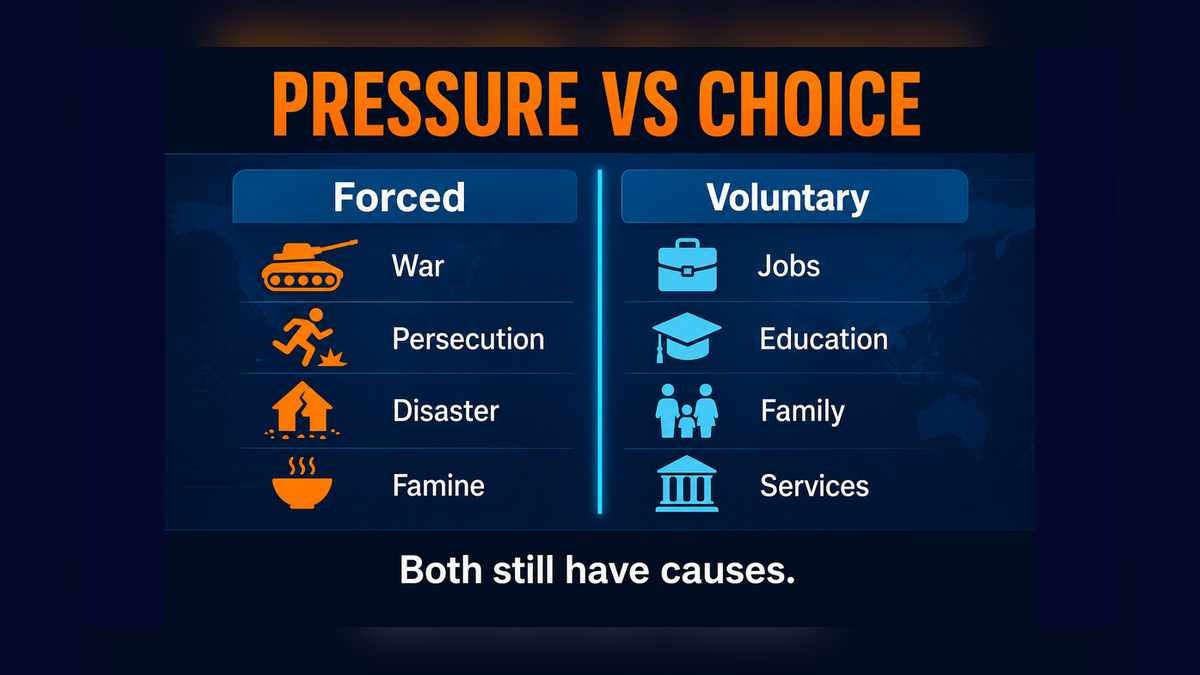
Forced and voluntary migration differ mainly in the level of choice. Forced migration has high pressure and low choice. Voluntary migration has more choice and is often shaped by pull factors.
Category
Forced Migration
Voluntary Migration
Main idea
People are compelled to move.
People choose to move.
Level of choice
Low or very limited.
Higher, though still shaped by conditions.
Common causes
War, persecution, disaster, famine, coercion.
Jobs, education, family, services, lifestyle.
Typical examples
Refugees, IDPs, disaster evacuees.
Labor migrants, students, retirees, family migrants.
Main AP question
What made staying unsafe or impossible?
What opportunity attracted the migrant?
AP clue: If the person is escaping danger, violence, or persecution, think forced migration. If the person is seeking opportunity or preference, think voluntary migration.
Spectrum
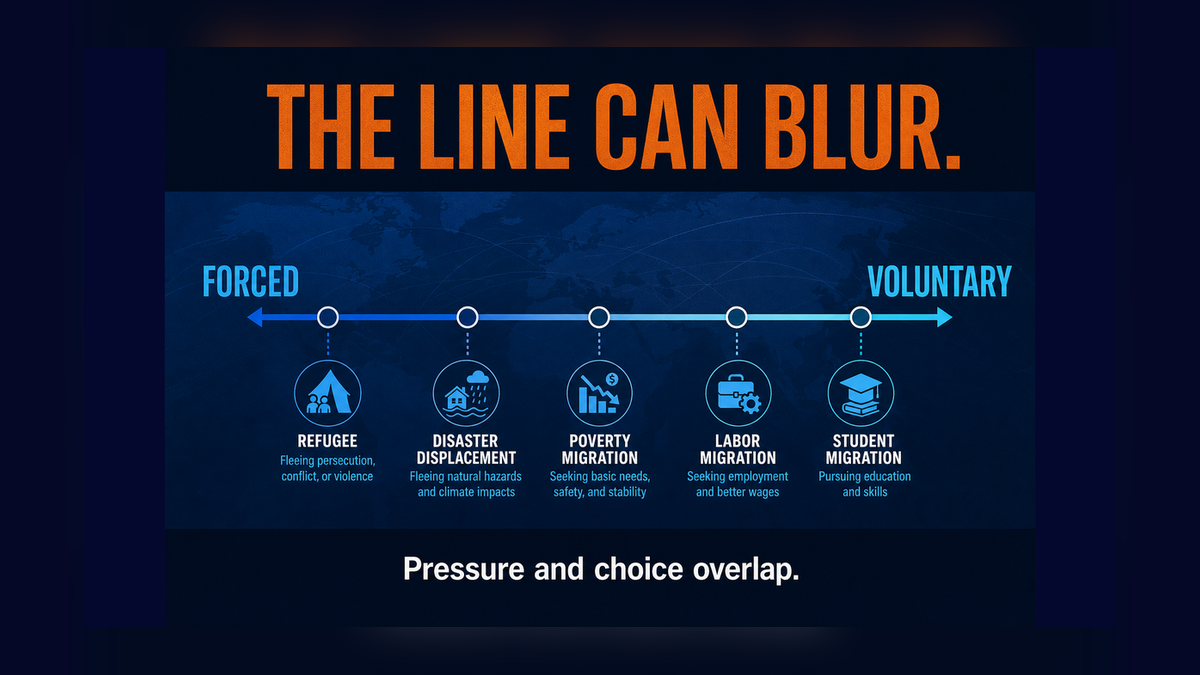
The Line Between Forced and Voluntary Migration Can Blur
Pressure and choice can overlap.
Not all migration fits perfectly into one category. Many migrants face pressure but still make choices about timing, destination, route, or whether to move. AP Human Geography often expects students to recognize this complexity.
Spectrum example
Classification
Why it fits
A family flees a war zone.
Clear forced migration
Danger makes staying unsafe.
A coastal community relocates after repeated flooding.
Mostly forced migration
Environmental risk limits choice.
A farmer leaves after years of drought and debt.
Mixed pressure and choice
Survival pressure and economic choice overlap.
A worker moves for higher wages.
Mostly voluntary migration
Opportunity is the main driver.
A student moves for college.
Clear voluntary migration
Education is a pull factor.
AP Exam Tip: If the scenario includes danger, coercion, or survival pressure, explain why the migration is forced or partly forced. If it includes opportunity and choice, explain why it is voluntary.
Forced categories
Refugees and Internally Displaced Persons
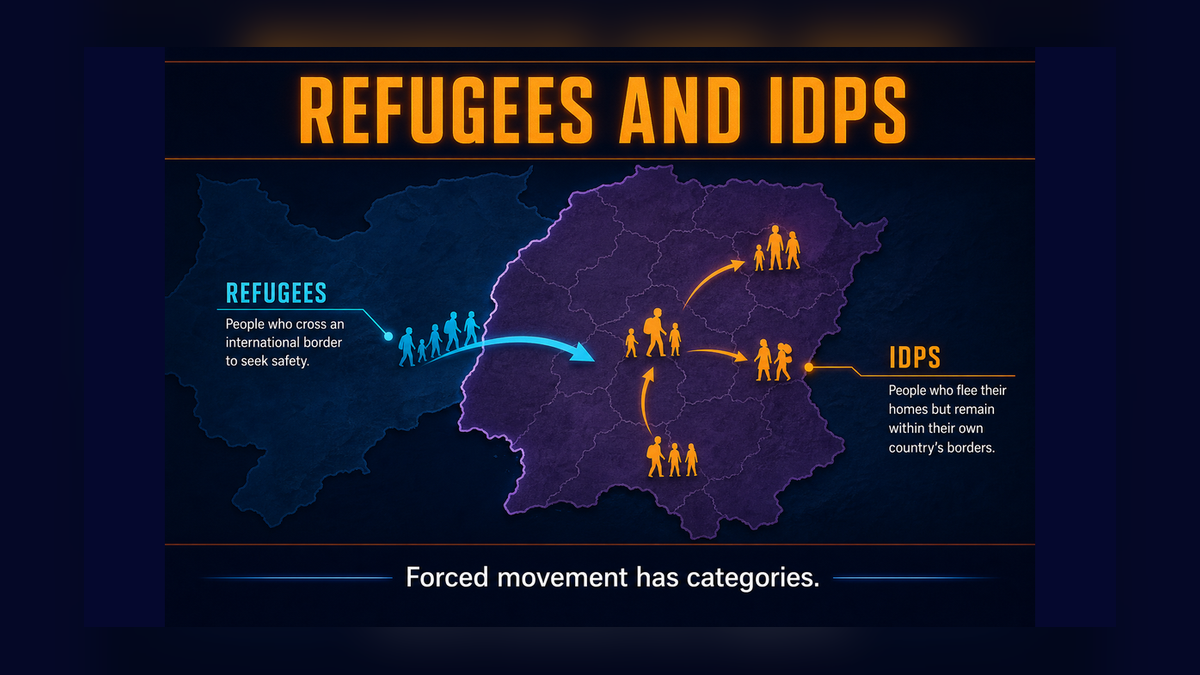
Refugees cross borders; IDPs stay inside.
Refugees and internally displaced persons are both connected to forced migration, but they differ by whether they cross an international border. Political boundaries matter here because a border changes the legal category of the migrant, so connect this idea to political boundaries and sovereignty.
Term
Meaning
Border Crossing?
Example
Refugee
A person forced to leave their country because of war, persecution, or violence.
Yes
A person flees conflict and enters another country.
Internally Displaced Person
A person forced to move within their own country.
No
A family moves from a conflict zone to a safer region in the same country.
Asylum Seeker
A person who requests legal protection in another country.
Yes
A migrant applies for protection after arriving.
For the full status comparison, review refugees, IDPs, and asylum seekers. That guide separates border crossing, legal recognition, and pending asylum claims.
Migration causes
How Push and Pull Factors Connect to Forced and Voluntary Migration
Forced and voluntary migration both involve push and pull factors, but the balance is different. Forced migration is usually dominated by strong push factors such as war, persecution, or disaster. Voluntary migration often involves both push factors at the origin and pull factors at the destination. For the complete cause framework, review push and pull factors.
Migration Type
Common Push Factors
Common Pull Factors
Forced migration
War, persecution, disaster, famine, violence.
Safety, asylum, humanitarian aid, family protection.
Type: Forced migration. Cause: War, persecution, or violence. Outcome: People cross international borders seeking protection.
Disaster Displacement
Type: Forced or partly forced migration. Cause: Flooding, earthquake, wildfire, hurricane, or drought. Outcome: People may relocate temporarily or permanently.
Labor Migration
Type: Mostly voluntary migration. Cause: Jobs, wages, or economic opportunity. Outcome: Workers move internally or internationally.
Student Migration
Type: Voluntary migration. Cause: Education and career opportunities. Outcome: Young adults move to universities or cities.
Family Reunification
Type: Voluntary or mixed migration. Cause: Family networks at the destination. Outcome: Chain migration can develop.
Development-Induced Displacement
Type: Forced migration. Cause: Infrastructure projects such as dams, roads, or urban redevelopment. Outcome: Communities are relocated.
FRQ strategy
How to Write About Forced vs Voluntary Migration on the AP Exam
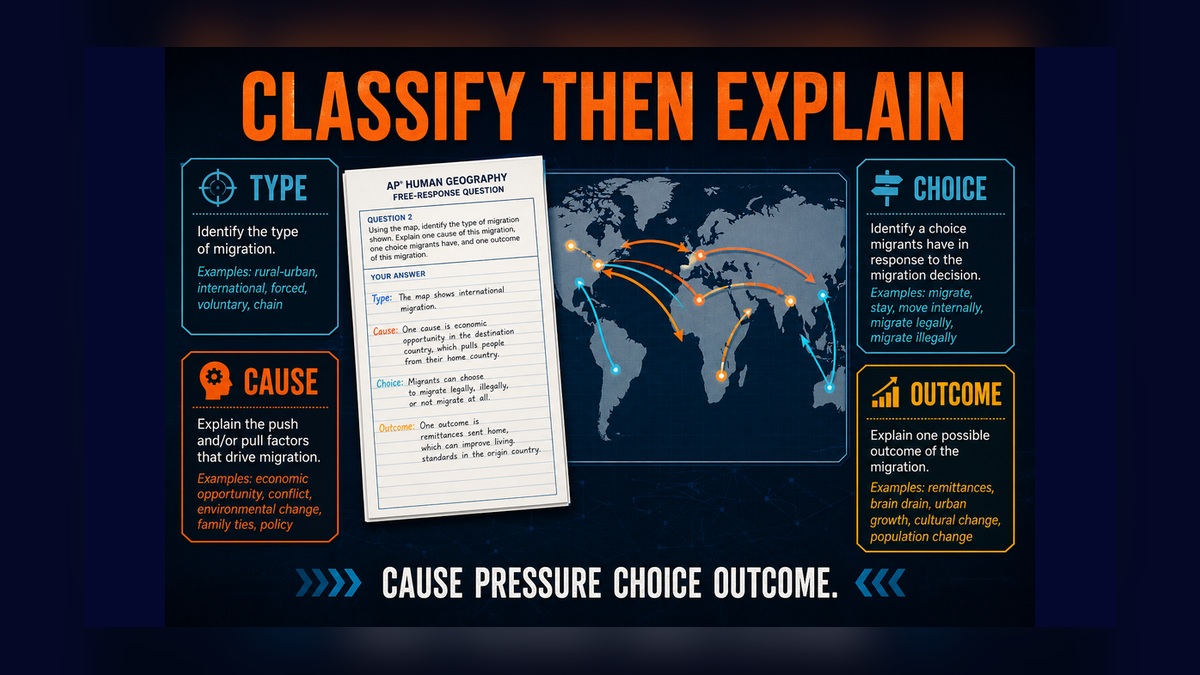
Classify type, cause, choice, and outcome.
Strong AP answers classify the migration type and explain the cause. Do not only name the type. Explain whether the migrant had meaningful choice and what geographic outcome resulted.
Migration Type→Cause→Level of Choice→Geographic Outcome
Sentence Starters
This is forced migration because...
This is voluntary migration because...
The migrant had limited choice because...
The movement is shaped by a push factor such as...
The destination is attractive because...
The geographic outcome is...
Strong answer example
This is forced migration because the population is leaving a conflict zone where staying would be unsafe. The main push factor is violence, and the pull factor is safety in a neighboring country. The geographic outcome may be refugee camps near borders and increased pressure on host-country services.
Mistakes
Common Forced vs Voluntary Migration Mistakes
Mistake
Fix
Thinking voluntary means the migrant has no problems.
Voluntary migration can still be shaped by hardship.
Calling all poor migrants forced migrants.
Poverty creates pressure, but the level of choice still matters.
Forgetting refugees cross borders.
Refugees cross international borders; IDPs remain within their country.
Listing causes without explaining migration type.
Explain how the cause limits choice or creates opportunity.
Ignoring pull factors in forced migration.
Forced migrants still choose destinations based on safety, family, or asylum access.
Treating migration as only one cause.
Most migration involves multiple causes and obstacles.
Quick check
Quick Check
A family leaves a war zone and crosses into a neighboring country to seek safety. Which migration type is this?
FRQ lab
Forced vs Voluntary Migration FRQ Practice
Draft your response, then reveal the rubric and suggested answer. The goal is to classify each migration type and explain how cause, choice, and outcome connect.
Prompt
A country experiences political violence in one region and rapid economic growth in another region. Some households flee violence and move across an international border, while other workers move from rural villages to growing cities for factory jobs.
A. Define forced migration.
B. Define voluntary migration.
C. Explain why the households fleeing violence are an example of forced migration.
D. Explain why rural workers moving for factory jobs are an example of voluntary migration.
E. Describe one geographic impact of either migration flow.
Tip: One clear cause-and-effect sentence can earn the explanation point.
Rubric
A: Must define forced migration as compelled movement due to danger, coercion, disaster, persecution, or survival pressure.
B: Must define voluntary migration as movement involving choice and opportunity.
C: Must connect political violence to limited choice or safety concerns.
D: Must connect factory jobs to economic opportunity and choice.
E: Must describe a geographic impact such as urban growth, refugee camps, border pressure, remittances, housing demand, service strain, or demographic change.
Suggested answer
A. Forced migration occurs when people are compelled to move because of danger, coercion, disaster, persecution, or survival pressure.
B. Voluntary migration occurs when people choose to move, usually because they expect better opportunities or living conditions.
C. The households fleeing violence are forced migrants because political violence makes staying unsafe and limits meaningful choice.
D. The rural workers moving for factory jobs are voluntary migrants because they are choosing to move for economic opportunity.
E. One geographic impact is rapid urban growth in destination cities, which may increase demand for housing, services, transportation, and jobs.
Status: Draft first, then compare your answer with the rubric.
Practice
Forced and Voluntary Migration Practice Questions
16 AP-style MCQs. Choices shuffle on load. Tap an answer for an explanation and AP clue.
Question 1
Which statement best defines forced migration?
AP exam clue: Look for danger, coercion, survival pressure, war, persecution, or disaster.
Question 2
Which statement best defines voluntary migration?
AP exam clue: Look for jobs, education, family, services, lifestyle, or other pull factors.
Question 3
A family flees violence and crosses an international border to seek protection. Which term best applies?
AP exam clue: Crossing an international border after danger is the refugee clue.
Question 4
A family flees a conflict zone but stays within the same country. Which term best applies?
AP exam clue: Same country plus forced movement means IDP.
Question 5
A worker moves from a rural village to a city for higher factory wages. Which migration type is most likely?
AP exam clue: Jobs and wages point to economic opportunity and voluntary migration.
Quick pause: review the explanation before the next set.
Question 6
What is the main difference between forced and voluntary migration?
AP exam clue: Classify the level of pressure before naming the type.
Question 7
Which is the strongest push factor in forced migration?
AP exam clue: Forced migration usually begins with powerful origin pressure.
Question 8
Which is the clearest pull factor in voluntary migration?
AP exam clue: Pull factors are destination attractions.
Question 9
Why can the line between forced and voluntary migration blur?
AP exam clue: Mixed pressure and choice means spectrum, not a simple binary.
Question 10
Which example best fits the middle of a forced-voluntary spectrum?
AP exam clue: Environmental and economic stress can create mixed migration.
Quick pause: review the explanation before the next set.
Question 11
A government builds a dam and relocates villages from the reservoir area. Which type is this?
AP exam clue: Dams, roads, redevelopment, and reservoirs often signal forced displacement.
Question 12
A wildfire destroys housing and residents evacuate to safer counties. Which interpretation is best?
AP exam clue: Disasters are environmental push factors.
Question 13
Rural residents move to a fast-growing city for factory jobs and services. What is the best classification?
AP exam clue: Urban jobs and services point to pull factors.
Question 14
Which comparison between refugees and IDPs is correct?
FAQs About Forced vs Voluntary Migration in AP Human Geography
What is forced migration in AP Human Geography?
Forced migration is movement in which people are compelled to leave because of danger, coercion, persecution, conflict, disaster, famine, or survival pressure.
What is voluntary migration in AP Human Geography?
Voluntary migration is movement based mainly on choice, usually because people expect better jobs, education, family connections, safety, or quality of life at a destination.
What is the difference between forced and voluntary migration?
Forced migration involves little or no meaningful choice because staying is unsafe or impossible. Voluntary migration involves more choice and is often shaped by opportunities or pull factors.
Is refugee migration forced or voluntary?
Refugee migration is forced migration because refugees leave their country due to war, persecution, violence, or danger.
What is an example of forced migration?
An example of forced migration is a family fleeing a war zone and crossing an international border to seek safety.
What is an example of voluntary migration?
An example of voluntary migration is a worker moving to a city or another country for better wages or job opportunities.
Can migration be both forced and voluntary?
Migration can fall on a spectrum. Some migrants face strong pressure, such as poverty or climate stress, but still make choices about timing, route, or destination.
What is the difference between refugees and internally displaced persons?
Refugees cross an international border, while internally displaced persons move within their own country.
How do push and pull factors relate to forced and voluntary migration?
Forced migration is often driven by strong push factors such as war or persecution. Voluntary migration often involves both push factors at the origin and pull factors at the destination.
What causes forced migration?
Forced migration can be caused by war, ethnic conflict, persecution, famine, natural disaster, development projects, violence, or environmental collapse.
What causes voluntary migration?
Voluntary migration is often caused by jobs, wages, education, healthcare, family networks, quality of life, or better services.
How should students write about forced vs voluntary migration in an FRQ?
Students should classify the migration type, explain the cause, describe the level of choice, and identify a geographic outcome.
Final review
Forced vs Voluntary Migration: Final Review
Forced migration means people are compelled to move by danger, coercion, disaster, persecution, or survival pressure.
Voluntary migration means people have more choice, often because pull factors make a destination attractive.
Refugees cross international borders; IDPs remain inside their country.
Push and pull factors appear in both forced and voluntary migration, but the balance differs.
AP answers should classify the migration type, explain the cause, describe choice, and identify a geographic outcome.