What is Malthusian Theory?
Malthusian Theory is the argument by Thomas Malthus (1798) that population grows geometrically (2, 4, 8, 16…) while food supply grows arithmetically (2, 4, 6, 8…). When population catches up to food, pressure builds and is released through positive checks (famine, disease, war) or preventive checks (delayed marriage, fewer children). For AP Human Geography, this is the foundational population-resource model in Unit 2.
Why Malthusian Theory matters on the AP Human Geography exam
Malthusian Theory is one of the most-tested population–resource models in Unit 2. Examiners use it when stimuli mention rapid natural increase, farmland limits, famine risk, or debates about whether growth outruns resources. You are not reciting a historical essay—you are explaining a mechanism: faster people growth, slower food growth, then a check that restores balance.
The model connects directly to Demographic Transition Model reasoning (how birth and death rates change with development), population pyramid interpretation (wide bases and youth dependency), carrying capacity, food security, and migration push factors when resources fail. FRQs often ask you to apply Malthus, then acknowledge a limitation—technology, trade, or Boserup-style innovation.
Pair your Malthus paragraph with the epidemiological transition model when a prompt links mortality decline to development but still asks whether food can keep pace with a growing population.
When you see a stimulus about arithmetic versus exponential growth, sketch two curves before you write. Label which line is population and which is food, then state what happens when the gap widens. That single visual habit prevents the common mistake of describing Malthus only as “overpopulation” without mentioning food supply.
Unit 2 also tests whether you can separate Malthus from Boserup and from Neo-Malthusian updates. Malthus predicts crisis when pressure builds; Boserup predicts innovation; Neo-Malthusians widen the resource list beyond calories. Examiners reward students who match the correct lens to the evidence in the prompt rather than defaulting to one slogan.
Three ways to define Malthusian Theory
Plain English
When more people are born than food can feed, something has to give—births fall or deaths rise.
Student-friendly
Population can grow faster than food. Eventually, society either limits births or loses lives.
AP-style
Malthus argued that unchecked population growth grows geometrically while agricultural output grows arithmetically, producing periodic crises that restore balance through positive or preventive checks.
On the exam, write the AP-style definition first, then add one clause about checks. A complete first sentence might read: “Malthusian Theory claims population can outrun food supply unless positive checks raise deaths or preventive checks lower births.” That structure scores better than a list of vocabulary alone.
Who was Thomas Malthus?
Thomas Robert Malthus (1766–1834) was a British economist and Anglican minister concerned with poverty and population pressure in industrializing England. He published An Essay on the Principle of Population in 1798, arguing that human numbers could double within a generation while farm output could not keep the same pace. His work influenced debates about welfare, famine, and later environmental limits—even when critics said he underestimated technology.
An Essay on the Principle of Population (1798)
Malthus’s first major statement that food supply limits population. Revised editions responded to critics, but the geometric-versus-arithmetic logic stayed central to AP Human Geography.
Malthus wrote during rapid population growth in Europe and debates about poor relief. He worried that charity might let more children survive without expanding farm output—a controversial claim, but it clarifies why he emphasized preventive checks such as delayed marriage. You do not need a long biography on the exam; focus on his mechanism and one historical context sentence.
Geometric vs arithmetic growth
Malthus contrasted two kinds of increase. Geometric growth multiplies each step—population might go 2, 4, 8, 16, 32, 64. Arithmetic growth adds a constant—food might go 2, 4, 6, 8, 10, 12. At first the lines match; by generation 3 the gap widens; by generation 6 population is far above food. That gap is the pressure Malthus said would trigger checks.
| Generation | Population (geometric) | Food (arithmetic) | Gap |
|---|---|---|---|
| 1 | 2 | 2 | 0 |
| 2 | 4 | 4 | 0 |
| 3 | 8 | 6 | 2 |
| 4 | 16 | 8 | 8 |
| 5 | 32 | 10 | 22 |
| 6 | 64 | 12 | 52 |
On data questions, translate words into sequences. If a table shows population doubling each generation while food increases by two units per step, you are looking at Malthus’s core contrast. If both rise quickly because of irrigation and high-yield seeds, the stimulus may be testing why critics challenged his prediction—not proving he was correct in every country.
Carrying capacity links directly to this section. Malthus did not use modern environmental vocabulary, but his logic asks how many people farmland can support before living standards fall. When an MCQ mentions carrying capacity with famine or resource strain, check whether the scenario fits Malthus (growth outruns food) or Boserup (pressure triggers innovation).
Positive and preventive checks
Positive checks — raise death rate
Famine, disease, war, and natural disaster increase mortality when resources cannot support the population. “Positive” means the check actively raises deaths—not that the outcome is good.
Preventive checks — lower birth rate
Delayed marriage, moral restraint, fewer children, and family planning slow growth before crisis peaks. Malthus preferred preventive checks as less suffering than famine.
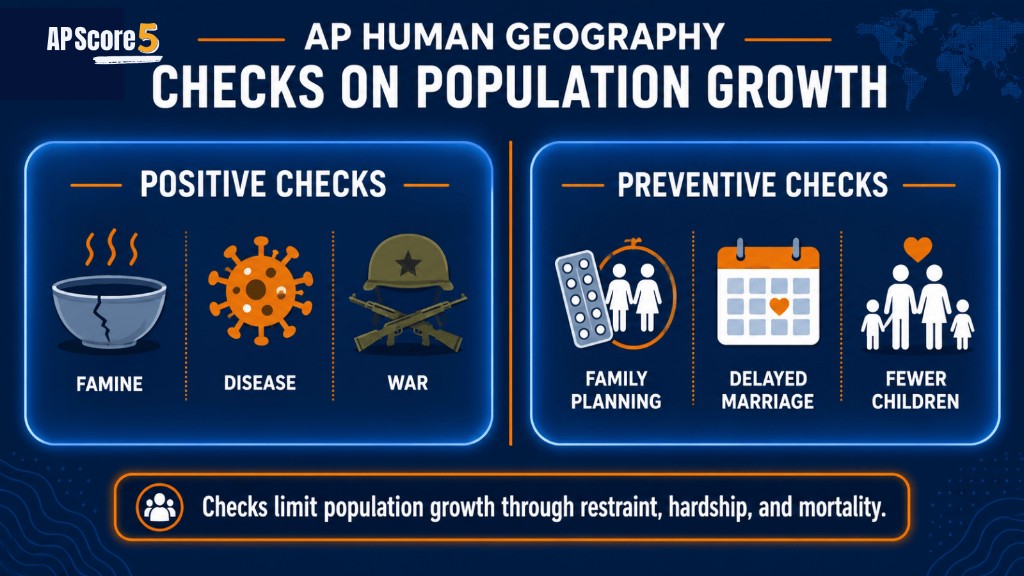
| Check type | What it affects | Examples |
|---|---|---|
| Positive check | Raises death rate | Famine, disease, war, natural disaster |
| Preventive check | Lowers birth rate | Delayed marriage, fewer children, moral restraint, family planning |
Family-planning programs illustrate why labels matter. A government clinic that lowers births is a preventive check in Malthusian language, even if the program is voluntary and supported today as human rights policy. A cholera outbreak that raises deaths is a positive check—even though public health workers would never call it positive in everyday speech.
War and conflict appear often as positive checks in historical examples. When fighting destroys farms and markets, mortality can rise while food access collapses. Strong answers name war as a check on population pressure while noting that modern famines still involve blockades, price spikes, and governance failures beyond Malthus’s original farm-output focus.
Real-world examples of Malthusian pressure
Irish Potato Famine (1845–1852)
Population had grown rapidly; diets depended heavily on one crop. Potato blight destroyed harvests—about one million died and about one million emigrated. Caveat: British policy and continued food exports also shaped the crisis.
Pre-industrial Europe
Recurring famines and disease episodes (including eras after the Black Death) showed how mortality could reset population when harvests failed—before industrial agriculture spread.
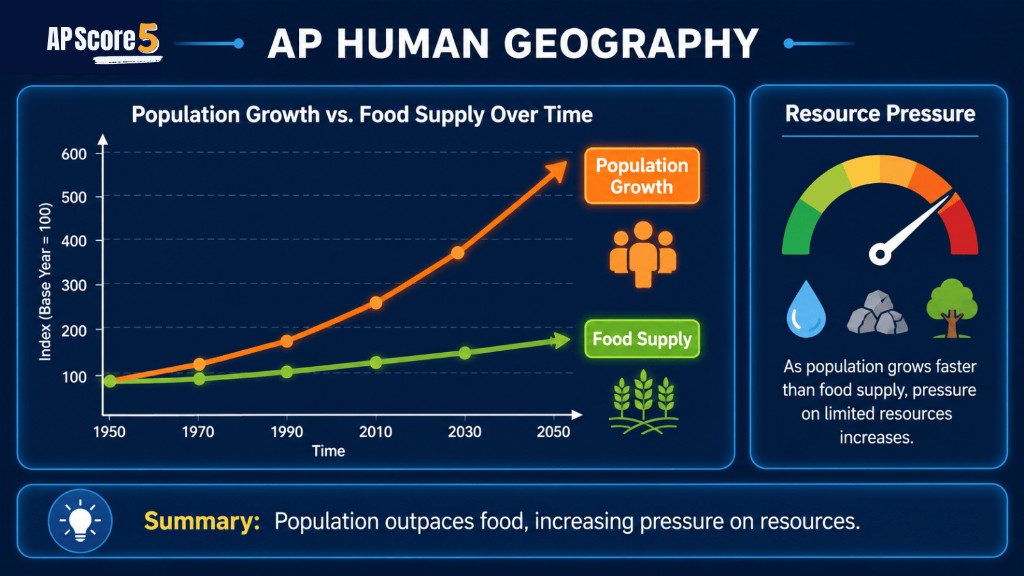
Sub-Saharan Africa and South Asia sometimes appear in prompts about rapid natural increase and food insecurity. A Malthusian reading would stress youth-heavy age structures, pressure on arable land, and risk when rainfall fails. A critical reading would add global trade, colonial land tenure, and investment in irrigation—showing you understand the model without treating hunger as inevitable.
Migration can follow Malthusian pressure when local food production fails. People leave rural districts when harvests collapse or when wages cannot keep pace with household size. Link migration to Unit 2 push factors: environmental stress, economic need, and instability after resource shocks.
AP Human Geography application
| AP HUG topic | How Malthusian Theory connects |
|---|---|
| Population growth | Rapid growth can strain resources when food or jobs lag. |
| Carrying capacity | Places may exceed the resources available to support people. |
| Migration | Resource pressure can push people to leave distressed regions. |
| Food security | Food supply is central to whether growth feels “safe.” |
| Development | Wealth, technology, and governance change whether Malthusian pressure bites. |
AP Exam Lens
- What College Board wants: Malthus is a population–resource model, not a complete theory of poverty.
- MCQ clues: famine, rapid population growth, food supply, carrying capacity.
- FRQ pattern: define → apply → example → limitation.
- Trap answer: calling every famine “Malthusian” when distribution and policy also matter.
When a free-response prompt asks you to compare models, place Malthus on the “limits and checks” side and the Demographic Transition Model on the “development changes birth and death rates” side. They answer different questions: Malthus explains resource pressure; DTM explains long-run demographic change as societies industrialize.
For exam-only drills—MCQ clue words, the Define → Apply → Example → Limitation FRQ formula, and fifteen scored practice questions—see Malthusian theory in AP Human Geography.
20 Malthusian Theory flashcards
Every 5th card shows an ad placeholder. The next arrow stays disabled for 3 seconds after an ad card. Shuffle once, then run the deck again after the practice quiz—vocabulary sticks when you alternate recall and application.
Watch for cards that pair terms together: geometric growth with arithmetic growth, positive with preventive, Malthus with Boserup. Those pairs mirror the comparison MCQs College Board favors in Unit 2.
Criticism of Malthusian Theory
Underestimated technology
The Green Revolution, mechanized farming, irrigation, and GMOs let food output grow faster than arithmetic in many regions.
Ignored the demographic transition
As countries develop, birth rates often fall without famine—voluntary preventive checks at scale.
Ignored trade
Food now moves globally; local population can exceed local farm output when imports work.
Hunger is not only shortage
Distribution, conflict, and inequality explain many modern famines more than total calories produced.
Industrial Europe is the classic case study for “Malthus was wrong.” Mechanization, crop rotation, transport, and later the Green Revolution raised output per worker. Urbanization and women’s education lowered desired family size—a preventive check Malthus hoped for but did not forecast at global scale. Use that history when an MCQ asks why his nineteenth-century timeline failed.
Even critics acknowledge Malthusian warnings in specific places and years: drought-prone regions, conflict zones, and communities without safety nets. The exam rewards nuance—technology delayed many crises, but vulnerability remains where governance and equity lag.
Boserup: the opposite argument
Ester Boserup flipped Malthus: population pressure on land can push societies to innovate—terracing, double-cropping, new seeds—rather than collapse. Same crowded fields, opposite predicted outcome. On FRQs, name which lens fits the evidence: scarcity crisis (Malthus) or intensification (Boserup).
Read the full comparison: Malthusian Theory vs Boserup TheorySide-by-side prompts, examples, and practiceBoserup studied agricultural change in developing countries where population density rose. She argued that scarcity pushed farmers toward more labor-intensive methods and new techniques. Use Boserup when the stimulus mentions irrigation terraces, shorter fallow periods, or adoption of improved seeds—not when the stimulus shows famine with no innovation response.
Neo-Malthusian Theory preview
Neo-Malthusians apply Malthus’s logic beyond food alone: water, energy, land, climate, and biodiversity can limit growth even when calories keep up. The original warning is updated for modern environmental limits and policy debates.
Read more: Neo-Malthusian TheoryEnvironmental limits and AP exam framingNeo-Malthusian thinkers often appear in prompts about climate, water stress, or biodiversity loss. You can agree that Malthus was wrong about immediate famine in every industrial country while still arguing that resource ceilings matter at global scale. That distinction shows mature geographic reasoning on the exam.
Common student mistakes
- Thinking Malthus only meant “too many people.” The theory is about the gap between population growth and food growth—not headcount alone.
- Calling positive checks “good.” Malthus meant they actively raise death rates.
- Confusing positive vs preventive. Positive raises deaths; preventive lowers births.
- Treating the theory as fully proven. Technology and trade have repeatedly delayed the predicted catastrophe.
- Forgetting Boserup or Neo-Malthusian on FRQs. Strong answers compare population–resource models instead of stopping at Malthus.
Build a one-page review sheet with the growth sequences (2-4-8 vs 2-4-6), two check examples each, one famine case with a policy caveat, and one sentence on the Green Revolution. Review that sheet the night before any Unit 2 test so the models stay separate in memory.
15 AP-style practice questions
Work through all fifteen questions at least once before test day. Read every explanation—even when you guess correctly—so you learn whether the trap was vocabulary (positive vs preventive) or application (Europe vs a high-growth country today). Ads appear after questions 5, 10, and 15; wait for the countdown before advancing.
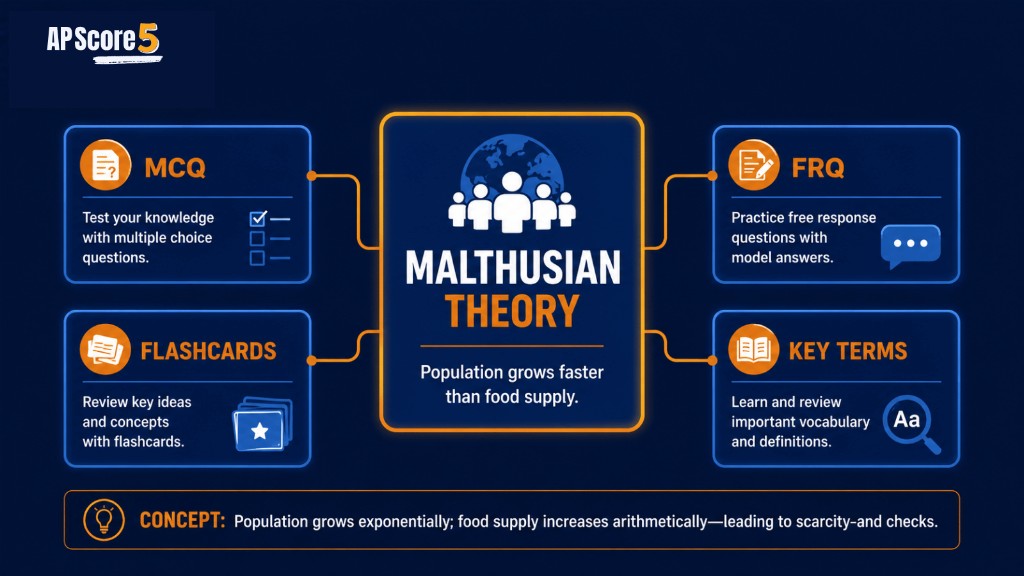
FRQ skill: Define → Apply → Example → Limitation
Malthusian Theory argues that population grows geometrically while food supply grows arithmetically, eventually triggering positive or preventive checks. In a region with rapid population growth and limited farmland, Malthus would predict rising pressure on food supply and possible famine. The Irish Potato Famine of the 1840s is often used as an example, when rapid population growth and dependence on one crop ended in mass starvation and emigration. A key limitation is that the theory underestimates agricultural technology—the Green Revolution, for instance, dramatically boosted yields and delayed the catastrophe Malthus predicted.
Practice writing this paragraph in under eight minutes. Underline your four moves: define (geometric vs arithmetic), apply (scenario), example (named place or event), limitation (technology, trade, or alternate theory). Graders look for all four parts even when the prompt does not list them as bullet points.
More Malthusian Theory guides
Final takeaway
- Population grows geometrically (2, 4, 8, 16); food grows arithmetically (2, 4, 6, 8).
- When population outruns food, positive checks (deaths) or preventive checks (fewer births) restore balance.
- Malthus underestimated technology, trade, and the demographic transition.
- Boserup flipped the argument: pressure can drive innovation.
- Neo-Malthusians extend the warning to water, energy, land, and climate.
Return to this recap after flashcards and the fifteen practice questions. If you can explain the gap between geometric and arithmetic growth aloud in one minute, you are ready for comparison prompts with Boserup and Neo-Malthusian Theory on the same Unit 2 assessment.
Malthusian Theory Review Slides
Frequently asked questions
What is Malthusian Theory in AP Human Geography?
Malthusian Theory argues that population tends to grow faster than food supply. Thomas Malthus (1798) claimed population grows geometrically (2, 4, 8…) while food grows arithmetically (2, 4, 6…), producing crises relieved by positive checks (higher death rates) or preventive checks (lower birth rates). On the AP exam it is a core Unit 2 population–resource model.
Who was Thomas Malthus?
Thomas Malthus (1766–1834) was a British economist and Anglican minister. He published An Essay on the Principle of Population in 1798, arguing that unchecked population growth would outrun food production unless checks restored balance.
What is the difference between geometric and arithmetic growth?
Geometric growth multiplies each step (2, 4, 8, 16)—Malthus applied this to population. Arithmetic growth adds a constant (2, 4, 6, 8)—Malthus applied this to food supply. The widening gap between the two curves is the heart of his prediction.
What are positive checks in Malthusian Theory?
Positive checks raise the death rate when population pressure builds. Examples include famine, disease, war, and natural disaster. Malthus used positive to mean the check actively increases deaths—not that the outcome is good.
What are preventive checks in Malthusian Theory?
Preventive checks lower the birth rate before a crisis peaks. Examples include delayed marriage, moral restraint, fewer children, and modern family planning. They restore balance by slowing population growth rather than raising deaths.
What is an example of Malthusian Theory?
The Irish Potato Famine (1845–1852) is often cited: rapid population growth, dependence on one crop, and mass starvation when blight hit. Strong AP answers also note British policy, exports, and distribution—not food shortage alone.
Why did Malthus's prediction not come true in industrial Europe?
Mechanized agriculture, trade, and urbanization increased food faster than Malthus expected, while smaller families and later marriage lowered births. The demographic transition added voluntary fertility decline he did not fully anticipate.
How does Malthusian Theory differ from Boserup Theory?
Malthus sees population pressure leading to scarcity and crisis; Boserup sees the same pressure spurring agricultural innovation and intensification. Same crowded landscape—opposite predicted outcomes on the AP exam.
What is Neo-Malthusian Theory?
Neo-Malthusians update Malthus for modern environmental limits: water, energy, land, climate, and biodiversity—not only food. They warn that technology may delay but not remove resource ceilings.
How is Malthusian Theory tested on the AP Human Geography exam?
MCQs use clue words like famine, rapid growth, food supply, and carrying capacity. FRQs reward define → apply → example → limitation, often paired with the Demographic Transition Model or Boserup as a contrast.