1. Which of the following best explains why Thomas Malthus proposed his population theory in the late 18th century?
EasyAnswer: A. Population grows geometrically while food grows arithmetically — without checks, population outstrips food.
AP Human Geography · Unit 2
Unit 2 cluster · Page 2 of 4 · ~12 min read · 12–17% of AP exam
This page is your exam playbook—not a repeat of the full theory lesson. Learn how Malthusian Theory shows up on MCQs and FRQs, which clue words to watch for, and how to earn the limitation point every time.
Malthusian Theory on the AP Human Geography exam means recognizing when population growth outruns food supply, naming positive or preventive checks, and—on FRQs—always closing with a limitation such as technology, trade, or Boserup-style innovation.
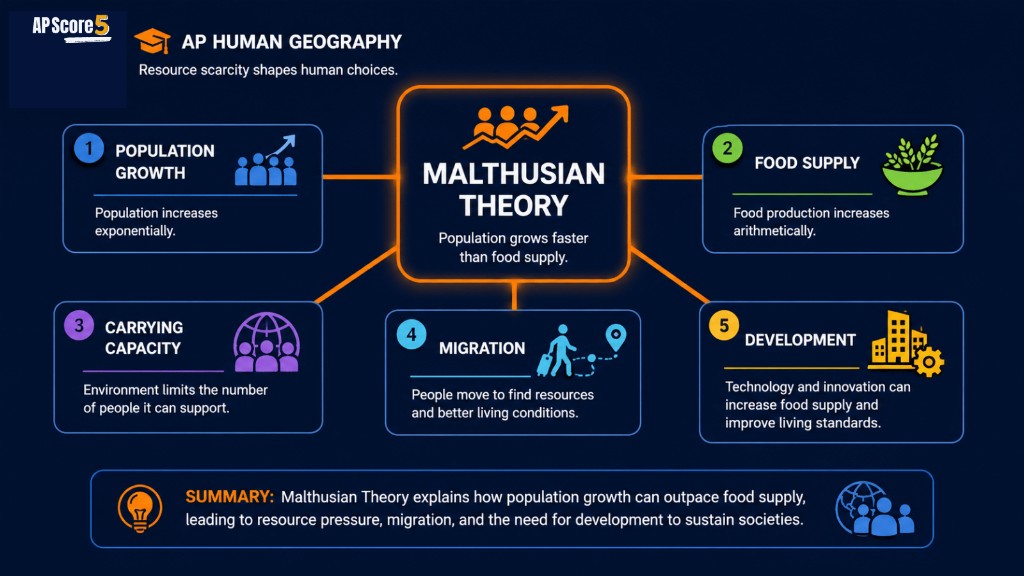
Malthusian Theory on the AP Human Geography exam is Thomas Malthus’s claim that population can grow faster than food supply unless positive checks (raising deaths) or preventive checks (lowering births) restore balance. Examiners test whether you can spot that mechanism in scenarios and whether you acknowledge limits such as technology or Boserup-style innovation on FRQs.
College Board treats Malthus as a core Unit 2 population–resource model. You are not asked to defend every prediction Malthus made in 1798; you are asked to read a stimulus, decide whether population pressure on food fits, and write in geographic language. That distinction matters: a strong answer names the mechanism (faster people growth, slower food growth, then a check), not a slogan like “overpopulation is bad.”
On multiple-choice items, Malthusian Theory competes with Boserup, Neo-Malthusian updates, and the Demographic Transition Model. Your first job is to match clue words to the right lens. Famine, food shortage, carrying capacity, and rapid natural increase with strained farmland point toward Malthus. Irrigation, intensification, terracing, and “population pressure led farmers to innovate” point toward Boserup. Water scarcity plus climate vocabulary often signals Neo-Malthusian reasoning. Falling birth and death rates together signal DTM—not Malthus alone.

Free-response prompts often describe a country with rapid population growth and limited agricultural land. The rubric typically awards one point for definition, one for application, one for a named example, and one for a limitation. Students who stop after application leave a full point on the table. One sentence on the Green Revolution, global trade, or Boserup is usually enough—if it is specific to the region in the prompt.
Before test day, say the four-step FRQ formula aloud once: define, apply, example, limitation. Pair that habit with the clue-word activity on this page so MCQs and FRQs use the same vocabulary. When you finish the fifteen practice questions below, revisit the Page 1 theory guide only for concepts you still confuse—not to reread everything.
Malthus sits in the population–resource block alongside carrying capacity, food security, and debates about growth limits. It connects forward to migration when resource failure pushes people out of origin regions, and backward to mortality decline when the epidemiological transition model lowers deaths before births fall—widening the gap Malthus warned about.
The Demographic Transition Model explains long-run stage change; Malthus explains short-run pressure when food cannot keep pace. Many stimuli show a country moving from Stage 2 toward Stage 3 while still facing hunger in rural districts—your answer can mention DTM for the rate trend and Malthus for the food strain in the same paragraph without contradicting yourself.
Carrying capacity appears on exams with Malthus more than with any other Unit 2 model. Define it as the maximum population an environment can support at a given standard of living, then name which resource is binding in the prompt (usually food on classical Malthus items). When the passage mentions innovation or intensification, pivot to Malthusian Theory vs Boserup Theory comparison language instead of insisting only on famine.
Neo-Malthusians broaden the resource list beyond calories. If an item mentions water stress, climate refugees, or ecological footprint, consider Neo-Malthusian Theory as the limitation or counter-frame after you apply classical Malthus to food. That layered answer matches how College Board writes synthesis questions.
Population pyramids with wide youth bases signal future food demand; link pyramid shape to Malthusian pressure only when the stimulus also mentions farmland limits or food prices—not from pyramid shape alone.
Return to the AP Human Geography Unit 2: Population and Migration hub when you want mixed practice across pyramids, migration, and the DTM—not only Malthus. Use daily AP practice to keep Unit 2 models separate in memory after you study this cluster.
Memorize four anchors: geometric vs arithmetic growth, positive vs preventive checks, the FRQ four-step formula, and one limitation sentence (technology, trade, or Boserup). If you can recite those without notes, you can earn most Malthus points on a typical exam form.
| Fact | What to write on the exam | Why it scores |
|---|---|---|
| Growth contrast | Population grows geometrically; food grows arithmetically | Shows you know Malthus’s mechanism, not only “too many people” |
| Positive check | Raises death rate (famine, disease, war) | MCQs often list four events—only some raise deaths |
| Preventive check | Lowers birth rate (delayed marriage, fewer children) | Distinguishes policy/family choices from mortality crises |
| FRQ sequence | Define → Apply → Example → Limitation | Matches rubric language on released scoring notes |
| Top example | Irish Potato Famine (with nuance) | Named place + event earns the example point |
| Top limitation | Green Revolution / Boserup intensification | Shows you know critics, not only the 1798 essay |
Checklist before you move on:
When terms blur together during cumulative review, say each “exam clue” aloud—positive check, preventive check, carrying capacity—before you read answer choices on practice sets.
The exam-ready definition: Malthusian Theory argues that population grows geometrically while food supply grows arithmetically, creating periodic crises restored through positive checks (raising deaths) or preventive checks (lowering births).
After the definition sentence, add one clause tying the prompt’s region to the mechanism: “In Country X, rapid natural increase on limited arable land widens the gap between population and food, increasing famine risk—a Malthusian pattern.” That second sentence is application, not a second definition—keep them distinct so graders see both rubric steps.
If the prompt asks you to compare theories, give Malthus’s definition in sentence one and Boserup’s in sentence two; do not blend them into one hybrid theory. The comparison page walks through side-by-side wording when you need more than one sentence.
When a stem mentions famine, food shortage, rapid population growth outpacing agriculture, carrying capacity, resource pressure, positive check, preventive check, or overpopulation tied to food—not technology fixes—the best answer is usually Malthusian Theory.
| Clue word or phrase | Likely model | Quick reasoning |
|---|---|---|
| Famine, starvation, food riot | Malthus | Positive check / food crisis language |
| Carrying capacity exceeded (food) | Malthus | Classic population–food limit |
| Irrigation, terracing, double-cropping | Boserup | Intensification response to pressure |
| Green Revolution, high-yield seeds | Often limitation to Malthus | Technology delayed the crisis |
| Water scarcity, climate migration | Neo-Malthusian | Resource beyond food only |
| Birth and death rates both falling | DTM | Stage change, not food arithmetic |

Read the outcome clause before you bubble. If population pressure leads to crisis, think Malthus. If pressure leads to innovation, think Boserup. If the question asks what Malthus would predict after new farming technology reduces famine, the answer often involves reduced positive checks—not praise for technology as Boserup’s main idea.
Work five MCQs below after you scan the table. Time yourself: thirty seconds per question once you know the clues—exam pacing matters as much as content on Unit 2.
Define → Apply → Example → Limitation
Each step maps to a rubric point on typical AP Human Geography population FRQs. Missing the last step is the most common reason students lose a point they could have earned in ten seconds.
| Step | What to write | Sample clause |
|---|---|---|
| 1. Define | Geometric vs arithmetic + checks | “Malthus argued population can outrun food unless checks restore balance.” |
| 2. Apply | Link mechanism to the prompt region | “In the Sahel, rainfall variability and high NIR strain rain-fed yields.” |
| 3. Example | Named place and event | “The Irish Potato Famine is often cited as a Malthusian food crisis.” |
| 4. Limitation | Technology, trade, or Boserup | “The Green Revolution increased yields, delaying Malthusian crisis in parts of Asia.” |

Practice writing step 4 even when the prompt does not say “evaluate.” Graders often award the limitation point whenever you show you understand the model is debated. Mentioning Boserup by name is high-yield: “Boserup argued population pressure can drive agricultural innovation, as in the Green Revolution, which complicates a strict Malthusian prediction for Country X.”
Strong answers name the food–population mechanism, apply it to the named region, give one real example, and add a limitation. Weak answers use vague words like “overpopulation,” ignore checks, or treat Malthus as always correct with no technology or trade counterpoint.
| Weak pattern | Strong replacement |
|---|---|
| “Malthus was right about everything.” | “Malthus explains food pressure in X, but Y technology/trade delayed crisis.” |
| “Too many people” with no food mention | Geometric vs arithmetic or carrying capacity tied to agriculture |
| Lists famine only, no check type | Names positive check (famine) or preventive check (policy) |
| Stops after definition | Four-step formula through limitation |
| Uses Boserup example for Malthus MCQ | Matches clue words to the model the outcome describes |
When comparing Malthus and Boserup on the same FRQ, spend equal length on each theory. A common weak structure is two sentences on Malthus and one vague line on Boserup. Balance earns comparison points; imbalance signals you memorized only one side.
Name a specific place and food-related crisis, then add one nuance sentence on politics, trade, or technology. The Irish Potato Famine is the standard high-scoring example; the Sahel, Bangladesh floodplain pressure, and historical European grain riots also work when tied to food supply.
Often cited as Malthusian because blight destroyed a staple crop while population depended on potatoes. Strong answers note British export policy and inequality—not population alone.
Rapid natural increase plus variable rainfall can outpace rain-fed farming—Malthusian framing. Add aid, trade, and improved seeds as limitations.
Dense population on fertile but hazard-prone land faces food risk when floods disrupt harvests—link to carrying capacity and positive checks.
Malthus predicted crisis; mechanized farming and preventive checks partly broke the prediction—use as limitation evidence, not proof he was fully right.
For full historical detail on checks and growth curves, use Page 1: Malthusian Theory real-world examples. On the exam, two sentences per example beat one long paragraph with no named place.
After you miss a practice question, label the trap type from this list in the margin. That habit builds faster review than rereading the whole guide.
Read each scenario and pick Malthus, Boserup, Neo-Malthusian, or DTM. Choices shuffle each time. Use wrong answers to revisit the MCQ clue table above.
Question 1 of 6
Review the MCQ clue table, then try the fifteen practice MCQs below.
Fifteen questions mirror released Unit 2 patterns: definition, checks, clue words, European industrial history, Irish Famine nuance, and comparison with Boserup or Neo-Malthusian ideas. Click an answer to reveal the explanation. Choices shuffle at display time.
Mix this set with daily AP practice so Malthus does not blur with migration or pyramid questions in your memory.
1. Which of the following best explains why Thomas Malthus proposed his population theory in the late 18th century?
Easy2. Which is an example of a positive check in Malthusian Theory?
Easy3. Which is an example of a preventive check?
Easy4. Malthus's term 'positive check' means:
Easy5. Malthusian Theory belongs to which AP HUG unit?
Easy6. A country develops new farming technologies that stabilize and increase food supply. According to Malthusian Theory, which of the following would best explain those results?
Medium7. Malthusian Theory would best explain which of the following?
Medium8. Which clue word in an MCQ most strongly signals Malthusian Theory rather than Boserup?
Medium9. In the early Industrial Revolution, Malthus argued population would outrun food supply. Which best explains why his prediction did not hold in 1800s Europe?
Medium10. What statement correctly explains why Malthus's prediction did not come true in 1800s Europe?
Medium11. A student writes on an FRQ: 'Malthus said population growth will always cause famine.' What is the strongest correction?
Hard12. On an AP FRQ asking you to apply Malthusian Theory to a region with rapid population growth, the highest-scoring response would:
Hard13. The Irish Potato Famine is often cited as a Malthusian example. What caveat should a strong AP FRQ response include?
Hard14. Which AP HUG model is most often paired with Malthusian Theory on FRQs that ask for comparison?
Hard15. A modern Neo-Malthusian would most likely argue in an FRQ that:
HardOutline answers using the four-step formula. Graders award partial credit when steps are clear even if prose is short.
Prompt: Explain how Malthusian Theory applies to a country with high natural increase and rain-fed agriculture vulnerable to drought.
Rubric (4 points): (1) Define geometric/arithmetic or checks. (2) Apply drought + population pressure to food. (3) Named example (e.g., Sahel). (4) Limitation—aid, improved seeds, or Boserup intensification where investment exists.
Prompt: Compare Malthusian and Boserup perspectives on rapid population growth in a river valley.
Rubric (4+ points): (1) Malthus prediction (crisis/checks). (2) Boserup prediction (intensification). (3) Apply both to valley farming. (4) Judgment which fits evidence OR layered “both partial” synthesis.
Prompt: A government expands irrigation and high-yield seeds. Explain outcomes using Malthusian Theory.
Rubric (4 points): (1) Define positive/preventive checks. (2) Apply: technology reduces positive checks (fewer famine deaths). (3) Example (Green Revolution region). (4) Limitation—water depletion, inequality, or Neo-Malthusian costs.
Read sample student responses on the Malthus vs Boserup comparison guide when you need full paragraph models for comparison prompts.
Check each line when you can do it without notes. When all five are checked, return to the Unit 2 hub for mixed topics.
0 of 5 ready
Malthusian Theory appears on AP HUG in two ways. On MCQs, it shows up as definition questions or scenario questions about famine, food shortage, carrying capacity, and rapid population growth. On FRQs, students must apply the theory to a region and acknowledge one limitation — technology, trade, or Boserup-style innovation.
The exam-ready definition is: Malthusian Theory argues that population grows geometrically while food supply grows arithmetically, creating periodic crises restored through positive checks (raising deaths) or preventive checks (lowering births).
Define → Apply → Example → Limitation. Define the theory. Apply it to the scenario in the prompt. Give one real-world example (Irish Potato Famine is the most common). Acknowledge one limitation — usually technology, the Green Revolution, trade, or Boserup. Each step earns one rubric point.
Famine, food shortage, rapid population growth, carrying capacity, resource pressure, positive check, preventive check, and overpopulation. If the question mentions agricultural innovation or intensification, the answer is Boserup, not Malthus.
Forgetting the limitation on FRQs. Students often define the theory and apply it but stop there. Adding one sentence about technology, trade, contraception, or Boserup-style innovation usually earns the final rubric point.
The Irish Potato Famine of 1845–1852 is the most-cited example. Use it carefully — say "often cited as Malthusian" and note that real famines also involve politics, trade, and inequality. That nuance earns extra credit.
Yes — Boserup is the most common limitation example. Saying "Boserup argued that population pressure can drive agricultural innovation rather than crisis, as shown by the Green Revolution" gives you the limitation point.
Malthus is part of Unit 2: Population and Migration, which is 12–17% of the exam. Malthusian theory itself usually appears in 1–2 MCQs per exam and is a common FRQ topic — appearing on most exams in some form since 2016.