What is a population pyramid?
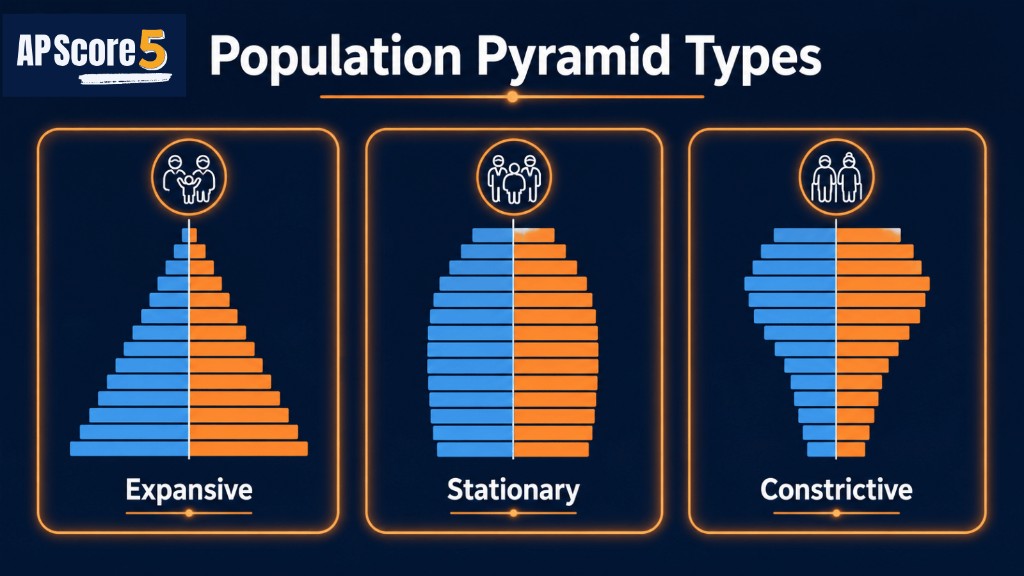
The parts of a population pyramid
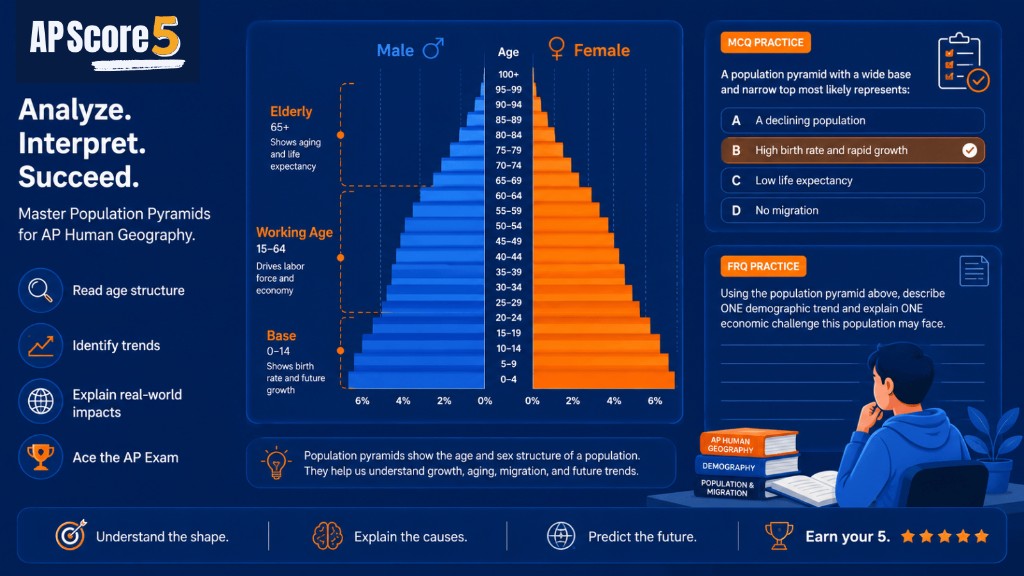
Before you interpret a country's story, locate the five structural pieces geographers always name on the exam. Use the diagram below, then expand each part in the list.
On stimulus questions, graders assume you know which band is the base, which is working age, and which side is male versus female. Mislabeling a section wastes time and can flip your conclusion about growth or aging.
Think of the pyramid as a snapshot of cohorts moving upward through time. A large cohort of ten-year-olds today becomes the working-age bulge twenty years later unless mortality or out-migration removes them.
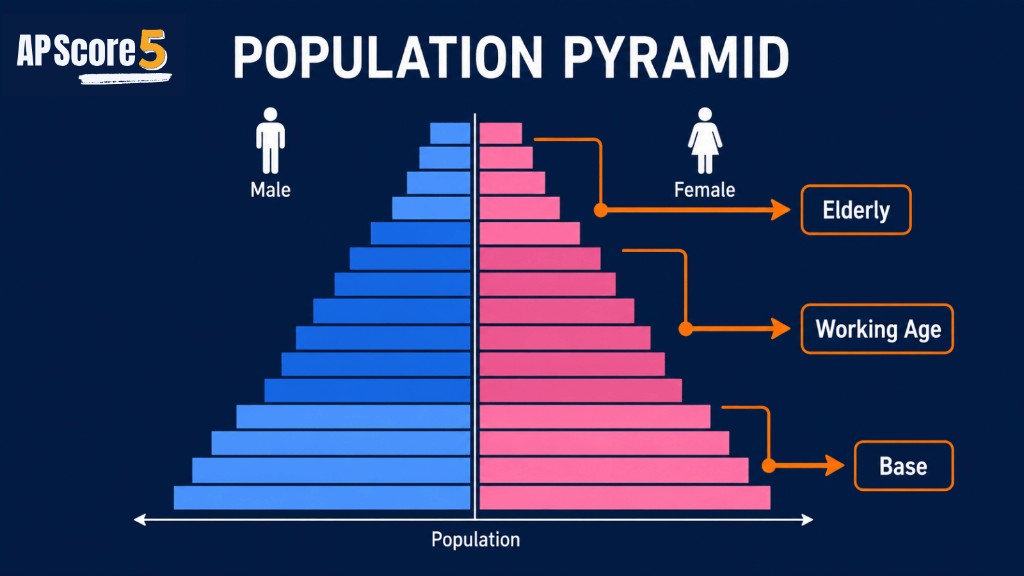
Base
The widest bars sit at the bottom and represent the youngest age groups. A wide base signals a high birth rate and many children relative to the total population. A narrow base signals low fertility and fewer young dependents entering the system.
Middle
The middle bands represent working-age people, roughly ages 15–64. A thick middle means a large workforce relative to dependents. That can create a demographic dividend if jobs and investment keep pace with the bulge.
Top
The top bars show the elderly population, usually ages 65 and older. A wide top means longer life expectancy and an aging society. That raises demand for health care, pensions, and elder services.
Left side (males)
The left side lists male cohorts by age. Comparing bar length to the right side reveals sex ratio imbalance. Missing young adult males may reflect war casualties, labor out-migration, or selective mortality.
Right side (females)
The right side lists female cohorts. Uneven sides can reflect migration patterns, conflict, or cultural preferences that change the balance of men and women at specific ages.
Why this matters: Every AP HUG question about pyramids starts with one of these parts. Read it first, then connect it to a cause.
When you are ready for exam-style prompts, continue to population pyramids AP Human Geography (Step 2) or drill the five-question diagnostic on this page.
What can you read from the shape?
Shape is evidence, not decoration. The table below links visible patterns to demographic meaning. Use it as a checklist before you write any free-response paragraph.
| Pattern in the graph | What it tells you |
|---|---|
| Wide base | High birth rate; likely rapid future growth |
| Narrow base | Low birth rate; slowing or shrinking population |
| Wide top | Aging population; longer life expectancy |
| Working-age bulge | Possible demographic dividend |
| Missing male cohort | War, labor migration, or selective mortality |
| Indentation in young adults | Past baby bust or migration wave |
| Rectangular shape | Stable population near replacement-level fertility |
Patterns rarely appear alone. A wide base plus a sudden pinch in young adults might mean a past baby bust layered on top of still-high fertility — read cohorts as history, not just a snapshot.
When a prompt gives both a pyramid and crude birth or death rates, your written answer should reconcile both sources. If the table and the graph disagree, explain which measure is more current or which reflects migration.
See the full step-by-step method in how to read population pyramids (Step 3 of this mini-course).
Why pyramids matter in AP HUG Unit 2
Unit 2 — Population and Migration — carries a large share of multiple-choice items and appears often on free-response questions. Population pyramids compress birth rates, death rates, aging, and sometimes migration into one visual, which is why College Board stimuli love them. If you only memorize labels like expansive, you will miss questions that ask for consequences such as school construction, pension stress, or guest-worker policy.
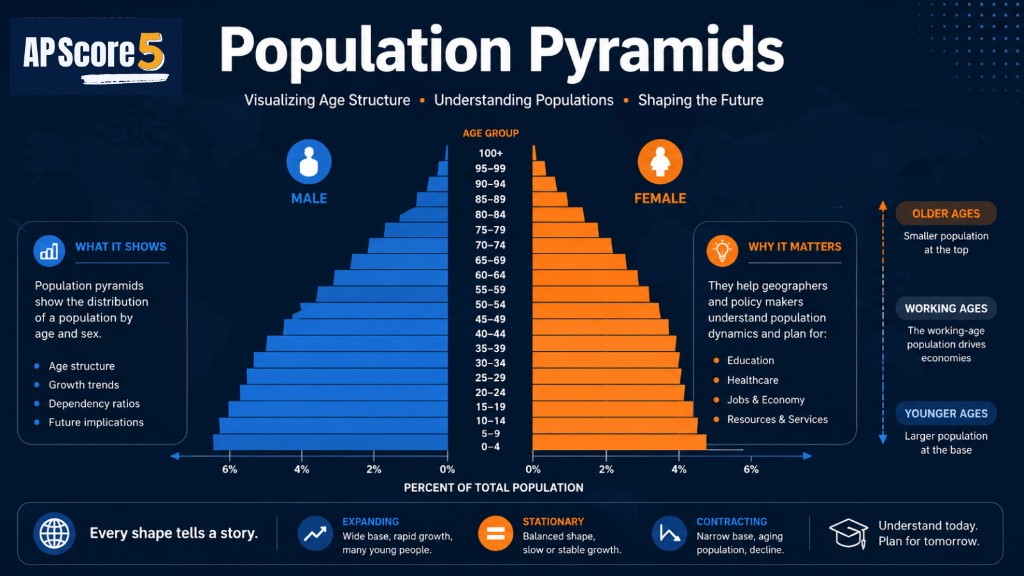
Each population pyramid shape lines up with a stage of the Demographic Transition Model, so reading the shape tells you the stage. Stage 2 societies usually show a very wide base; late Stage 3 and Stage 4 move toward straighter sides; Stage 5 discussions often feature a pinched base and a heavy top. Pair pyramid reading with crude rates when the prompt gives numbers — the graph and the rates should tell the same story.
Dependency ratios connect directly to pyramid geometry. A wide base raises youth dependency; a wide top raises elderly dependency. Demographic momentum explains why population can keep growing after fertility falls: a large share of people may already be in childbearing years. A bulging middle can signal a demographic dividend, but only if economies create jobs for that cohort — the pyramid shows potential, not guaranteed wealth.
Migration also writes itself into age-sex structure. Missing young adult males may reflect guest-worker out-migration; sudden additions in working ages may reflect immigration. Ravenstein-style patterns and push-pull vocabulary belong in the same paragraph when the pyramid shows uneven sides or odd indentations. Compare your read to Unit 2 Overview notes on migration effects when a prompt blends movement with composition.
Population policies show up as future pyramid changes. Pronatalist incentives may slowly widen the base; antinatalist rules can pinch young cohorts for decades. Link policy examples to Malthusian Theory when a question asks whether growth outruns resources — pyramids show composition, while Malthus debates limits.
The three main shapes
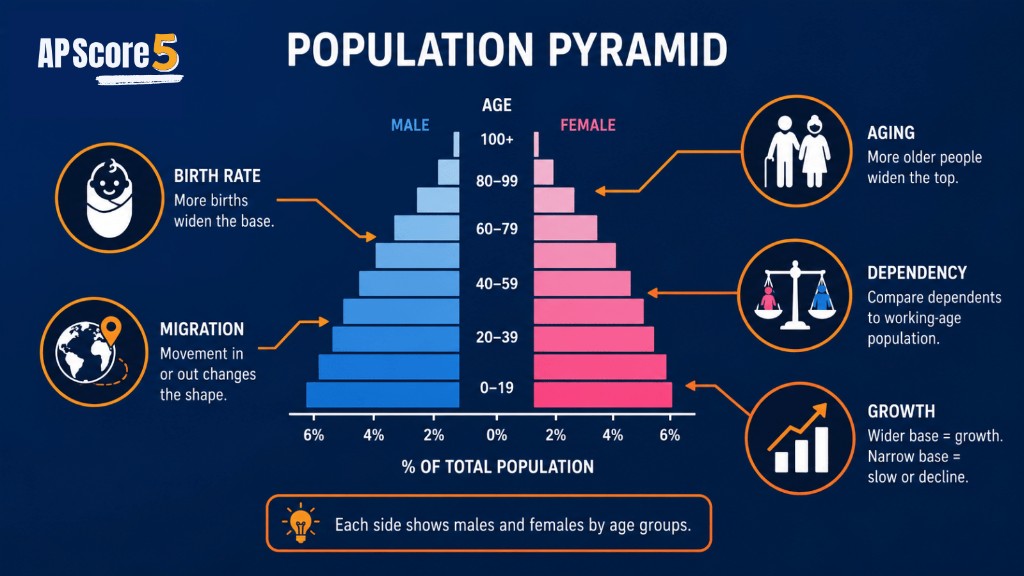
Geographers group most exam pyramids into three silhouettes. Learn the thumbnail, then open the deep comparison on Step 4.
Expansive
Wide base, narrow top — rapid growth. Maps to DTM Stage 2 or early Stage 3.
Stationary
Roughly rectangular — slow or stable growth. Maps to late Stage 3 or DTM Stage 4.
Constrictive
Narrow base, wider middle and top — aging and possible decline. Maps to Stage 4 or DTM Stage 5.
Full comparison, country examples, and a matching quiz live on types of population pyramids.
Connect shapes to theory: Malthusian Theory debates limits on growth, while the Demographic Transition Model explains why birth and death rates changed historically.
5-question diagnostic
Quick check on the basics. Routes you to the spoke you need most.
Population pyramid vocabulary
Tap to flip. Rate "Got it" or "Practice more" to send weak cards back later.
These thirty terms cover the language AP scorers expect when pyramids appear on Unit 2 items. Flip a card, then say the definition out loud before you peek.
Strong answers use precise terms — dependency ratio, cohort, replacement-level fertility — instead of vague phrases like young country or old country.
Where AP HUG students lose points on pyramid questions
Most lost points come from confusing share of population with total population, or from naming a shape without explaining fertility, mortality, or migration.
Wide base = bigger population
The trap: Wide base = bigger population.
The truth: A wide base only means a larger share of young people, not the largest total population. Total size also depends on every other cohort and on migration.
A narrow top means everyone died young
The trap: A narrow top means everyone died young.
The truth: A narrow top can also reflect a recently formed country or recent population growth where few people have reached old age yet. Always read the base with the top.
Every gap means migration
The trap: Every gap means migration.
The truth: Gaps can also come from war, baby busts, or antinatalist policies such as historic one-child rules. Name the most likely cause for the country in the prompt.
Pyramid = always Stage 2
The trap: Pyramid = always Stage 2.
The truth: Expansive pyramids cluster around Stage 2 and early Stage 3, not Stage 2 alone. Falling birth rates can narrow the base while growth continues from momentum.
The shape predicts when the country becomes rich
The trap: The shape predicts when the country becomes rich.
The truth: Pyramids predict demographic outcomes such as dependency and growth, not GDP. Confusing shape with wealth costs FRQ points.
Symmetrical sides mean no migration
The trap: Symmetrical sides mean no migration.
The truth: Migration may still happen; the pyramid may not show it unless flows are large and sex-selective enough to carve out a cohort gap.
Drill traps with forty practice MCQs or jump to population pyramids AP Human Geography for exam framing.
Population pyramid practice questions
40 questions with rising difficulty and live scoring.
Questions mix pyramid stimuli with Unit 2 population concepts. Read every explanation — AP Human Geography rewards reasoning, not memorized letters.
After twenty questions, pause and list three terms you missed. Revisit those flashcards before you finish the set.
Practice AP HUG-style written responses
Use the Pattern → Cause → Effect formula in each answer. The full five-step reading method is on how to read population pyramids.
Scenario 1: Wide-base pyramid
Prompt: A country's pyramid has a very wide base, a thinning middle, and a small top. Identify one demographic trend shown, explain one likely cause, and predict one challenge the government will face.
Model answer (Pattern → Cause → Effect): Pattern: rapid natural increase with high youth dependency. Cause: high total fertility rate combined with falling infant mortality (common in DTM Stage 2). Effect: pressure to build schools, hire teachers, and fund child health programs while the young cohort moves through the system.
Scenario 2: Constrictive pyramid
Prompt: A country's pyramid has a narrow base and a large elderly group. Identify one demographic trend shown, explain one cause, and explain one economic consequence.
Model answer (Pattern → Cause → Effect): Pattern: aging population with low fertility and possible decline. Cause: long-term low birth rates, longer life expectancy, and limited immigration of young workers. Effect: rising pension and health-care costs with fewer workers paying into social programs unless policy or migration changes the balance.
5–10 minute daily study loop
Day 1
Learn the parts on this page, then open the population pyramids AP Human Geography exam guide (Step 2).
Day 2
Finish Step 2 and answer 10 practice MCQs with explanations.
Day 3
Open how to read population pyramids (Step 3) and run the five-step method on one sample pyramid.
Day 4
Open types of population pyramids (Step 4) and try the shape-matching practice.
Day 5
Mix flashcards and 15 MCQs; mark any term you rated Practice more.
Day 6
Write one FRQ response in eight minutes, then compare to the model answer.
Day 7
Re-take the diagnostic, then preview the Demographic Transition Model to connect rates and pyramid shape.
Track your Population Pyramids mini-course
Sign up free to save weak topics and finish all four connected guides.
Build a Unit 2 streak
Daily practice that adapts to your weak topics.
See missed terms automatically
Vocab you rate Practice more comes back more often.
Track all 4 Population Pyramid guides
Finish the mini-course and save your progress.
Frequently asked questions about population pyramids
These answers focus on what pyramids are and how to read them. For AP Human Geography exam strategy, see Step 2 of this mini-course.
What is a population pyramid?
A population pyramid is a back-to-back bar chart that shows how many males and females fall in each age group for one population at one point in time. It is also called an age-sex pyramid or age-structure diagram.
What do population pyramids show?
Population pyramids show age structure, sex ratio, likely growth or decline, youth and elderly dependency, and sometimes migration or past shocks visible as gaps or bulges in specific cohorts.
What are the 3 types of population pyramids?
The three main types are expansive (wide base, rapid growth), stationary (roughly rectangular, stable growth), and constrictive (narrow base, aging). See the full comparison on the types of population pyramids guide in this mini-course.
How do you read a population pyramid step by step?
Start with the base for fertility, compare left and right sides for sex imbalance, scan the middle for workforce size, read the top for aging, then explain what the overall shape suggests about growth or decline. The five-step method is on the how to read population pyramids guide (Step 3).
What is the difference between a population pyramid and a regular bar graph?
A regular bar graph can compare any categories. A population pyramid always compares age cohorts for males and females at the same time, with ages stacked from youngest at the bottom to oldest at the top.
How do population pyramids connect to the Demographic Transition Model?
Each stage of the Demographic Transition Model tends to produce a characteristic pyramid shape: expansive bases in high-growth stages, more rectangular shapes when birth and death rates both fall, and constrictive profiles when fertility stays low and populations age.
What does a wide base on a population pyramid mean?
A wide base means a large share of the population is young, which usually signals high birth rates and high youth dependency. Planners often expect more demand for schools and child health services when the base stays wide.
What does a narrow base on a population pyramid mean?
A narrow base means low fertility and fewer children entering the population. Over time that can mean slower growth, population decline, labor shortages, and rising elderly dependency unless migration adds younger workers.
Can population pyramids show migration?
Yes. Uneven sides, missing cohorts, or sudden bulges in working ages can reflect in-migration, out-migration, war losses, or policy effects such as guest-worker programs — if you read the shape alongside other data.
Which countries are examples of each pyramid type?
Niger and Nigeria often illustrate expansive pyramids; the United States and France are common stationary examples; Japan and Germany are widely cited constrictive, aging societies. Always tie the example to current rates, not just the silhouette.
Next: Population Pyramids on the AP HUG Exam
Keep your momentum. Page 2 turns everything you just learned into AP-style answers.