What is the difference between Malthusian Theory and Boserup Theory?
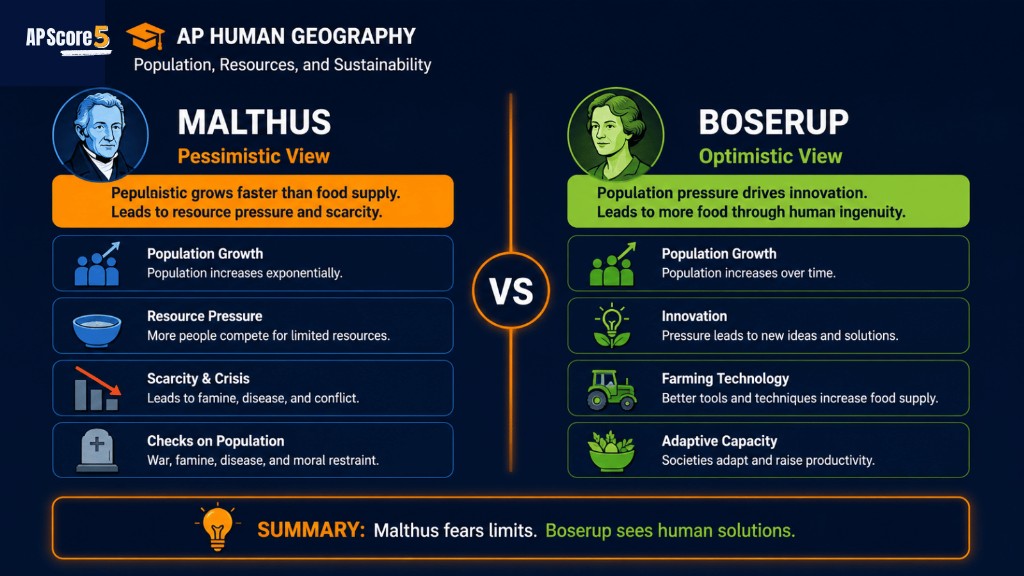
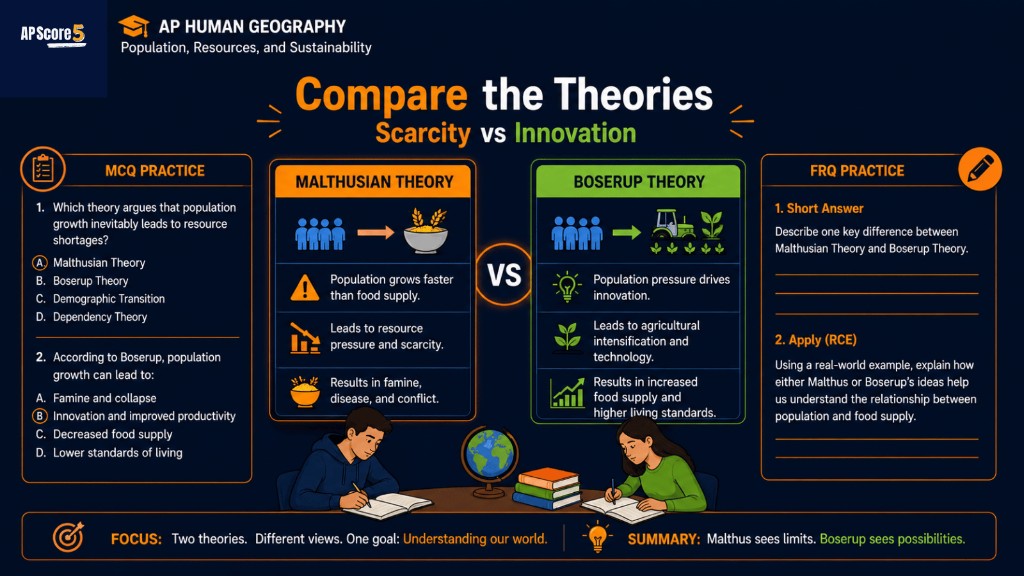
Malthusian Theory claims population outruns food, causing crisis through famine or disease. Boserup Theory claims pressure drives farm innovation so supply expands. Same trigger — Malthus = scarcity; Boserup = innovation.
Why AP HUG students confuse Malthus and Boserup
Both theories deal with population pressure, food supply, and resources. Both ask what happens when there are more people than the land easily supports. That shared starting point makes them feel interchangeable on a quick read — especially when a stimulus only mentions “rapid population growth” without saying whether famine or innovation followed.
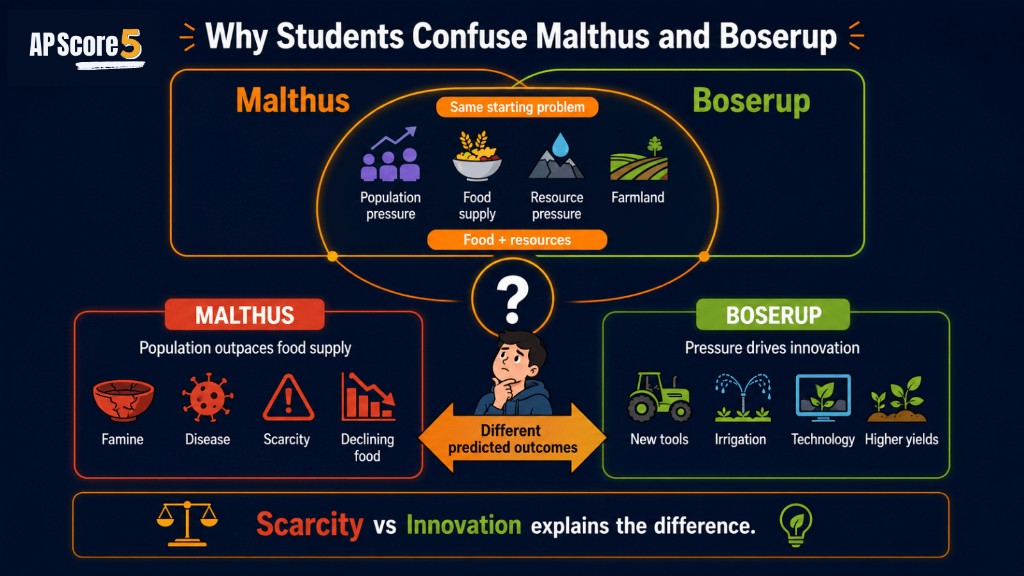
The difference is the predicted outcome. Malthus expects scarcity: food cannot keep pace, so positive checks (higher deaths) or preventive checks (fewer births) restore balance. Boserup expects adaptation: pressure forces more labor per acre, new tools, and new crops. On the exam, name what each theory predicts will happen, not just that both “study population and food.”
Students who recently studied the Demographic Transition Model sometimes lump all Unit 2 models together. DTM explains stage-based birth and death rate change; Malthus and Boserup explain resource pressure responses. Keep the models separate, then connect them when a prompt shows development lowering births while technology raises yields.
Another trap is treating Boserup as “anti-population.” She never argued that population does not matter. She argued that population pressure is the engine of change — farmers respond because they must feed more mouths on the same fields. If your FRQ says Boserup “ignored population,” graders will mark it wrong. If you say she “reinterpreted population pressure as an innovation trigger,” you are on track.
Malthusian Theory recap
Thomas Malthus published in 1798 that population tends to grow geometrically (2, 4, 8, 16…) while food grows arithmetically (2, 4, 6, 8…). When the gap widens, crisis follows — relieved by positive checks (famine, disease, war) or preventive checks (delayed marriage, fewer children). His tone is pessimistic: unchecked growth is dangerous. For geometric growth detail and check examples, use the full guide linked below.
Need the full theory? Read the complete Malthusian Theory guideDefinition, checks, examples, and 15 practice MCQsOn comparison FRQs, one sentence of Malthusian theory definition (geometric vs arithmetic) is enough before you pivot to Boserup — graders want balance, not two full biographies.
Positive checks (famine, disease, war) and preventive checks (delayed marriage, fewer children) belong on the Malthus side of your answer. If the prompt describes terracing, irrigation, or shorter fallows, move to Boserup. The full Malthusian theory guide walks through check examples with AP-style wording you can reuse in one sentence here.
Who was Ester Boserup?
Ester Boserup (1910–1999) was a Danish economist. She published The Conditions of Agricultural Growth in 1965 and argued the opposite of Malthus: when population pressure rises, humans adapt by working harder, intensifying land use, and inventing new farming methods. Her work challenged more than a century and a half of Malthusian thinking by showing innovation as a systematic response to density, not a lucky accident.
Her core claim is that necessity is the mother of invention. Crowded land does not have to mean famine. It can mean shorter fallows, more irrigation, more labor per acre, and new crops suited to tight schedules. Boserup studied farmers in Africa and Asia where density climbed — and documented terracing, multi-cropping, and tool change as rational responses.
Boserup's book
The Conditions of Agricultural Growth (1965) — challenged 167 years of Malthusian thinking with evidence that population pressure can expand food supply through intensification.
Boserup did not claim innovation is painless. She documented that intensification often requires more labor per hectare — longer hours, more irrigation maintenance, and riskier bets on a single season. That nuance helps on FRQs that ask about social costs, not only calorie totals. Compare her work to Rostow or Wallerstein only if the prompt is clearly about development stages or world-system trade — those models live in Unit 7, not this population-resource pair.
Malthusian vs Boserup: side-by-side comparison
Use this table as your exam cheat sheet. Each row is a common comparison prompt. Memorize the contrast column — AP MCQs often test tone (pessimistic vs optimistic) and process (scarcity vs intensification) before they test dates.
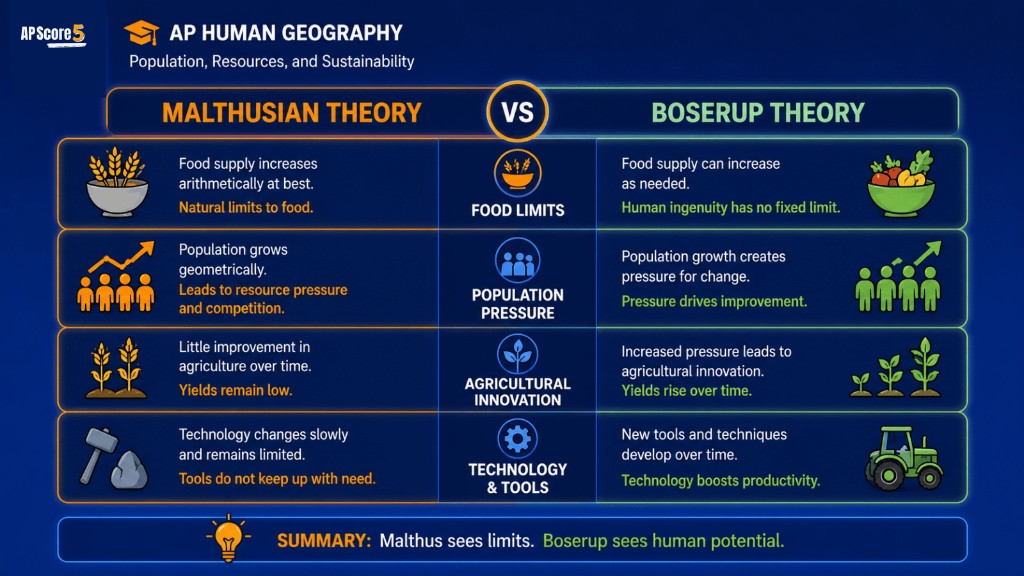
| Category | Malthusian Theory | Boserup Theory |
|---|---|---|
| Main thinker | Thomas Malthus | Ester Boserup |
| Published | 1798 | 1965 |
| Main idea | Population can outgrow food supply | Population pressure can cause innovation |
| View of population growth | Dangerous if unchecked | Can drive change |
| View of food supply | Limited and slower-growing | Can expand through innovation |
| Tone | More pessimistic | More optimistic |
| Key process | Scarcity and checks | Agricultural intensification |
| Example outcome | Famine, disease, war, lower birth rates | Irrigation, terracing, fertilizers, double-cropping |
| AP HUG connection | Overpopulation, carrying capacity, famine | Innovation, technology, land-use change |
| Main criticism | Underestimates technology | May underestimate environmental limits |
When a question pairs Malthus with migration, remember push factors: food shortage and resource strain can expel people from origin regions — a Malthusian storyline. When the same question mentions new irrigation or seed varieties, shift toward Boserup. The population pyramid shape (wide youth base) often appears in stimuli about rapid growth; use it to justify which theory fits the scenario's outcome, not just the starting population size.
Print or copy the table into your notebook and cover the right column — can you fill in Boserup from memory? Repeat with the left column hidden. Students who can recite the “key process” row (scarcity and checks vs agricultural intensification) rarely miss comparison MCQs, because those phrases appear verbatim in answer choices.
Key difference in one sentence
Two scenarios compared
Apply both lenses to the same place before you pick a winner. Examiners reward students who show Malthusian and Boserup readings of one region, then justify which fits the evidence.
| Scenario | Malthusian interpretation | Boserup interpretation |
|---|---|---|
| Population rises quickly in a region with limited farmland | Food supply cannot keep up; expect famine and pressure to migrate | Farmers switch to intensive methods — irrigation, fertilizer, double-cropping |
| A river valley becomes overcrowded | Scarcity pressure increases; checks will follow | Land use becomes more intensive; terracing and new tools emerge |
| Food production improves through technology | Theory is challenged; the catastrophe is delayed | Theory is supported; pressure caused the innovation |
| Environmental damage rises from intensive farming | Confirms resource limits matter | Concedes innovation has costs but population can still be fed |
Link scenario work to the epidemiological transition model when mortality drops before fertility — that pattern raises population fast and can trigger either Malthusian stress or Boserup-style intensification depending on policy and technology access.
On timed tests, write two short columns labeled M and B under the stimulus before you draft your essay. One bullet per theory keeps you from writing a one-sided paragraph. Even if you conclude Boserup fits better, the grader still wants to see the Malthusian reading of the same facts — food strain, possible famine, migration pressure — before you dismiss it with evidence.
Agricultural intensification (key Boserup term)
Agricultural intensification means producing more food per unit of land through more labor, water, fertilizer, or technology. It is the central process in Boserup Theory — not a synonym for “more people,” but a deliberate change in how land is used when density rises.
Irrigation
Bringing water to dry land — Egypt, India, US Southwest.
Terracing
Carving hillsides into flat steps — Andes, Southeast Asia.
Double/triple cropping
Multiple harvests per year — China rice paddies.
Fertilizer & high-yield seeds
Green Revolution-style intensification.
Mechanization
Tractors, combines, precision agriculture.
Shorter fallow periods
Less rest for soil between crops when pressure rises.
Mechanization can be intensification when it raises output per hectare, but exam writers sometimes use “machines replace labor” to test whether you know Boserup also emphasized more labor per acre in many historical cases. Read whether the stimulus celebrates higher yields per field (Boserup) or collapsing rural employment without food gains (may fit Malthusian stress or political economy beyond either theory).
Which theory was more accurate?
Globally, Boserup looks more accurate so far. Food output has grown faster than population for much of the 20th and 21st centuries. The Green Revolution, GMOs, and global trade all support her view that innovation can answer density — at least where capital and markets allow investment.
But Neo-Malthusian theory argues it is too early to call the debate settled. Innovations have environmental costs — water depletion, soil exhaustion, climate impact. Local famines still happen in conflict zones. Both theories may capture part of the truth: innovation has worked at scale, yet limits remain.
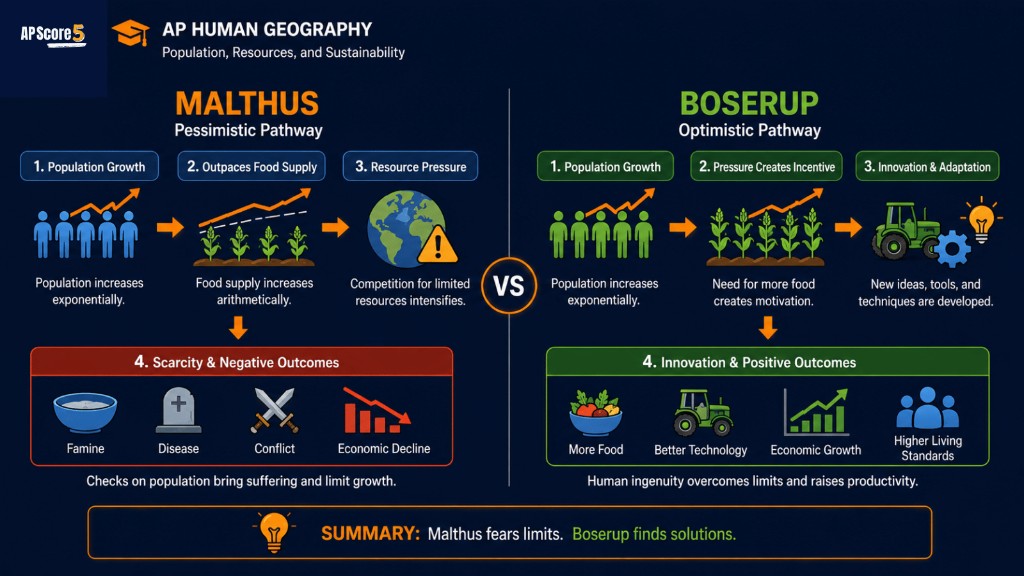
Your teacher may ask “who won?” — the AP-correct answer is often “both explain part of the story.” Cite global yield gains for Boserup, then cite persistent hunger in conflict zones or environmental stress for Neo-Malthusian caution. That balanced close matches how College Board frames synthesis questions in Unit 2.
AP exam comparison
College Board rarely asks “who was right forever.” They ask which lens fits the stimulus. Train yourself to read the outcome clause: crisis words point Malthus; innovation words point Boserup.
AP EXAM LENS
How comparison questions actually appear
- MCQ clue: “famine,” “food shortage,” “carrying capacity” → Malthusian
- MCQ clue: “agricultural innovation,” “intensification,” “irrigation,” “terracing” → Boserup
- MCQ clue: “population pressure caused…” → look at what comes after. Crisis = Malthus. Adaptation = Boserup.
- FRQ asking you to compare → use the formula Define both → Apply both to the scenario → State which fits better and why
- Common trap answer → saying Boserup “disagreed that population matters.” She did not. She agreed it matters, just predicted a different outcome.
For exam-only drills on Malthus wording and MCQ traps, see Malthusian theory AP Human Geography. For mixed Unit 2 review, use AP Human Geography practice questions after this comparison quiz.
When stimuli mention “carrying capacity,” tie it to Malthus: how many people the land can support before living standards fall. When stimuli mention “agricultural intensification” or “innovation,” tie it to Boserup. If both phrases appear, write two sentences — one per theory — then judge which outcome the data support. That pattern alone covers many 2-point comparison rubrics.
20 Malthus vs Boserup flashcards
Every 5th card shows an ad placeholder. The next arrow stays disabled for 3 seconds after an ad card. Shuffle once, then run the practice quiz — comparison vocabulary sticks when you alternate recall and MCQ application.
Common student mistakes
- Saying Boserup “disagreed that population growth is important.” She agreed it matters — she just predicted a different outcome.
- Calling Boserup “the opposite of Malthus.” Better: same trigger, opposite predicted outcome.
- Confusing Boserup with the Green Revolution. The Green Revolution is one example of intensification; Boserup's theory is broader and older.
- Forgetting examples of intensification (irrigation, terracing, double-cropping) on an FRQ.
- Saying Boserup “proved Malthus wrong.” Neither is fully proven or disproven. Each captures part of the picture.
- Mixing up Boserup with Wallerstein or Rostow — those are Unit 7 development models, not Unit 2 population theories.
Before your next practice test, say aloud: “Same trigger, opposite outcome.” If you can add one Malthus example (famine, carrying capacity) and one Boserup example (irrigation, double-cropping) without looking at notes, you are exam-ready for this pair.
Sort each phrase into Malthus or Boserup
Read each phrase and decide which theory it belongs to before you check the answer column. This mirrors “which lens fits?” MCQs.
| Phrase | Belongs to |
|---|---|
| Food supply is the limit | Malthus |
| Pressure drives invention | Boserup |
| Famine restores balance | Malthus |
| Terracing on steep land | Boserup |
| Population grows geometrically | Malthus |
| Double-cropping in dense regions | Boserup |
| Preventive checks lower births | Malthus |
| The Green Revolution as evidence | Boserup |
15 AP-style comparison questions
Work through all fifteen questions. Ads appear after questions 5, 10, and 15; wait for the countdown before advancing. Questions 1–3 align with common AP HUG stems on Malthus and the Green Revolution. After each miss, say whether the trap was vocabulary (intensification vs famine) or theory choice (Malthus vs Boserup) — that habit fixes repeat errors faster than rereading the table alone.
FRQ skill: comparison prompts
FRQ 1
Prompt: Using Malthusian Theory and Boserup Theory, explain how a region experiencing rapid population growth might respond. Provide one example for each theory.
- 1 pt: Correctly define Malthusian Theory (population vs food supply, checks)
- 1 pt: Correctly define Boserup Theory (population pressure → agricultural intensification)
- 1 pt: Give one valid example of each (e.g., Irish famine / Green Revolution intensification)
FRQ 2
Prompt: Which theory better explains modern global food trends since 1950? Defend your answer with evidence.
- 1 pt: State a clear position (Boserup more accurate, or partially)
- 1 pt: Evidence (Green Revolution, mechanization, trade, global food output growth)
- 1 pt: Acknowledge a limitation (environmental costs, local famines, Neo-Malthusian concerns)
More Unit 2 population guides
Return to the AP Human Geography Unit 2 Population and Migration hub for pyramids, DTM, and migration topics.
Final takeaway
- Malthus 1798: population grows fast, food grows slow, crisis follows.
- Boserup 1965: population pressure drives agricultural intensification.
- Same trigger — population pressure on land. Opposite outcome.
- AP exam clue words: famine/carrying capacity = Malthus; intensification/innovation = Boserup.
- Top FRQ answers: define both, apply both, pick one with evidence.
Revisit the comparison table and fifteen MCQs the week before your Unit 2 test — spaced repetition locks in the clue words faster than one long cram session.
Frequently asked questions
What is the difference between Malthusian Theory and Boserup Theory?
Malthusian Theory says population can outgrow food supply, leading to famine and disease. Boserup Theory says population pressure drives humans to innovate — irrigation, terracing, fertilizers — so food supply expands. Same trigger, opposite outcome.
Is Boserup the opposite of Malthus?
They start from the same trigger (population pressure on land) but predict opposite outcomes. Malthus expects scarcity. Boserup expects innovation. Calling them "opposites" is a useful shortcut but misses that they agree on what causes the pressure.
Who was Ester Boserup?
Ester Boserup (1910–1999) was a Danish economist who published The Conditions of Agricultural Growth in 1965. She challenged Malthus by arguing that population pressure causes agricultural innovation, not just crisis.
What is agricultural intensification?
Agricultural intensification is producing more food per unit of land — through more labor, irrigation, fertilizer, double-cropping, or technology. It is the central process in Boserup Theory.
Which theory does the AP HUG exam favor?
The AP HUG exam does not pick one. Strong FRQ answers use both, apply each to the scenario, and pick one with a justification. The exam rewards the ability to compare, not to memorize one side.
Was Boserup right?
Globally, Boserup's prediction has held up better since 1950 — food output has grown faster than population, supported by intensification and the Green Revolution. But Neo-Malthusians say environmental costs of innovation prove there are still limits.
What is an example of Boserup Theory in action?
The Green Revolution — high-yield seeds, irrigation, and fertilizer spreading through Asia and Latin America in the 1960s — is the most-cited example. Terracing in Southeast Asia and intensive double-cropping in China also fit.
How do I keep Malthus and Boserup straight on the exam?
Memorize the contrast: Malthus = scarcity, Boserup = innovation. Same trigger (population pressure), opposite outcome. If the question mentions famine or carrying capacity, think Malthus. If it mentions intensification or technology, think Boserup.