AP Courses AP Biology AP Biology Units AP Human Geography AP HUG Units AP Computer Science Principles AP CSP Units
Practice Daily Practice Practice by Course Practice by Topic Practice Tests
AP Exam Resources AP Exam Dates Registration Fees Scores & Credit What to Bring
Start Practicing → Login Register →
← Unit 2 hub

AP Human Geography · Unit 2 · Health

Epidemiological Transition Model (ETM) for AP Human Geography

Five stages of disease change, three scored FRQs with rubrics, quick MCQs, and exam traps—built for Unit 2 population review.

Review first: Read the DTM Overview for birth and death rates, then return here for causes of death.

Updated May 2026 · Reviewed by APScore5 Editorial Team

5 ETM stages3 FRQsvs DTM
DTM Overview ↗ DTM vs ETM FRQ practice Quick MCQs Exam traps
The Epidemiological Transition Model tracks how dominant causes of death shift from infectious disease and famine toward chronic and lifestyle illness as countries develop. Pair it with the DTM when prompts mention sanitation, vaccines, life expectancy, or infant mortality.
AP HUG Epidemiological
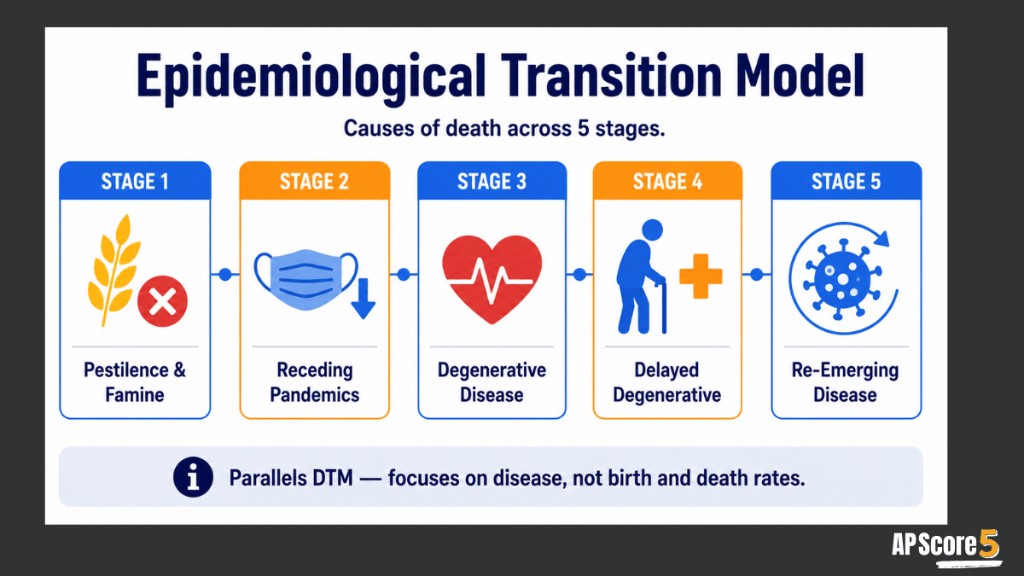
Figure - Epidemiological Transition Model 5 Stages
Big picture

Five ETM stages at a glance

Use this table when a stimulus names disease types, public health policy, or mortality trends—not birth rates alone.

StageDominant causes of deathHealth focusExample
1 — Pestilence & famineInfectious disease, malnutritionBasic survivalPre-modern Europe
2 — Receding pandemicsInfectious; rates fallVaccines, sanitationUS/UK early 1900s
3 — DegenerativeHeart disease, cancerLifestyle, screeningMid-late 1900s MDCs
4 — Delayed degenerativeLater-onset chronic diseaseGeriatrics, preventionJapan, Western Europe
5 — Re-emergence?Resistance, new epidemicsGlobal surveillanceCOVID-19 discussions
Deep dive

Stage-by-stage cards

Stage 1

Pestilence & famine

Infectious · malnutrition

Deaths cluster around infectious disease, poor sanitation, and food shortages. Life expectancy stays low because epidemics and famine recur.

AP move: Cite pre-industrial settings—not modern countries with hospitals and vaccination programs.
Stage 2

Receding pandemics

Falling infectious deaths

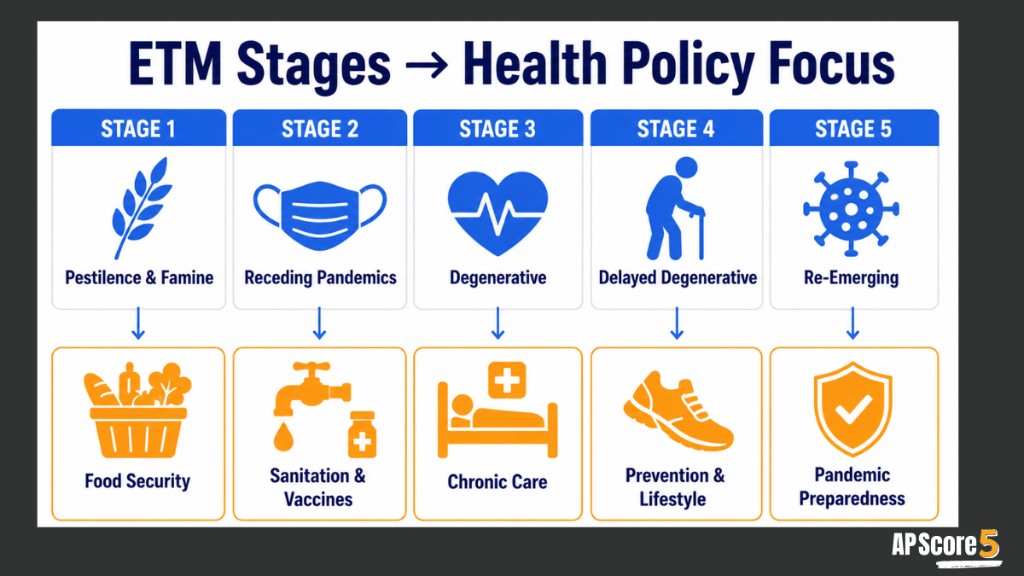
Public health, clean water, vaccines, and better nutrition cut epidemic deaths before lifestyle diseases dominate. This often aligns with DTM Stage 2 when crude death rates fall.

Examples: Cholera decline after piped water in industrial cities; smallpox vaccination campaigns.

Stage 3

Degenerative & human-made

Heart disease · cancer

People live long enough for chronic illness to become the leading killer. Smoking, diet, and occupational hazards add human-made risk factors.

Examples: Mid-twentieth-century United States and Western Europe as cardiovascular disease rose with urban diets.

Stage 4

Delayed degenerative

Later chronic onset

Medical treatment and prevention push chronic disease later in life. Aging populations need geriatric care, screening, and long-term management.

Examples: Japan and much of Western Europe today—high life expectancy with top-heavy age structures.

Stage 5

Re-emergence of infectious disease

Resistance · pandemics

Some scholars add Stage 5 when antibiotic resistance, global travel, or novel pathogens revive infectious mortality concerns alongside chronic disease burdens.

Examples: COVID-19 mortality spikes; drug-resistant tuberculosis in crowded cities.

etm stages health policy
Figure - Re Emergence Infectious ETM Stages Health Policy
Compare models

DTM vs ETM — when to use which

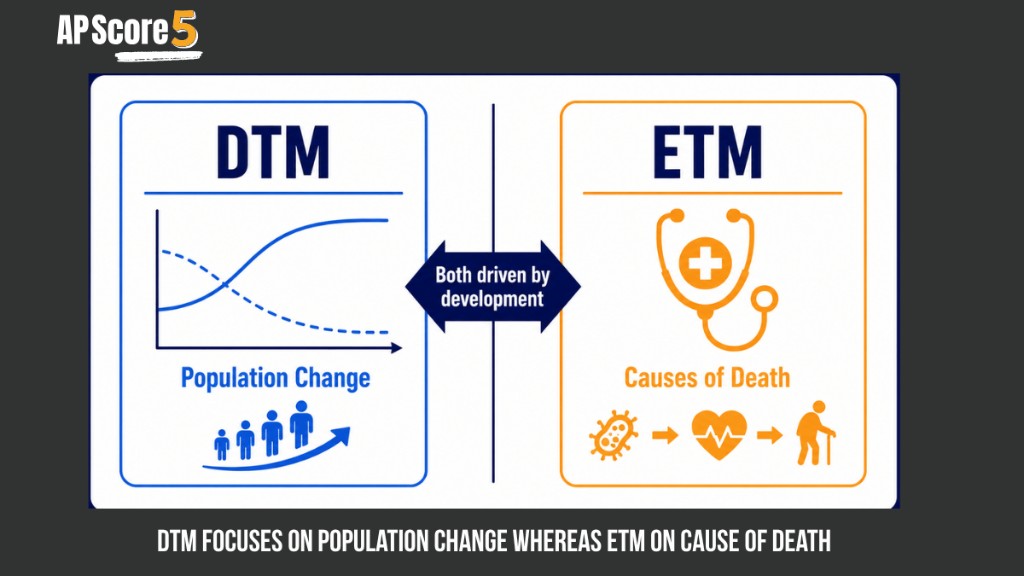
difference between dtm etm
Figure - DTM Vs ETM Difference Between Models
FeatureDTMETM
Primary focusBirth & death ratesCauses of death
Typical unitsCBR, CDR, NIDisease categories
Stage 2 signalFalling CDRReceding pandemics
Policy linkFertility programsPublic health systems
Exam rule: Sanitation or vaccine prompts → ETM Stage 2 language. Pyramid or CBR/CDR graphs → DTM. Many FRQs need both models with different evidence for each.
  • ETM can advance while fertility stays high—a country may be DTM Stage 2 and ETM Stage 2 at once.
  • Chronic disease dominance does not automatically mean DTM Stage 4; check rates and pyramid shape.
FRQ lab

Epidemiological transition model FRQ practice

Each prompt comes from real search and exam themes—Omran’s model, DTM comparisons, policy, and limitations. Draft your answer first, then open the rubric and sample.

Warm-up

Quick-check MCQs (3 questions)

ETM-focused practice. For more items, use the DTM practice quiz.

Q1. Which causes of death dominate ETM Stage 1?

Easy
Answer: A. Stage 1 is pestilence and famine—infectious deaths and malnutrition.

AP tip: ETM asks what kills people, not CBR/CDR levels.

Q2. Improved sanitation and vaccines most directly signal:

Medium
Answer: B. Receding pandemics follow public health gains that cut infectious mortality.

AP tip: Pair with DTM Stage 2 when death rates fall first.

Q3. Heart disease as the leading cause of death suggests:

Medium
Answer: B. Degenerative and delayed degenerative stages feature chronic killers.

AP tip: Longer life expectancy makes chronic disease visible.

Exam prep

Common ETM mistakes

Mistake: ETM is about birth rates

Fix: ETM tracks causes of death and disease patterns.

Mistake: Same stage on DTM and ETM

Fix: Health can improve while fertility stays high.

Mistake: Ignoring re-emerging disease

Fix: Globalization can spread new or resistant pathogens.

Mistake: Label only, no evidence

Fix: Name disease types or health policies that support the stage.

FRQ pattern

Identify ETM stage from disease data → explain why mortality shifted → link one public health policy → connect to DTM only if the prompt asks about population growth.

Frequently asked questions

What is the epidemiological transition model?

A model describing how dominant causes of death shift from infectious disease to chronic conditions as countries develop.

Who developed the ETM?

Abdel Omran summarized twentieth-century mortality shifts in industrialized countries.

How is ETM different from the DTM?

DTM tracks birth and death rates; ETM tracks disease types and health infrastructure.

What is ETM Stage 2?

Receding pandemics as public health, vaccines, and sanitation reduce infectious deaths.

What diseases dominate ETM Stage 3?

Degenerative and human-made diseases such as heart disease and some cancers.

Can ETM stages overlap with multiple DTM stages?

Yes—health can improve while fertility remains high, producing different stage numbers on each model.

How is life expectancy used with ETM?

Rising expectancy reflects fewer infectious deaths; study life expectancy alongside ETM stages.

Where should I practice DTM after ETM?

Start with the DTM overview and practice MCQs.

DTM practice Stage 2 (trap)