What is Neo-Malthusian Theory?
Neo-Malthusian Theory is the modern update of Malthus's 1798 argument: population growth and consumption together strain limited resources—not only food, but water, energy, land, climate, and biodiversity. Neo-Malthusians warn that planetary carrying-capacity limits make environmental crises more likely as population and consumption both rise.
Three ways to define Neo-Malthusian Theory
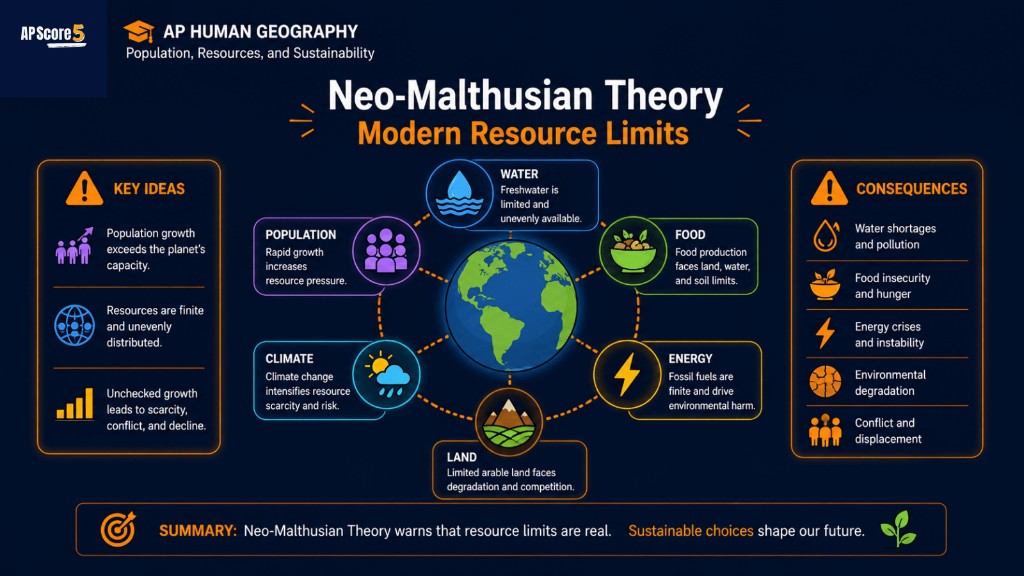
Plain English
There are limits to how many people the planet can support at a given standard of living—and those limits include clean water, stable climate, and habitat—not just food on the table.
Student-friendly
More people plus higher consumption can strain Earth’s systems even when grocery shelves look full. Neo-Malthusians say we should plan births and use resources carefully before damage becomes hard to reverse.
AP-style
Neo-Malthusian Theory argues that population growth combined with rising per-capita resource use can exceed environmental carrying capacity across multiple systems (water, energy, land, climate, food, biodiversity), producing scarcity, conflict, or ecological decline unless preventive policy slows pressure.
On free-response questions, lead with the AP-style sentence, then add one clause naming a resource beyond food. A strong opener might read: “Neo-Malthusian Theory claims that population and consumption together can exceed sustainable limits on water, energy, and land, not only on farm output.” That structure earns definition points while signaling you know how the model differs from classical Malthus.
Pair this definition with the original Malthusian theory guide when a prompt asks you to compare historical population–resource models. Examiners reward students who can state Malthus’s food arithmetic in one sentence and Neo-Malthusian multi-resource pressure in the next.
How Neo-Malthusian Theory differs from classical Malthus
Thomas Malthus (1798) compared geometric population increase to arithmetic food growth and predicted positive or preventive checks when the gap widened. Neo-Malthusians keep the core warning—growth can outrun supply—but expand “supply” to include water withdrawals, fossil energy, arable land, stable climate, and living ecosystems. They also highlight consumption: a smaller population with very high per-person resource use can stress the planet as much as a larger population with modest use.
Thinkers such as Paul Ehrlich (The Population Bomb, 1968) and the Club of Rome’s Limits to Growth (1972) brought Neo-Malthusian ideas into public debate. Their forecasts were controversial—some predictions did not match short-run timelines—but the framework still appears on AP exams when questions link population, affluence, and environmental impact. The Malthusian versus Boserup comparison page helps you place Neo-Malthusian caution alongside Boserup’s innovation argument: technology can raise yields, yet Neo-Malthusians ask what happens to soils, aquifers, and climate when intensification continues for decades.
| Feature | Classical Malthus (1798) | Neo-Malthusian (20th–21st c.) |
|---|---|---|
| Primary limit | Food supply | Multiple resources (water, energy, land, climate, biodiversity) |
| Growth contrast | Geometric population vs arithmetic food | Population plus per-capita consumption vs ecological capacity |
| Typical checks | Famine, disease, war; delayed marriage | Resource scarcity, environmental damage, policy limits on growth or pollution |
| Role of technology | Often underestimated in original essay | Acknowledged but seen as buying time, not removing limits |
| Wealthy countries | Less central in original writing | High consumption per person is part of the problem |
| AP clue words | Famine, carrying capacity, food shortage | Ecological footprint, climate, water stress, sustainability |
The Demographic Transition Model explains why birth rates fall as societies develop; Neo-Malthusians still ask whether falling births arrive fast enough while consumption per person rises. A country can move to Stage 3 or 4 on the DTM yet increase total environmental pressure if households buy more cars, meat, and air conditioning. That nuance separates strong Unit 2 answers from oversimplified “development fixes everything” claims.
Why Neo-Malthusian Theory still matters today
Global population passed eight billion in the 2020s. Food production has often kept pace thanks to irrigation, fertilizers, and trade—supporting Boserup-style readings of history. Neo-Malthusians respond that calories are only one line on the balance sheet: aquifers are falling, greenhouse gases are rising, and species extinction rates remain high. AP Human Geography treats this debate as evidence that population geography connects to environmental sustainability, not only to arithmetic on a farm spreadsheet.
Water scarcity
Groundwater mining in the Ogallala Aquifer, shrinking reservoirs in the American Southwest, and competition along the Nile or Indus rivers show demand outpacing renewable supply—even where food is still exported.
Climate change
More people and more fossil-fuel use raise atmospheric carbon. Heat waves, droughts, and sea-level rise can reduce carrying capacity in coastal and arid regions.
IPAT framework
Impact = Population × Affluence × Technology. Neo-Malthusian logic fits IPAT when exam writers ask how consumption and technology amplify or reduce environmental damage.
Ecological footprint
Measures how much biologically productive land and water a population needs. Many countries run an ecological deficit by importing resources.
Biodiversity loss
Habitat conversion for farms and cities removes species faster than background extinction rates. Limits are not only about human calories.
Urban megacities
Dhaka, Lagos, and Mexico City concentrate demand for water, energy, and waste management. Local carrying capacity is tested at extreme density.
When you read a news headline about “overpopulation,” rewrite it in exam language: Is the issue total headcount, unequal consumption, weak governance, or a specific resource limit? Neo-Malthusian Theory is most precise when you name the resource under stress and whether technology or trade temporarily masks the gap.
Link megacity examples to population pyramid shapes: a wide youth base today means more workers and consumers tomorrow, which can intensify pressure on infrastructure and ecosystems unless investment and policy keep pace.
Carrying capacity and ecological limits
Carrying capacity is the maximum population an environment can sustain at a given standard of living without degrading the resource base. Classical Malthus implied carrying capacity for food; Neo-Malthusians treat carrying capacity as multidimensional—you might have enough grain but not enough freshwater, acceptable air quality, or intact wetlands. On the exam, define carrying capacity first, then explain which resource in the stimulus is binding (the limit that bites first).
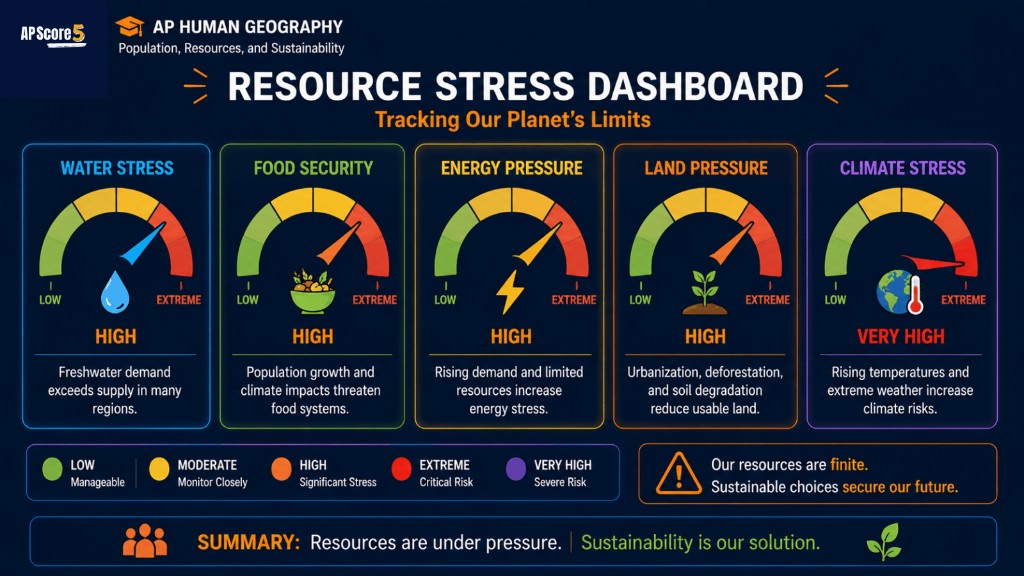
Carrying capacity is not a single permanent number. Technology can raise effective capacity by increasing yields or desalinating water; degradation can lower it through soil erosion or salinization. Neo-Malthusian arguments often accept Boserup-style innovation in the short run while asking whether the same pathway depletes groundwater or adds carbon over the long run. That is how you hold both theories in one paragraph without contradicting yourself.
Compare regional cases. The Netherlands supports dense population with imports, engineering, and wealth—high capacity supported by global trade. Parts of the Sahel face lower effective capacity when rainfall fails and soils erode, even with similar family sizes. Geography exams reward place-specific reasoning, not a universal headcount limit printed on a map.
Six resource systems under pressure
Neo-Malthusian maps often group environmental stress into six interacting systems. Population growth multiplies demand; rising affluence multiplies per-person use; together they press on water, energy, land, climate, food, and biodiversity. The diagram below is a study aid—not a literal model from one textbook—but it matches how College Board stimuli bundle multiple resources in a single question.
Practice explaining each arrow with one real region. Water: Arabian Peninsula desalination dependence. Energy: rising electricity demand in India. Land: Amazon deforestation for cattle and soy. Climate: Pacific island nations and sea-level rise. Food: still relevant—Yemen or Haiti under conflict and import disruption. Biodiversity: Indonesia’s forest loss. Two sentences per system on a review sheet will prepare you for multi-resource FRQs.
Real-world Neo-Malthusian examples
Examples on the exam should be named, located, and linked to a specific resource limit. Always note governance and inequality—Neo-Malthusian theory describes pressure; it does not claim that scarcity is morally acceptable or inevitable without policy choices.
| Region / issue | Resource under stress | Neo-Malthusian reading | Counterpoint or nuance |
|---|---|---|---|
| Aral Sea shrinkage | Water, land | Irrigation for cotton diverted rivers; population and farm expansion increased demand beyond renewable flow. | Soviet planning choices and crop selection shaped the crisis—not population alone. |
| Sub-Saharan drought cycles | Food, water, climate | Rapid natural increase plus climate variability can strain rain-fed agriculture. | Trade, aid, and improved seeds have prevented some famines; conflict still blocks access. |
| U.S. Southwest growth | Water, energy | Suburban expansion in arid climates raises per-capita water and electricity use beyond local renewable supply. | Conservation, pricing, and interstate water law can redistribute scarcity. |
| China’s industrial rise | Energy, climate, air quality | Large population plus rising affluence increased coal use and emissions before major clean-energy shifts. | Government policy and technology investment are changing the trajectory. |
| Deforestation in Brazil | Land, biodiversity, climate | Global demand for beef and soy plus local settlement pressure removes forest carbon sinks. | Export markets and land tenure matter; blame is not only local birth rates. |
| Pacific atoll nations | Climate, land | Sea-level rise threatens habitable land and freshwater lenses for small populations. | Migration agreements and adaptation funding are political responses in progress. |
Migration connects many examples to Unit 2 push factors. When water fails or farms collapse, people move internally or internationally—link Neo-Malthusian stress to Ravenstein patterns and refugee flows where the syllabus expects it. Return to the AP Human Geography Unit 2 Population and Migration hub for migration vocabulary alongside these case studies.
Population growth versus consumption
A central Neo-Malthusian insight is that Impact = Population × Affluence × Technology (IPAT). Holding technology constant, doubling population doubles impact; doubling affluence (consumption per person) does the same. Exam questions may describe a wealthy country with slow population growth but large ecological footprints and a poorer country with fast growth but smaller per-person use. Ask which factor the stimulus emphasizes before you label the scenario Neo-Malthusian.
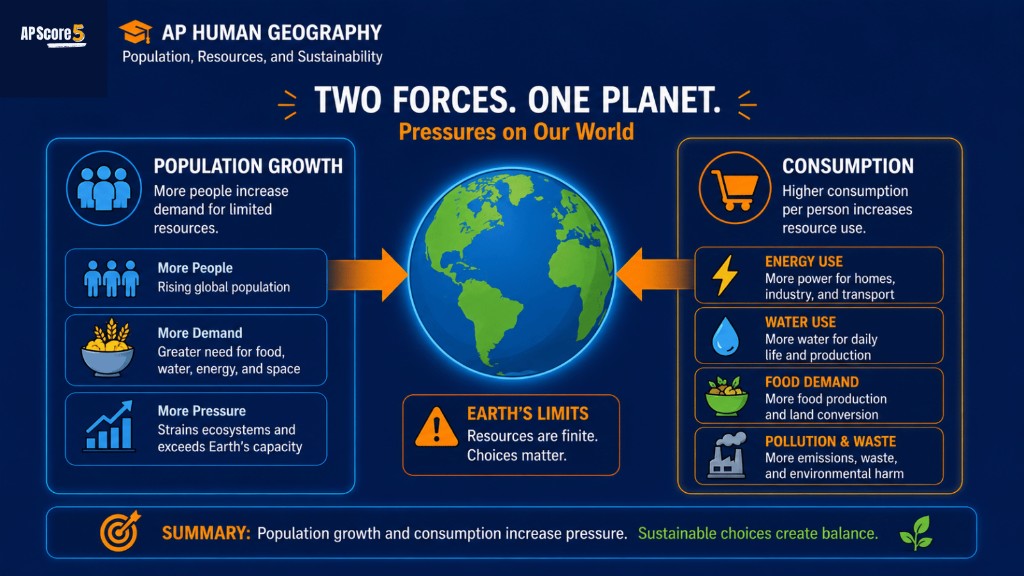
Debate example: the United States has slower natural increase than Nigeria but far higher per-capita energy and material use. A food-only Malthus answer might miss the point; a Neo-Malthusian answer discusses carbon emissions, vehicle miles, and meat consumption alongside population size. Conversely, in countries where most people still need basic calories and electricity, population growth can remain the dominant pressure line. Context decides which term in IPAT you stress.
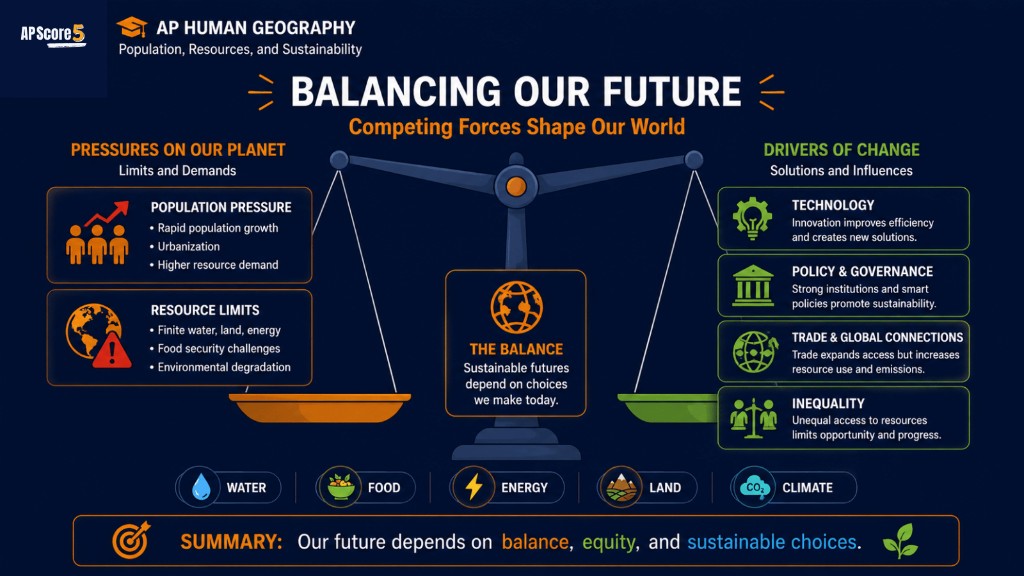
Policy implications appear in family-planning programs (preventive checks in Malthusian language) and in efficiency standards, fuel taxes, or renewable energy (technology and affluence terms in IPAT). AP prompts rarely ask you to endorse a policy, but they reward recognition that Neo-Malthusian solutions can target births, consumption, or technology—or all three.
Criticism of Neo-Malthusian Theory
Neo-Malthusian ideas have been debated for decades. Critics argue that alarmist timelines failed, that innovation continues to expand effective limits, and that blaming population oversimplifies inequality and political economy. Supporters reply that long-run trends in climate, water, and extinction support caution even when specific books dated their crises too early. On the exam, show both sides in one limitation paragraph after you apply the theory.
| Criticism | What critics claim | Neo-Malthusian response |
|---|---|---|
| Failed predictions | Ehrlich’s 1960s–70s forecasts did not match global famine timelines. | Timing was wrong in places; long-run resource trends still show stress. |
| Technology optimism | Green Revolution, GMOs, and renewables expand carrying capacity. | Innovation helps but can create new costs (water depletion, emissions). |
| Distribution ignored | Hunger is often about access and conflict, not total calories. | Agreed—Neo-Malthusian pressure interacts with inequality and governance. |
| Blaming the poor | Low-income countries with high birth rates are singled out unfairly. | Affluent consumption must be part of the same analysis (IPAT). |
| Anti-immigration misuse | Population rhetoric has been used to justify exclusionary policies. | Academic models describe limits; ethical policy is a separate debate. |
Compare with Boserup on the Malthusian Theory vs Boserup Theory page: Boserup explains how farmers intensify; Neo-Malthusians ask whether intensification erodes the resource base over decades. You can accept Boserup for food output trends while still using Neo-Malthusian logic for climate and water—examiners like layered answers.
AP Human Geography application
Unit 2 frequently tests population models together. Use Neo-Malthusian Theory when the stimulus moves beyond famine to sustainability vocabulary: footprint, climate, pollution, water table, or biodiversity. Tie back to carrying capacity, push factors for migration, and contrasts with the Demographic Transition Model when birth rates fall but consumption rises.
AP Exam Lens
- What College Board wants: Neo-Malthusian as a modern population–resource–environment model, not a repeat of 1798 food math alone.
- MCQ clues: ecological footprint, climate change, water scarcity, biodiversity, consumption, sustainability.
- FRQ pattern: define Neo-Malthusian → apply to scenario → named example → limitation (technology, equity, or Boserup).
- Trap answer: describing only food when the passage mentions carbon, water, or habitat.
- Compare: Malthus (food checks), Boserup (innovation), Neo-Malthusian (multiple limits + consumption).
After studying this page, run mixed drills on AP Human Geography Unit 2 practice questions so population pyramids, migration, and resource models stay separate in memory. Say aloud which model each clue word triggers before you read answer choices—that habit cuts careless mismatches on test day.
Neo-Malthusian vs classical Malthus
Classical Malthus centered food and nineteenth-century checks. Neo-Malthusians retain the idea that growth can outrun supply but update the resource list and foreground affluence. If your teacher asks “Is Neo-Malthusian just Malthus again?” answer: same family of warning, wider set of limits and modern policy debates.
Read the full guide: Malthusian TheoryGeometric vs arithmetic growth, checks, and practice MCQsWhen a comparison FRQ pairs the two, spend one sentence on shared logic (pressure when demand exceeds sustainable supply) and two sentences on differences (food only vs six systems; consumption; climate vocabulary). Cite one classical example (Irish Potato Famine as food dependence) and one modern example (Southwest water rules or deforestation) to show chronological range.
Neo-Malthusian vs Boserup
Boserup argued population pressure drives agricultural innovation. Neo-Malthusians often agree innovation occurs but question whether it stays ahead of water depletion, soil exhaustion, and emissions. On the exam, Boserup fits stimuli about terracing, irrigation, or shorter fallows; Neo-Malthusian fits stimuli about aquifer decline, climate refugees, or ecological deficit.
Read the full comparison: Malthusian Theory vs Boserup TheorySide-by-side table, scenarios, and fifteen practice questionsA synthesis paragraph might read: “Boserup explains how Egyptian farmers intensified irrigation as density rose; Neo-Malthusian analysis adds that long-term Nile stress and salinization may still cap sustainable yields unless water use is managed.” That sentence earns credit for both theories without claiming only one is correct everywhere.
20 Neo-Malthusian Theory flashcards
Every 5th card shows an ad placeholder. The next arrow stays disabled for 3 seconds after an ad card. Shuffle once, then take the fifteen-question practice quiz—linking vocabulary to MCQ clues builds faster recall than either activity alone.
Focus on cards that contrast Malthus, Boserup, and Neo-Malthusian outcomes. College Board often stacks two models in one stimulus and asks which prediction matches the data.
Common student mistakes
- Equating Neo-Malthusian with “only food.” The theory explicitly includes water, energy, land, climate, and biodiversity.
- Ignoring consumption. High per-capita use in wealthy countries is part of the model, not an afterthought.
- Treating failed short-run predictions as proof limits do not exist. Examiners want nuance—technology helps, yet long-run stress remains.
- Confusing Neo-Malthusian with Boserup. Boserup emphasizes innovation; Neo-Malthusian emphasizes limits and costs of growth.
- Using Neo-Malthusian to blame only high-fertility countries. Strong answers discuss affluence and global trade fairly.
- Forgetting carrying capacity definition. Always tie the term to a specific resource named in the prompt.
Build a one-page sheet: six resource labels from the diagram, IPAT formula, one difference row from the Malthus comparison table, and one limitation sentence. Review it after flashcards and before the practice quiz.
15 AP-style practice questions
Work through all fifteen questions. Read every explanation—even when you guess correctly—so you learn whether the trap was vocabulary (IPAT vs DTM) or application (which region fits Neo-Malthusian stress). Ads appear after questions 5, 10, and 15; wait for the countdown before advancing.
FRQ skill: define, apply, example, limitation
FRQ 1
Prompt: Define Neo-Malthusian Theory and explain how it applies to a country experiencing rapid population growth and rising middle-class consumption. Use one specific environmental resource in your answer.
- 1 pt Correct Neo-Malthusian definition (population + consumption vs multiple resource limits)
- 1 pt Apply to scenario (which resource is stressed—water, climate, land, etc.)
- 1 pt Named example or process (ecological footprint, IPAT, carrying capacity)
- 1 pt Limitation (technology, inequality, or Boserup-style innovation)
FRQ 2
Prompt: Compare Neo-Malthusian Theory with Boserup Theory as explanations for food production in a densely populated region.
- 1 pt Neo-Malthusian position (pressure can exceed long-run environmental capacity)
- 1 pt Boserup position (pressure can trigger intensification and innovation)
- 1 pt Example of intensification (irrigation, terracing, double-cropping)
- 1 pt Synthesis (both may be partially true; name a cost such as water depletion or emissions)
More Unit 2 population guides
Explore population pyramids and the Unit 2 hub to connect age structure and migration to resource pressure stories.
Final takeaway
- Neo-Malthusian Theory updates Malthus: limits include water, energy, land, climate, food, and biodiversity—not food alone.
- Population × affluence × technology (IPAT) links headcount to consumption and environmental impact.
- Carrying capacity depends on which resource is binding in a given place and time.
- Technology and trade can delay crisis; critics and supporters debate how long delays last.
- On the exam, contrast with classical Malthus (food checks) and Boserup (innovation) using clue words in the stimulus.
Return to this recap after flashcards and the practice quiz. If you can explain the six-resource diagram and one IPAT example aloud in one minute, you are ready for mixed Unit 2 prompts on population and the environment.
Frequently asked questions
What is Neo-Malthusian Theory in simple terms?
Neo-Malthusian Theory updates Malthus's 1798 argument for the modern world. It says population growth and consumption together pressure environmental systems — water, energy, land, climate, and biodiversity — not just food.
How is Neo-Malthusian Theory different from original Malthusian Theory?
Malthus focused only on food. Neo-Malthusians broaden the concern to all environmental and resource systems and add per-capita consumption as a key factor.
Who is associated with Neo-Malthusian Theory?
Paul Ehrlich is the best-known name. His 1968 book The Population Bomb popularized Neo-Malthusian thinking. Many other scientists and economists have contributed since.
Is Neo-Malthusian Theory valid today?
It's a useful framework but not settled fact. Strong evidence supports concerns about water, climate, and biodiversity. Critics point out that technology, governance, and distribution also shape outcomes.
What is an example of Neo-Malthusian Theory?
Water scarcity in rapidly growing cities (Cape Town, Chennai, Phoenix), climate-driven migration from the Sahel, urban overcrowding in megacities, and biodiversity loss are all common Neo-Malthusian examples.
What is the biggest criticism of Neo-Malthusian Theory?
That it can blame population growth while ignoring consumption, distribution, technology, and governance. Wealthy countries often have higher per-capita resource use than poor countries with faster population growth.
How is Neo-Malthusian Theory used on the AP exam?
AP HUG uses Neo-Malthusian Theory in Unit 2 (population), Unit 5 (sustainability and agriculture), Unit 6 (urban environment), and Unit 7 (development). On FRQs, define, apply to a modern example, and acknowledge a limitation.
Is Boserup the opposite of Neo-Malthusian Theory?
Roughly yes. Boserup says population pressure drives innovation that expands resource limits. Neo-Malthusians say innovation has limits and environmental pressure is real.
What is carrying capacity in Neo-Malthusian Theory?
Carrying capacity is the maximum population an environment can support given available resources. Neo-Malthusians argue we are now testing planetary carrying capacity, not just regional limits.
Did Paul Ehrlich's predictions come true?
Not as predicted. Ehrlich's 1968 forecast of mass starvation in the 1970s and 1980s did not happen, partly because of the Green Revolution. Critics use this to argue Neo-Malthusians overstate the danger. Supporters say the underlying limits remain.