Genotype vs Phenotype AP Biology: Unit 5 Heredity Guide
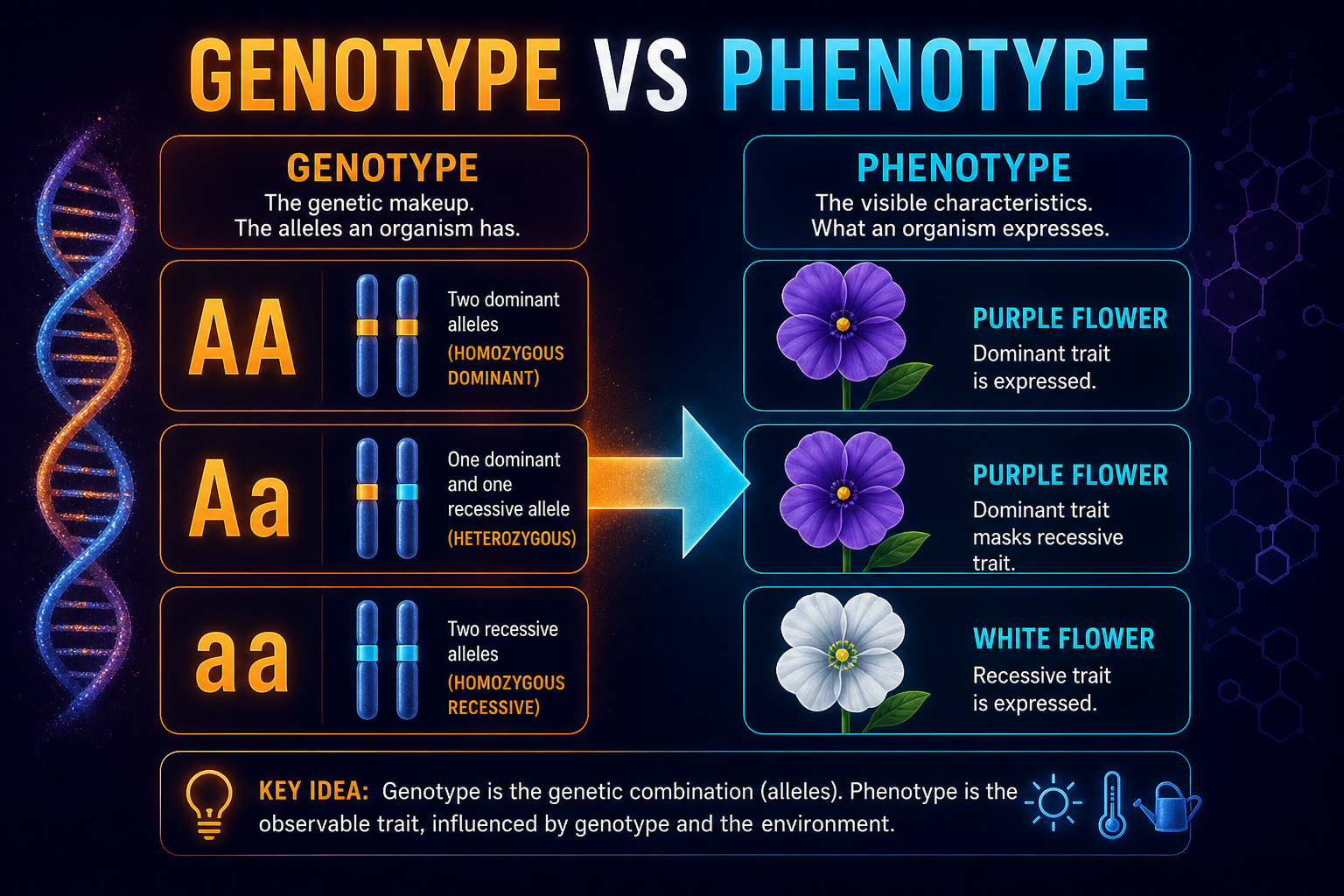
Genotype and phenotype are two of the most important vocabulary pairs in AP Biology Unit 5. A genotype is the allele combination an organism has, such as AA, Aa, or aa. A phenotype is the expressed trait that results from the genotype and the inheritance pattern.
Updated June 3, 2026 · Reviewed by APScore5 Editorial Team
What is the difference between genotype and phenotype in AP Biology?
A genotype is an organism's allele combination, such as AA, Aa, or aa. A phenotype is the observable or expressed trait. In complete dominance, AA and Aa can have the same dominant phenotype because the dominant allele masks the recessive allele.
Say it fast
Genotype is the allele code. Phenotype is the trait you see.
AP exam tip: If the question asks for allele letters, give the genotype. If it asks for the expressed trait, give the phenotype.
Unit 5 heredity questions often stack vocabulary: alleles → genotype → dominance pattern → phenotype. Mastering this chain early makes Punnett square and monohybrid cross problems much faster because you already know which label the rubric wants.
Genotype
🧬
What Is a Genotype?
A genotype is the allele combination an organism carries for a gene. For a simple Mendelian trait, genotypes may be written as AA, Aa, or aa. The letters represent alleles, not the trait itself. On AP Biology exams, genotype answers use allele notation—never describe a visible flower color when the rubric asks for genotype.
Genotypes can be homozygous (two matching alleles) or heterozygous (two different alleles). The same gene may have many allele versions in a population, but a diploid organism carries only two alleles for that gene at a given locus. When a pedigree or Punnett square lists parent genotypes, that information tells you which allele combinations offspring can inherit.
A phenotype is the expressed trait or observable result. A phenotype can be visible, such as flower color, or measurable, such as enzyme activity. Phenotype depends on genotype, dominance pattern, and sometimes environment. AP Biology FRQs often award points when you connect a stated genotype to the correct phenotype using the inheritance pattern in the prompt.
Phenotypes appear at the organism level: purple petals, white petals, type A blood, or reduced enzyme function. Two organisms with the same genotype can sometimes show different phenotypes if environmental conditions differ, but the genotype itself does not change unless a mutation occurs.
Purple flower color
White flower color
Blood type
Tall plant
Enzyme activity level
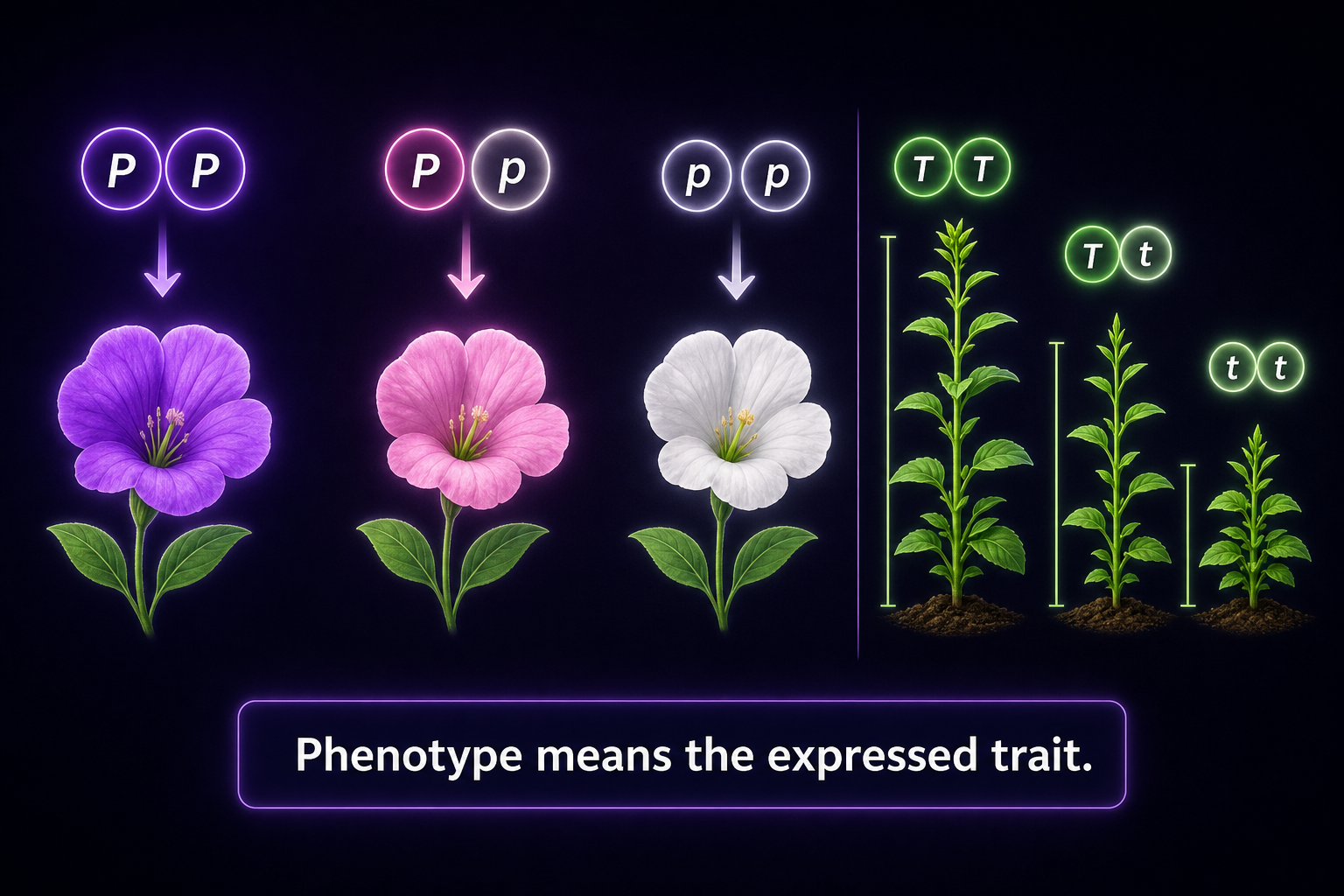
Figure - Phenotype Means Expressed TraitAA Aa aa
⬛
AA, Aa, and aa: Genotype and Phenotype Examples
Genotype
Genotype Name
Complete-Dominance Phenotype
AP Meaning
AA
Homozygous dominant
Dominant phenotype
Two dominant alleles
Aa
Heterozygous
Dominant phenotype
One dominant allele masks recessive allele
aa
Homozygous recessive
Recessive phenotype
No dominant allele present
Key idea: In complete dominance, AA and Aa have different genotypes but the same phenotype.
Figure - Different Genotypes Share Phenotypes
These three genotypes are the foundation of most introductory AP Biology genetics problems. When a question says “homozygous dominant,” write AA. When it says “heterozygous,” write Aa. When it says “homozygous recessive,” write aa—unless the prompt assigns different allele letters.
Pea flower color with complete dominance
Suppose purple (P) is dominant over white (p). Genotypes PP and Pp both produce purple flowers, while pp produces white flowers.
Result: Genotypes PP and Pp → purple phenotype. Genotype pp → white phenotype.
AP clue: AP clue: Two different genotypes (PP and Pp) can share the same phenotype under complete dominance.
Blood type as a measurable phenotype
Blood type is a phenotype you can test in a lab even though you cannot see it without a test. The genotype includes the allele combination at the blood-type locus.
Result: Genotype determines which antigens appear on red blood cells.
AP clue: AP clue: Phenotype is not always visible to the naked eye—it can be measurable.
Aa × Aa Punnett square translation
A monohybrid cross produces genotypes AA, Aa, Aa, and aa. Under complete dominance, three of four genotypes show the dominant phenotype.
A pedigree may show an affected individual with unaffected parents. That pattern can reveal recessive inheritance, but a dominant phenotype in one generation does not prove AA rather than Aa.
Result: Dominant phenotype could be AA or Aa under complete dominance.
AP clue: AP clue: Link pedigree symbols to phenotype first, then infer possible genotypes.
Decoder
🔍
Genotype-to-Phenotype Decoder
Choose a genotype and inheritance pattern to see how the phenotype changes. The decoder shows why AP Biology treats Aa differently under complete dominance, incomplete dominance, and codominance. Try switching patterns while keeping Aa selected—that is the fastest way to see why “heterozygous” alone does not tell you what the organism looks like.
Genotype
Inheritance pattern
AP warning: Do not assume Aa always looks dominant. That is true for complete dominance, but not for incomplete dominance or codominance.
Remember: Same genotype, different inheritance pattern, different phenotype.
Punnett squares
⬜
Genotype vs Phenotype in Punnett Squares
A Punnett square gives genotypes first. Then you translate those genotypes into phenotypes using the inheritance pattern. For example, Aa × Aa produces AA, Aa, Aa, and aa. Under complete dominance, AA and Aa share the dominant phenotype, so the phenotype ratio is 3 dominant : 1 recessive.
Step-by-step for Aa × Aa:
List gametes: each parent can pass A or a.
Fill genotypes: AA, Aa, Aa, aa.
Count genotype ratio: 1 AA : 2 Aa : 1 aa.
Apply complete dominance: AA and Aa → dominant phenotype; aa → recessive phenotype.
Report phenotype ratio: 3 dominant : 1 recessive.
The genotype ratio and phenotype ratio are both valid answers—but they answer different questions. Read the prompt carefully before you respond.
Yes. In complete dominance, AA and Aa can both show the dominant phenotype. This is why an organism with a dominant phenotype may be homozygous dominant or heterozygous. A test cross can help identify the unknown genotype.
Example: A purple-flower plant could be AA or Aa if purple is dominant. Without a cross or pedigree evidence, you cannot tell which genotype produced the dominant phenotype. That is a common source of FRQ reasoning points—students must explain that dominant appearance does not prove homozygosity.
Test crosses are covered in depth on the monohybrid crosses guide. Pedigrees show phenotypes across generations; use the pedigrees guide when family trees replace Punnett squares in the prompt.
Dominance
⚖️
When Genotype Does Not Predict a Simple Dominant Phenotype
The simple AA/Aa/aa pattern assumes complete dominance. In non-Mendelian inheritance, the heterozygote may have a different phenotype. In incomplete dominance, the heterozygote can show an intermediate phenotype. In codominance, both alleles can be expressed.
Use the Genotype-to-Phenotype Decoder above to compare how the same Aa genotype changes under each pattern. On the exam, keywords like “blended,” “intermediate,” or “both traits visible” signal that complete-dominance logic may not apply.
Yes. Phenotype can be influenced by genotype and environment. For example, nutrition, temperature, light, or other conditions can affect how a trait appears. AP Biology often asks students to separate genetic causes from environmental effects.
A classic example is coat color in some mammals where temperature affects which pigment is produced—the underlying genotype sets the potential, but environment shapes the final phenotype. When an FRQ mentions conditions outside inheritance rules, explain how environment modifies expression without changing allele letters.
AP exam clue: If the DNA or allele combination changes, it is genotype-level. If the visible expression changes because of conditions, it may be environmental influence on phenotype.
Exam clues
🔎
AP Bio Exam Clues for Genotype vs Phenotype
“AA, Aa, aa”
→ genotype
“Visible trait”
→ phenotype
“Allele combination”
→ genotype
“Expressed trait”
→ phenotype
“Dominant phenotype but unknown genotype”
→ could be AA or Aa
“Recessive phenotype”
→ usually aa in complete dominance
“Aa looks blended”
→ incomplete dominance
“Aa shows both traits”
→ codominance
“Punnett square boxes”
→ genotypes first, phenotypes second
1
Read whether the prompt asks for genotype or phenotype
Underline the exact wording. If the question asks for allele letters or combinations, report genotype. If it asks for the expressed trait or appearance, report phenotype.
2
Identify the inheritance pattern before interpreting Aa
Complete dominance, incomplete dominance, and codominance change how Aa looks. Use the Genotype-to-Phenotype Decoder on this page to compare patterns quickly.
3
Separate Punnett square steps
First fill genotypes in each box. Then group genotypes into phenotypes using the dominance rule stated in the prompt.
4
Use AA, Aa, and aa consistently
AP Biology expects standard allele notation. Homozygous dominant is AA, heterozygous is Aa, and homozygous recessive is aa unless the prompt uses different letters.
Mistakes
🚫
Common Genotype vs Phenotype Mistakes
Saying genotype is what you see
Fix: Genotype is the allele combination. Phenotype is the expressed trait.
Saying phenotype is always visible
Fix: Phenotype can be visible or measurable, such as enzyme activity.
Assuming Aa is always dominant-looking
Fix: Aa shows the dominant phenotype only in complete dominance.
Confusing genotype ratio and phenotype ratio
Fix: Genotype ratio counts allele combinations. Phenotype ratio counts expressed traits.
Thinking dominant means more common
Fix: Dominant means expressed in a heterozygote, not necessarily more frequent.
Forgetting environment
Fix: Phenotype can be affected by both genes and environment.
When you miss a practice MCQ, reread the question stem for the words “allele combination” versus “expressed trait.” That single check fixes a large share of genotype vs phenotype errors on timed exams.
MCQ practice
✅
Genotype vs Phenotype Practice Questions
Answer all eight questions. Choices shuffle on reload.
Open each card, draft your response, then reveal the rubric and sample answer. Strong FRQ answers name genotype and phenotype separately, cite AA/Aa/aa when relevant, and explain how dominance connects allele combination to expressed trait.
0 of 2 FRQs opened
Prompt
A student says that genotype and phenotype are the same because both describe traits. Explain why this statement is incorrect using AA, Aa, and aa examples.
Scoring rubric
Genotype is allele combination.
Phenotype is expressed trait.
AA and Aa can have the same phenotype under complete dominance.
aa shows recessive phenotype under complete dominance.
Therefore, genotype and phenotype are related but not identical.
Sample response
The statement is incorrect because genotype and phenotype describe different things. A genotype is the allele combination, such as AA, Aa, or aa. A phenotype is the expressed trait. Under complete dominance, AA and Aa can both show the dominant phenotype even though they have different genotypes. The genotype aa usually shows the recessive phenotype. This shows that genotype influences phenotype, but they are not the same.
Status: Draft your answer first—then open the rubric or sample.
Prompt
A Punnett square for Aa × Aa gives AA, Aa, Aa, and aa. Explain the genotype ratio and phenotype ratio under complete dominance.
Scoring rubric
Genotype ratio is 1 AA : 2 Aa : 1 aa.
AA and Aa show dominant phenotype under complete dominance.
aa shows recessive phenotype.
Phenotype ratio is 3 dominant : 1 recessive.
Explain why genotype and phenotype ratios differ.
Sample response
The Punnett square produces one AA, two Aa, and one aa, so the genotype ratio is 1:2:1. Under complete dominance, AA and Aa both show the dominant phenotype because one dominant allele is enough for expression. The aa genotype shows the recessive phenotype. Therefore, the phenotype ratio is 3 dominant : 1 recessive. The ratios differ because genotype counts allele combinations, while phenotype counts expressed traits.
Status: Draft your answer first—then open the rubric or sample.
These eleven questions cover the genotype vs phenotype vocabulary AP Biology Unit 5 expects on MCQs and FRQs. If a ratio question still feels confusing, return to the AA/Aa/aa table and decoder sections above before practicing.
What is the difference between genotype and phenotype in AP Biology?
A genotype is an organism's allele combination, such as AA, Aa, or aa. A phenotype is the observable or expressed trait. In complete dominance, AA and Aa can have the same dominant phenotype because the dominant allele masks the recessive allele.
What is a genotype?
A genotype is the allele combination an organism carries for a gene. For a simple Mendelian trait, genotypes may be written as AA, Aa, or aa.
What is a phenotype?
A phenotype is the expressed trait or observable result. It can be visible, such as flower color, or measurable, such as enzyme activity.
What are examples of genotypes?
Examples include AA (homozygous dominant), Aa (heterozygous), and aa (homozygous recessive). The letters represent alleles, not the trait itself.
What are examples of phenotypes?
Examples include purple flower color, white flower color, blood type, tall plant height, and enzyme activity level.
Can two different genotypes have the same phenotype?
Yes. In complete dominance, AA and Aa can both show the dominant phenotype even though they have different genotypes.
Why do AA and Aa have the same phenotype under complete dominance?
The dominant allele A masks the recessive allele a in the heterozygote. One dominant allele is enough to show the dominant phenotype.
What phenotype does aa usually show?
Under complete dominance, aa usually shows the recessive phenotype because no dominant allele is present.
How do Punnett squares connect genotype and phenotype?
A Punnett square gives offspring genotypes first. You then translate those genotypes into phenotypes using the inheritance pattern, such as complete dominance.
Can environment affect phenotype?
Yes. Phenotype can be influenced by genotype and environment. Nutrition, temperature, light, or other conditions can affect how a trait appears.
How should I answer genotype vs phenotype FRQs?
Define genotype as allele combination and phenotype as expressed trait. Use AA, Aa, and aa examples. Explain how dominance pattern connects genotype to phenotype. Separate genotype ratios from phenotype ratios when Punnett squares are involved.