Body temperature regulation
Loop type: Negative feedback
Responses such as sweating or shivering help move temperature back toward a range.
AP Biology · Unit 4 Phase 2 Deep Dive
Homeostasis is the maintenance of relatively stable internal conditions, and feedback loops are the control systems that help maintain that stability. A variable moves away from a set point, sensors detect the change, control centers coordinate effectors, and responses change the variable. In AP Biology Unit 4, the key skill is tracing the loop and predicting what happens if one part fails.
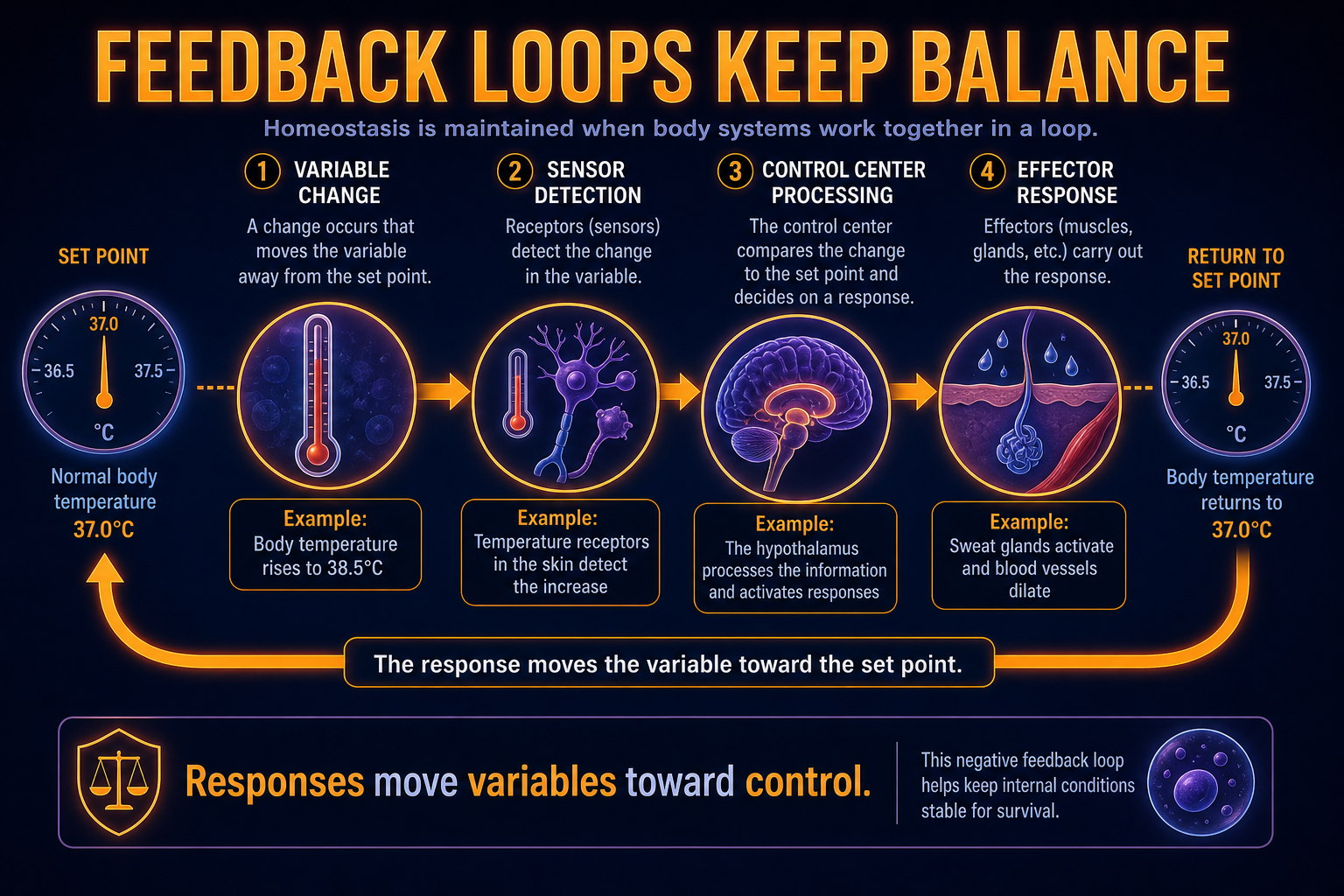
The core Feedback Mechanisms page explains negative and positive feedback as broad AP Biology patterns. This Phase 2 page focuses on how homeostatic control loops are built from variables, set points, sensors, control centers, effectors, and responses. Use it when a prompt asks you to trace a whole regulatory loop.
Homeostasis and Feedback Loops
Control-system structure.
Bridge guides: Cell Communication and Cell Signaling Pathways show how signals become loop responses.
Use the Feedback Mechanisms guide to learn the broad AP Biology difference between negative and positive feedback. Use this Homeostasis and Feedback Loops guide when you need to explain how a variable moves away from a set point, how sensors detect change, how control centers coordinate effectors, and how the response changes the variable.
| Page | Best for | Link |
|---|---|---|
| Feedback Mechanisms | Broad concept: negative vs positive feedback | Open guide |
| Negative Feedback | Specific loop type: response reduces original change | Open guide |
| Positive Feedback | Specific loop type: response amplifies original change | Open guide |
| Homeostasis and Feedback Loops | Control-system structure: set point, sensor, control center, effector, response | You are here |
Feedback loops maintain homeostasis by detecting when a variable moves away from a set point and producing a response that changes the variable. In negative feedback, the response reduces the original change and helps restore stability. In positive feedback, the response amplifies the original change until a specific endpoint stops the loop.
Homeostasis uses feedback loops to regulate internal conditions.
Build the loop step by step, choose a scenario, and predict the outcome.
Outcome: Variable near set point.
Response meter: Stable
Homeostasis means maintaining relatively stable internal conditions even when the environment or body activity changes. It does not mean conditions never change. It means regulatory systems keep important variables within a functional range.
Homeostasis means keeping internal conditions within a working range.
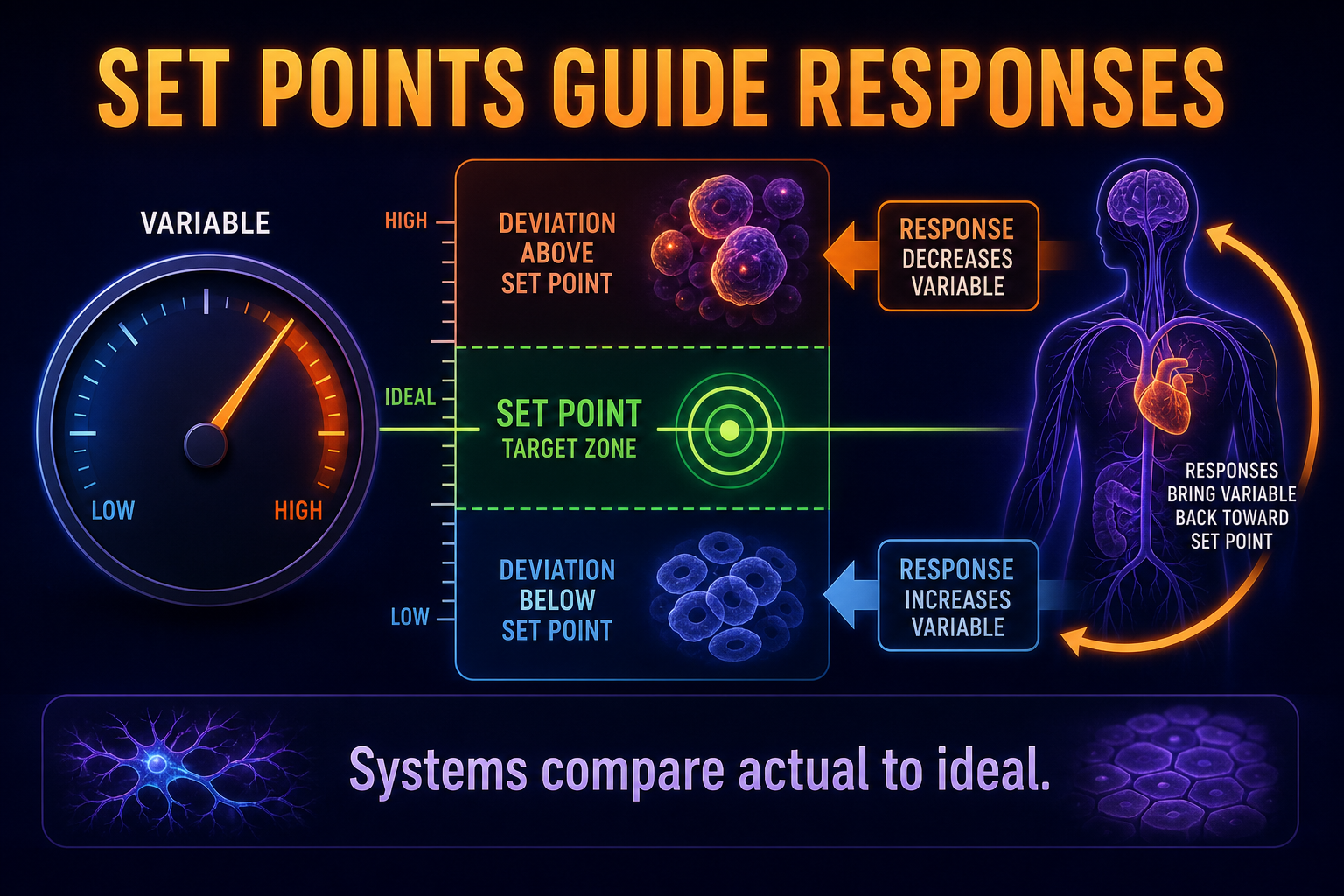
A set point is the target value or range for a regulated variable. If the variable moves too far above or below that target, the system can detect the deviation and trigger a response. AP Biology questions may ask what happens when the response moves the variable back toward the set point.
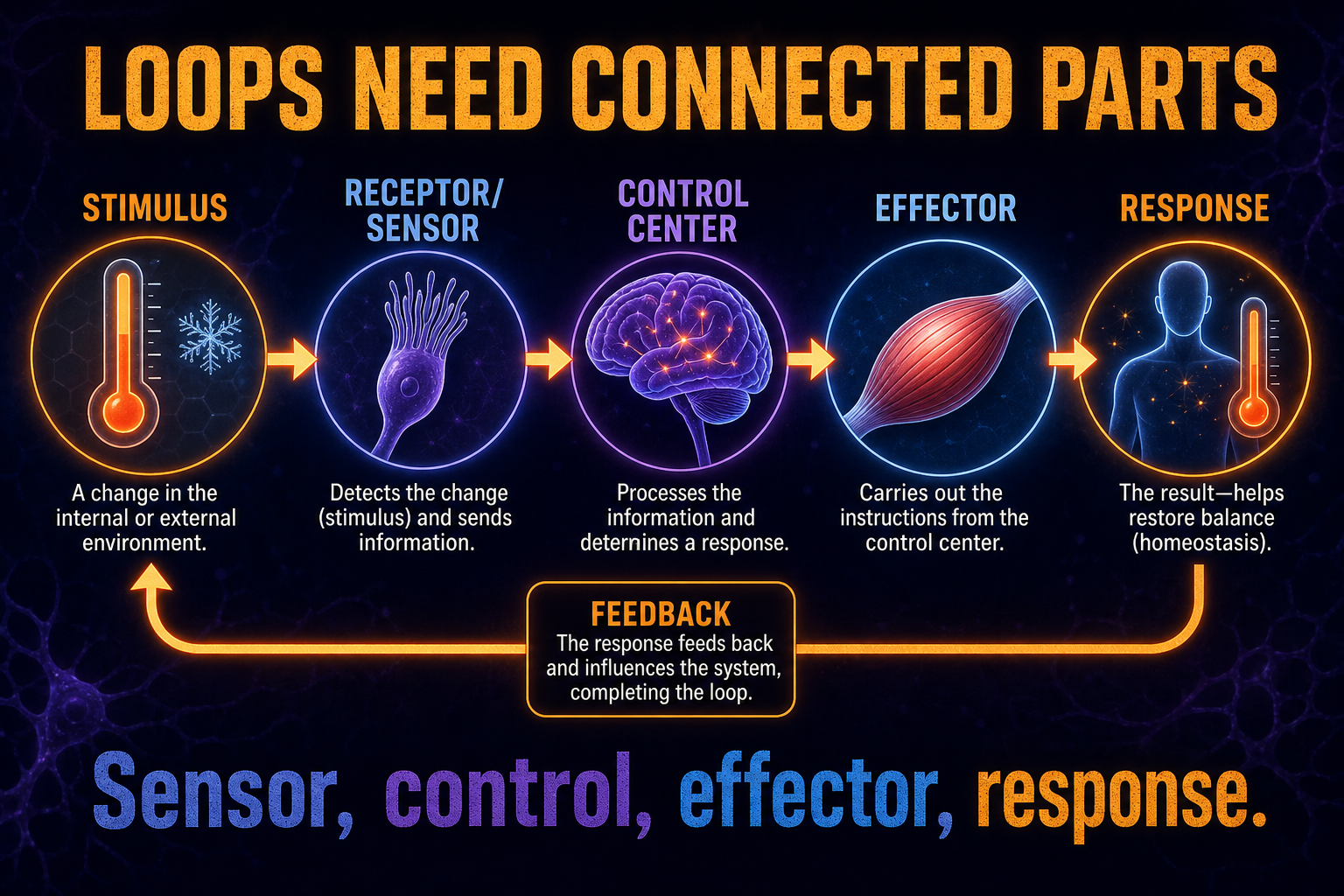
A homeostatic feedback loop usually includes a stimulus, receptor or sensor, control center, effector, and response. The sensor detects the change, the control center processes information, and the effector produces the response. The response then changes the regulated variable.
| Part | Role | AP clue |
|---|---|---|
| Variable | Condition being regulated | glucose, temperature, hormone level |
| Set point | Target range | normal value, target range |
| Sensor | Detects change | receptor detects deviation |
| Control center | Coordinates response | sends signal |
| Effector | Carries out response | muscle, gland, cell response |
| Response | Changes variable | restores or amplifies |
Negative feedback reduces the original change. If a variable rises too high, the response lowers it. If a variable falls too low, the response raises it. This is the most common feedback pattern for maintaining homeostasis.
See the dedicated Negative Feedback guide for loop-type reasoning and glucose or temperature examples.
Positive feedback amplifies the original change instead of restoring a set point immediately. It is useful when a process needs to move quickly toward an endpoint, such as childbirth or blood clotting. The loop must eventually stop, or the response could become excessive.
Compare with homeostatic loops on the Positive Feedback guide.
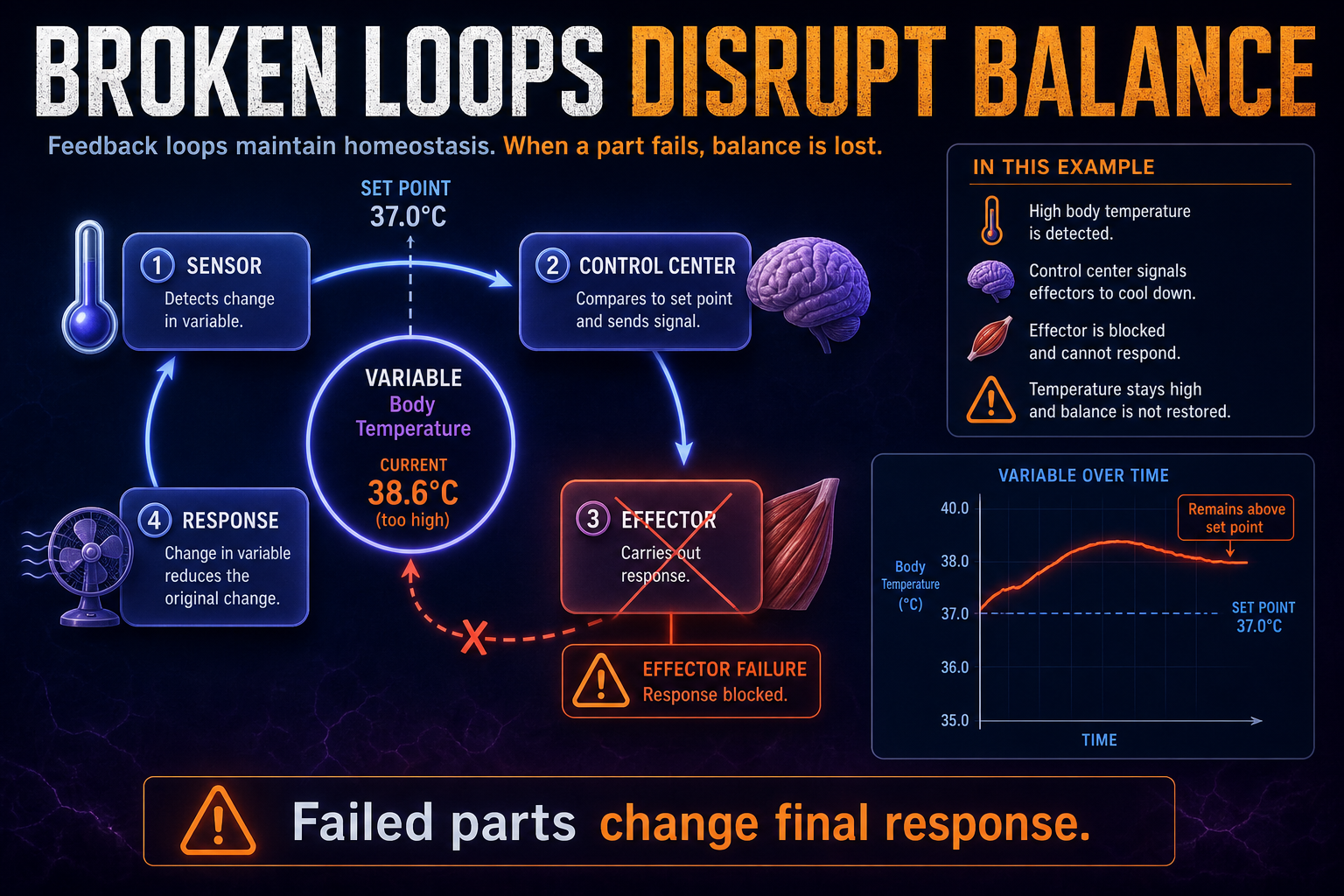
If a sensor fails, the system may not detect the variable change. If the control center sends the wrong signal, the response may not match the problem. If the effector is blocked, the variable may stay away from the set point even if the signal was detected.
Loop type: Negative feedback
Responses such as sweating or shivering help move temperature back toward a range.
Loop type: Negative feedback
Hormonal responses help bring glucose levels toward normal.
Loop type: Positive feedback
The response amplifies contractions until birth acts as the endpoint.
Loop type: Positive feedback
Platelet activation recruits more platelets until the clot forms.
Homeostatic regulation is being tested.
Negative feedback is likely.
Positive feedback is likely.
The system may not detect change.
The response may not correct the variable.
Positive feedback may be involved.
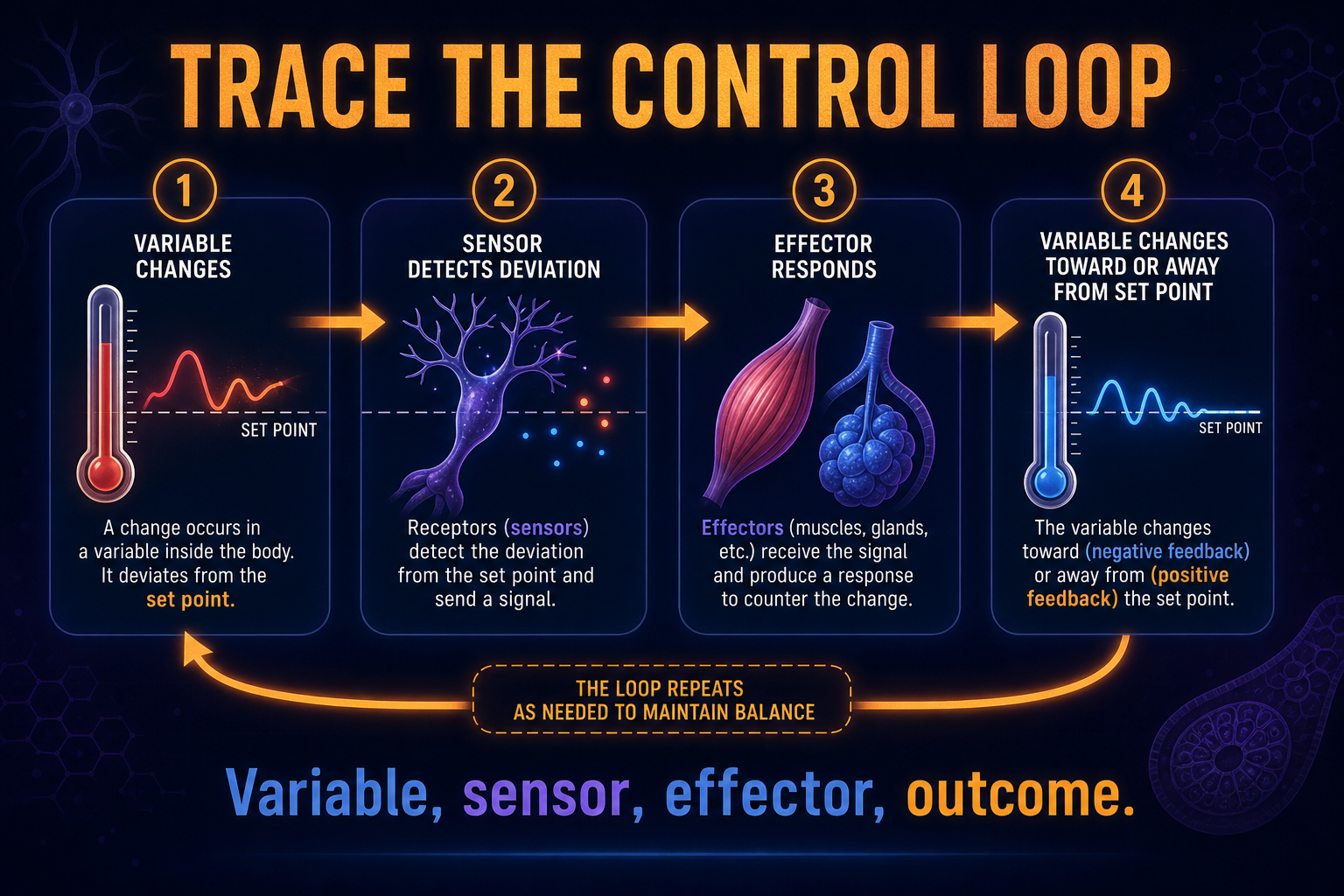
Name what is being controlled and the target range.
Describe the sensor and control center role.
State what carries out the change to the variable.
Connect loop type to the final outcome.
When ___ moves away from the set point, ___ detects the change. The control center signals ___, which causes ___. This changes the variable by ___.
Fix: Homeostasis means maintaining conditions within a functional range.
Fix: Sensors detect change; effectors carry out responses.
Fix: Negative means the response reduces the original change.
Fix: Positive means the response amplifies change until an endpoint.
Fix: Homeostatic loops compare the variable with a target range.
Fix: Feedback Mechanisms is the broad guide; this page focuses on homeostatic loop structure.
Answer all eight questions. Choices shuffle on reload—trace the loop, not the letter.
More drills: Unit 4 practice questions or the Unit 4 FRQ guide.
Open each card, draft your response, then reveal the rubric and sample.
A regulated variable rises above its set point. Sensors detect the change, a control center sends a signal, and effectors produce a response that lowers the variable toward the set point.
This is negative feedback because the response lowers the variable that rose above the set point. Homeostasis is maintained because the system detects deviation and produces a response that moves the variable back toward the target range. If the effector is blocked, the corrective response may not occur, so the variable could remain too high even though sensors detected the change.
Status: Draft your answer first—then open the rubric or sample.
During a biological process, the response increases the original stimulus until a specific endpoint occurs.
This is positive feedback because the response increases the original stimulus. An endpoint is important because positive feedback amplifies change and must stop once the process is complete. A homeostatic negative feedback loop usually reduces deviation and returns a variable toward a set point, while this loop drives change forward until the endpoint is reached.
Status: Draft your answer first—then open the rubric or sample.
Homeostasis is the maintenance of relatively stable internal conditions. It does not mean nothing changes. It means regulated variables stay within a functional range.
Feedback loops detect when a variable moves away from a set point and trigger a response. In negative feedback, that response reduces the original change. This helps return the variable toward the target range.
A set point is the target value or range for a regulated variable. The system compares the actual condition with the set point. If the variable moves too far away, a response may be triggered.
A sensor detects a change in the regulated variable. It sends information to a control center or signaling pathway. If the sensor fails, the system may not respond correctly.
An effector carries out the response that changes the variable. Effectors can include cells, tissues, organs, glands, or muscles depending on the system. If the effector is blocked, homeostasis may not be restored.
Negative feedback is the main pattern used to maintain homeostasis. The response reduces the original change and moves the variable back toward a set point. Examples include temperature and blood glucose regulation.
Positive feedback is usually not used to maintain a stable set point in the same way negative feedback is. It amplifies a response until an endpoint occurs. Examples include childbirth contractions and blood clotting.
If a sensor, control center, signal, or effector fails, the response may not correct the variable. The variable can remain too high or too low. AP Biology often asks students to predict that final consequence.
The Feedback Mechanisms page explains negative and positive feedback broadly. This page focuses on homeostasis and the parts of a regulatory loop, such as set points, sensors, control centers, and effectors. Use both pages together for stronger FRQ answers.
Start by identifying the regulated variable and set point. Then trace the sensor, control center, effector, and response. Finish by predicting whether the variable moves toward the set point, away from it, or toward an endpoint.