Surface Area to Volume Ratio: AP Biology Cell Size Guide
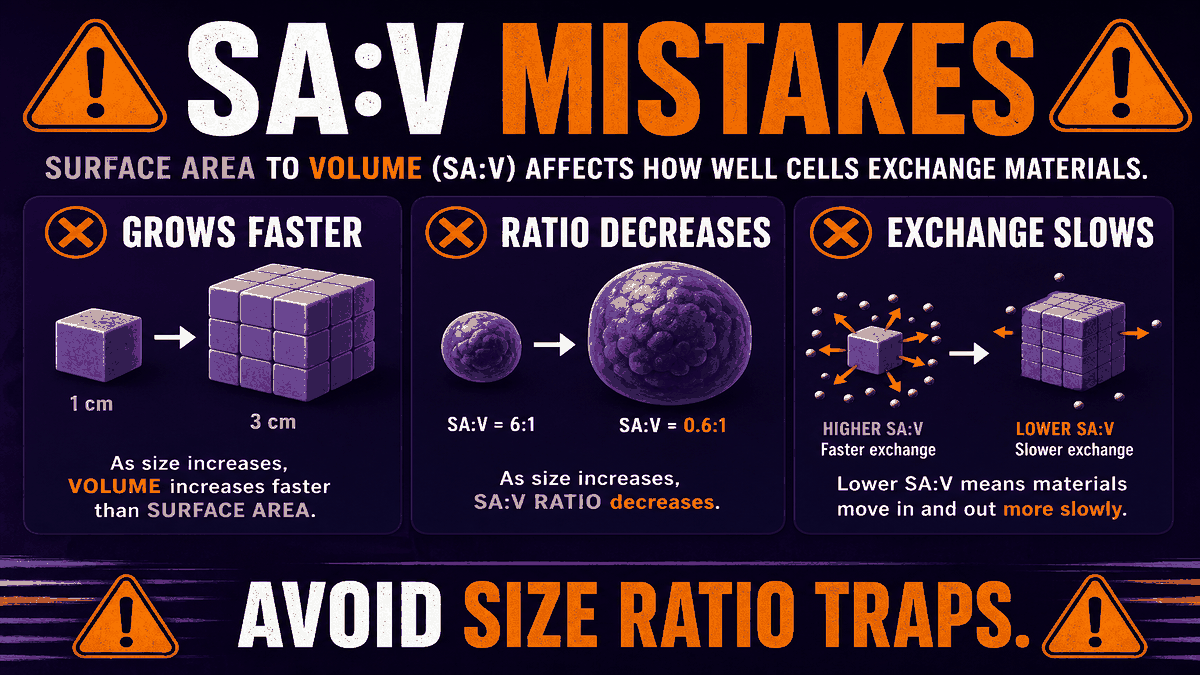
Surface area to volume ratio AP Biology questions test why cell size affects exchange efficiency. As a cell gets larger, its volume increases faster than its surface area, so the cell has less membrane area available for each unit of cytoplasm.
This guide helps you calculate surface area-to-volume ratio, explain why cells stay small, predict exchange efficiency from cube models, and answer AP-style questions about cell size, diffusion, and transport.
Updated May 29, 2026 · Reviewed by APScore5 Editorial Team
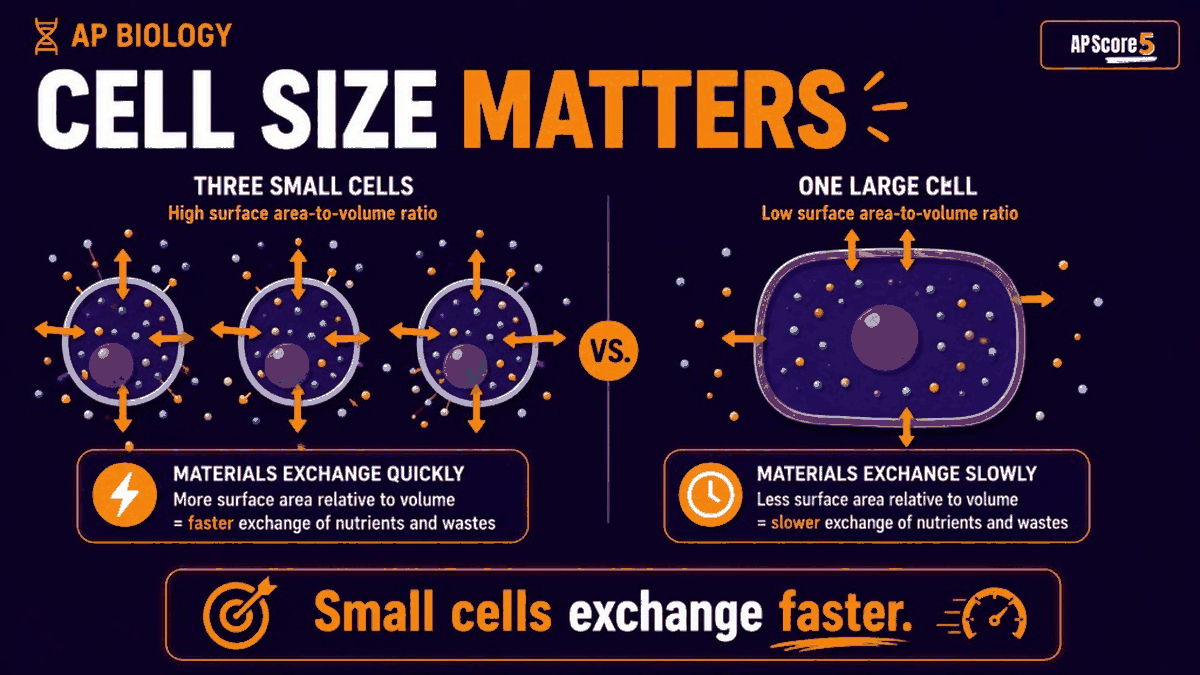
Surface area-to-volume ratio explains why smaller cells exchange materials more efficiently.
Learning journey
Where Surface Area to Volume Ratio Fits in Unit 2
The previous page, prokaryotic vs eukaryotic cells, compared how cell types differ in nucleus, organelles, and organization. This page explains why cell size matters for both cell types and how exchange efficiency limits how large a cell can grow.
After this page, you will study plasma membrane structure, then selective permeability, passive transport, and active transport. Cell size sets the demand; the membrane controls what crosses the boundary.
The membrane controls what enters and exits the cell.
Learning Journey Checkpoint: Compare exchange surface to internal demand. If volume grows faster than surface area, the cell must stay small or increase surface area by shape and folds.
What Is Surface Area to Volume Ratio in AP Biology?
Surface area-to-volume ratio compares the outside surface available for exchange to the inside volume that needs resources and produces waste. Think of surface area as the exchange surface and volume as internal demand. In AP Biology, smaller cells usually have higher surface area-to-volume ratios, which helps them exchange materials more efficiently than larger cells.
For AP Biology, the fastest way to explain cell size limits is to check whether membrane surface area can keep up with cytoplasm volume.
Say It Fast
Surface area = exchange surface
Volume = internal demand
Small cells have high SA:V
Large cells have low SA:V
Volume grows faster than surface area
Lower SA:V means slower exchange
Cell size affects diffusion and transport
AP Exam Clue: If a question asks why cells stay small, answer with surface area-to-volume ratio and exchange efficiency.
Cell size lab
Cell Size Engineering Lab: Which Cell Exchanges Faster?
Predict exchange efficiency before you reveal the answer. Read each scenario, choose which design exchanges materials faster, then check the AP reasoning—the same habit used in data questions and short free response.
0 of 5 predictions checked
Cell Size Engineering Lab · Case 1
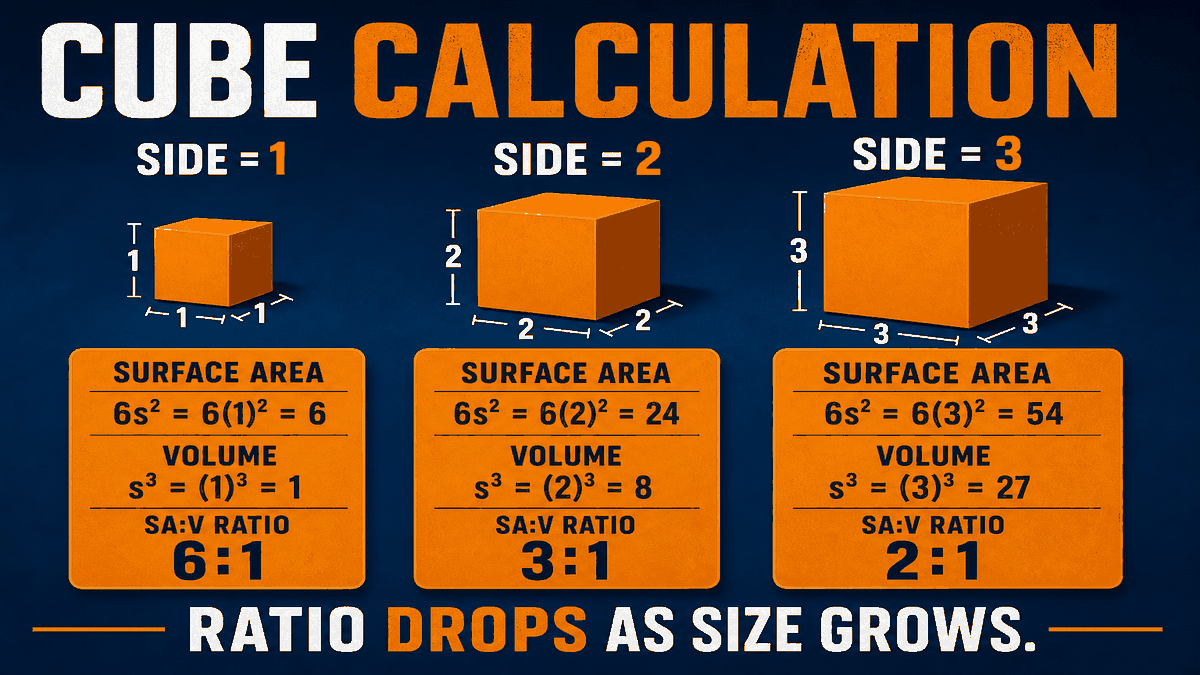
A cell with side length 1 has a SA:V ratio of 6:1. A cell with side length 3 has a SA:V ratio of 2:1. Which cell exchanges materials more efficiently?
Answer: The smaller cell (side length 1) exchanges materials more efficiently.It has more surface area per unit of volume, so more membrane is available to serve each unit of cytoplasm.
Cell Size Engineering Lab · Case 2
Ten small cubes versus one large cube with the same total volume—which design provides more total membrane surface for exchange?
Answer: Many small cubes.Dividing volume into smaller units increases total surface area compared with one large cell of equal volume.
Cell Size Engineering Lab · Case 3
A long, thin cell versus a round cell with the same volume—which shape exchanges materials faster across its membrane?
Answer: The long, thin cell.Elongated shapes increase surface area relative to volume and shorten diffusion distance to the cell interior.
Cell Size Engineering Lab · Case 4
A cell with folded membrane projections versus a smooth spherical membrane with the same outer diameter—which design supports faster exchange?
Answer: The folded membrane.Folds and projections increase membrane surface area without increasing volume as quickly.
Cell Size Engineering Lab · Case 5
A highly active cell with high metabolic demand but limited membrane surface area—what must the cell do to meet exchange needs?
Answer: Increase surface area or stay small.High metabolism increases internal demand; without enough membrane surface, exchange cannot keep up with cytoplasm needs.
Students can predict exchange efficiency by comparing surface area-to-volume ratios.
AP Exam Tip: Always compare membrane surface available for exchange to internal volume demand.
Core rule
Why Volume Increases Faster Than Surface Area
When a cell grows, surface area and volume do not increase at the same rate. Surface area increases with the square of length, while volume increases with the cube of length. This means volume grows faster than surface area.
More volume means more cytoplasm needing nutrients and producing waste. If surface area does not keep up, exchange becomes less efficient—even though the cell has more total membrane than before.
For a cube: Surface Area = 6s²
Volume = s³
SA:V = Surface Area ÷ Volume
Connect this to biology on every AP answer: explain why exchange slows as cell size increases—not just recite formulas.
AP Exam Clue: The exam usually cares less about memorizing formulas and more about explaining why exchange slows as cell size increases.
Cube model
How to Calculate Surface Area to Volume Ratio
Use cube models to practice the pattern AP Biology loves: as side length increases, SA:V ratio decreases and exchange prediction shifts from fast to slow.
Cube Side Length
Surface Area
Volume
SA:V Ratio
Exchange Prediction
1
6
1
6:1
Fast exchange
2
24
8
3:1
Moderate exchange
3
54
27
2:1
Slower exchange
4
96
64
1.5:1
Slowest exchange
Tip: Scroll sideways to see the full table.
As cube size increases, the SA:V ratio decreases. There is less surface available for each unit of internal volume, so the membrane must serve more cytoplasm per square unit of exchange area.
Cube models show that surface area-to-volume ratio decreases as cell size increases.Cell size
Why Are Cells Usually Small?
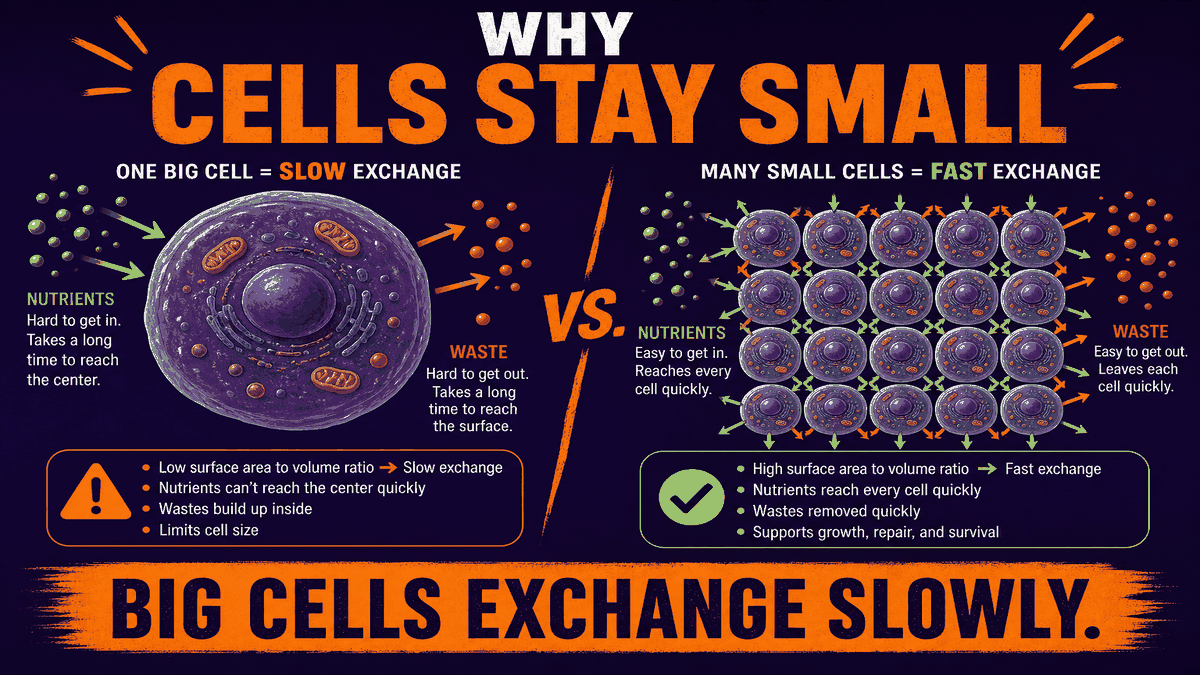
Cells stay small because they need to exchange materials quickly. Nutrients, gases, ions, water, and waste must cross the plasma membrane. If a cell becomes too large, its internal demand increases faster than its membrane exchange surface.
Nutrients must enter the cell
Oxygen may need to enter for aerobic metabolism
Carbon dioxide and waste must leave
Ions and water must be regulated for homeostasis
Signals must be received and processed at the membrane
For water-specific outcomes in different environments, see the osmosis and tonicity guide—this page focuses on why cell size sets exchange demand, not full water movement rules.
Review how structure supports exchange on the cell structure and function overview when you need the big-picture reasoning.
Cells stay small because exchange becomes less efficient as volume increases faster than surface area.
AP Exam Clue: Do not say “cells are small because large cells cannot exist.” Say large cells have lower SA:V ratios, which makes exchange less efficient.
Exchange efficiency
How Cell Size Affects Diffusion and Transport
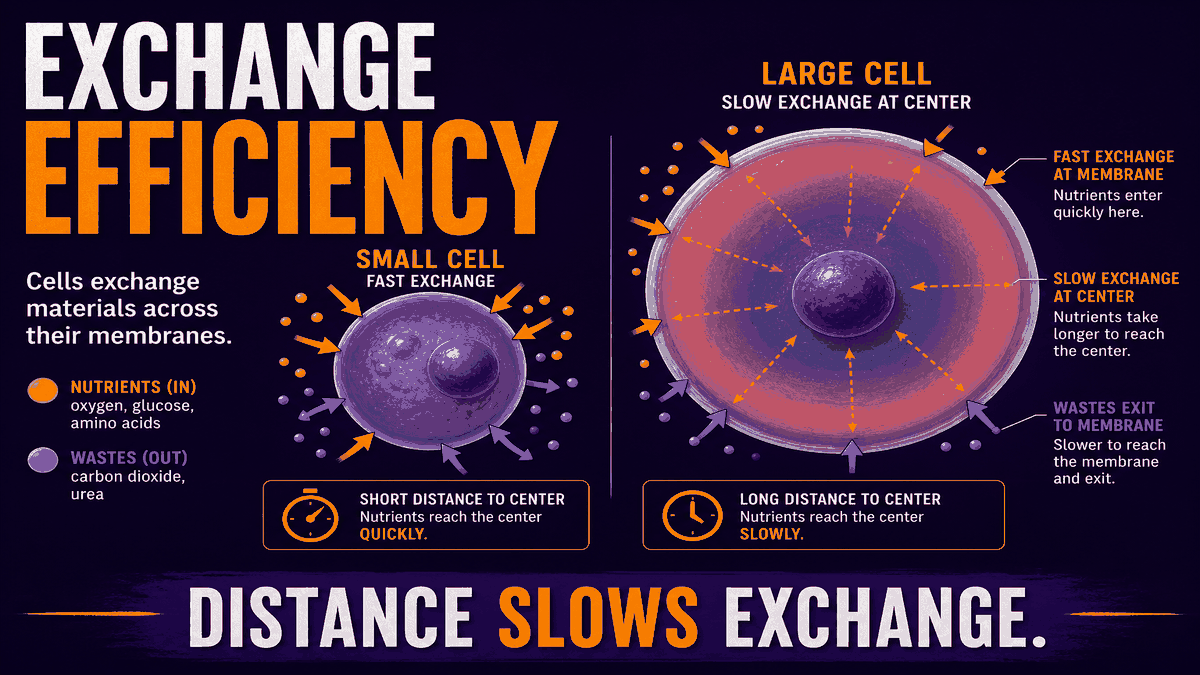
A smaller cell has shorter internal distances. Substances do not need to travel as far from the membrane to the center of the cell. A large cell has more internal volume and a longer distance from surface to center.
High SA:V = more exchange surface per volume
Low SA:V = less exchange surface per volume
Short diffusion distance = faster internal distribution
Long diffusion distance = slower internal distribution
Small cells exchange materials faster because substances travel shorter distances relative to cell volume.Adaptations
How Cells and Tissues Increase Surface Area
Some cells and tissues increase surface area without becoming giant spheres. This helps maintain exchange efficiency while still performing specialized jobs.
Adaptation
How It Helps Exchange
Microvilli
Increase membrane surface area for absorption
Root hairs
Increase absorption area in plant roots
Flattened shape
Shortens diffusion distance across the cell
Folded membranes
Increase surface or reaction space
Many small cells
Maintain high SA:V ratio in tissues
Tip: Scroll sideways to see the full table.
AP Exam Clue: Shape matters. Cells can increase surface area by being folded, flattened, or divided into many smaller units.
Common mistakes
Common Mistakes About Surface Area to Volume Ratio
Many missed points come from treating SA:V as pure math or from vague statements about cell size. Use this table to upgrade weak phrases into AP-ready explanations.
Mistake
Better AP Biology Understanding
"Bigger cells are always better"
Bigger cells often have lower SA:V ratios
"Surface area and volume increase equally"
Volume increases faster than surface area
"Large cells cannot exchange anything"
They exchange less efficiently, not necessarily zero
"SA:V is only a math topic"
It explains cell exchange, diffusion, and transport limits
"Higher volume means faster exchange"
Higher volume means more internal demand
"Only membrane transport matters"
Cell size and shape affect exchange efficiency too
Tip: Scroll sideways to see the full table.
Common mistakes happen when students forget that volume increases faster than surface area.MCQ practice
Surface Area to Volume Ratio Practice Questions
Answer all ten questions. Choices shuffle each time you reload, so focus on reasoning—not letter memorization.
Question 1 of 10Start
Correct: 0Answered: 0Streak: 0Accuracy: 0%
FRQ practice
AP-Style FRQ Practice: Surface Area to Volume Ratio
Open each card, draft your response, then reveal the rubric and sample when ready. In SA:V FRQs, always connect the calculation to exchange efficiency.
0 of 2 FRQs opened
Prompt
Calculate the surface area-to-volume ratio for a cube with side length 1.
Calculate the surface area-to-volume ratio for a cube with side length 3.
Identify which cube would exchange materials more efficiently.
Tip: Show surface area, volume, and ratio for each cube before comparing exchange.
Scoring rubric (4 points)
1 pt — Side length 1: surface area = 6, volume = 1, SA:V = 6:1.
1 pt — Side length 3: surface area = 54, volume = 27, SA:V = 2:1.
1 pt — The smaller cube exchanges materials more efficiently.
1 pt — Smaller cells have more surface area per unit volume, so more membrane is available for exchange relative to internal demand.
Sample response
A. For side length 1, surface area = 6, volume = 1, so SA:V = 6:1.
B. For side length 3, surface area = 54, volume = 27, so SA:V = 2:1.
C. The cube with side length 1 exchanges materials more efficiently.
D. Smaller cells have more membrane surface area per unit of cytoplasm volume, so nutrients and wastes can cross the membrane fast enough to meet internal demand.
Self-check before you reveal
Status: Draft your answer first—then open the rubric or sample.
Prompt
Describe one reason large cells may have difficulty maintaining homeostasis.
Explain how increasing surface area can improve exchange.
Identify one cell or tissue adaptation that increases surface area.
Explain how this adaptation supports function.
Tip: Accept microvilli, root hairs, folds, flattened cells, or many small cells.
Scoring rubric (4 points)
1 pt — Large cells have lower SA:V ratios, so exchange may not meet internal demand efficiently.
1 pt — More surface area provides more membrane available for transport, diffusion, or absorption.
1 pt — Accept microvilli, root hairs, folded membranes, flattened cells, or many small cells.
1 pt — Explanation connects increased surface area or shorter diffusion distance to improved exchange.
Sample response
A. Large cells have lower surface area-to-volume ratios, so the membrane may not exchange nutrients and wastes fast enough to maintain stable internal conditions.
B. Increasing surface area adds more membrane for substances to cross, improving diffusion and transport relative to internal volume.
C. Intestinal cells use microvilli to increase membrane surface area.
D. Microvilli increase absorption area without making each cell a giant sphere, so nutrients can enter faster relative to cytoplasm volume.
Self-check before you reveal
Status: Draft your answer first—then open the rubric or sample.
FRQ Tip
In SA:V FRQs, always connect the calculation to exchange efficiency.
Keep learning
Continue the Unit 2 Learning Journey
You now understand why cell size affects exchange efficiency. Use these links to study membranes, transport, and Unit 2 practice.
FAQs About Surface Area to Volume Ratio in AP Biology
What is surface area to volume ratio in AP Biology?
Surface area-to-volume ratio compares the outside surface available for exchange to the inside volume that needs resources and produces waste.
Why are cells usually small?
Cells are usually small because smaller cells have higher surface area-to-volume ratios, allowing more efficient exchange of nutrients, gases, water, ions, and waste.
What happens to surface area-to-volume ratio as cell size increases?
As cell size increases, surface area-to-volume ratio decreases because volume grows faster than surface area.
Why does volume increase faster than surface area?
Surface area increases with the square of length, while volume increases with the cube of length, so volume grows faster as size increases.
How do you calculate surface area-to-volume ratio for a cube?
For a cube, calculate surface area using 6s², calculate volume using s³, then divide surface area by volume.
Why do small cells exchange materials faster?
Small cells exchange materials faster because they have more surface area per unit volume and shorter internal diffusion distances.
How can cells increase surface area?
Cells can increase surface area by using folds, projections such as microvilli, flattened shapes, or many smaller cells instead of one large cell.
How is surface area-to-volume ratio tested on AP Biology?
AP Biology may test surface area-to-volume ratio with cube calculations, diagrams, diffusion scenarios, exchange efficiency questions, or FRQs about cell size and homeostasis.
Is surface area-to-volume ratio only a math topic?
No. Surface area-to-volume ratio is a biology concept because it explains how cell size and shape affect exchange, diffusion, transport, and homeostasis.
Checkpoint
Before You Move On
Can you explain why volume grows faster than surface area?
Can you calculate SA:V for a cube from side length?
Can you predict which cell exchanges materials faster?
Can you name one adaptation that increases surface area?
Can you connect SA:V to diffusion distance and homeostasis?