1 Does the cell have a nucleus?
Yes
Eukaryotic cell.
No
Go to Step 2.
Unit 2 Learning Journey · Step 5
Prokaryotic vs eukaryotic cells AP Biology questions usually test one big idea: both cell types share basic features, but eukaryotic cells have a nucleus and membrane-bound organelles while prokaryotic cells do not.
This guide helps you compare prokaryotic and eukaryotic cells, identify the clues that separate them, avoid common AP Biology mistakes, and practice exam-style questions about cell organization.
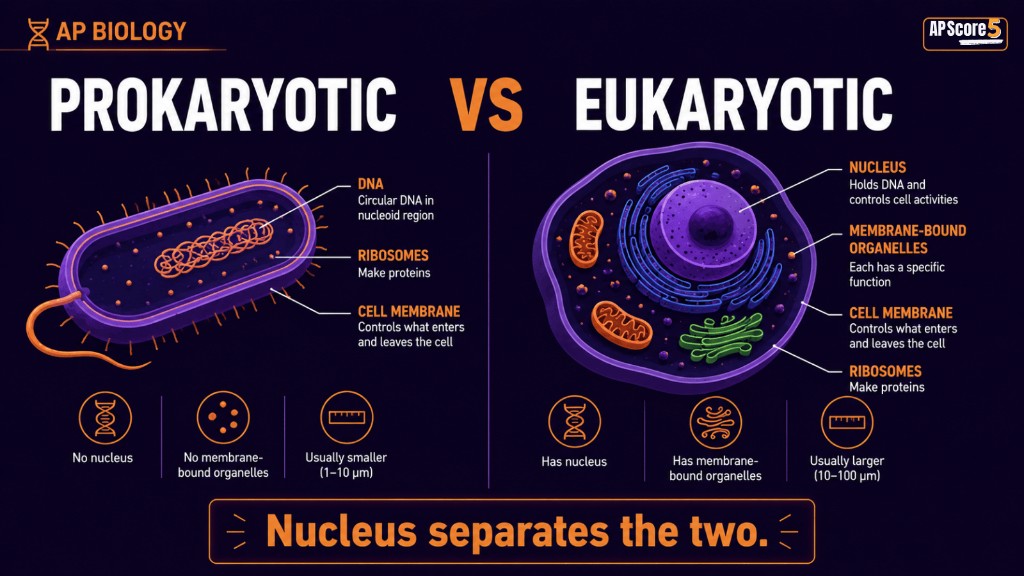
The previous page, cell organelles and their functions, focused on major cell structures and the jobs they perform. This page asks which cells have those structures and how internal organization differs between prokaryotic and eukaryotic cells.
After this page, you will study surface area to volume ratio, which explains why cell size affects exchange efficiency. You will also connect cell type to membrane structure and transport later in Unit 2.
Prokaryotic vs Eukaryotic Cells
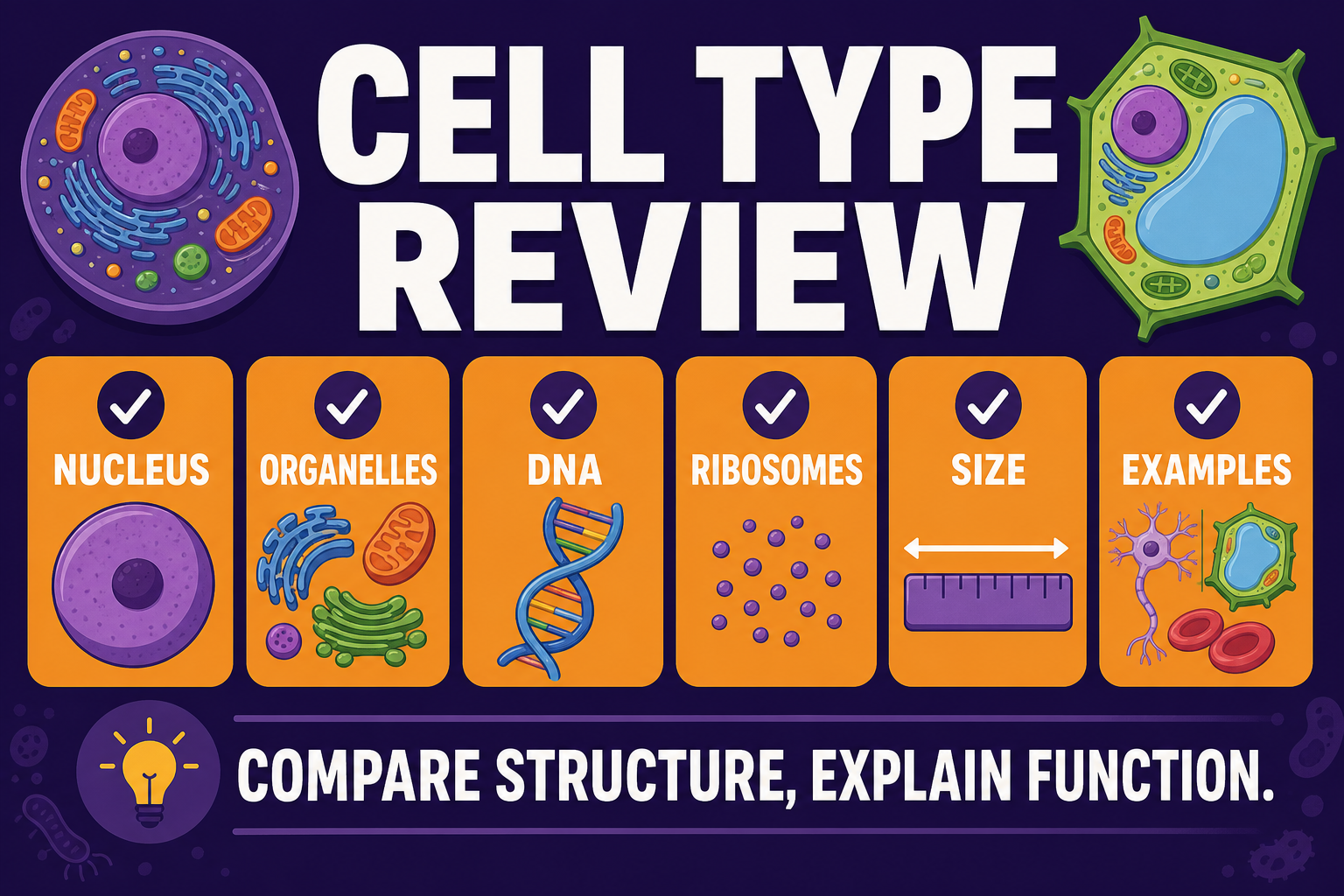
Cell types differ in nucleus, organelles, size, and organization.
The main difference between prokaryotic and eukaryotic cells is that eukaryotic cells have a nucleus and membrane-bound organelles, while prokaryotic cells do not. Both cell types have DNA, ribosomes, cytoplasm, and a plasma membrane.
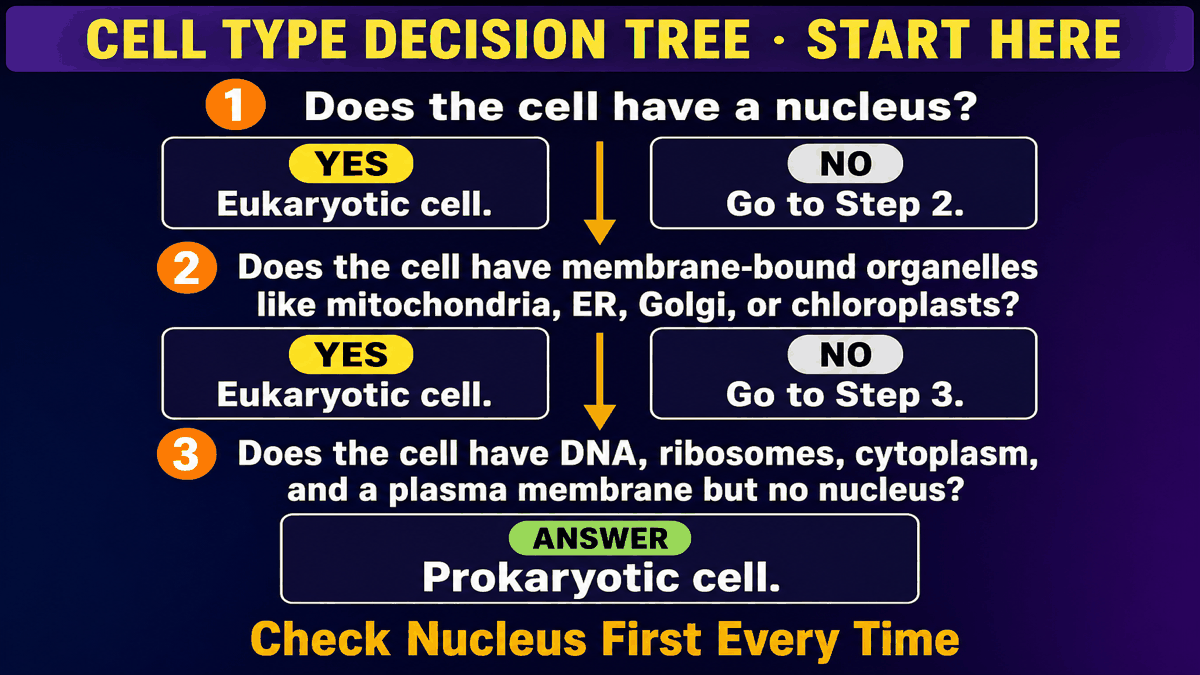
For AP Biology, the fastest way to compare prokaryotic and eukaryotic cells is to check for a nucleus first, then membrane-bound organelles.
When an AP Biology question gives you a cell description, do not start by memorizing every structure. Start with the fastest clue: nucleus or no nucleus. Then check for membrane-bound organelles, DNA location, and example type.
1 Does the cell have a nucleus?
Eukaryotic cell.
Go to Step 2.
2 Does the cell have membrane-bound organelles like mitochondria, ER, Golgi, or chloroplasts?
Eukaryotic cell.
Go to Step 3.
3 Does the cell have DNA, ribosomes, cytoplasm, and a plasma membrane but no nucleus?
Prokaryotic cell.
4 Is the example bacteria or archaea?
Prokaryotic cell.
5 Is the example animal, plant, fungi, or protist?
Eukaryotic cell.
Students often focus only on differences, but AP Biology questions also test shared features. Both cell types are living cells that must store genetic information, build proteins, carry out metabolism, and regulate exchange with the environment.
| Shared Feature | Why It Matters |
|---|---|
| DNA | Stores genetic information |
| Ribosomes | Build proteins |
| Cytoplasm | Holds many cell processes |
| Plasma membrane | Controls movement in and out |
| Metabolism | Cells process energy and materials |
| Genetic code | Both use DNA/RNA/protein systems |
Tip: Scroll sideways to see the full table.
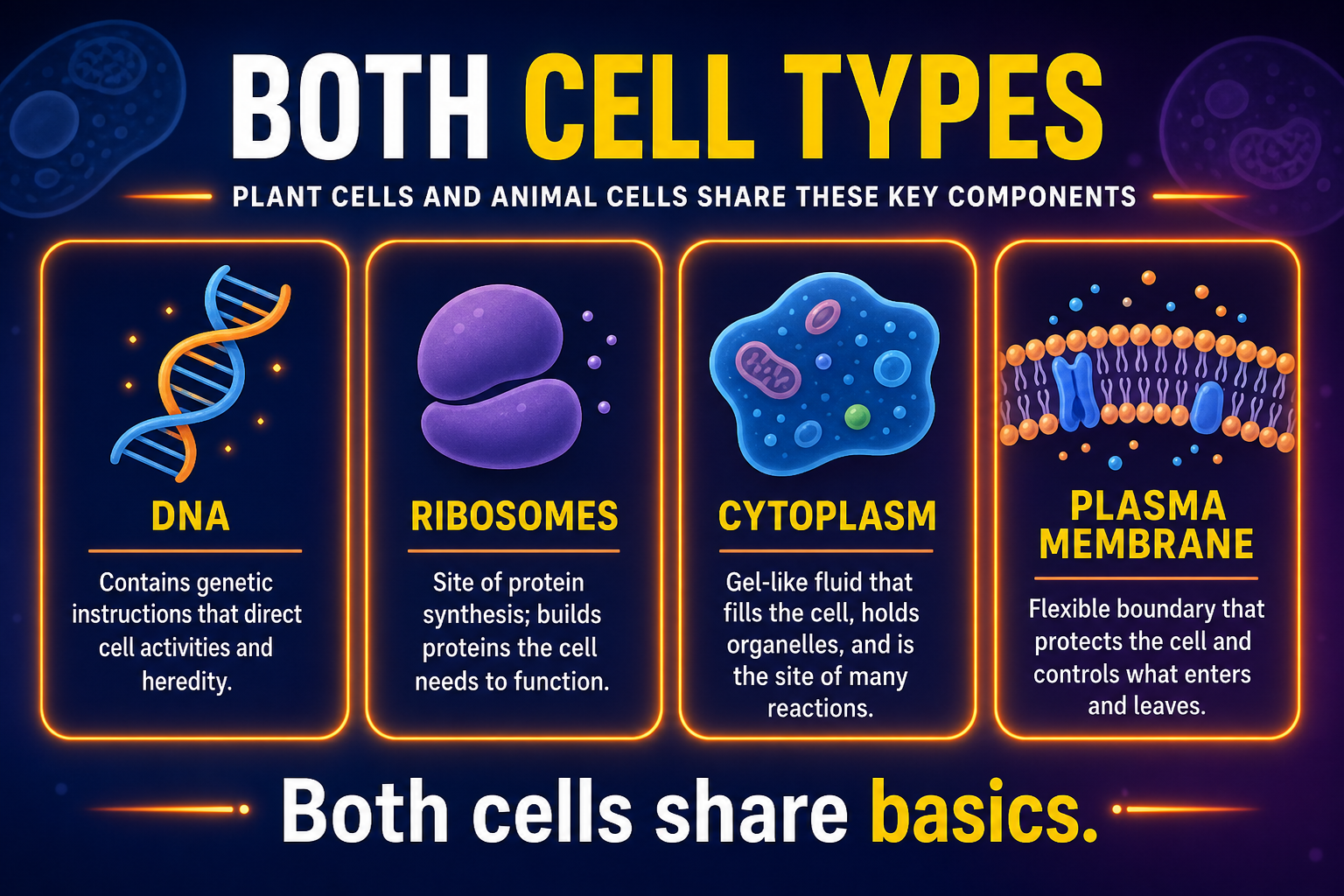
Both cell types rely on the plasma membrane to control exchange. Review how structure supports function on the cell structure and function overview when you need the big-picture reasoning.
Use this chart as your main side-by-side comparison. The goal is not to memorize every row. The goal is to connect each difference to the clue that usually appears in AP-style questions.
| Feature | Prokaryotic Cells | Eukaryotic Cells |
|---|---|---|
| Nucleus | No nucleus | Nucleus present |
| DNA location | Nucleoid region | Nucleus |
| Membrane-bound organelles | No | Yes |
| Ribosomes | Yes | Yes |
| Plasma membrane | Yes | Yes |
| Cytoplasm | Yes | Yes |
| Typical size | Smaller | Larger |
| Examples | Bacteria and Archaea | Animals, plants, fungi, protists |
| Compartmentalization | Limited | High |
| Cell division | Binary fission | Mitosis or meiosis |
Tip: Scroll sideways to see the full table.
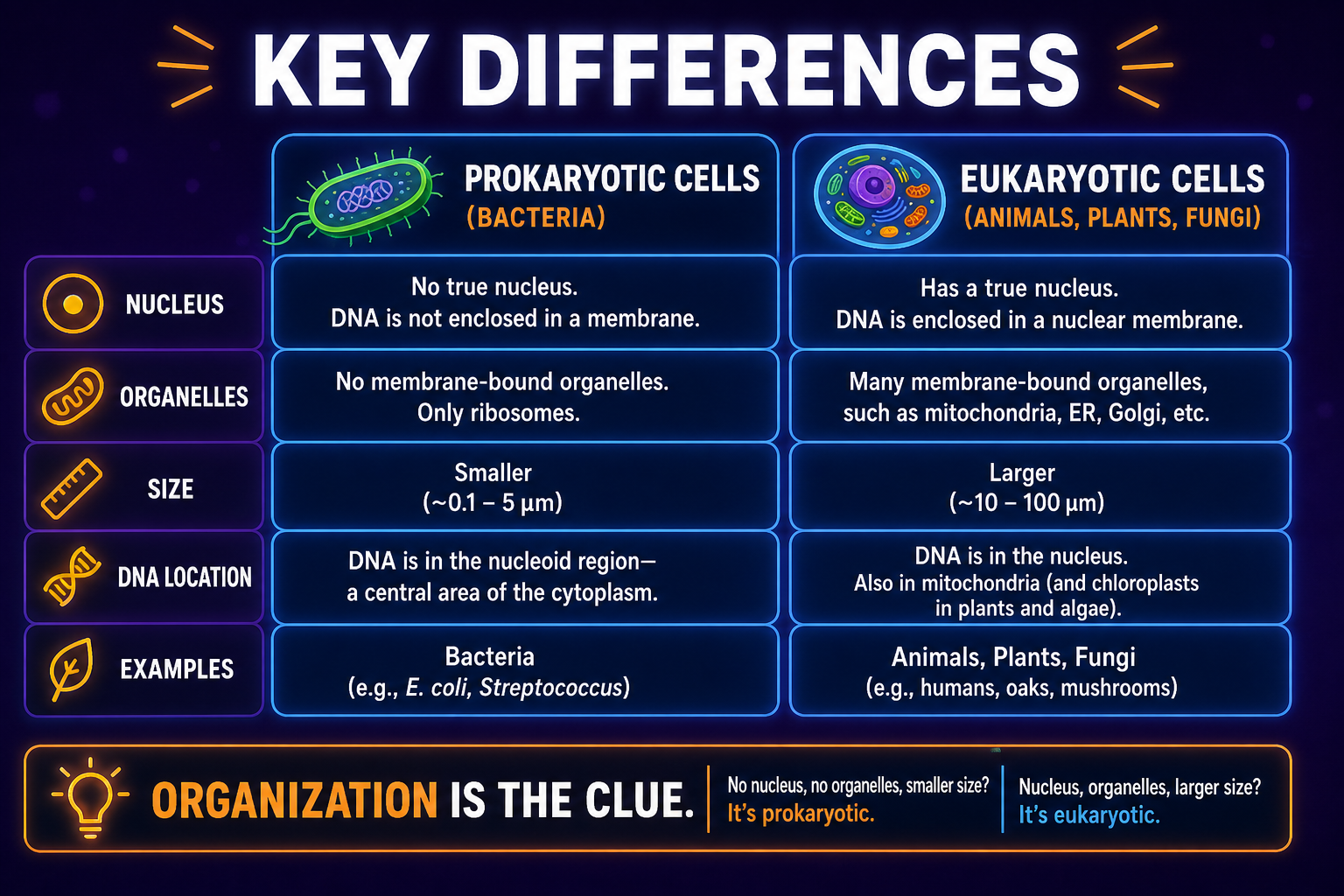
Prokaryotic cells are usually smaller and simpler in internal organization. They do not have a nucleus or membrane-bound organelles. Their DNA is usually found in a nucleoid region. They still have ribosomes, cytoplasm, and a plasma membrane.
Common examples: Bacteria and Archaea.
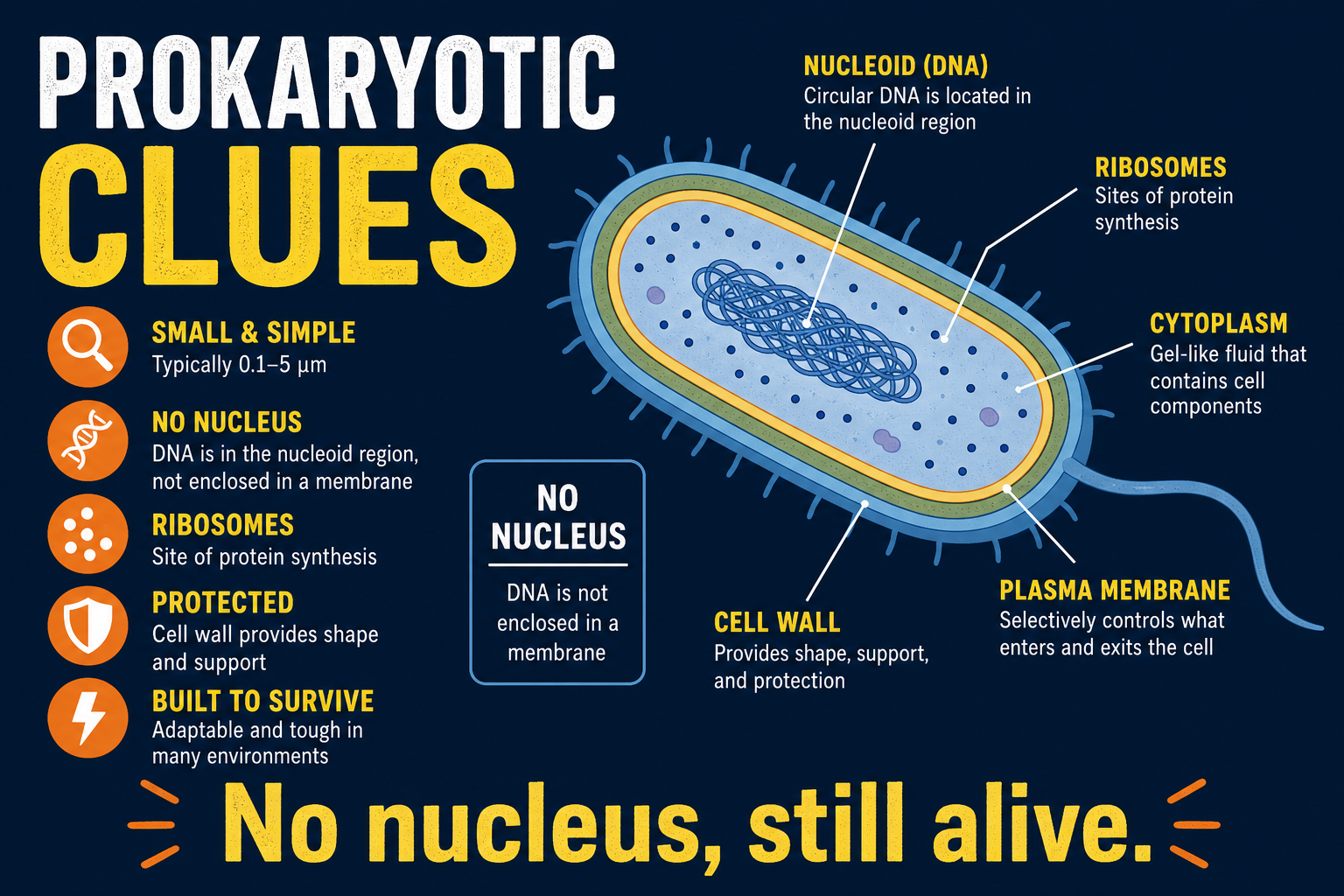
Eukaryotic cells have a nucleus and membrane-bound organelles. These compartments help organize cellular work. Eukaryotic cells are usually larger and more complex than prokaryotic cells.
Common examples: Animal cells, plant cells, fungal cells, and protist cells.
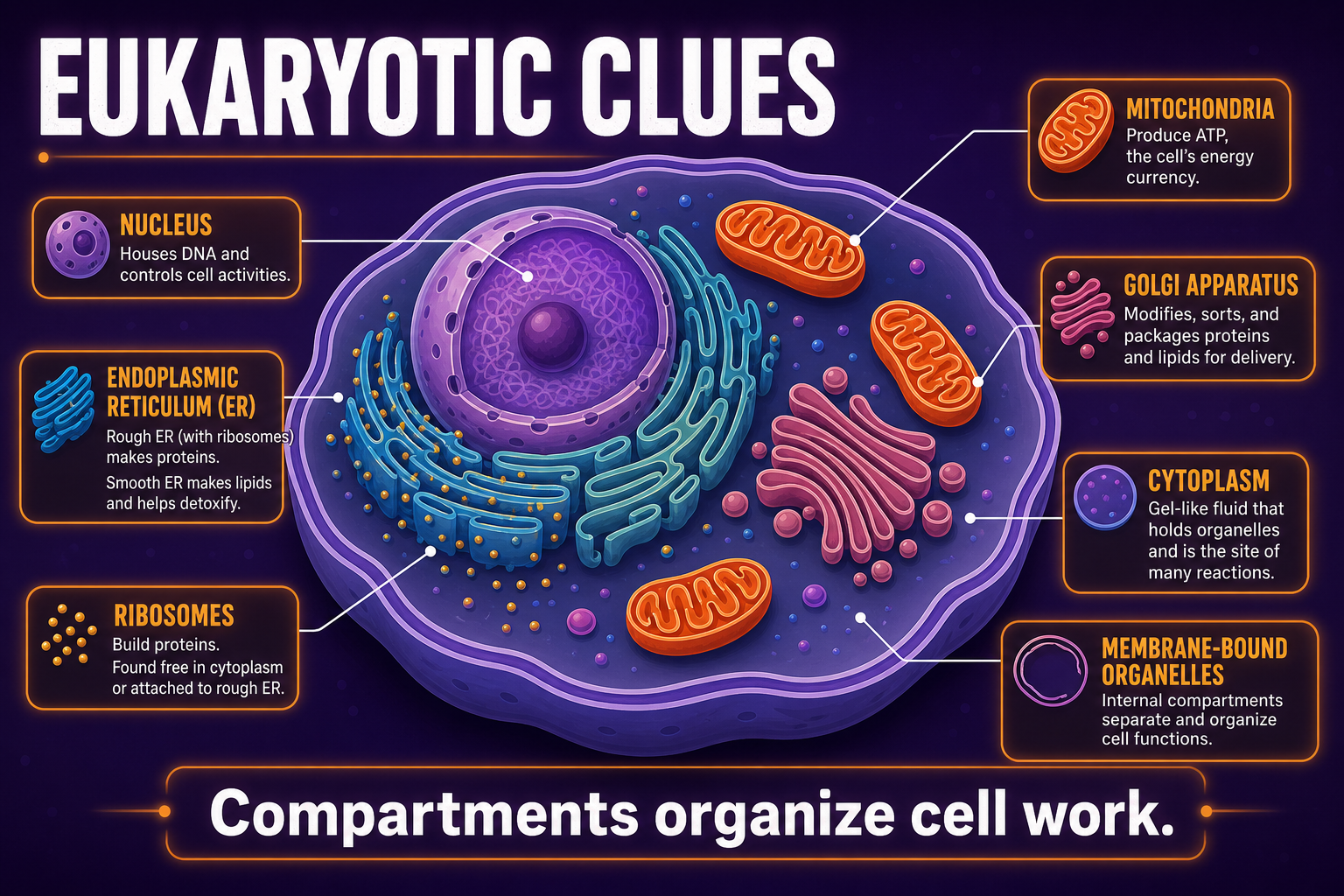
For organelle names and jobs, return to the cell organelles and their functions guide. This page focuses on cell type, not a full organelle chart.
Eukaryotic cells are larger and more complex, so internal compartments help organize cell processes. Membrane-bound organelles create specialized spaces for DNA storage, protein processing, ATP production, photosynthesis, digestion, and transport.
Compartments organize cell work by separating incompatible processes and concentrating enzymes where they are needed. For a deeper explanation of why eukaryotes use internal compartments, see the cell compartmentalization guide.
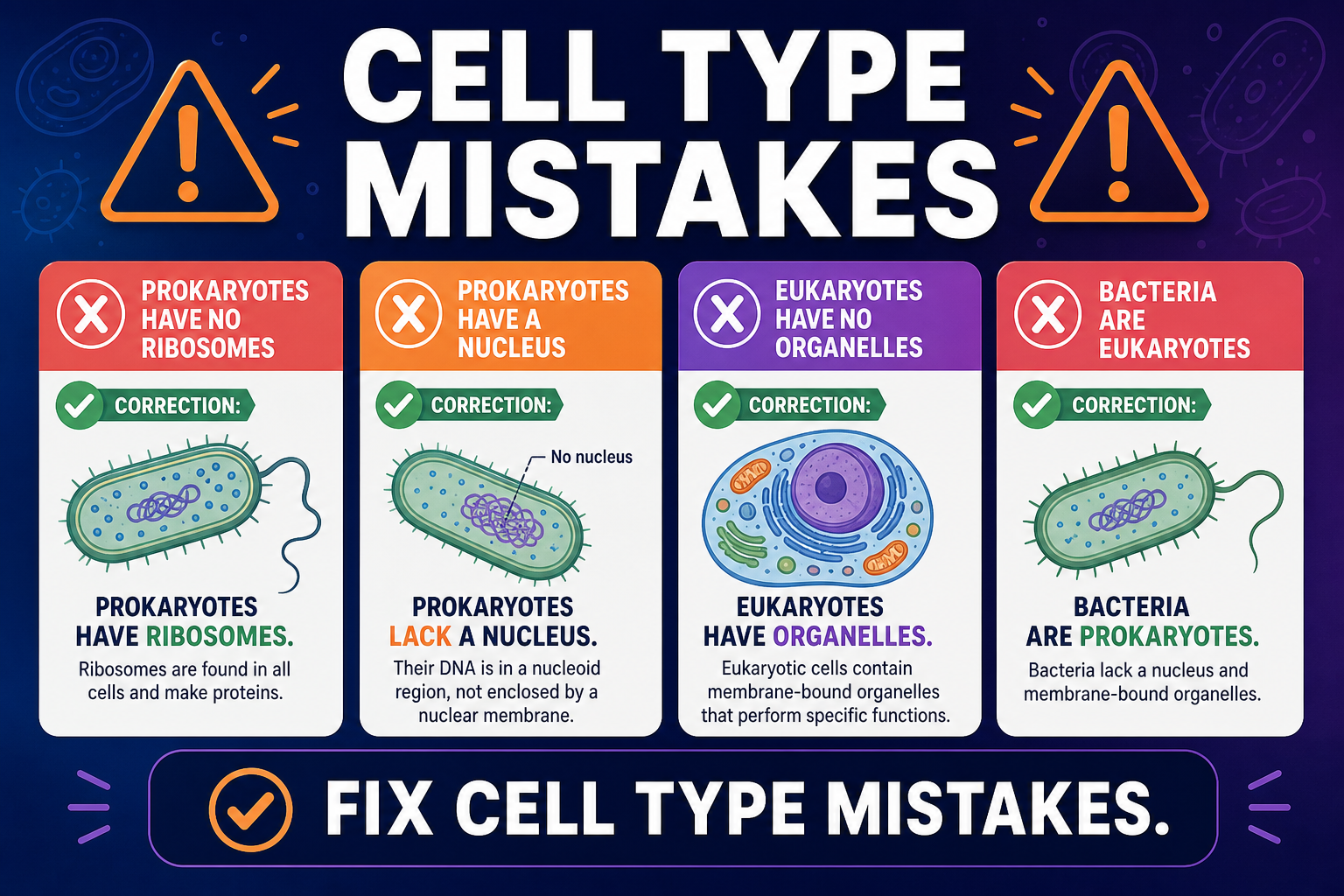
Many missed points come from vague wording about organelles or DNA. Use this table to upgrade weak phrases into AP-ready explanations.
| Mistake | Better AP Biology Understanding |
|---|---|
| "Prokaryotes have no organelles at all" | Prokaryotes lack membrane-bound organelles but have ribosomes |
| "All cells have a nucleus" | Only eukaryotic cells have a nucleus |
| "Only eukaryotes have DNA" | Both cell types have DNA |
| "Only eukaryotes have ribosomes" | Both cell types have ribosomes |
| "Bacteria are eukaryotes" | Bacteria are prokaryotes |
| "All eukaryotes have chloroplasts" | Plants and algae have chloroplasts; animals and fungi do not |
| "Prokaryotes are not alive" | Prokaryotes are living cells |
Tip: Scroll sideways to see the full table.
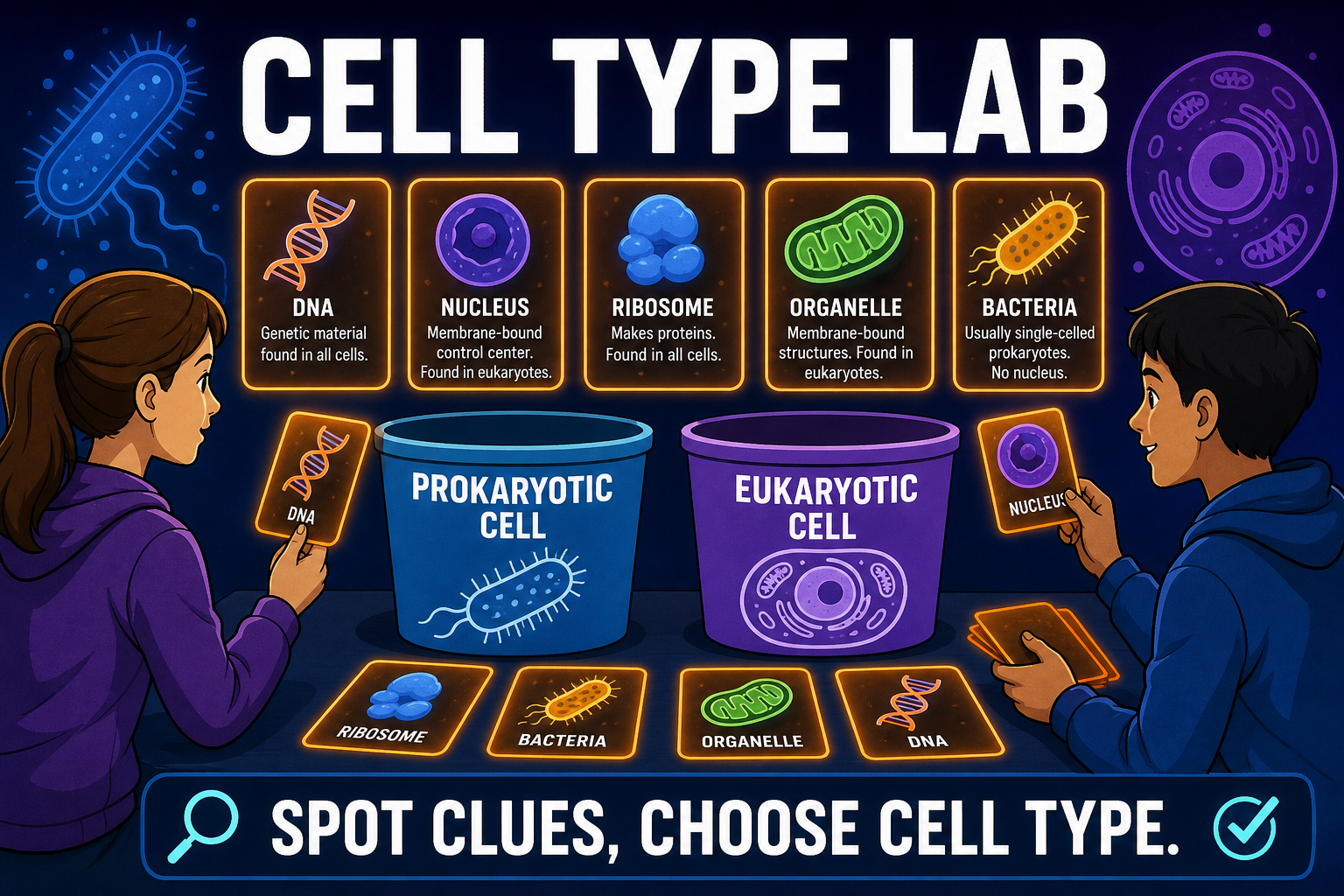
Use the decision tree first, then reveal the answer. Read each scenario, predict the cell type, then check your reasoning—the same approach AP Biology uses in data questions and short free response.
A cell has DNA, ribosomes, cytoplasm, and a plasma membrane, but no nucleus.
Answer: Prokaryotic cell.Clue used: no nucleus.
A cell has a nucleus, mitochondria, ER, and Golgi apparatus.
Answer: Eukaryotic cell.Clue used: nucleus and membrane-bound organelles.
A bacterial cell divides by binary fission.
Answer: Prokaryotic cell.Clue used: bacteria.
A plant cell contains chloroplasts and a large central vacuole.
Answer: Eukaryotic cell.Clue used: chloroplasts and central vacuole.
A cell has ribosomes but no membrane-bound organelles.
Answer: Prokaryotic cell.Clue used: ribosomes present, no membrane-bound organelles.
A fungal cell has a nucleus and mitochondria.
Answer: Eukaryotic cell.Clue used: nucleus and fungi are eukaryotes.
A cell has circular DNA in a nucleoid region.
Answer: Prokaryotic cell.Clue used: nucleoid region instead of a nucleus.
A cell has mitochondria but no chloroplasts.
Answer: Eukaryotic cell, likely animal or fungal depending on other clues.Clue used: mitochondria are membrane-bound organelles.
A cell lacks a nucleus but can build proteins.
Answer: Prokaryotic cell because ribosomes are present.Clue used: no nucleus, but ribosomes still build proteins.
A cell uses internal organelles to separate different processes.
Answer: Eukaryotic cell.Clue used: compartmentalization with membrane-bound organelles.
Answer all ten questions. Choices shuffle each time you reload, so focus on reasoning—not letter memorization.
Open each card, draft your response, then reveal the rubric and sample when ready. In comparison FRQs, do not just list features. Explain how each feature affects cell organization or function.
Tip: Name the structure, describe the function, and explain how that function helps the cell.
Sample response: Both prokaryotic and eukaryotic cells have ribosomes that build proteins. Eukaryotic cells also have a nucleus that stores DNA separately from the cytoplasm. Ribosomes are important in both cell types because proteins carry out most cell functions. Compartmentalization benefits eukaryotic cells by separating processes such as DNA storage, protein processing, and ATP production into specialized membrane-bound spaces.
Status: Draft your answer first—then open the rubric or sample.
Tip: Use clue language from the diagnosis lab, then explain mechanism.
Sample response: A prokaryotic cell lacks a nucleus and often has DNA in a nucleoid region. A eukaryotic cell has a nucleus and membrane-bound organelles such as mitochondria. Saying prokaryotes have no organelles is misleading because they still have ribosomes, which build proteins. Cell structure affects function because specialized structures allow cells to store DNA, synthesize proteins, process energy, and regulate transport in organized ways.
Status: Draft your answer first—then open the rubric or sample.
In comparison FRQs, do not just list features. Explain how each feature affects cell organization or function.
The main difference is that eukaryotic cells have a nucleus and membrane-bound organelles, while prokaryotic cells do not.
Yes. Prokaryotic cells have ribosomes, which build proteins. Ribosomes are not membrane-bound organelles.
Yes. Prokaryotic cells have DNA, usually located in a nucleoid region instead of a nucleus.
Yes. Eukaryotic cells have ribosomes, cytoplasm, DNA, and a plasma membrane, along with a nucleus and membrane-bound organelles.
Bacteria are prokaryotic cells.
Animal cells are eukaryotic cells because they have a nucleus and membrane-bound organelles.
Plant cells are eukaryotic cells because they have a nucleus and membrane-bound organelles. Many plant cells also have chloroplasts, a cell wall, and a large central vacuole.
Both cell types have DNA, ribosomes, cytoplasm, and a plasma membrane.
Eukaryotic cells are more compartmentalized because they use membrane-bound organelles to separate and organize different cell processes.
If yes, you are ready for surface area-to-volume ratio.
You now know how to compare prokaryotic and eukaryotic cells. Continue with Surface Area to Volume Ratio, or test yourself with Unit 2 practice questions.