Plasma membrane
Flexible boundary made mostly of phospholipids and proteins. It controls movement in and out of the cell.
AP clue: Connect to selective permeability and homeostasis.
Unit 2 Learning Journey · Step 3
AP Biology cell structure and function is the foundation of Unit 2 because cells are not just bags of parts. Every structure inside or around a cell has a job, and AP Biology often asks you to explain how that structure helps the cell survive, exchange materials, process energy, or maintain homeostasis.
This guide helps you connect cell parts to their functions, compare prokaryotic and eukaryotic cells, understand why cell size matters, and explain how membranes and compartments help cells work efficiently.
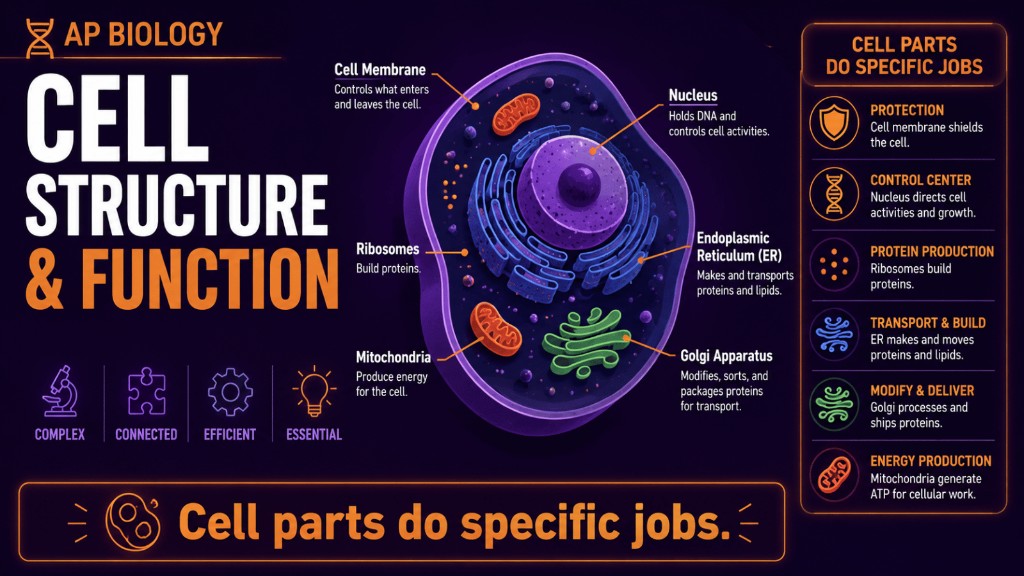
The Unit 2 hub gives the full roadmap for cell structure, membranes, transport, and efficiency. After reviewing osmosis and tonicity, this page begins the core biology reasoning: cell structures are useful because they perform specific functions. You will still zoom in on organelles, prokaryotic versus eukaryotic cells, cell size, membranes, transport, and compartmentalization on later pages—but every deep dive starts with one question: what job does this cell part perform?
Think of this guide as your structure-to-function map. When you see a diagram on an AP exam, your first move is not to label everything. Your first move is to connect visible features to processes: exchange at the membrane, protein synthesis at ribosomes, genetic control in the nucleus, ATP production in mitochondria, or specialized spaces inside eukaryotic organelles.
Cell Structure and Function
Connect each cell part to the job it performs.
Cell Organelles and Their Functions
Learn specific organelles and how they support cellular work.
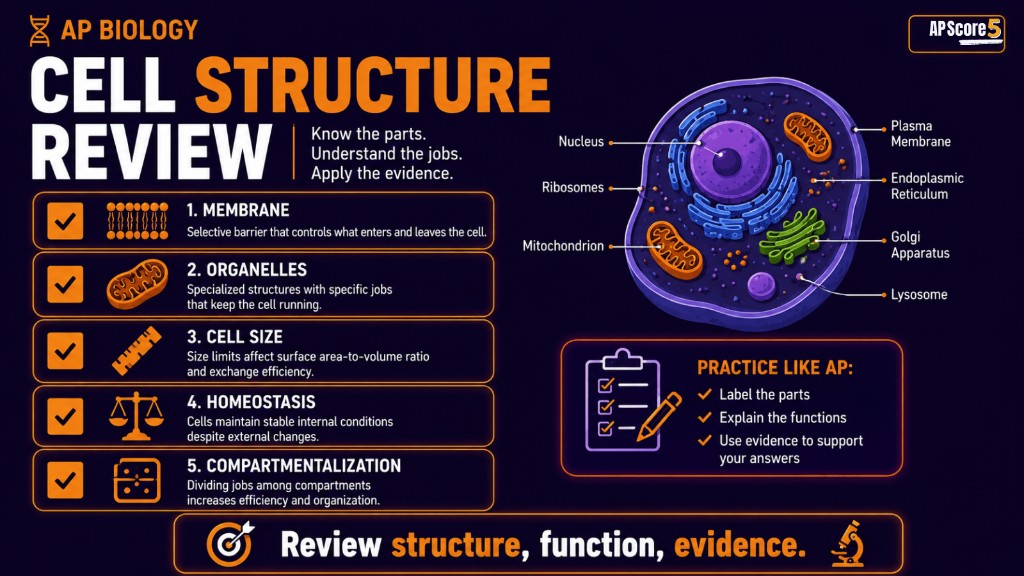
Cell structure and function in AP Biology means understanding how parts of a cell, such as the plasma membrane, ribosomes, nucleus, mitochondria, chloroplasts, cytoskeleton, and other organelles, help the cell carry out life processes. AP Biology questions often ask students to explain how a structure supports a specific function.
In biology, structure and function are connected. A cell part's shape, location, membrane, surface area, or chemical properties help it perform a job. AP Biology often rewards students who can explain this relationship instead of simply naming a structure. When you study Unit 2, treat every organelle as a solution to a cellular problem: how to control exchange, build proteins, store DNA, capture energy, recycle waste, or organize reactions in space.
This is why Unit 2 overlaps with Unit 1 chemistry. Phospholipid polarity explains membrane barriers. Protein shape explains transport and receptors. Water movement connects membranes to osmosis and tonicity. Strong Unit 2 answers sound like mini explanations, not flashcard lists.
| Cell Structure | Main Function | AP Biology Connection |
|---|---|---|
| Plasma membrane | Controls movement in and out | Selective permeability and transport |
| Ribosomes | Build proteins | Protein synthesis and cell activity |
| Nucleus | Stores DNA | Eukaryotic genetic control |
| Mitochondria | Help produce ATP | Energy processing |
| Chloroplasts | Carry out photosynthesis | Energy capture in plants and algae |
| Cell wall | Provides support and protection | Plant, fungal, and bacterial structure |
| Cytoskeleton | Gives shape and helps movement | Cell organization and intracellular transport |
| Vacuole | Stores water or materials | Storage and water balance |
| Lysosome | Breaks down waste and macromolecules | Recycling and cellular cleanup |
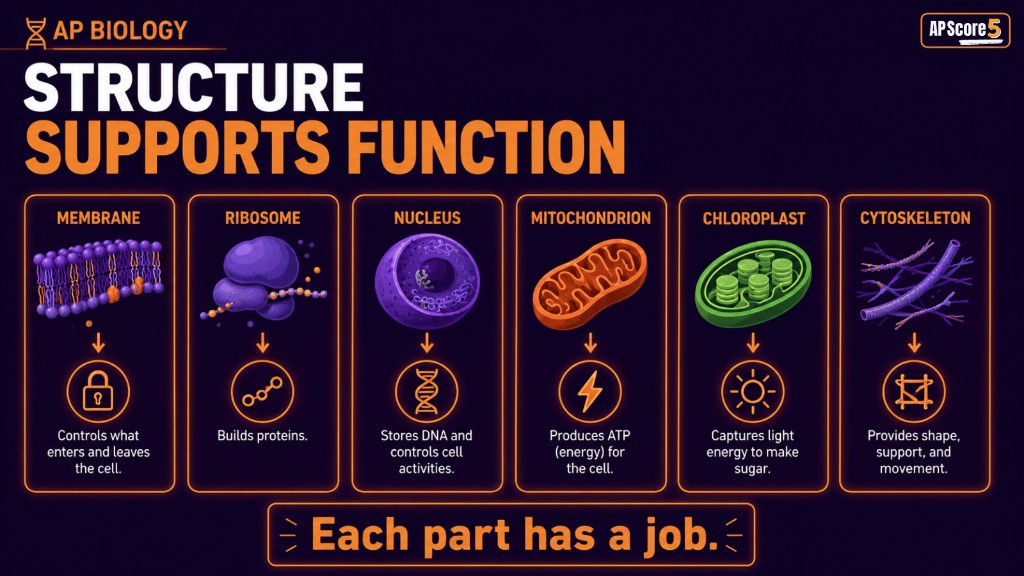
AP Biology does not expect you to draw every organelle perfectly, but you must know what major structures do and how they connect. This section introduces the parts you will see again on the dedicated cell organelles and their functions page. Focus on the job each structure performs and the AP clue that usually appears in questions.
Eukaryotic cells coordinate many structures at once. Ribosomes build proteins while the ER and Golgi process and ship them. Mitochondria supply ATP while the membrane regulates what crosses the boundary. Chloroplasts capture light in plant cells while vacuoles store water and support turgor. The cytoskeleton organizes shape and internal traffic. None of these parts works in isolation—AP FRQs often ask how two or three structures cooperate.
Flexible boundary made mostly of phospholipids and proteins. It controls movement in and out of the cell.
AP clue: Connect to selective permeability and homeostasis.
Fluid region inside the cell where many reactions and structures are found.
AP clue: Connect to cellular organization and reaction space.
Structures that build proteins.
AP clue: Both prokaryotic and eukaryotic cells have ribosomes.
Membrane-bound structure that stores DNA in eukaryotic cells.
AP clue: Prokaryotes do not have a nucleus.
Membrane network involved in protein and lipid processing.
AP clue: Rough ER has ribosomes; smooth ER does not.
Modifies, sorts, and ships cellular products.
AP clue: Often connected to protein processing and secretion.
Organelles involved in ATP production.
AP clue: Connect to energy demand and cellular respiration.
Organelles that carry out photosynthesis in plants and algae.
AP clue: Connect to energy capture and glucose production.
Storage structures; plant central vacuoles help maintain water balance.
AP clue: Connect to osmosis and plant cell support.
Digest and recycle materials.
AP clue: Connect to breakdown of macromolecules and damaged cell parts.
Rigid support outside the plasma membrane in plants, fungi, bacteria, and some protists.
AP clue: Cell wall is not the same as cell membrane.
Protein network that helps with shape, support, and movement.
AP clue: Connect to structure, transport, and organization.
For deeper organelle explanations, continue to the cell organelles guide after this overview.
AP Biology students must know that prokaryotic and eukaryotic cells share basic cell features, but eukaryotic cells have a nucleus and membrane-bound organelles. Both cell types have DNA, ribosomes, cytoplasm, and a plasma membrane. The difference is organization: eukaryotes compartmentalize many processes inside membrane-bound spaces, while prokaryotes carry out most reactions in the cytoplasm near a nucleoid region.
Size matters here too. Prokaryotic cells are generally smaller, which supports faster exchange relative to volume. Eukaryotic cells are larger and more complex, which makes internal membranes and organelles especially important for efficiency. When a question describes a cell with no nucleus but with ribosomes and a membrane, think prokaryote—not "no organelles at all."
| Feature | Prokaryotic Cells | Eukaryotic Cells |
|---|---|---|
| Nucleus | No | Yes |
| Membrane-bound organelles | No | Yes |
| DNA location | Nucleoid region | Nucleus |
| Ribosomes | Yes | Yes |
| Cytoplasm | Yes | Yes |
| Plasma membrane | Yes | Yes |
| Typical size | Smaller | Larger |
| Examples | Bacteria and Archaea | Animals, plants, fungi, protists |
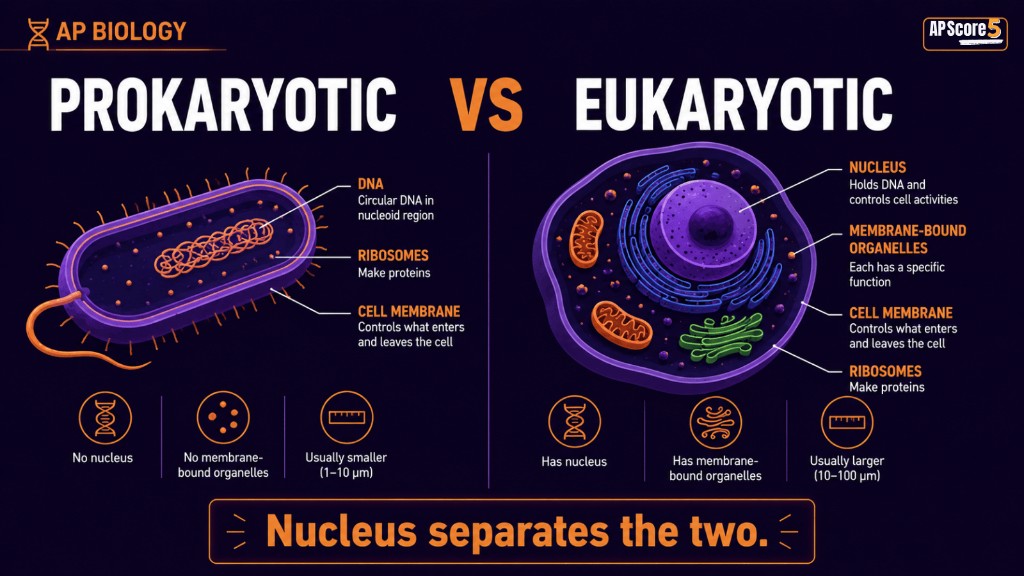
Compare cell types in depth on the prokaryotic vs eukaryotic cells page.
Cells need to exchange nutrients, gases, water, ions, and wastes with their environment. As a cell grows larger, its volume increases faster than its surface area. This makes exchange less efficient because the membrane cannot supply the interior quickly enough. That is why most cells stay small and why multicellular organisms use many small cells instead of one giant cell.
Small cells usually have a higher surface area-to-volume ratio, which helps them exchange materials more efficiently. Large cells may struggle because the membrane surface cannot keep up with the needs of the growing volume. Diffusion and transport over short distances happen faster than movement across a large internal space, so size directly affects how quickly a cell can respond to environmental change.
The AP exam may ask why cells do not simply keep growing larger. The answer is that larger cells have lower surface area-to-volume ratios, which can limit transport and exchange. You may also see cube models or radius comparisons in data questions—always link bigger volume to relatively less membrane area.
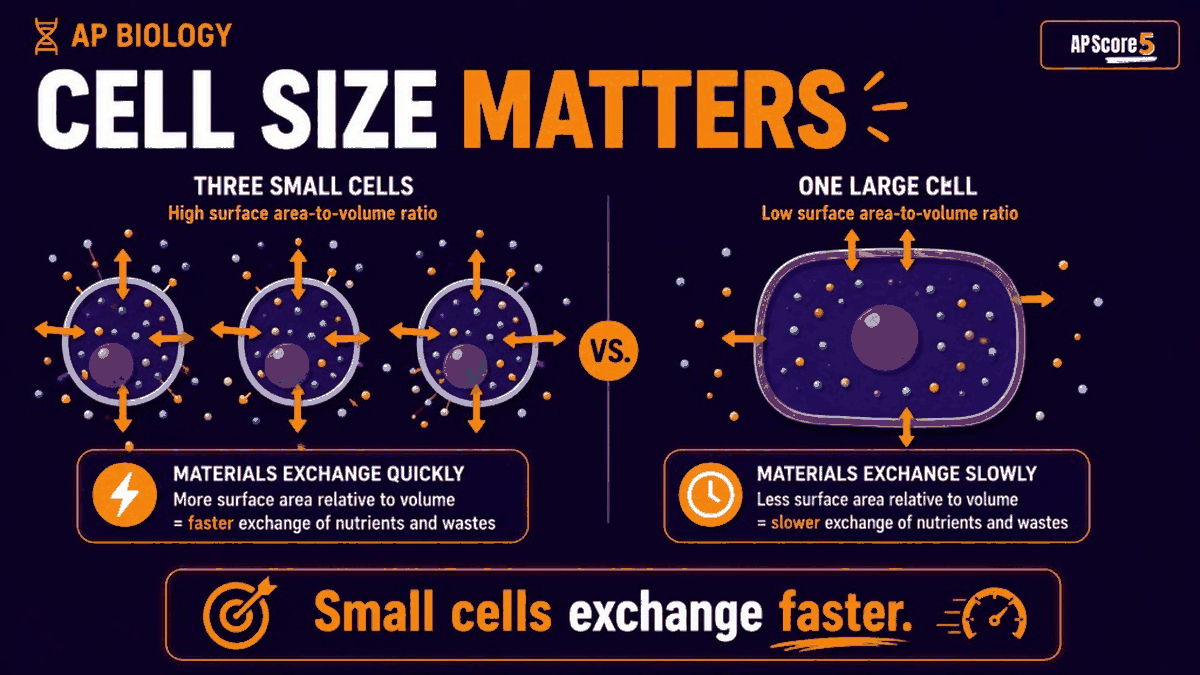
Explore calculations and examples on the surface area to volume ratio page.
The plasma membrane is a phospholipid bilayer. The hydrophilic heads interact with water, while hydrophobic tails face inward. Proteins in the membrane help move materials, receive signals, and identify cells. Cholesterol helps maintain fluidity, and carbohydrates on the surface can support cell recognition. The membrane is flexible—not a solid wall—which matters when cells change shape, fuse vesicles, or respond to osmotic pressure.
The plasma membrane is important because its structure allows the cell to control what enters and exits, helping the cell maintain homeostasis. Selective permeability means some substances cross easily, some need transport proteins, and some cannot cross without vesicle transport. This page introduces membrane logic; the dedicated guides cover structure and transport in more detail.
| Membrane Feature | Function |
|---|---|
| Phospholipid bilayer | Creates a flexible boundary |
| Hydrophilic heads | Face watery environments |
| Hydrophobic tails | Form an interior barrier |
| Transport proteins | Help specific substances cross |
| Cholesterol | Helps regulate membrane fluidity |
| Receptor proteins | Receive signals |
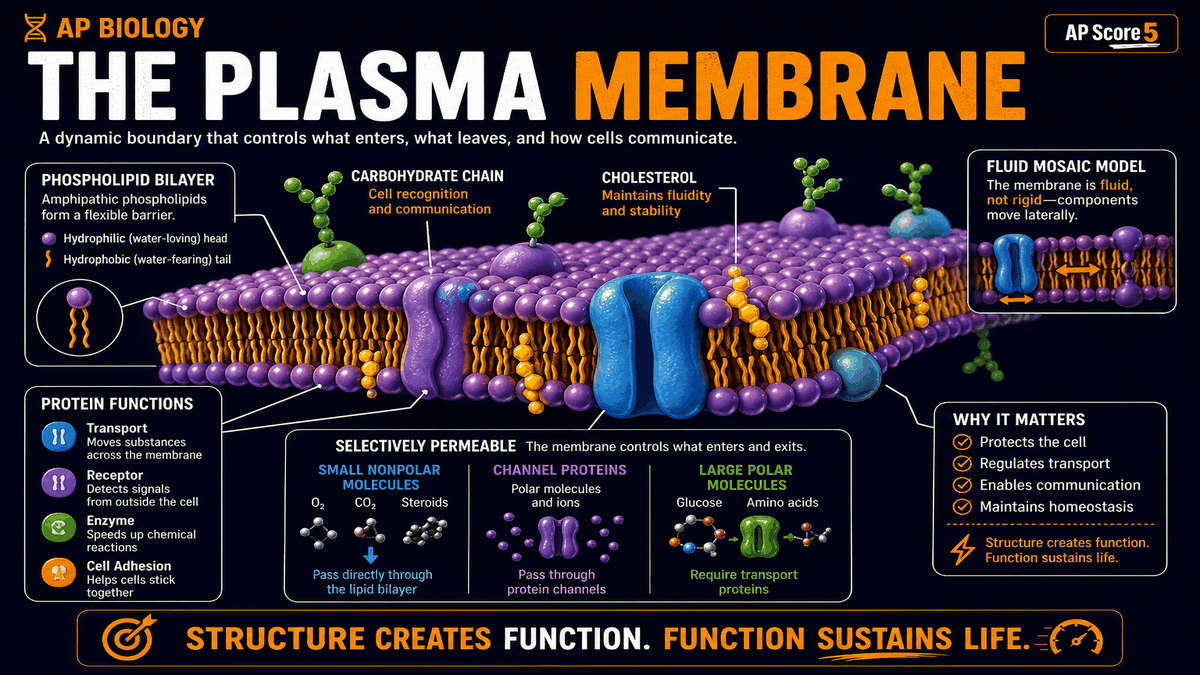
Continue with plasma membrane structure, selective permeability, passive transport and diffusion, and active transport.
Homeostasis means maintaining stable internal conditions. Cell structures help maintain homeostasis by controlling exchange, processing energy, building proteins, storing materials, and breaking down waste. When external conditions change—such as solute concentration, temperature, or signaling molecules—structures like the membrane, vacuole, lysosome, and mitochondria help the cell respond without losing function.
Water balance is a classic Unit 2 example. The membrane controls osmosis, while plant vacuoles store water to maintain turgor. Ion pumps use ATP to keep internal concentrations different from the environment. Protein synthesis adjusts when the cell needs new enzymes or membrane transporters. Homeostasis is not one organelle's job—it is the outcome of many structures working together.
| Structure | Homeostasis Role |
|---|---|
| Plasma membrane | Regulates entry and exit |
| Vacuole | Stores water and materials |
| Lysosome | Breaks down waste |
| Mitochondria | Supplies usable ATP |
| Ribosomes | Build proteins needed for cell function |
| Cytoskeleton | Maintains shape and organization |
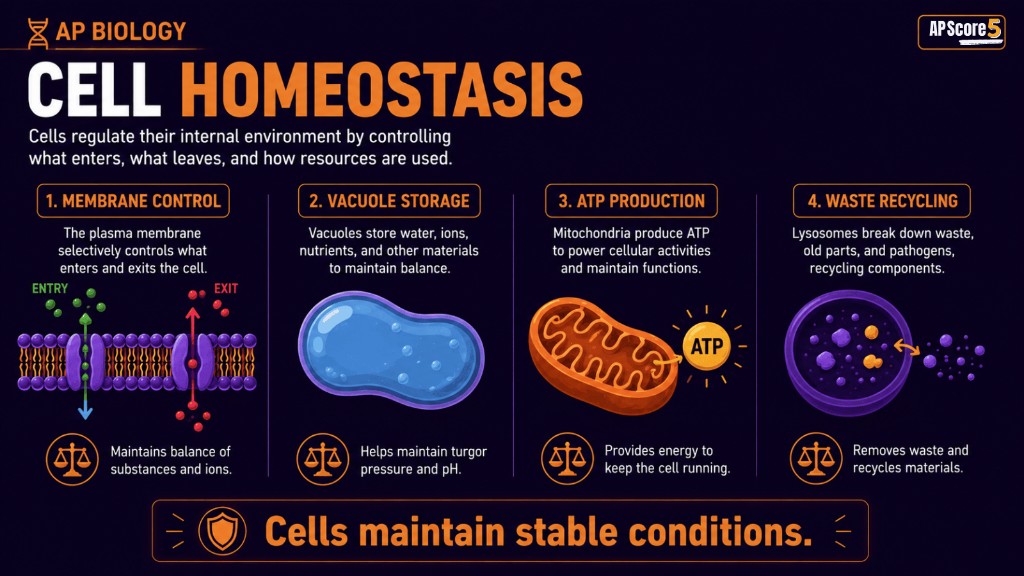
Review water movement and cell outcomes on the osmosis and tonicity page.
Eukaryotic cells use internal membranes to separate different processes. Organelles create specialized spaces where specific reactions can happen more efficiently. Without compartments, incompatible reactions would interfere with each other, and the cell would lose control over local conditions such as pH, enzyme concentration, or substrate availability.
Compartmentalization also helps cells run opposing processes at the same time. While proteins are built and shipped in one pathway, the membrane can regulate ion balance and the cytoskeleton can reorganize the cell for movement or division. This is a major reason eukaryotic cells can be larger and more complex than prokaryotic cells.
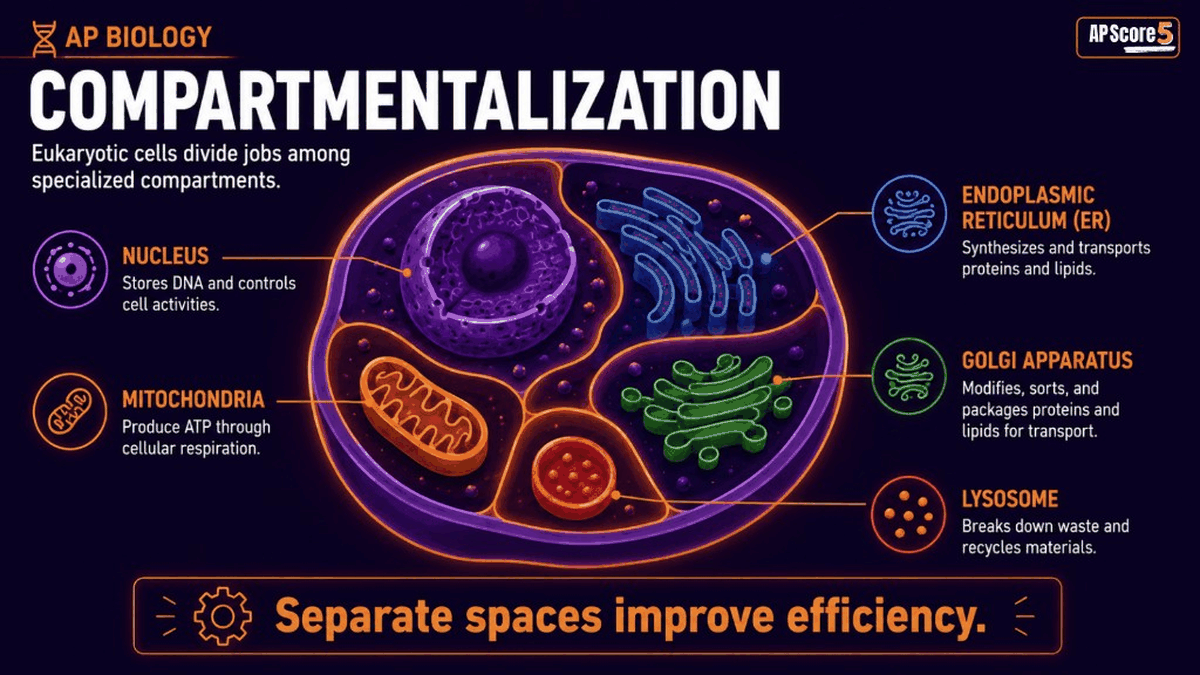
Go deeper on the cell compartmentalization page.
Use these ten scenarios to train AP-style reasoning. Read the cellular need first, predict the structure, then reveal the answer. On test day, the same habit helps with diagrams, short free response, and multiple-choice data questions.
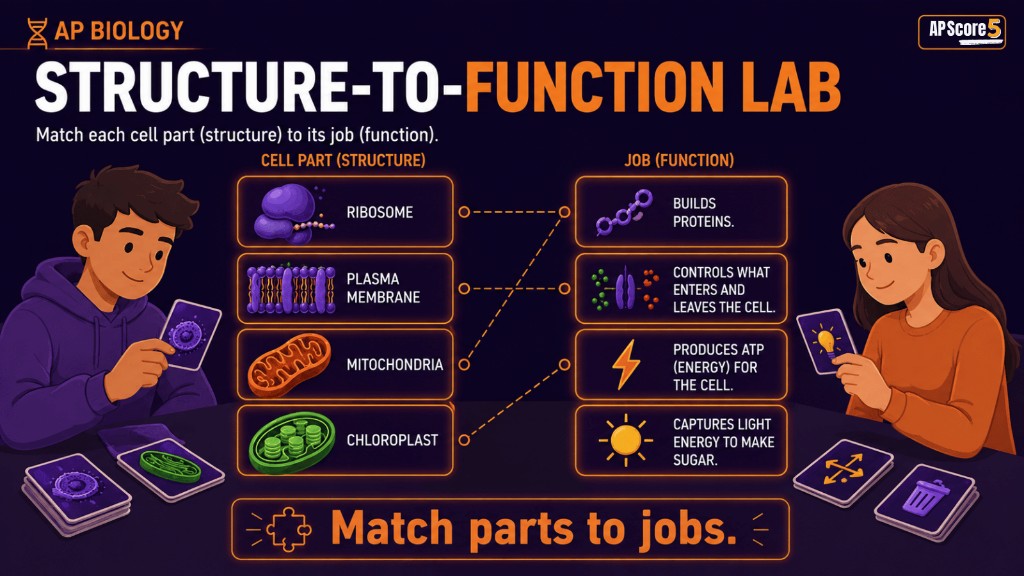
A cell needs to control which ions enter and leave.
Answer: Plasma membrane and transport proteins.
A cell is producing large amounts of protein for secretion.
Answer: Ribosomes, rough ER, and Golgi apparatus.
A plant cell needs to capture light energy.
Answer: Chloroplasts.
A cell needs large amounts of ATP for active transport.
Answer: Mitochondria.
A cell must maintain shape and move materials internally.
Answer: Cytoskeleton.
A plant cell needs support and protection outside the membrane.
Answer: Cell wall.
A cell needs to store water and maintain pressure.
Answer: Central vacuole.
A cell must break down damaged cell parts.
Answer: Lysosomes.
A bacterial cell has DNA but no nucleus.
Answer: Prokaryotic cell structure.
A eukaryotic cell separates different reactions into organelles.
Answer: Compartmentalization.
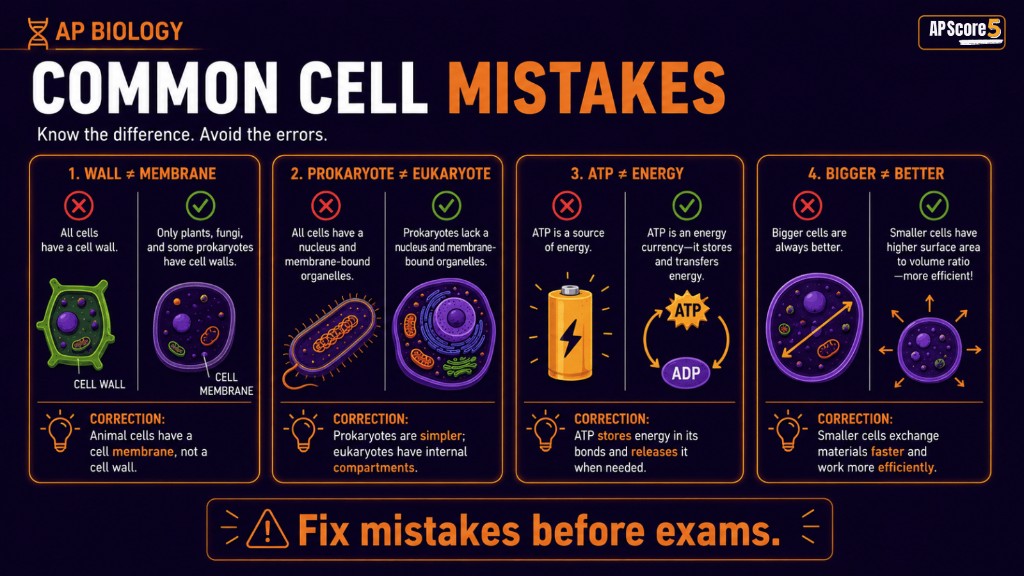
Many Unit 2 missed points come from vague vocabulary or swapped roles. Use this table to upgrade weak phrases into AP-ready explanations.
| Mistake | Better AP Understanding |
|---|---|
| Memorizing organelles is enough | AP Biology expects structure-function explanations |
| Prokaryotes have no organelles | Prokaryotes lack membrane-bound organelles but have ribosomes |
| The cell wall controls what enters and leaves | The plasma membrane controls exchange; the wall gives support |
| Bigger cells are more efficient | Larger cells often have lower surface area-to-volume ratios |
| Mitochondria make energy | Mitochondria help produce ATP, the usable energy currency |
| All cells have a nucleus | Eukaryotic cells have nuclei; prokaryotic cells do not |
| Membranes are solid walls | Membranes are flexible, selectively permeable barriers |
Answer all ten questions. Choices shuffle each time you reload, so focus on reasoning—not letter memorization.
Open each card, draft your response, then reveal the rubric and sample when ready. In cell structure FRQs, name the structure, describe the function, and explain how that function helps the cell.
Tip: Name the structure, describe the function, and explain how that function helps the cell.
A. The plasma membrane is a phospholipid bilayer with embedded proteins. The bilayer blocks many polar substances, while transport proteins help specific materials cross, so the cell can regulate entry and exit.
B. A smaller cell has more membrane surface area relative to its volume. That higher surface area-to-volume ratio lets materials reach the interior faster, so exchange is more efficient.
C. Ribosomes build proteins. In secretion pathways, the rough ER folds or modifies proteins and the Golgi sorts and packages them for transport.
D. Compartmentalization uses internal membranes to separate DNA processing, ATP production, digestion, and other reactions into specialized organelles, so incompatible processes can run at the same time.
Status: Draft your answer first—then open the rubric or sample.
Tip: Name the structure, describe the function, and explain how that function helps the cell.
A. Both cell types have a plasma membrane, cytoplasm, ribosomes, and DNA.
B. Eukaryotic cells have a nucleus and membrane-bound organelles such as mitochondria, which prokaryotic cells lack.
C. The plasma membrane helps maintain homeostasis by controlling which ions and molecules enter or leave, keeping internal conditions stable.
D. Structure-function relationships matter because AP Biology asks how a part's shape, location, or composition enables a process—not just what the part is called.
Status: Draft your answer first—then open the rubric or sample.
In cell structure FRQs, name the structure, describe the function, and explain how that function helps the cell.
Cell structure and function in AP Biology means understanding how cell parts, such as membranes, ribosomes, organelles, and the cytoskeleton, help cells perform life processes.
AP Biology students should know the plasma membrane, cytoplasm, ribosomes, nucleus, mitochondria, chloroplasts, ER, Golgi apparatus, vacuoles, lysosomes, cell wall, and cytoskeleton.
Structure and function are important because the shape, location, and organization of a cell part help it perform its job.
The plasma membrane is made of phospholipids and proteins, which allows it to act as a selectively permeable barrier that controls what enters and exits the cell.
Prokaryotic cells lack a nucleus and membrane-bound organelles, while eukaryotic cells have a nucleus and membrane-bound organelles.
Cells are usually small because smaller cells have a higher surface area-to-volume ratio, which helps them exchange materials more efficiently.
The plasma membrane helps maintain homeostasis by controlling the movement of substances into and out of the cell.
Compartmentalization means that eukaryotic cells use internal membranes and organelles to separate processes into specialized spaces.
Yes. Cell structure and function is a central part of AP Biology Unit 2, which focuses on cells, membranes, transport, cell size, and compartmentalization.
You now understand the main structure-function idea behind AP Biology Unit 2. Continue with Cell Organelles and Their Functions, or test yourself with Unit 2 practice questions.