Niger
Expansive
Stage 2
Wide 0–4 bars dominate; TFR near 6+.
High fertility + falling infant mortality.
Schools and youth services under pressure for decades.
Most students can describe a pyramid shape, but lose points naming the type and connecting it to a DTM stage in one breath.
Types of population pyramids come down to three shapes — expansive, stationary, and constrictive. Each one tells you a country's growth story, dependency burden, and stage in the Demographic Transition Model. This guide walks all three side by side, with country examples and matching practice.
This is Step 4 of 4. New here? Start with the Population Pyramids overview → then work forward.
The 3 types in one glance
Tap a shape to jump to its section. Name the type and DTM stage together on FRQs. For line-by-line reading, use the 5-step method.
Step 4 closes the mini-course — pattern recognition for any pyramid stimulus.
Part of AP Human Geography Unit 2: Population and Migration. Pair types with the how to read population pyramids method and the AP Human Geography exam guide.
Return to the Unit 2 hub for migration, density, and 50 course-wide MCQs.
Use this 45–60 word answer on timed items, then study the three types below.
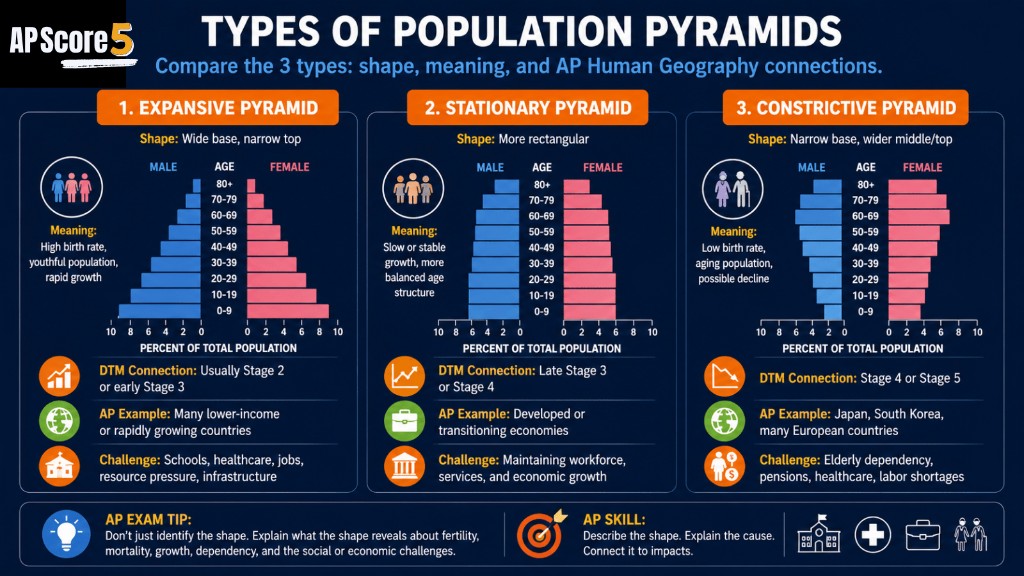
Every stimulus you see on the AP Human Geography exam collapses into one of these pyramid classifications. Learn the silhouette first, then add the Demographic Transition Model stage and one consequence. For line-by-line reading, use the 5-step method from Step 3 — this page is pattern recognition, not re-teaching those steps.
Exam items often use shape words before type names: wide base (rapid growth), rectangular (stable growth), and narrow base (aging or decline). The infographic below maps those shapes to the three official AP labels.
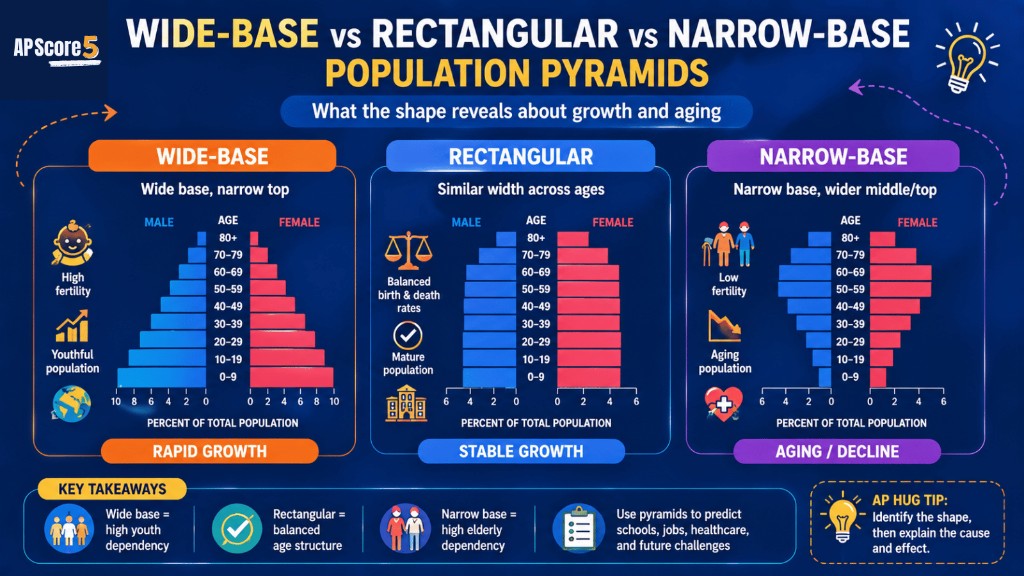
The three deep-dive sections below follow the same rhythm: shape, cause, DTM match, two countries, a common mistake, and a prediction. That parallel structure is intentional — once you know the template, every type feels familiar on test day.
On MCQs, exam writers often show a schematic pyramid without a country label. Your job is to decide whether the base or the top dominates, then pick expansive, stationary, or constrictive. On FRQs, write one sentence that names the type, names the DTM stage, and states one human-geography effect — schools, pensions, labor supply, or migration pressure.
Transitional countries blur the lines. India, Brazil, and Indonesia are classic examples where the base has started to narrow but growth has not stopped. The matching quiz below includes those harder profiles so you practice telling expansive from stationary when the silhouette is in motion.
In one sentence: an expansive population pyramid has a wide base, a clearly tapering middle, and a small top — the classic high-growth shape.
A triangle. The 0–4 cohort is the widest bar, and each older cohort is narrower. The pyramid rarely reaches above age 75.
High total fertility rate, often combined with declining infant mortality. Families remain large, contraception access is limited, and rural agricultural economies still reward larger families.
Expansive pyramids cluster around DTM Stage 2 and early Stage 3 — high birth rates, falling death rates.
| Country | Why it fits |
|---|---|
| Niger | TFR around 6.7, very wide base, narrow top |
| Afghanistan | High youth dependency, limited access to contraception |
What you'd predict: continued population growth for at least 20 years from demographic momentum, even if fertility falls.
In one sentence: a stationary population pyramid is roughly rectangular from base to top, signaling fertility near replacement and a stable population size.
Not really a pyramid anymore — more like a column with a slight taper near the top. The 0–4 cohort is about the same width as the 20–24 and 40–44 cohorts.
Fertility has fallen to near the replacement rate (about 2.1 children per woman). Death rates are low across all ages. Migration is roughly balanced.
Stationary pyramids match DTM Stage 4 — low birth rate, low death rate, stable population.
| Country | Why it fits |
|---|---|
| United States | Replacement-level fertility with a baby boom bulge at 60–75 |
| France | Mild taper, supported by pronatalist family policy |
What you'd predict: slow growth or stability for one generation, then gradual aging as the boomer-style cohorts age into the top.
In one sentence: a constrictive population pyramid has a narrow base and a wider middle or top, signaling an aging and likely declining population.
Top-heavy. The base is the narrowest part of the chart. The 40–60 cohorts are often wider than everything below them.
Total fertility rate well below replacement, very low mortality, high life expectancy. Often paired with limited immigration.
Constrictive pyramids match DTM Stage 5 — birth rate below death rate.
| Country | Why it fits |
|---|---|
| Japan | TFR around 1.3, narrow base, very wide elderly top |
| Italy | Below-replacement fertility, high life expectancy |
What you'd predict: population decline, rising elderly dependency ratio, and policy debates over immigration and pronatalist incentives.
Use this table when you need to classify a stimulus fast. Types of population pyramids on the AP exam are really three pyramid shapes tied to three growth stories.
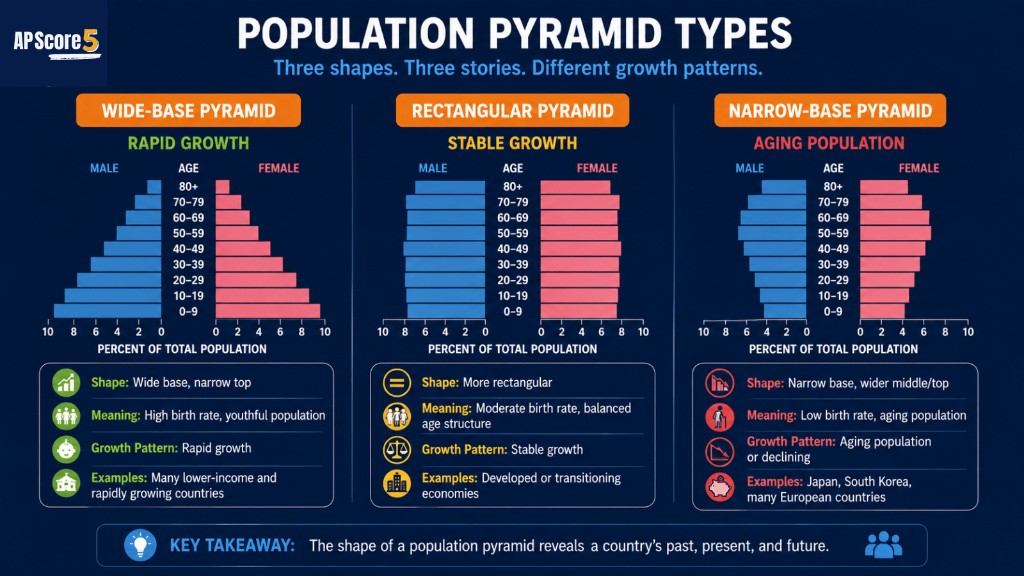
Scan the infographic for silhouette first, then use the table below for shape, DTM stage, growth rate, and dependency in one view.
| Feature | Expansive | Stationary | Constrictive |
|---|---|---|---|
| Shape | Wide base, narrow top | Rectangular | Narrow base, wide top |
| TFR | High (3+) | Near replacement (~2.1) | Below replacement (<2) |
| Growth | Rapid | Stable / slow | Decline likely |
| Life expectancy | Lower | High | Very high |
| Dependency burden | Youth | Balanced | Elderly |
| DTM stage | 2 or early 3 | 4 | 5 |
| Country examples | Niger, Afghanistan | United States, France | Japan, Italy |
This mapping is the single highest-yield connection on AP HUG pyramid FRQs. Each pyramid classification is visual proof of where a country sits on the model.
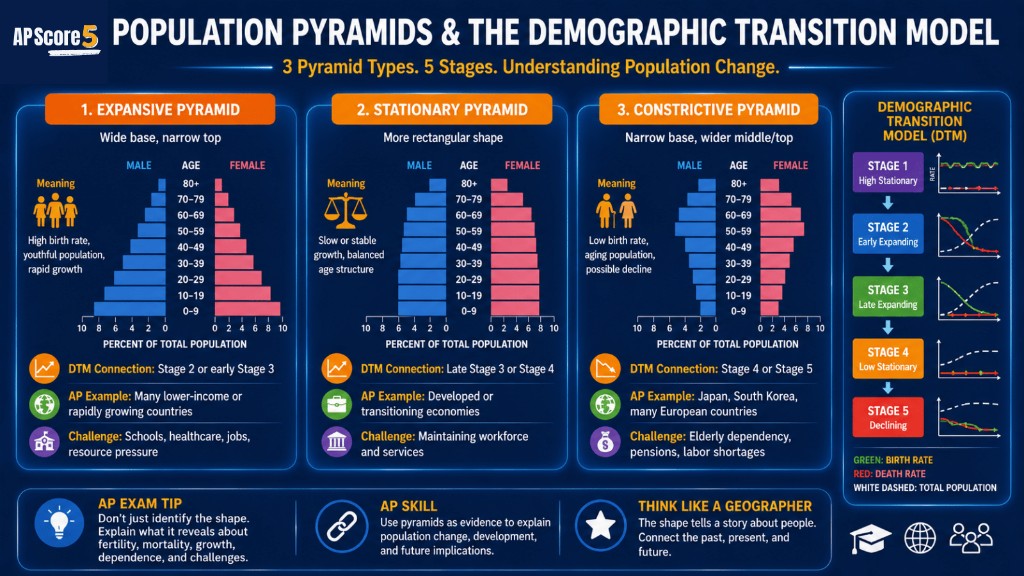
Use the stage strip below for quick recall; the infographic above shows how birth rate, death rate, and pyramid shape change across all five DTM stages.
Pre-expansive (rare today)
Very wide base, very narrow top
Pre-industrial populations
Expansive
Wide base, narrow top
Niger
Expansive transitioning
Narrowing base
India, Mexico
Stationary
Rectangular
United States
Constrictive
Narrow base, wide top
Japan
Want the full stage-by-stage walkthrough with case studies? Open the Demographic Transition Model guide.
Memorize at least one country per type. On timed items, anchor your label to a real silhouette you have seen before.
Expansive
Stage 2
Wide 0–4 bars dominate; TFR near 6+.
High fertility + falling infant mortality.
Schools and youth services under pressure for decades.
Expansive
Stage 2
Youth-heavy triangle, narrow top.
High TFR, limited contraception access.
Youth dependency and rapid future growth.
Stationary
Stage 4
Near-rectangle with boomer bulge at 60–75.
Replacement-level fertility, low mortality.
Aging boomers raise pension and health demand.
Stationary
Stage 4
Mild taper; pronatalist policy support.
Near-replacement TFR, long life.
Stable size with gradual aging at the top.
Constrictive
Stage 5
Narrow base, very wide elderly top.
TFR near 1.3, very low mortality.
Decline risk, pension strain, immigration debate.
Constrictive
Stage 5
Top-heavy; base narrower than middle.
Below-replacement fertility, high life expectancy.
Labor shortage and elderly dependency rise.
Six unlabeled pyramids — pick Expansive, Stationary, or Constrictive for each. Obvious cases and harder transitional shapes are mixed in.
Score: 0 / 0
Pyramid 1
Pyramid 2
Pyramid 3
Pyramid 4
Pyramid 5
Pyramid 6
Trap: “It's a pyramid so it must be expansive.”
Better answer: Not every pyramid is expansive — check whether the base is the widest part.
Trap: “Stationary means flat.”
Better answer: Stationary pyramids are rectangular, not flat. Bars still differ slightly.
Trap: “Constrictive = shrinking right now.”
Better answer: Constrictive is the shape; many constrictive countries still grow slowly from momentum.
Trap: “India is expansive.”
Better answer: India is expansive transitioning — the base has started to narrow (Stage 3).
Trap: “Stage 4 means no future change.”
Better answer: Stage 4 countries can drift toward Stage 5 as fertility falls further.
Trap: “The type alone is the answer.”
Better answer: Name the type and the DTM stage and one consequence — that is where the points are.
25 MCQs — many ask you to classify or compare pyramid shapes. An ad appears after every 5th question.
Re-read the Expansive section; memorize Niger and Afghanistan.
Re-read the Stationary section; memorize the United States and France.
Re-read the Constrictive section; memorize Japan and Italy.
Do the matching quiz; aim for 5/6 or better.
Walk back through the 5-step reading method on one country pyramid.
Open the Demographic Transition Model guide and pair each stage with a type.
25-question mixed practice plus one FRQ-style sentence (type + stage + consequence).
Sign up free to save your shape drills and finish all four connected guides.
Daily 5-minute drills.
Drill it back to mastery.
4 guides, one click.
Next up: the Demographic Transition Model — the framework that ties every shape together.
The three types are expansive (wide base, rapid growth), stationary (roughly rectangular, stable population), and constrictive (narrow base, aging or declining population). Each type maps to characteristic DTM stages.
An expansive pyramid has a wide base and tapering middle and top. It signals high fertility, youth dependency, and often DTM Stage 2 or early Stage 3.
A stationary pyramid is roughly rectangular — cohort widths stay similar from youth through working ages. It signals fertility near replacement and DTM Stage 4 stability.
A constrictive pyramid has a narrow base and wider middle or top. It signals below-replacement fertility, aging, and often DTM Stage 5.
Niger, Afghanistan, and many countries in Sub-Saharan Africa show expansive profiles. Always tie the label to current fertility, not only the silhouette.
The United States and France are common AP examples — near-replacement fertility with cohort history such as a baby boom bulge still visible.
Japan and Italy are widely cited — narrow bases, wide elderly tops, and TFR well below replacement.
Expansive maps to Stage 2 and early Stage 3, stationary to Stage 4, and constrictive to Stage 5. Transitional countries may sit between types as fertility falls.
Expansive pyramids are widest at the base; constrictive pyramids are narrowest at the base and often widest in middle or elderly cohorts. Growth direction and dependency burden differ sharply.
India's fertility has fallen toward replacement while a large young population keeps growth going from demographic momentum. The base narrows even as totals still rise — a Stage 3 transitional profile.
You can now name any pyramid type and match it to a DTM stage. The DTM guide gives you the framework behind the shapes — the 5 stages every country moves through.