Base
Width of youngest cohorts
Most AP HUG students glance at a pyramid and guess. The students who score 5s walk the same 5 steps every time.
How to read population pyramids is one skill, repeated. This guide gives you the 5-step method — base, top, sides, bulges, prediction — and walks you through three real country pyramids so the steps become automatic.
Already know how it's tested? Good. If not, read the Population Pyramids AP Human Geography guide first, then return here.
Work through the 5-step method in order — each step has its own section below.
Part of Unit 2: Population and Migration. Return to the Unit 2 hub for migration, density, and 50 course-wide MCQs beyond this mini-course.
Step 3 builds the muscle memory for reading any pyramid.
Use this 45–60 word answer on timed items, then drill the five steps below.
Reading a population pyramid step by step means running the same checklist every time. How to read population pyramids on the AP exam is not memorizing one country — it is repeating these five moves until they take about 90 seconds total.
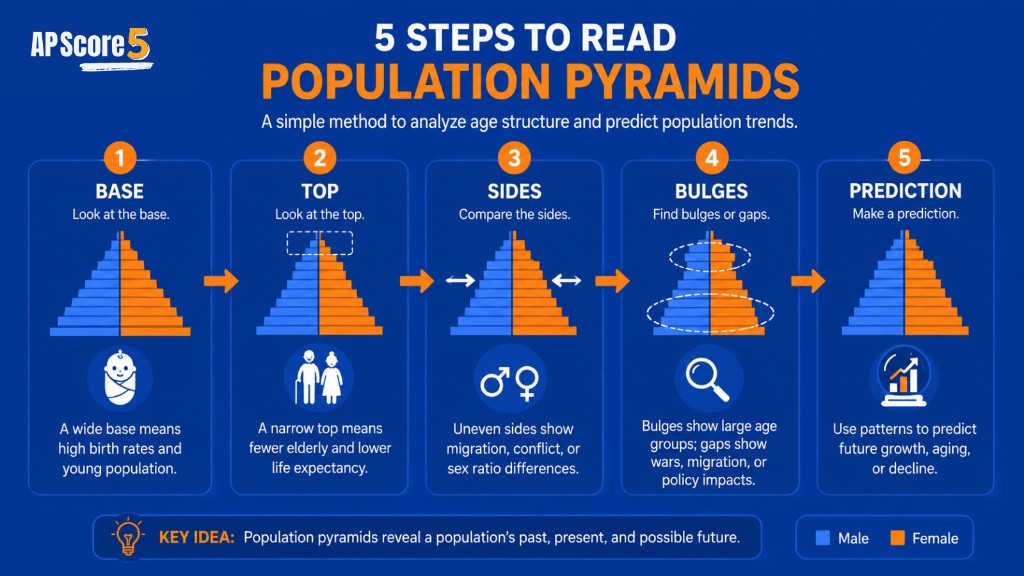
Width of youngest cohorts
Height and width of 65+
Male vs female balance
Past shocks in the middle
Growth, aging, or decline
Each step takes about 15 seconds once you know the pattern. Total: 90 seconds to read any pyramid.
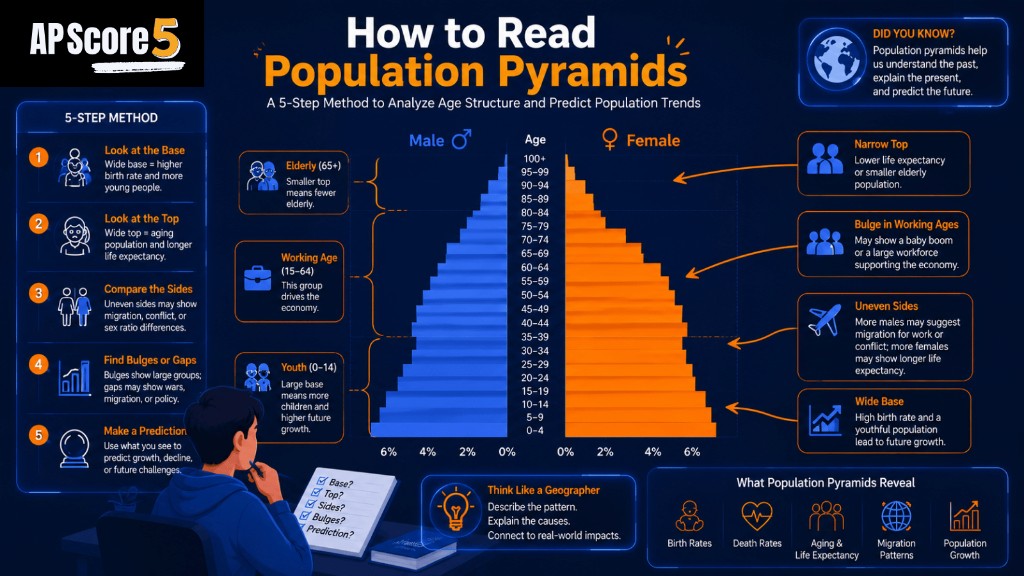
At a glance: Read the base: how wide is it relative to the rest?
In one sentence: the width of the bottom bars tells you the fertility rate and the country's near-term growth potential.
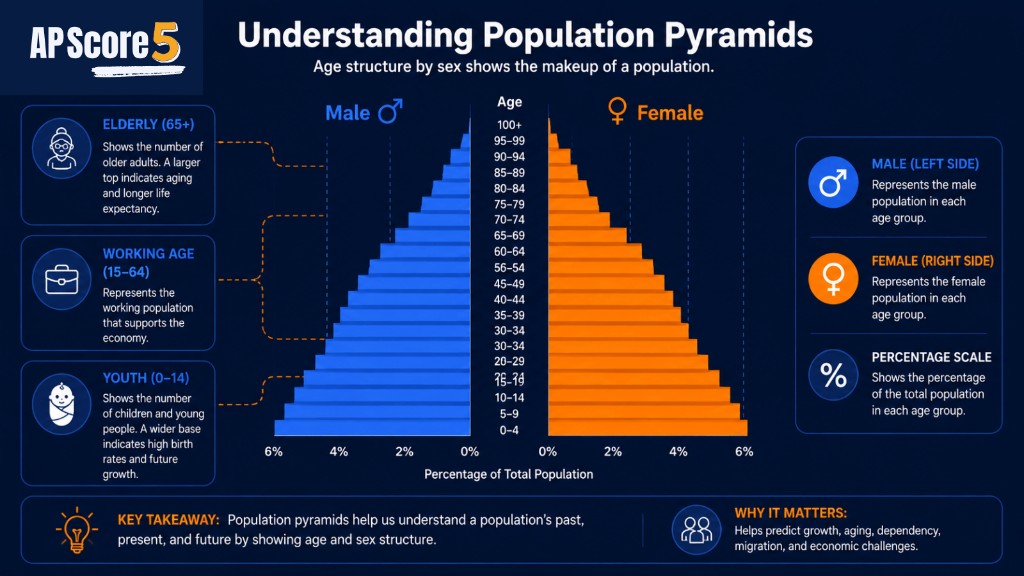
The base is ages 0–14. On the exam, the width of those bars matters more than the absolute count printed on the axis.
A wide base means a high total fertility rate and many children relative to the total population. A narrow base means low fertility or fertility below replacement.
When the 0–4 cohort is narrower than the 5–9 cohort, you are watching the base fall — fertility may already be dropping even if the country still grows.
Worked micro-example: Niger's 0–4 cohort is the widest single bar — predicts continued rapid growth.
Wide bases cluster around DTM Stage 2 and early Stage 3. See the full Demographic Transition Model guide.
At a glance: Read the top: how high and how wide?
In one sentence: the size and reach of the bars above age 65 tell you life expectancy and the elderly dependency picture.
The top is ages 65 and older. Ask how high the pyramid reaches and how wide those upper bars are — both signals matter.
A tall, wide top means high life expectancy and often strong health access. A wide top with a narrow base is the classic aging-society profile.
Female bars are often wider than male bars above 75 because women outlive men — that pattern is normal, not automatically migration.
Worked micro-example: Japan's top is broad and reaches past 90 — one of the world's most aged populations.
Top-heavy pyramids match DTM Stage 5. Compare shapes on the Demographic Transition Model page.
At a glance: Read the left vs right sides: are males and females symmetrical?
In one sentence: comparing male (left) and female (right) bars reveals sex ratio imbalances caused by migration, war, or selective mortality.
Male cohorts are on the left; female cohorts are on the right. They should mostly mirror each other.
Asymmetry is the clue. The 20–40 age range is where labor migration usually appears on AP stimuli.
Heavy male skew in working ages often signals in-migration of laborers. Heavy female skew can signal male out-migration in remittance economies.
Worked micro-example: Qatar's 25–44 male bars dwarf the female bars — labor in-migration of construction and service workers.
Pair migration reads with the Unit 2 Overview migration themes when a prompt blends population and movement.
At a glance: Find bulges and gaps: do any cohorts stick out or disappear?
In one sentence: bulges and gaps in the middle of the pyramid show past events — baby booms, baby busts, wars, or policy changes.
A "bulge" is a cohort wider than the ones above and below it. A "gap" is the opposite.
The vertical position of the bulge or gap dates the event: a bulge in 60–75 today was a birth wave decades ago.
Today's bulge becomes tomorrow's aging burden — planners read cohort history, not only current fertility.
Worked micro-example: The United States shows a clear baby boom bulge in the 60–75 range and a baby bust beneath it.
At a glance: Predict what's next: growth, aging, decline, or migration.
In one sentence: the shape of the pyramid plus its current bulges tell you which way the population is heading — growth, stability, or decline.
Take everything from Steps 1–4 and forecast 20–30 years out. This is the prediction AP FRQs reward.
Wide base + young bulge → growth ahead. Rectangular shape → stability for a generation. Narrow base + wide top → aging and likely decline.
Name one consequence: future labor force, dependency burden, or policy pressure (schools, pensions, immigration).
Worked micro-example: Japan's narrow base + wide top → predicts continued aging, rising dependency, and policy pressure for immigration or pronatalism.
The full DTM mapping is on the Demographic Transition Model guide. Each shape lines up with a specific stage.
Practice the method on Niger, the United States, and Japan. Say each step aloud before you check the table.
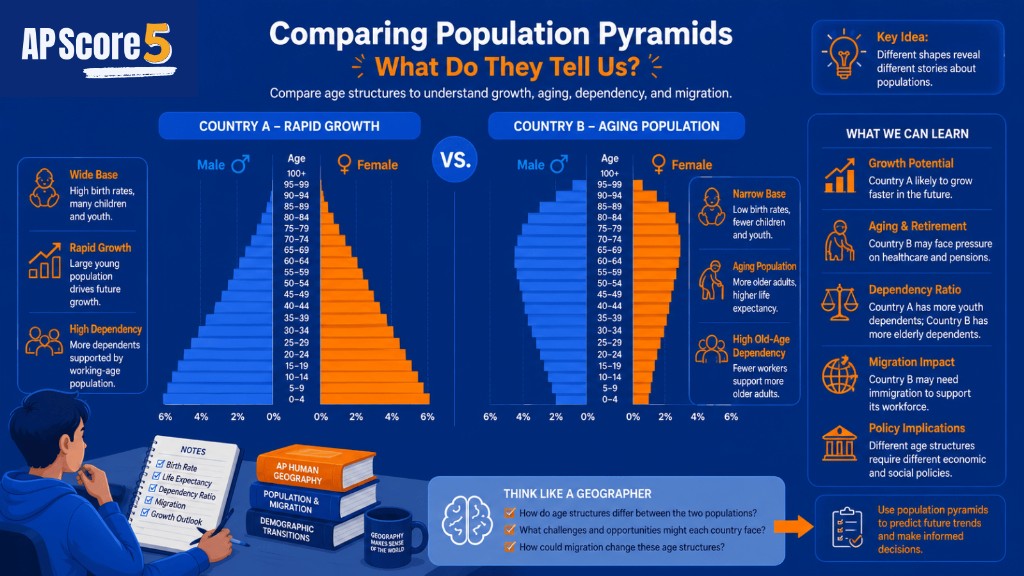
| Step | What I see | What it tells me |
|---|---|---|
| 1. Base | 0–4 bar is the widest on the chart | Very high fertility |
| 2. Top | Almost nothing above 70 | Lower life expectancy |
| 3. Sides | Roughly symmetrical | No major migration story |
| 4. Bulges / gaps | Smooth widening from top to bottom | No major past shock |
| 5. Predict | Rapid growth ahead | Likely DTM Stage 2 |
| Step | What I see | What it tells me |
|---|---|---|
| 1. Base | Slightly narrower than middle bars | Below-replacement fertility |
| 2. Top | Reaches past 85, women wider | Long life expectancy |
| 3. Sides | Slight female advantage in 60+ | Normal mortality pattern |
| 4. Bulges / gaps | Clear bulge in 60–75 | Baby boom legacy |
| 5. Predict | Slow growth, gradual aging | DTM Stage 4 |
| Step | What I see | What it tells me |
|---|---|---|
| 1. Base | Narrow — narrower than the 40–60 cohort | Very low fertility |
| 2. Top | Very wide, reaches past 90 | High life expectancy, aged population |
| 3. Sides | Female advantage above 75 | Normal pattern amplified by longevity |
| 4. Bulges / gaps | Bulge near 70, gap below 30 | Post-war boom, fertility collapse |
| 5. Predict | Population decline, high dependency | DTM Stage 5 |
Use Italy's schematic pyramid below. Answer each prompt in a sentence, then reveal the model walkthrough.
Three silhouettes you will keep seeing — full definitions live on the types guide.
Wide base, narrow top
Roughly rectangular
Narrow base, wide middle/top
Trap: “Wide base = bigger country.”
Better reading: Wide base means a larger share of children, not the largest total population.
Trap: “Tall pyramid = more people.”
Better reading: Height shows how far the population reaches into old age, not total count.
Trap: “Symmetrical = no story.”
Better reading: Even symmetrical pyramids reveal fertility, mortality, and DTM stage.
Trap: “Any gap means a war.”
Better reading: Gaps can come from fertility drops, policy changes, emigration, or war.
Trap: “I described the shape so I'm done.”
Better reading: Description covers Steps 1–4; the AP point is Step 5 — the prediction.
Trap: “The pyramid alone tells me the GDP.”
Better reading: Pyramids predict demographics; link outcomes through dependency or labor force.
20 MCQs tied to reading and interpreting pyramid stimuli. An ad appears after every 5th question.
Walk the 5 steps on Niger from memory.
Walk the 5 steps on the United States from memory.
Walk the 5 steps on Japan from memory.
Do the "Your turn" pyramid; compare to the model answer.
Open the Demographic Transition Model guide; match each example pyramid to a stage.
Answer 10 practice MCQs; time-box at 8 minutes.
Open Types of Population Pyramids to start Step 4.
Sign up free to save your reading drill and finish all four connected guides.
Drill one pyramid a day.
Compare to model walkthroughs.
Finish the mini-course path.
Walk five steps in order: read the base for fertility, the top for life expectancy, the left and right sides for sex balance, the middle for bulges or gaps from past events, then predict growth, aging, or decline and link the shape to a Demographic Transition Model stage.
The five steps are (1) read the base, (2) read the top, (3) compare left vs right sides, (4) find bulges and gaps, and (5) predict what comes next. Run them in order on every stimulus.
The base shows ages 0–14. A wide base signals high fertility and youth dependency; a narrow base signals low fertility, possible decline, and less demographic momentum over time.
The top shows ages 65 and older. A tall, wide top signals long life expectancy and high elderly dependency; a small top often reflects younger overall age structure or lower life expectancy.
Uneven male and female bars, especially in ages 20–40, can reflect labor migration, war losses, or sex-selective mortality. Compare sides before you claim migration — name the cohort pattern as evidence.
Bulges and gaps come from past birth waves, fertility drops, wars, emigration, or policies such as guest-worker programs or family-size limits. The vertical position of the irregularity dates the event.
Combine base width, top width, cohort bulges, and side balance to forecast growth, stability, or decline over 20–30 years. End with a DTM stage label and one consequence such as schools, pensions, or labor supply.
Each DTM stage tends to produce a characteristic silhouette: expansive bases in Stage 2, narrowing bases in Stage 3, rectangular profiles in Stage 4, and constrictive aging shapes in Stage 5. The pyramid is visual evidence for stage diagnosis.
Examiners often use Niger (very expansive), the United States (baby boom bulge), Japan (aging constrictive), and Gulf states such as Qatar (male labor migration) because each silhouette teaches a different reading skill.
With practice, a full five-step read takes about 90 seconds: roughly 15 seconds per step. On MCQs you may only need two steps; on FRQs walk all five and end with prediction plus DTM.
You can now read any pyramid in 90 seconds. Page 4 names the three shapes you will keep seeing — expansive, stationary, constrictive — and the countries that match each.