Demographic Transition Model Stages: AP Human Geography
All five DTM stages with birth-rate and death-rate patterns, real country examples, and exam traps—built for quick review before practice.
Main stage guide: Use these five stage cards for AP review. Skim the DTM overview first if you need CBR/CDR definitions, then add country examples for FRQ evidence.
Updated May 2026 · Reviewed by APScore5 Editorial Team
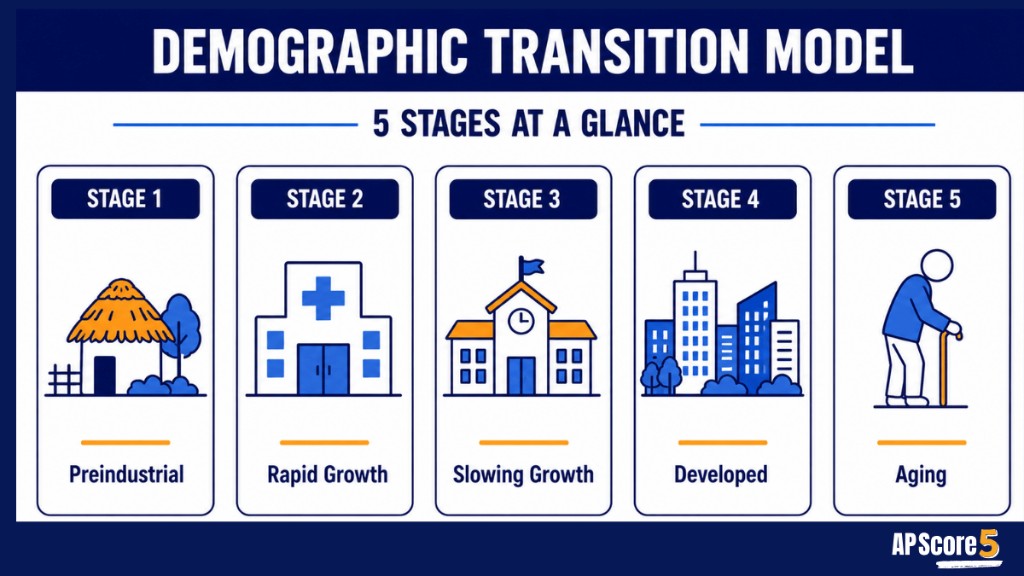
The Demographic Transition Model has five stages. Each stage pairs birth and death rates with a growth pattern—from preindustrial balance (Stage 1) to possible natural decrease (Stage 5). On the AP exam, name the stage, justify it with rates or a pyramid, and predict one consequence.
Figure - Demographic Transition Model 5 StagesBig picture
All five DTM stages at a glance
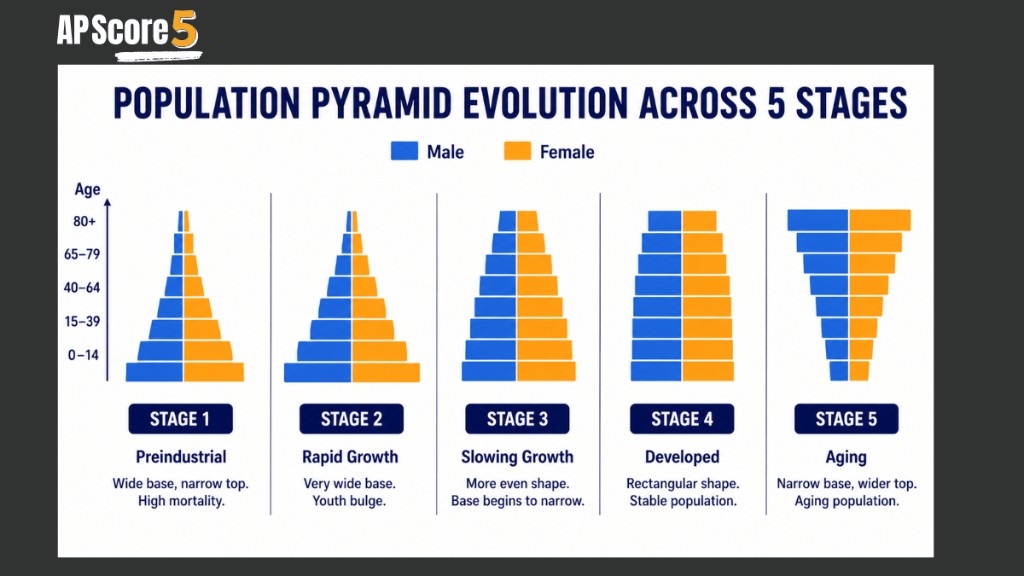
Use this table when a stimulus gives numbers or a pyramid silhouette. Then open the stage cards below for rate patterns and exam wording, or jump to eleven countries on a world map when the prompt names a place.
Stage
CBR / CDR
Natural increase
Pyramid clue
Example regions
1 — High stationary
High / high
Near zero
Wide base, narrow top
Pre-1750 Europe; historic norm
2 — Early expanding
High / falling
Rapid
Very wide base
Niger; parts of Sub-Saharan Africa
3 — Late expanding
Falling / low
Moderate, slowing
Base narrows
India; Bangladesh (transitioning)
4 — Low stationary
Low / low
Near zero
Column-like
United States; Thailand
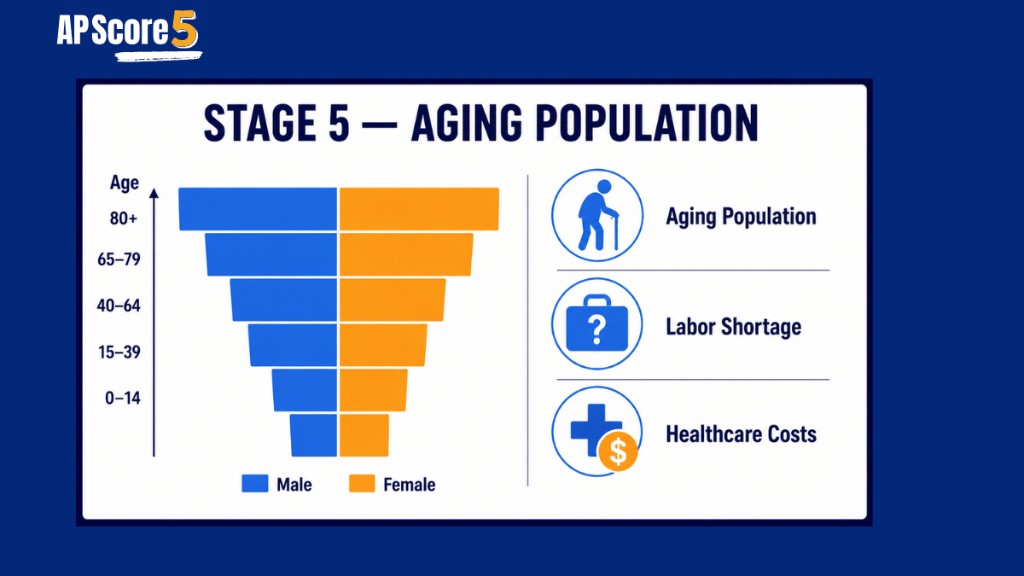
5 — Declining?
Very low / low
Negative possible
Pinched or inverted base
Japan; Germany; South Korea
Figure - Demographic Transition Model All Five DTMDeep dive
Stage-by-stage cards
Stage 1
High stationary
High CBR · High CDR
Both crude birth and death rates stay high, so natural increase is near zero. Infant mortality, disease, and limited medicine keep deaths elevated; families still have many children for labor and security.
AP move: Cite pre-industrial Europe or historic global patterns—not modern countries with hospitals and vaccines.
Stage 2
Early expanding
High CBR · Falling CDR
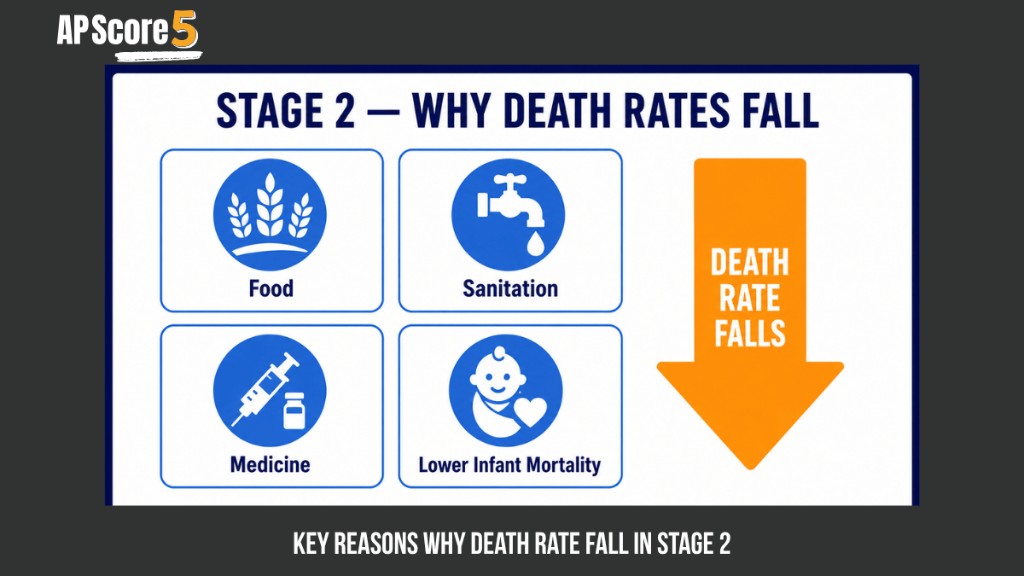
Death rates fall first (sanitation, vaccines, food security) while birth rates stay high. The gap produces the fastest natural increase and a very wide pyramid base.
Figure - Demographic Transition Model Early Expanding DTM
Examples: Much of Sub-Saharan Africa and Guatemala showed classic Stage 2 patterns in the late twentieth century. Name a mechanism (clean water, antibiotics) plus a consequence (school crowding, youth dependency). See the Niger rapid-growth write-up for a full FRQ-style sentence.
Stage 3
Late expanding
Falling CBR · Low CDR
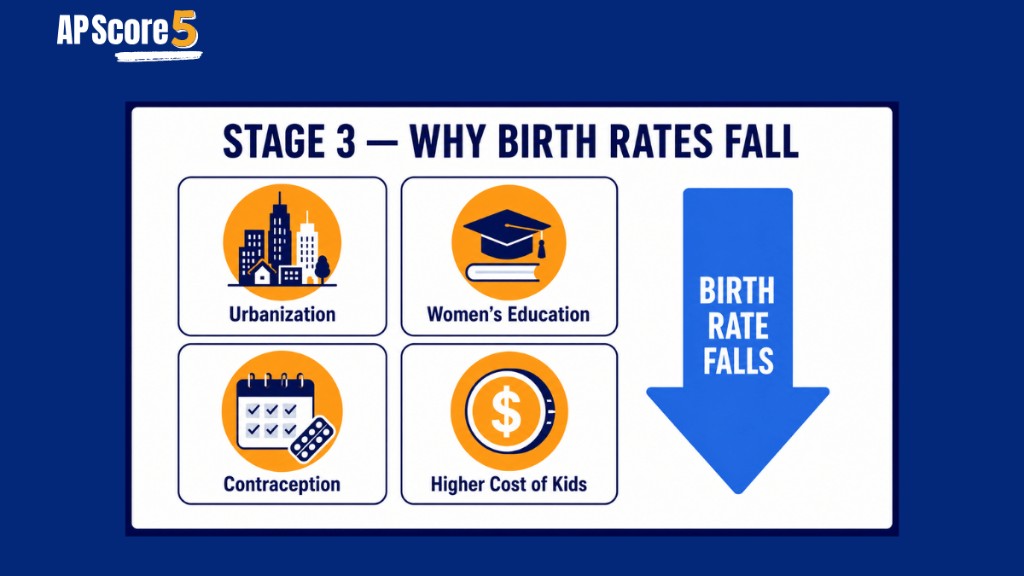
Birth rates decline with urban jobs, education, and contraception access while death rates remain low. Population still grows, but the pace slows and the pyramid base narrows.
Figure - Late Expanding Birth Rates Fall Stage 3
Examples: Brazil, Mexico, and Indonesia during late industrialization. The trap: Stage 3 is not the fastest growth—that is Stage 2. Compare India population momentum and Brazil urbanization on the country examples page.
Stage 4
Low stationary
Low CBR · Low CDR
Both rates are low; natural increase is small. Societies age, dependency shifts toward elders, and migration may matter more than births minus deaths.
Examples: United States, France, and much of Thailand today. Pair a rectangular pyramid with retirement and health-care policy debates.
Stage 5
Declining (debated)
Very low CBR
Some textbooks add Stage 5 when fertility falls below replacement and deaths can exceed births without immigration. Aging workforces and pronatalist debates dominate.
Figure - Declining Debated DTM Stage 5 Aging Population
Examples: Japan, Germany, Italy, and South Korea. Distinguish natural decrease from out-migration on FRQs—they need different policy tools. Read the Japan aging example and Germany labor-pressure example for model answers.
Answer: A. Stage 1 is high stationary—both rates stay high.
AP tip: Eliminate stages with low death rates first.
Q2. Rapid natural increase with falling CDR indicates:
Easy
Answer: B. Stage 2 opens when deaths fall before births.
AP tip: Look for the death-rate drop clue.
Q3. A narrowing pyramid base with low CDR suggests:
Medium
Answer: B. Stage 3 shows falling CBR while CDR stays low.
AP tip: Pyramid shape backs rate trends.
Exam prep
Exam traps and how to identify stages
Before test day: Re-read the DTM Overview, then sketch CBR and CDR lines from memory.
Fast memory: growth by stage
Stage 1: Little growth (high births, high deaths)
Stage 2: Fastest growth (deaths fell first)
Stage 3: Slower growth (births now falling)
Stage 4: Near-stable (both rates low)
Stage 5: Possible decline (very low fertility)
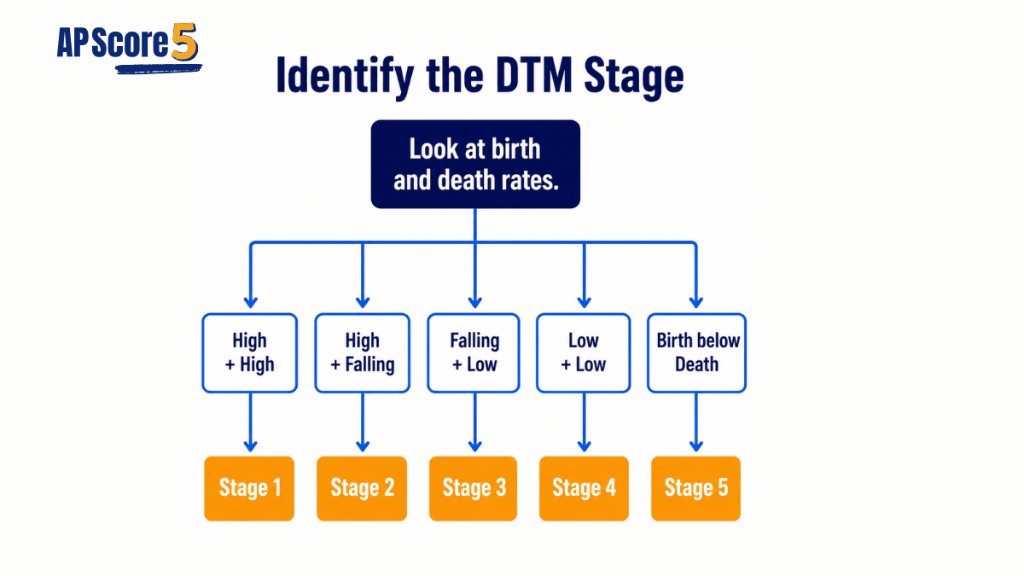
How to identify a DTM stage
On MCQs and FRQs, compare birth and death rates first, then check the pyramid. Use this flow when a country name is not given.
Figure - Identify DTM Stage HUG Demographic Transition Model
Stage 2 vs Stage 3 — the biggest trap
Stage
Birth rate
Death rate
Growth
Stage 2
Still high
Falling
Fastest
Stage 3
Falling
Low
Slowing
Rule of thumb: If birth rates are still high, think Stage 2. If birth rates are clearly trending down with low deaths, think Stage 3.
Common mistakes to avoid
Mistake: Calling Stage 2 low birth
Fix: CBR stays high in Stage 2; deaths fell first.
Mistake: Fastest growth in Stage 3
Fix: Stage 2 has the widest rate gap.
Mistake: Label only, no evidence
Fix: Add CBR/CDR direction or pyramid shape.
Mistake: Every country fits perfectly
Fix: The DTM is a model; policy and migration bend the path.
FRQ pattern
Stage from graph or pyramid → explain why CBR and CDR look that way → one social or economic effect → one policy (family planning, pronatalist, or migration).
India is usually placed in late Stage 3 or early Stage 4: death rates are low, birth rates have fallen sharply since the 1970s, but momentum from past high fertility still adds people. Mention a narrowing pyramid base and slowing—not explosive—growth.
Where does China fit on the DTM?
Modern China aligns with Stage 4 and Stage 5 pressure: very low fertility after urbanization and past family-planning policy, plus rapid aging. Do not describe today’s China as Stage 2; cite low CBR/CDR and top-heavy age structure.
Why is Japan a Stage 5 example?
Japan has had below-replacement fertility for decades, so natural decrease is possible without immigration. Exam answers should link aging, labor shortages, and limits of pronatalist subsidies—not only government programs.
What stage is Brazil?
Brazil is largely Stage 4 with regional variation: low CBR and CDR nationally, but the Northeast historically lagged the industrialized South. Mention uneven development inside one country when the prompt allows comparison.
How do I separate Stage 2 and Stage 3 on MCQs?
Stage 2: high CBR with CDR that recently fell—widest growth gap. Stage 3: CBR clearly declining while CDR stays low—growth continues but slows. A graph with CBR sliding toward CDR signals Stage 3; high CBR beside newly low CDR signals Stage 2.
Where can I practice more stage questions?
Use the DTM practice page for 20 MCQs with explanations and three FRQ prompts with rubrics.