Learn arithmetic, physiological, and agricultural density with formulas, examples, AP exam clues, and map-reading strategies for Unit 2 Population and Migration.
Updated June 12, 2026 · Reviewed by APScore5 Editorial Team
AP Human Geography · Unit 2Population density formulas22 flashcards16 AP-style questionsFRQ-ready examples
AP Human Geography uses arithmetic, physiological, and agricultural density to answer different population questions.
population density AP Human Geography uses arithmetic, physiological, and agricultural density to measure people or farmers against different land areas. Arithmetic density uses total land, physiological density uses arable land, and agricultural density uses farmers per arable land to explain population pressure, farming intensity, and development.
The three density types use different denominators, so each one answers a different AP Human Geography question.Quick answer
What Are the Types of Population Density in AP Human Geography?
The three main types of population density in AP Human Geography are arithmetic density, physiological density, and agricultural density. Arithmetic density divides total population by total land area. Physiological density divides total population by arable land. Agricultural density divides the number of farmers by arable land. Each density type answers a different geographic question about population pressure, land use, agriculture, and development.
Key Takeaways
Population density measures people or farmers in relation to land.
Arithmetic density uses total land area.
Physiological density uses arable land.
Agricultural density uses farmers and arable land.
Physiological density shows pressure on farmable land.
Agricultural density can suggest farming technology and level of development.
Strong AP answers explain what the density measure actually reveals.
Memory Shortcut
Arithmetic = people / all land.Physiological = people / farmable land.Agricultural = farmers / farmable land.
Start Here: How to Use This Population Density Guide
Learn what population density means.
Memorize the three formulas.
Focus on the denominator.
Compare what each density type reveals.
Practice with MCQs, flashcards, and an FRQ.
Definitions
Population Density Definitions
Population density describes how people are distributed in relation to land. In AP Human Geography, different density formulas reveal different kinds of pressure and development. If you need the spatial side first, review distribution, then return here to calculate the density measures.
Population Density
A measure of people or farmers compared to land area.
Arithmetic Density
Total population divided by total land area.
Physiological Density
Total population divided by arable land.
Agricultural Density
Number of farmers divided by arable land.
Arable Land
Land suitable for growing crops.
Total Land Area
All land in a country or region, including deserts, mountains, forests, and cities.
Population Distribution
The way people are arranged across space.
Population Pressure
Stress placed on land, resources, food systems, or infrastructure by population size.
Density evidence often pairs with population pyramids because pyramids show who lives in a place while density shows how population relates to land.
People over all land
Arithmetic Density
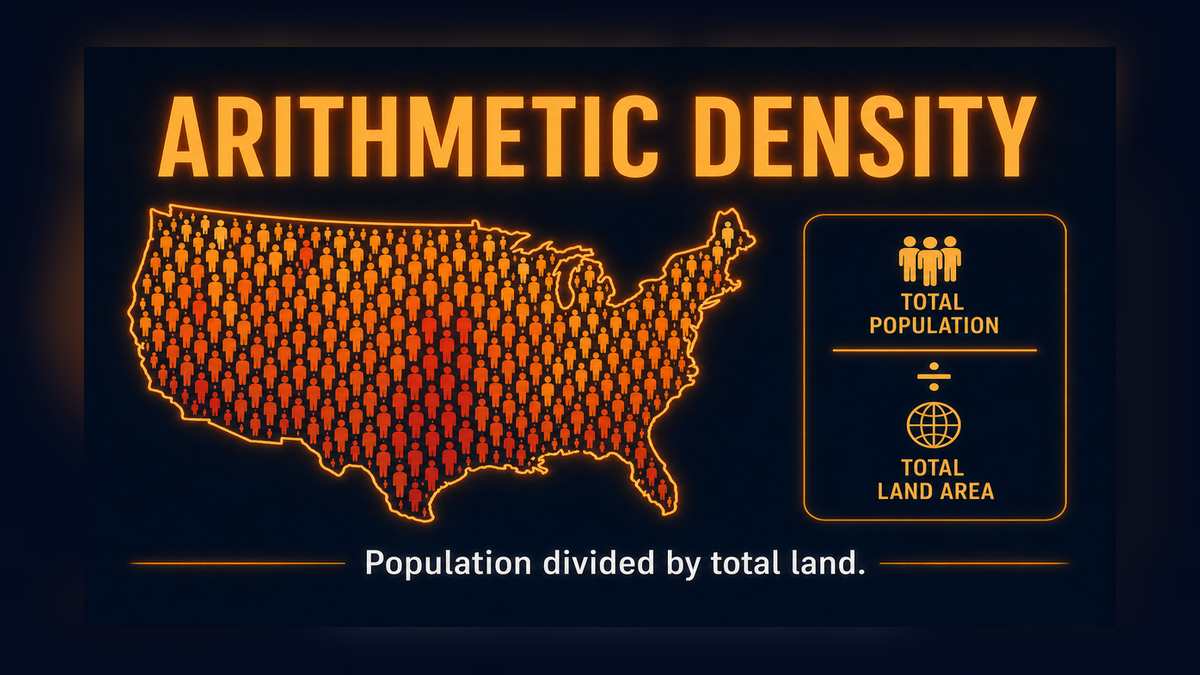
Arithmetic density measures total population divided by total land area.
Arithmetic density is the simplest population density measure. It divides total population by total land area. It gives a broad overview of how crowded a country or region is, but it can hide important differences because not all land is equally usable.
Arithmetic Density=Total Population÷Total Land Area
Example: If a country has 10,000,000 people and 100,000 square kilometers of land, its arithmetic density is 100 people per square kilometer.
What it shows
general population density
broad comparison between countries or regions
overall people-per-area measure
What it can hide
deserts, mountains, and forests
uneven settlement
differences in arable land
clustered urban populations
AP Exam Tip: Arithmetic density is useful for a quick comparison, but it does not show whether the land can actually support farming.
People over farmland
Physiological Density
Physiological density measures how much population pressure exists on farmable land.
Physiological density measures total population divided by arable land. It is more useful than arithmetic density when the question is about food pressure, land stress, or a country’s ability to support its population through farming.
Physiological Density=Total Population÷Arable Land
Example: If a country has 10,000,000 people and only 10,000 square kilometers of arable land, its physiological density is 1,000 people per square kilometer of arable land.
pressure on farmable land
possible food-production stress
how many people depend on each unit of arable land
why some countries with large land areas still face land pressure
AP Exam Tip: If a question mentions arable land, food pressure, farmland, or carrying capacity, physiological density is usually the best answer. This also connects to Malthusian theory when prompts compare population and food supply.
Farmers over farmland
Agricultural Density
Agricultural density measures the number of farmers per unit of arable land.
Agricultural density measures the number of farmers divided by arable land. It helps geographers understand how labor-intensive farming is and can suggest differences in technology, mechanization, and economic development.
Agricultural Density=Number of Farmers÷Arable Land
Example: If a country has 500,000 farmers and 10,000 square kilometers of arable land, its agricultural density is 50 farmers per square kilometer of arable land.
farming labor intensity
level of mechanization
possible development differences
how much human labor is used on farmland
AP Exam Tip: A high agricultural density often suggests more labor-intensive farming and lower levels of mechanization. A low agricultural density often suggests more mechanized farming, which connects to subsistence vs commercial agriculture.
Compare
Arithmetic vs Physiological vs Agricultural Density
The three density types use different formulas because they answer different questions. AP Human Geography often tests whether students can select the correct density type for the scenario.
Density Type
Formula
Denominator
What It Shows
AP Clue
Arithmetic Density
Total population ÷ total land area
Total land
Overall people per area
Broad country comparison.
Physiological Density
Total population ÷ arable land
Farmable land
Population pressure on farmland
Food pressure or land stress.
Agricultural Density
Farmers ÷ arable land
Farmable land
Farming labor intensity
Technology and development clues.
Common Mistake: Do not use physiological density and agricultural density interchangeably. Both use arable land, but physiological density uses total population, while agricultural density uses number of farmers.
Formula strategy
How to Choose the Correct Density Formula
The fastest way to choose the correct density formula is to read the denominator.
The easiest way to choose the right density formula is to read the denominator. The denominator tells you what land measure matters.
If the question says total land area, use arithmetic density.
If the question says arable land and total population, use physiological density.
If the question says arable land and farmers, use agricultural density.
If the question asks about food pressure, think physiological density.
If the question asks about farming labor or technology, think agricultural density.
AP Exam Tip: Read the denominator before calculating. Many wrong answers happen because students confuse arable land with total land.
Examples
Population Density Examples
Large Country, Low Arithmetic Density
Scenario: A country has a huge land area but much of it is desert or mountains. Interpretation: Arithmetic density may look low, but usable land may be limited.
High Physiological Density
Scenario: A country has many people but little arable land. Interpretation: There may be high pressure on farmland and food systems.
High Agricultural Density
Scenario: Many farmers work on a small amount of farmland. Interpretation: Farming may be labor-intensive and less mechanized.
Low Agricultural Density
Scenario: Few farmers work a large amount of farmland. Interpretation: Farming may be highly mechanized.
Urbanized Country
Scenario: Most people live in cities, but the country imports food. Interpretation: Density measures must be combined with trade, technology, and land-use analysis.
Agricultural Region
Scenario: A farming region has many farmers per arable acre. Interpretation: Agricultural density may reveal labor intensity better than arithmetic density.
Density vs distribution
Population Density vs Population Distribution
Population density and population distribution are related but not the same. Density measures amount per area. Distribution describes how people are arranged across space. A country can have a high density overall, but people may still be clustered in a few cities.
How to Write About Population Density on the AP Exam
Strong density FRQs calculate the correct measure, explain what it shows, and connect it to land pressure or development.
Strong AP answers do more than calculate a density value. They explain what the value reveals about population pressure, farmland, technology, or development.
Identify Formula→Calculate Correctly→Explain Meaning→Connect to Significance
Sentence Starters
Arithmetic density measures...
Physiological density is more useful here because...
Agricultural density helps show...
This density is high because...
This density suggests pressure on...
This matters because...
Strong answer example
Physiological density is the best measure for evaluating pressure on farmland because it divides total population by arable land. A high physiological density suggests that many people depend on a limited amount of farmable land, which may create food pressure or increase dependence on imports.
Mistakes
Common Population Density Mistakes
Mistake
Fix
Using total land when the question asks about arable land.
Use physiological or agricultural density when arable land matters.
Confusing physiological and agricultural density.
Physiological uses total population; agricultural uses farmers.
Thinking arithmetic density shows food pressure.
Arithmetic density uses total land, not farmable land.
Forgetting units.
Density is usually expressed per square kilometer, square mile, hectare, or acre.
Only calculating and not explaining.
AP answers must explain what the number reveals.
Confusing density with distribution.
Density measures amount per area; distribution describes arrangement across space.
Quick check
Quick Check
A country has a large population and very little arable land. Which density measure best shows pressure on farmland?
FRQ lab
Population Density FRQ Practice
Draft your response, then reveal the rubric and suggested answer. The goal is to define the three density measures, calculate correctly, and explain land pressure.
Prompt
Country A has 60 million people, 300,000 square kilometers of total land, 30,000 square kilometers of arable land, and 3 million farmers.
A. Define arithmetic density.
B. Define physiological density.
C. Define agricultural density.
D. Calculate the physiological density of Country A.
E. Explain what a high physiological density may indicate.
Tip: Show the denominator and units before explaining significance.
Rubric
A: Must define arithmetic density as population divided by total land area.
B: Must define physiological density as population divided by arable land.
C: Must define agricultural density as farmers divided by arable land.
D: Must calculate 2,000 people per square kilometer of arable land.
E: Must connect high physiological density to pressure on farmland, food supply, land stress, or dependence on imports.
Suggested answer
A. Arithmetic density is total population divided by total land area.
B. Physiological density is total population divided by arable land.
C. Agricultural density is the number of farmers divided by arable land.
D. Country A’s physiological density is 60,000,000 ÷ 30,000 = 2,000 people per square kilometer of arable land.
E. A high physiological density indicates that many people depend on a limited amount of farmable land, which may create food-production pressure, land stress, or dependence on food imports.
Status: Draft first, then compare your answer with the rubric.
Practice
Population Density Types Practice Questions
16 AP-style MCQs. Choices shuffle on load. Tap an answer for an explanation and AP clue.
Question 1
Which statement best defines population density in AP Human Geography?
AP exam clue: Look for people or farmers divided by land.
Question 2
Which formula gives arithmetic density?
AP exam clue: Total land area is the arithmetic clue.
Question 3
Which formula gives physiological density?
AP exam clue: Arable land plus total population points to physiological density.
Question 4
Which formula gives agricultural density?
AP exam clue: Farmers in the numerator point to agricultural density.
Question 5
A country has 20 million people and 200,000 square kilometers of total land. What is its arithmetic density?
AP exam clue: Use total population divided by total land area.
Quick pause: review the explanation before the next set.
Question 6
A country has 30 million people and 15,000 square kilometers of arable land. What is its physiological density?
AP exam clue: Use total population divided by arable land.
Question 7
A country has 600,000 farmers and 12,000 square kilometers of arable land. What is its agricultural density?
AP exam clue: Use farmers divided by arable land.
Question 8
Which situation is best measured by physiological density?
AP exam clue: Food pressure, farmland, and arable land point to physiological density.
Question 9
A high physiological density most directly suggests which concern?
AP exam clue: Connect physiological density to farmable land pressure.
Question 10
A high agricultural density often suggests which interpretation?
AP exam clue: Farmers per farmland is the development and mechanization clue.
Quick pause: review the explanation before the next set.
Question 11
Why can arithmetic density be misleading?
AP exam clue: Arithmetic density is broad, not food-pressure specific.
Question 12
What is the key difference between physiological and agricultural density?
AP exam clue: Check the numerator: population or farmers.
Question 13
Which statement correctly compares density and distribution?
AP exam clue: Density equals amount; distribution equals arrangement.
Question 14
An AP question mentions arable land, food supply, and total population. Which answer is most likely?
AP exam clue: Arable land plus total population is the clue.
Question 15
A prompt asks which density measure can suggest farming technology and level of development. Which should you choose?
AP exam clue: Technology and farming labor point to agricultural density.
Quick pause: review the explanation before the next set.
Question 16
Country A has high arithmetic density, very high physiological density, and low agricultural density. Which FRQ interpretation is strongest?
AP exam clue: FRQ answers should compare what each measure reveals.
Flashcards
Population Density Types Flashcards
Use these 22 cards for terms, definitions, and AP exam clues. Tap the card to flip from term to explanation.
Card 1 of 22Tap card to flip
Quick pause: say the definition aloud before the next card unlocks.
Dependency RatioCBR, CDR, and Natural Increase RateMalthusian TheorySustainable AgricultureIntensive vs Extensive Agriculture
FAQs
FAQs About Population Density in AP Human Geography
What is population density in AP Human Geography?
Population density is a measure of people or farmers compared to land area. AP Human Geography commonly uses arithmetic density, physiological density, and agricultural density.
What are the three types of population density?
The three main types are arithmetic density, physiological density, and agricultural density.
What is arithmetic density?
Arithmetic density is total population divided by total land area.
What is physiological density?
Physiological density is total population divided by arable land.
What is agricultural density?
Agricultural density is the number of farmers divided by arable land.
What is the difference between arithmetic and physiological density?
Arithmetic density uses total land area, while physiological density uses only arable or farmable land.
What is the difference between physiological and agricultural density?
Physiological density divides total population by arable land, while agricultural density divides farmers by arable land.
Why is physiological density important?
Physiological density is important because it shows how much population pressure exists on farmable land.
Why is agricultural density important?
Agricultural density is important because it can show farming labor intensity and suggest differences in technology or development.
Which density type uses arable land?
Both physiological density and agricultural density use arable land as the denominator.
Which density type uses total land area?
Arithmetic density uses total land area as the denominator.
How should students write about population density in an FRQ?
Students should identify the correct density type, use the correct formula, calculate carefully, and explain what the result reveals about population pressure, land use, agriculture, or development.
Final review
Population Density Types: Final Review
Arithmetic density is total population divided by total land area.
Physiological density is total population divided by arable land.
Agricultural density is farmers divided by arable land.
Use the denominator to choose the formula.
AP answers should calculate, interpret, and connect density to land pressure, agriculture, or development.