Pair sources before you lock an answer
Read legends, scales, units, and captions together—decide whether evidence supports a regional trend or a misleading aggregation inside one polygon.
The Columbian Exchange in AP Human Geography explains how this topic appears across places and scales. Use it to interpret map evidence, compare spatial patterns, and write precise AP-style geographic explanations.
Practice with real AP Human Geography examples, compare spatial evidence across maps, and review with 25 flashcards plus 18 AP-style questions with explanations.
Learn in 7 mins · Practice in 10 mins
The Columbian Exchange names the two-way movement of plants, animals, people, and diseases across the Atlantic after 1492—reshaping diets, populations, and landscapes in both Old and New Worlds. AP prompts treat it as the classic example of intercontinental diffusion tying agriculture, disease, and labor systems together.
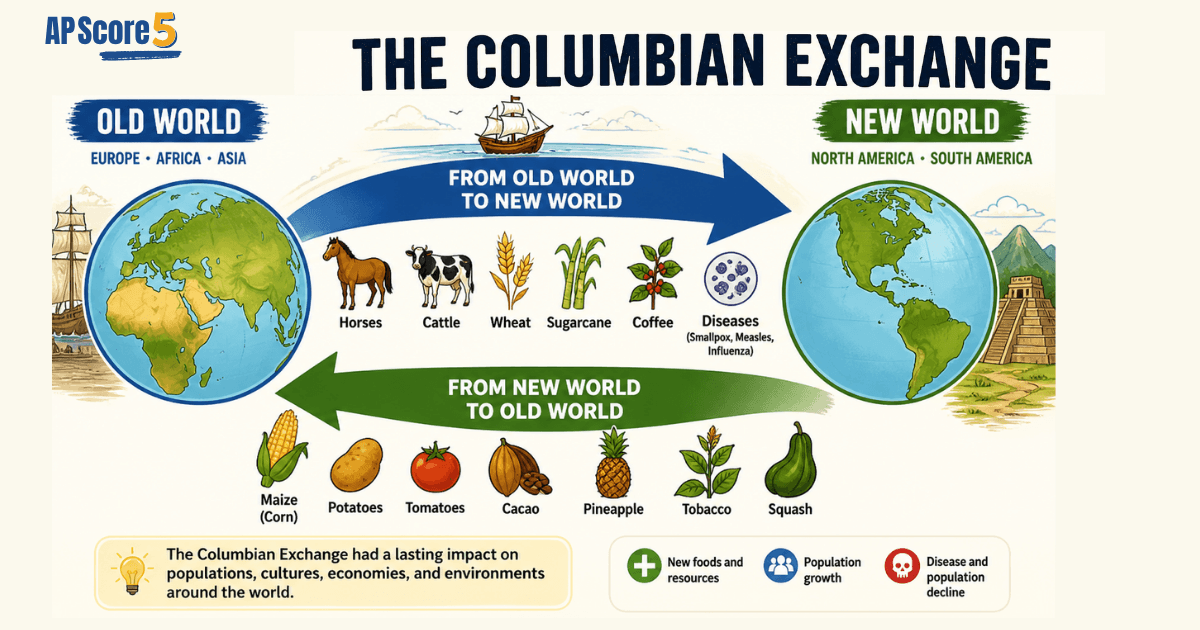
In one sentence: The Columbian Exchange is the long-run two-way movement of crops, animals, diseases, and people across the Atlantic after 1492.
Unit 5 is roughly 12–17% of the AP Human Geography exam. The Columbian Exchange ties together agricultural diffusion, population change, and forced migration, so you should carry its vocabulary into Units 2 and 3 FRQs as well as plantation-agriculture prompts.
Think of the exchange as a bundle of networks rather than a single event. Atlantic shipping lanes, credit instruments, imperial legal orders, and domestication histories all had to align before potatoes could anchor Irish tenancy systems or before sugar boilers could run night shifts in Barbados. That systemic framing helps when stimuli quote partial statistics—you interpret flows instead of memorizing isolated vocabulary lists.
Readers grade geography arguments by scale and causal chain. A sharp paragraph moves from global exchange → regional plantation belt → household labor pattern → demographic outcome. A weaker paragraph stops at “Europe got richer.” Likewise, linking Indigenous survivance strategies—alliances, diplomacy, legal petitions, environmental knowledge—to epidemic disruption demonstrates geographic sophistication beyond catastrophe narration.
For stimulus-based MCQs, underline verbs that signal directionality (“introduced,” “returned to Spain,” “diffused into West Africa”) and map them to Old or New World origin. For math-free quantitative clues, treat population estimates and cargo tallies as relative magnitudes: you rarely compute on the exam, but you must compare orders of magnitude (millions of captives vs thousands of colonists).
Finally, practice articulating ethical geography without moral grandstanding. AP rewards sober acknowledgment that colonial institutions structured who benefited from calorie bonanzas or suffered under coerced planting schedules. Pair evidence with agency: African farmers adopted maize strategically; Indigenous diplomats contested land patents; maroon communities forged autonomy within hostile empires. Nuance reads as mastery.
Atlantic swapping rewrote global distribution patterns within decades—use those vocabulary bridges when FRQs ask for diffusion scales.
Shrinking effective distance across oceans belongs with space-time compression geography examples whenever stimuli highlight sailing weeks versus telegraph minutes.
Compare outbreak geography with distance decay across regions so disease gradients read as spatial processes, not moral footnotes.
↔ Maize · potatoes · horses · diseases · crops
The Columbian Exchange was the wide-scale movement of plants, animals, foods, diseases, technology, and people between the Old World (Europe, Africa, and Asia) and the New World (the Americas) after voyages associated with Christopher Columbus beginning in 1492. It functions in AP Human Geography as one of the clearest demonstrations of cultural and agricultural diffusion at ocean-crossing scale: ideas, germs, and calories moved together because ships moved together. When you answer prompts about globalization roots or plantation labor demand, you are often asked to trace consequences back to this first sustained hemispheric linkage.
The historian Alfred W. Crosby coined the term Columbian Exchange in his 1972 book. Earlier textbooks treated 1492 mainly as political theater—the expanding Spanish empire meeting Indigenous empires. Crosby insisted that the deeper drama was biological: Old World livestock reshaped American grasslands; New World calories reshaped Old World carrying capacity; epidemic disease reshaped who survived to farm those calories at all. Graders reward geographic framing: trace how a species moved, where it thrived, and which human networks transported it. Memorizing lists alone earns fewer points than explaining mechanisms.
To prepare FRQs, rehearse three bundles you can mix and match: nutrition (potato and maize-driven calorie shocks), immunity (novel pathogens ahead of colonizers), and coercion (sugar, tobacco, cotton demanding captive African labor). Naming silver flows toward Asian markets helps Unit 7 prompts about early globalization. Mentioning syncretic religions or Creole languages connects Unit 3 diffusion vocabulary without drifting off-topic.
Simple definition: The Columbian Exchange is the two-way transfer of living things and goods between the Americas and the rest of the world that began after Columbus’s voyages in 1492.
Goods traveled east and west. Europeans did not simply “deliver civilization”; Indigenous peoples returned crops that rewrote European diets.
Crops, livestock, and germs produced the largest demographic and ecological shifts; bullion mattered economically but pathogens shaped who lived to spend coin.
The Bahamas landfall opened recurring sail loops that standardized biological mixing across centuries.
Old World = Europe + Africa + Asia. New World = the Americas. AP stimuli assume you deploy those labels cleanly.
Colonizers, missionaries, and enslaved Africans physically carried seedstock, animals, languages, and rituals across water.
Plantation circuits bundled crops and captive labor; ignoring coercion loses FRQ nuance.
Definition paragraphs on exams should answer four beats: who swapped places (Old ↔ New), what categories moved (plants/animals/diseases/people), when (after 1492), and why geography cares (food systems, mortality regimes, global trade).
Students confuse Columbus “starting agriculture.” Indigenous societies already practiced intensive cultivation—Columbus altered which species competed on American soils and which pathogens culled human populations first.
Use this diagram-style chart as your mental map whenever an MCQ mentions Atlantic crossings. Pair it with arrow clues on stimuli—exam writers often embed implied directions (“Spanish settlers introduced…”).
Westbound cargo examples
Animals: horses, cattle, pigs, sheep, goats, chickens, donkeys.
Crops: wheat, sugar cane, rice, bananas, coffee, citrus, grapes, olives, onions, lettuce.
Diseases: smallpox, measles, influenza, typhus, yellow fever, malaria, chickenpox, plague.
People & tech: colonizers, forced African migrants, iron tools, wheels, firearms, alphabets.
Eastbound cargo examples
Crops: potato, maize, tomato, cacao, vanilla, peppers, tobacco, beans, peanuts, cassava, sweet potato, squash, pineapple, avocado, sunflower, rubber.
Animals: turkey; llamas/alpacas/guinea pigs (limited).
Disease debate: syphilis spread is contested—cite uncertainty if prompted.
Materials: silver and gold liquidity reshaped European and Asian economies.
The pattern was deliberately uneven: Eurasian and African disease pools devastated immunologically naive American populations, while American calorie crops fed Afro-Eurasian demographic swelling. That asymmetry—pathogens mostly westbound, staple crops mostly eastbound—is the thesis paragraph for countless Atlantic-world essays.
For SEO clarity: this section functions as a columbian exchange map, diagram, and chart simultaneously—plain-language labels map onto AP vocab alongside other figures on this page.
Plants, animals, diseases, people, and commodities all crossed—biology dominated demographic outcomes.
| Old World → New World | New World → Old World |
|---|---|
| Wheat, sugar cane, rice, bananas, coffee, citrus, grapes, olives, onions, lettuce, apples, peaches | Potatoes, maize, tomatoes, cacao, vanilla, peppers, beans, peanuts, cassava, sweet potatoes, squash, pumpkins, pineapples, avocados, tobacco |
The potato migration might be the single largest calorie shock traveling east: Andean cultivars thrived in cloudy Irish or German fields where wheat yielded poorly. Dense carbohydrates supported rural labor pools feeding proto-industrial towns. Maize exploded across African farming systems because it ripened quickly and tolerated drought stress better than some sorghum varieties in specific niches—though agronomists caution against treating adoption as uniform continent-wide.
Traveling west, wheat and cattle reframed temperate grasslands from the Pampas to the Great Plains; sugar reframed Caribbean ecologies through monoculture, irrigation demands, and brutal labor regimes. Coffee and citrus followed plantation or estate models wherever colonial land law allowed concentrated ownership.
| Old World → New World | New World → Old World |
|---|---|
| Horses, cattle, pigs, sheep, goats, chickens, donkeys, dogs/cats (selected breeds) | Turkeys; llamas/alpacas limited; guinea pigs |
Domesticated megafauna skewed west for a simple historical reason: Afro-Eurasian farmers had millennia of selective breeding; many American megafauna had vanished after Pleistocene extinction pulses, leaving fewer candidates besides camelids in the Andes. Reintroduced horses turned some Plains nations into equestrian societies within generations—an adaptive response to new fauna, not “new culture imported wholesale.”
| Old World → New World | New World → Old World |
|---|---|
| Smallpox, measles, influenza, typhus, yellow fever, malaria, chickenpox, plague, whooping cough | Syphilis (debated) |
Indigenous populations lacked inherited resistance to many crowd infections that had circulated for centuries across Afro-Eurasia. Smallpox alone killed staggering shares of affected communities; combined with warfare, dislocation, and extractive labor, total hemispheric population estimates plummet from roughly tens of millions in 1492 toward much smaller figures by 1600 in standard textbook ranges. AP answers must treat this as demographic fact, not footnote.
This is why the exchange belongs in Unit 2 migration prompts as well as Unit 3 diffusion essays.
Balanced AP responses refuse cheerleading. Benefits appeared—but privilege structured who tasted them first.
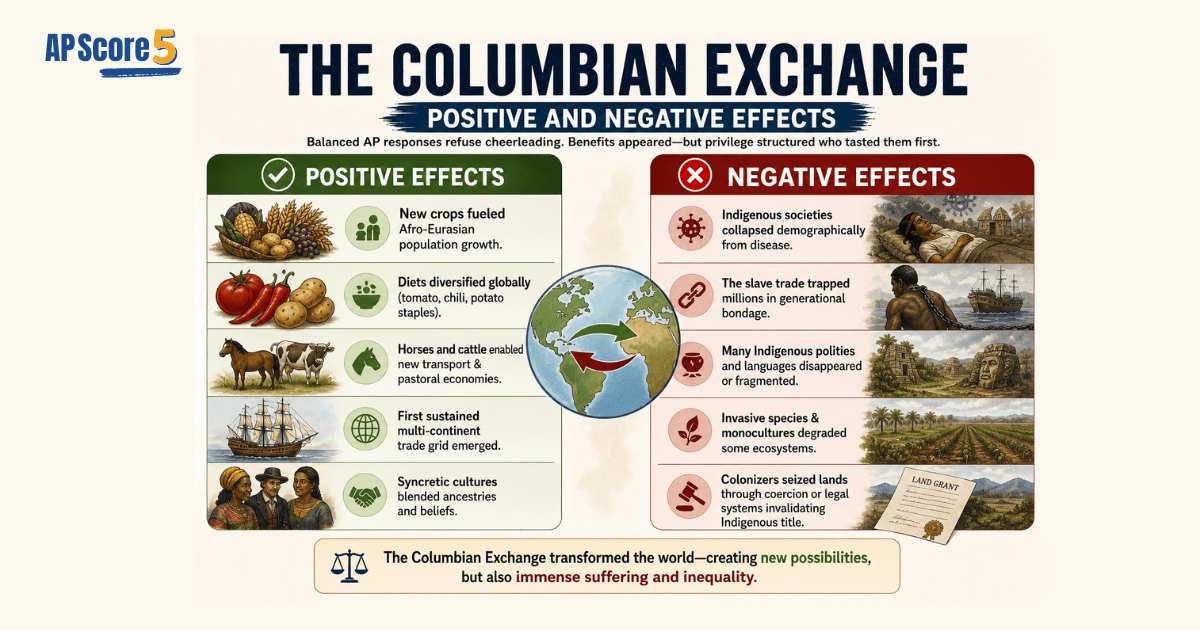
| Positive effects | Negative effects |
|---|---|
| New crops fueled Afro-Eurasian population growth. | Indigenous societies collapsed demographically from disease. |
| Diets diversified globally (tomato, chili, potato staples). | The slave trade trapped millions in generational bondage. |
| Horses and cattle enabled new transport & pastoral economies. | Many Indigenous polities and languages disappeared or fragmented. |
| First sustained multi-continent trade grid emerged. | Invasive species & monocultures degraded some ecosystems. |
| Syncretic cultures blended ancestries and beliefs. | Colonizers seized lands through coercion or legal systems invalidating Indigenous title. |
The honest synthesis is positional: if you lived through invasion-era Mesoamerica, catastrophe outweighed tomato futures; if you lived in eighteenth-century Ireland, potato dependence lifted ceilings until blight exposed monoculture risk. AP graders want specificity—“Europe benefited” loses to “Irish rural laborers ate more calories per acre until reliance on one cultivar became fragile.” Likewise “Indigenous people suffered” improves when naming epidemic incidence plus colonial labor drafts.
Economic historians emphasize silver circuits knitting Potosí mines to Ming tax reforms—another effect pathway alongside biology. Environmental historians emphasize invasive Kentucky bluegrass or escaped livestock reshaping biomes. Cultural historians emphasize Ladino, mestizo, Creole, Afro-descendant identities forged inside colonial hierarchies. Geography synthesizes them by mapping flows instead of telling morality tales.
Population climbed where potato and maize calories supplemented rye/oats diets; stimulant crops (coffee, cacao, tobacco) reorganized labor rhythms and trade deficits.
Epidemic mortality, land seizure, coerced tribute, yet selective adaptation—horse economies on Prairies, negotiated survivance in highlands.
Atlantic slavery drained coastal demographics while maize/cassava sometimes augmented calories—but adoption varied sharply by agro-ecology.
New World silver monetized trade; sweet potato and peanut spread on hillside margins supporting Qing-era demographic expansion in scholarship narratives.
Sugar monoculture annihilated Taíno populations within decades and rebuilt societies atop enslaved labor.
Biota interdependence—the Anthropocene trace scientists argue begins here alongside fossil regimes.
When comparing regions, underline mechanisms: silver impacted liquidity and taxation in Ming China; potatoes impacted hill slopes in China’s interior differently than wheat plains in England; horses impacted bison economies differently than oxen plowing Andean terraces.
European exploration supported by sailing tech, mercantile thirst for Asian goods, Iberian competition for empire, religious rationales for expansion—and the biological inevitability that separated continents once reunited would swap germs.
Effects recap ties back to Sections effects and regional impacts; causation FRQs expect paired sentences bridging mechanism + outcome.
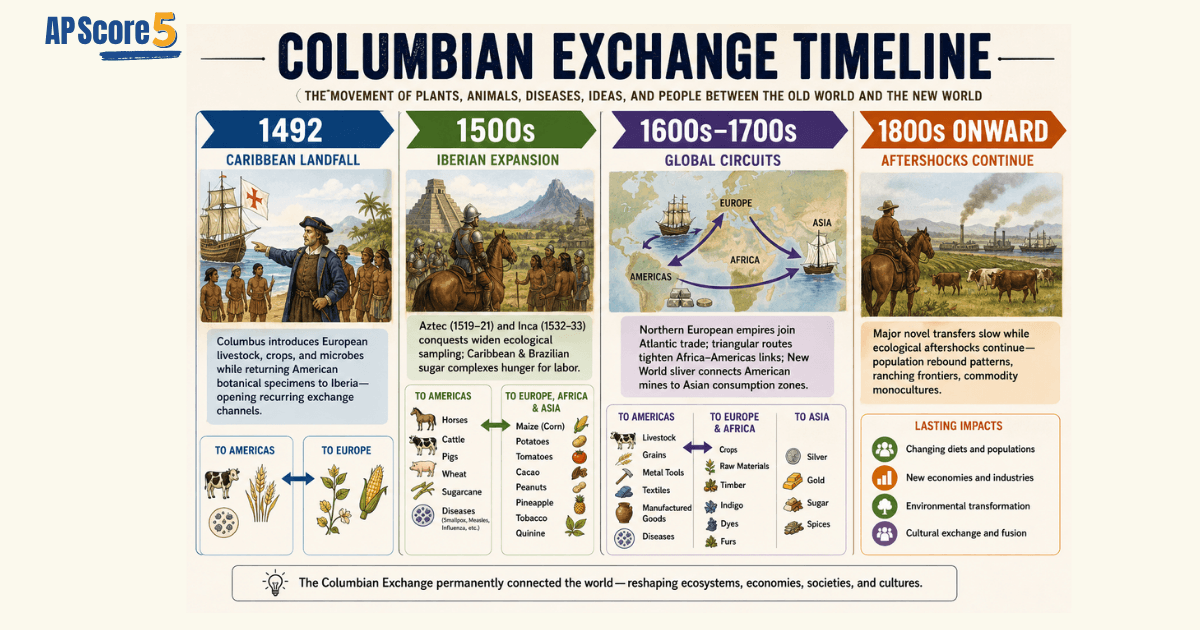
| Year | Event |
|---|---|
| 1492 | Landfall in Bahamas — exchange begins. |
| 1493 | Second voyage ferries livestock, sugar, wheat seed. |
| 1494 | Treaty of Tordesillas divides Iberian claims. |
| 1500s | Epidemic waves sweep continents. |
| 1519–1521 | Aztec Empire defeated—Mesoamerican crops surge east. |
| 1532–1533 | Inca collapse—Andean potatoes circulate globally. |
| 1500s–1800s | Transatlantic slavery peaks. |
| 1600s | Plantation complexes widen. |
| 1700s | New World staples engrain Afro-Eurasian diets. |
| 1800s | Novel transfers taper as industrial globalization emerges. |
| 1972 | Crosby publishes The Columbian Exchange. |
Quick answer: Overlap yes—identity no.
| Feature | Columbian Exchange | Triangular trade |
|---|---|---|
| Describes | Two-way biological/cultural/economic transfer | Three-leg Atlantic commerce pattern |
| Period | 1492–~1800 | 1500s–1800s |
| Scope | Planetary diffusion story | Commercial routing story |
| MCQ clue | Plants/animals/disease wording | Three-hop shipping diagram |
Forced migration, demographic collapse, voluntary colonization.
Relocation diffusion, syncretism, linguistic layering.
Second agricultural revolution, plantation agriculture, global food webs.
Colonial port cities as exchange nodes.
Silver circuits, wage labor seeds, commodity chains.
Link diffusion + agriculture + migration in one thesis chain.
Vocabulary to rehearse aloud: relocation diffusion, plantation agriculture, demographic collapse, forced migration, syncretism, globalization.
When a free-response item pairs the exchange with a map, trace latitudinal fit (Andean tubers in Atlantic Europe) and institutional fit (Iberian land grants enabling wheat estates). When a population pyramids stimulus appears, connect Old World disease loads to age-structure disruption in the Americas, then counter with partial recovery where mission stations or cash-crop booms pulled in coerced or contract labor. These paired moves show you can read both natural and social data layers.
It permanently bridged hemispheres separated for millennia—reshaping calories, immunity, labor coercion, and cultural hybridity more decisively than any single treaty line.
Identify crops/animals moved, consequences of disease, or compare short- and long-term diffusion impacts.
Explain how exchange items altered diets, labor systems, or environments in one Old and one New World society.
Maps of Atlantic trade, tables of crop origins, timeline stimuli.
Strong AP answer structure: Item → Direction (Old↔New) → Effect → Geographic significance.
The Columbian Exchange involved:
Review timing: every fifth card transition pauses on an ad placeholder with a three-second timer before the next card appears.
Score card tracks accuracy; after every fifth answered question you will see a short break before the next item loads.
Prompt: The Columbian Exchange reshaped both Old and New Worlds after 1492.
A. It was the wide-scale two-way transfer of plants, animals, diseases, people, and goods between the Old World (Europe, Africa, Asia) and the New World (Americas) after sailing contact beginning in 1492.
B. Positive: Europe’s population rose as potato and maize expanded calorie supply. Negative: Indigenous American populations collapsed from smallpox and other pathogens combined with colonial violence.
C. It exemplifies cultural diffusion—especially relocation diffusion—because colonizers and enslaved Africans carried crops, animals, languages, and religions physically across the Atlantic, producing syncretic cultures.
Part A needs two-way language plus biological categories. Part B needs explicit regional anchors. Part C must define diffusion type, not label-drop alone.
Only praising Europe, skipping 1492, or mentioning diffusion without concrete transfers.
Before you leave this guide, rehearse a thirty-second spoken outline: name Crosby, pair hemispheres, cite one calorie crop eastbound and one pathogen westbound, acknowledge slavery and epidemic loss, then close with globalization as the long arc. If that cadence feels natural, you have internalized the geographic storyline examiners expect. Add one place-name—Andes, Taíno homelands, or the Pampas—to ground the abstract flows in a specific region you can defend under time pressure.
It was the two-way transfer of plants, animals, diseases, people, and goods between the Old World (Europe, Africa, Asia) and the New World (the Americas) starting in 1492. It permanently linked two halves of the planet that had been almost completely separated for thousands of years.
It started in 1492 with Columbus's first voyage. The major period of new transfers ended around 1800. After that, the exchange merged into modern globalization, which is still going on.
Christopher Columbus. The historian Alfred W. Crosby coined the term in his 1972 book The Columbian Exchange.
It linked the world's two halves for the first time, reshaped diets, fueled population growth in Europe and Asia, caused demographic collapse in the Americas, drove the transatlantic slave trade, and laid the foundation for modern globalization.
New crops like potato, maize, tomato, and cacao spread to the Old World and supported population growth. The Americas gained livestock like horses and cattle that reshaped agriculture and transport. New global trade networks formed.
Indigenous American populations collapsed by 80–90% in many regions due to Old World diseases. The transatlantic slave trade forcibly moved 12.5 million Africans. Many Indigenous cultures, languages, and political systems were destroyed.
Potatoes, maize (corn), tomatoes, cacao (chocolate), vanilla, peppers, beans, peanuts, cassava, sweet potatoes, squash, pineapples, avocados, and tobacco.
Wheat, sugar cane, rice, bananas, coffee, citrus fruits, grapes, olives, onions, and apples.
From the Old World to the New: horses, cattle, pigs, sheep, goats, chickens, donkeys. From the New World to the Old: turkeys, guinea pigs, and in limited numbers llamas and alpacas.
The Columbian Exchange is the broad biological, cultural, demographic, and economic transfer between Old and New Worlds. The triangular trade is one specific commercial pattern — a three-leg Atlantic shipping route — that operated inside the larger exchange.
Strictly, the period of major new transfers ended around 1800. The biological and cultural mixing it started never stopped — it grew into modern globalization. Most AP-level answers say the Columbian Exchange itself describes 1492–1800.
It appears in Unit 2 (forced migration, demographic collapse), Unit 3 (cultural diffusion, syncretism), Unit 5 (agricultural diffusion, plantation agriculture, second agricultural revolution), Unit 6 (urban growth in the New World), and Unit 7 (early globalization).
Treat this microtopic as living vocabulary—reuse these habits whenever stimuli combine maps, tables, interviews, or timelines.
Read legends, scales, units, and captions together—decide whether evidence supports a regional trend or a misleading aggregation inside one polygon.
Population change, cultural diffusion, borders, rural systems, urban service gaps, and economic indicators all reward the spatial precision you practice in Unit 1.
Name the place, pull a detail from the stimulus, connect to a course concept, and end with a consequences sentence—skip definition dumps.
Call out who collected the data, at what geography, and when. Note missing groups when quantitative and qualitative pieces disagree.