Demographic Transition Model Real-World Examples for AP Human Geography
A real-world example of the Demographic Transition Model is Niger, often used to explain rapid population growth because it has a high birth rate and a youthful population. Japan is another strong example because it shows Stage 5-style challenges: very low fertility, an aging population, and possible population decline. The DTM is a model, not a fixed label — use countries as evidence for a process, not as memorized stage tags.
Updated May 2026 · Reviewed by APScore5 Editorial Team
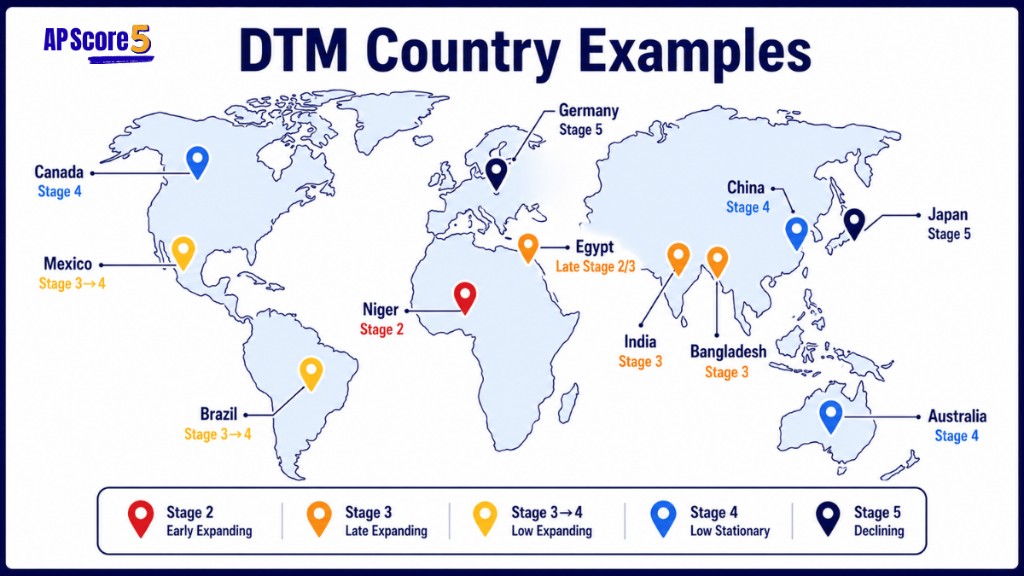
11 country examples — Niger, India, Bangladesh, Egypt, Brazil, Mexico, China, Canada, Australia, Japan, Germany — mapped to DTM stages, with the exact sentence frames that score points on the AP exam.
11 CountriesStages 2–5FRQ Sentence Frames8 FAQs8 Mini MCQs
How Countries Fit the Demographic Transition Model
The Demographic Transition Model describes how birth rates and death rates change as societies develop. In early stages, both rates are high and population growth is limited. When death rates fall before birth rates adjust, natural increase rises sharply — the classic Stage 2 pattern. Later, falling fertility, better healthcare, education, and urbanization pull birth rates down until both rates are low in Stage 4 societies.
Figure - Demographic Transition Model Countries Fit DTM
On the AP Human Geography exam, countries are evidence for that process. A strong answer names the country, describes rate patterns, explains growth or decline, and connects to a development factor such as healthcare access, women's education, migration effects, or aging. Start with the DTM stages guide (main stage-by-stage reference in this cluster), skim the DTM hub overview for rate vocabulary, then return here for country-specific FRQ sentences.
DTM Stage
Birth Rate
Death Rate
Population Growth
AP HuG Clue
Stage 1
High
High
Low or stable
Preindustrial society
Stage 2
High
Falling
Rapid growth
Youthful population, high natural increase
Stage 3
Falling
Low
Slowing growth
Fertility decline, urbanization
Stage 4
Low
Low
Stable or slow growth
Developed economy, low fertility
Stage 5
Very low
Low
Possible decline
Aging population, labor shortage concerns
A strong AP answer includes 5 parts:
The country
The likely DTM pattern
Birth rate and death rate clues
Population growth or decline
A development factor (healthcare, urbanization, education, fertility, aging, migration)
[Country] can be used as a Demographic Transition Model example because it has [birth/death rate pattern], which leads to [population growth pattern]. This connects to development because [healthcare, urbanization, women's education, fertility decline, aging, or migration factor].
Compare rate direction on the DTM and ETM link when a prompt mentions disease or life expectancy, not only birth and death rates.
Quick Country Comparison
Use this table to pick a country fast, then jump to the matching card below. If two stages seem possible, read Stage 2 vs 3 before you write.
Country
Useful DTM Pattern
Best AP HuG Takeaway
Niger
Stage 2 / early transition
High fertility, youthful population, rapid growth
India
Stage 3 transition
Falling birth rates, population momentum, uneven development
Bangladesh
Stage 3 transition
Fertility decline, development progress, high density
Each card below explains one country you can cite on the exam. Use these demographic transition model country examples on FRQs by explaining rates and consequences — not by listing stage numbers alone. If you need stage definitions or traps first, read the five DTM stages guide, then return here for country evidence. When you finish a section, try DTM practice questions or review pyramids on the hub.
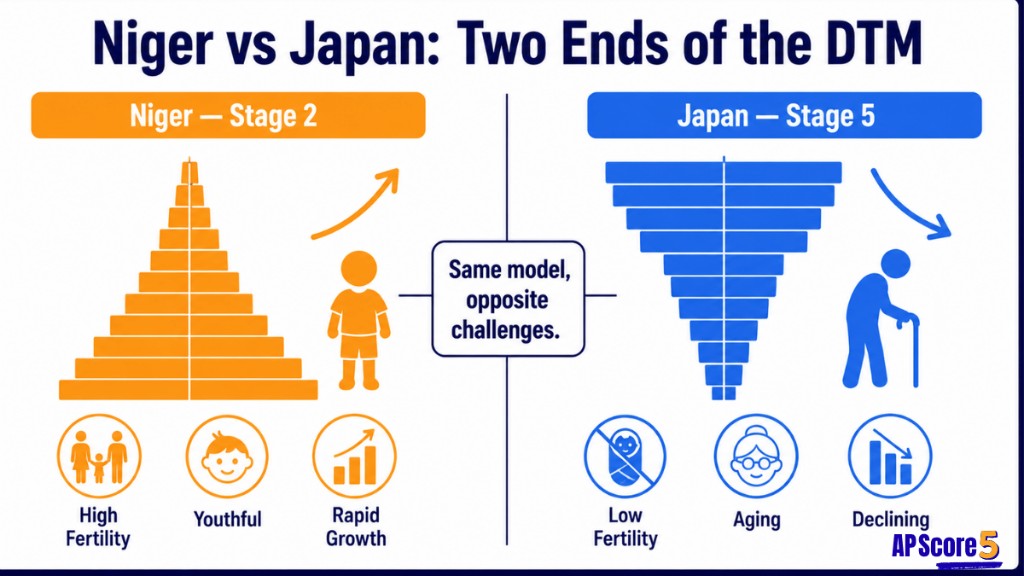
Figure - Country Examples Niger Vs Japan DTM Two ExtremesStage 2
Niger — A Strong Example of Rapid Population Growth
Niger is one of the clearest DTM country examples for rapid population growth. In AP Human Geography, Niger represents a country with a high birth rate, a youthful age structure, and strong population momentum.
Niger is discussed as a Stage 2 pattern or early Stage 3-style example because death rates have fallen compared with earlier historical conditions, but birth rates remain high. This creates a large gap between births and deaths, leading to rapid natural increase.
Niger is useful for explaining:
High fertility
Youth dependency
Rapid natural increase
Pressure on schools and healthcare
Need for jobs and infrastructure
Population momentum
Strong AP sentence:Niger can be used as a Demographic Transition Model example because it has a high birth rate and a youthful population, which contribute to rapid population growth and create pressure on schools, healthcare, housing, and employment.
Pairing: Niger contrasts well with Japan aging pressures — Niger shows the challenges of a very young and fast-growing population; Japan shows the challenges of an older, shrinking population.
Stage 3
India — A Major Stage 3 Transition Example
India shows how a very large country can move through demographic change unevenly. India is used to discuss Stage 3-style patterns: death rates are low, birth rates have declined, and population growth continues because of population momentum.
India helps students understand that demographic transition is not identical everywhere inside a country. Some regions have lower fertility and more urban development; others still have higher fertility and faster growth. Compare patterns with the Stage 3 definition before you label a region.
India is useful for explaining:
Fertility decline
Population momentum
Urbanization
Regional variation
Large working-age population
Development differences inside one country
Strong AP sentence:India can be used as a Demographic Transition Model example because its birth rate has declined over time, but its large population and age structure continue to support population growth through population momentum.
Pairing: India connects well to population pyramid shapes — a country with a large base or large younger cohorts often has future population growth built into its age structure, even if fertility is falling.
Stage 3
Bangladesh — Fertility Decline and Development Progress
Bangladesh shows how fertility decline can happen alongside social and economic development. Densely populated countries can still experience important demographic changes.
Bangladesh fits Stage 3-style transition because birth rates have declined while death rates remain low. It is a useful example of how public health, education, family planning, and development influence total fertility trends.
Bangladesh is useful for explaining:
Falling fertility
High population density
Development and public health
Women's education
Family planning
Slowing but continuing growth
Strong AP sentence:Bangladesh can be used as a Demographic Transition Model example because fertility has declined over time, showing how education, healthcare, and development can reduce birth rates even in a densely populated country.
Pairing: Bangladesh compares well with India — both show Stage 3 transition with different development patterns and population pressures.
Late Stage 2 / Stage 3
Egypt — Youthful Population and Urban Pressure
Egypt helps students explain how a country can face population pressure even while developing. It can be discussed as late Stage 2 or Stage 3-style depending on the classroom source.
The important AP idea is not the exact stage label — it is the relationship between youthful population structure, urban growth, employment pressure, housing demand, and development.
Egypt is useful for explaining:
Youthful population
Urbanization
Pressure on infrastructure
Population growth near major urban areas
Development transition
Employment challenges
Strong AP sentence:Egypt can be used as a Demographic Transition Model example because its youthful population and continuing growth create pressure on cities, jobs, schools, housing, and public services.
Pairing: Egypt is also useful for discussing population distribution patterns because much of the population is concentrated near the Nile River and major urban centers — a bridge between DTM, population density, and physical geography.
Stage 3 → 4
Brazil — Urbanization and Falling Fertility
Brazil is a strong example of a country moving from Stage 3 transition toward Stage 4 rates. It connects demographic transition to urbanization, fertility decline, economic change, and regional inequality.
As countries urbanize, families often have fewer children. Children become more expensive to raise in cities, women gain greater access to education and employment, and contraception becomes more available. Brazil shows how these factors lower birth rates over time.
Brazil is useful for explaining:
Urbanization
Fertility decline
Slower population growth
Regional inequality
Development transition
Changing family size
Strong AP sentence:Brazil can be used as a Demographic Transition Model example because urbanization and development have contributed to lower fertility rates, slowing population growth as the country moves toward a Stage 4 pattern.
Pairing: Brazil contrasts with Niger rapid growth — Niger shows rapid growth and high fertility; Brazil shows how urbanization and development reduce birth rates.
Stage 3 → 4
Mexico — Fertility Decline, Migration, and Changing Age Structure
Mexico connects demographic transition to fertility decline, migration, urbanization, and changing age structure. It is often used as a Stage 3 to Stage 4 transition example.
Mexico helps students understand that population growth can slow as birth rates decline, but migration and age structure still matter. A country may have lower fertility while still having a large working-age population or strong migration connections with nearby countries.
Mexico is useful for explaining:
Falling birth rates
Urbanization
Migration patterns
Changing age structure
Slowing population growth
Development transition
Strong AP sentence:Mexico can be used as a Demographic Transition Model example because birth rates have declined with development and urbanization, while migration and age structure continue to shape population patterns.
China — Low Fertility and Aging After Rapid Change
China connects population transition to government policy, development, low fertility, and aging. It is often discussed as a Stage 4 country with Stage 5-style concerns because of its very low fertility and aging population.
China's demographic pattern has been shaped not only by development but also by population policy effects — making it a strong example for explaining how government decisions influence population structure.
China is useful for explaining:
Low fertility
Aging population
Population policy effects
Shrinking workforce concerns
Urbanization
Long-term demographic consequences
Strong AP sentence:China can be used as a Demographic Transition Model example because low fertility and an aging population show how rapid development and population policy can create long-term demographic challenges.
Pairing: China contrasts with India population momentum — India still has more population momentum; China faces stronger aging and low-fertility concerns.
Stage 4
Canada — Stage 4 and Immigration-Supported Growth
Canada has low birth rates, low death rates, high life expectancy, and slow natural increase. It also helps students understand how immigration affects population growth in highly developed countries.
In Stage 4 countries, natural increase is low because both birth rates and death rates are low. A country can still grow through immigration — connecting the DTM to migration and totals.
Canada is useful for explaining:
Low birth and death rates
High life expectancy
Slow natural increase
Immigration-supported population growth
Aging population concerns
Developed economy population patterns
Strong AP sentence:Canada can be used as a Demographic Transition Model example because it has low birth and death rates typical of Stage 4, while immigration helps support population growth and labor force needs.
Pairing: Canada contrasts with Japan low fertility — both are developed, but immigration plays a larger role in Canada's growth.
Stage 4
Australia — Stage 4, Immigration, and Urban Concentration
Australia is a strong Stage 4 example with low birth rates, low death rates, and high development. It is useful for showing how immigration and urban concentration shape population patterns in developed countries.
Australia's population is highly concentrated in major urban and coastal areas — connecting the DTM to population distribution, urbanization, and migration.
Australia is useful for explaining:
Stage 4 population pattern
Low fertility
High life expectancy
Immigration
Urban concentration
Developed economy demographics
Strong AP sentence:Australia can be used as a Demographic Transition Model example because it has low birth and death rates typical of a developed Stage 4 country, while immigration and urban concentration shape its population distribution.
Pairing: Australia compares well with Canada immigration growth — both show how immigration influences population growth in developed societies.
Stage 5
Japan — The Clearest Stage 5 Example
Japan is one of the strongest real-world examples of Stage 5 patterns. It shows very low fertility, long life expectancy, an aging population, and concerns about population decline.
Japan demonstrates that development does not always mean population growth. In later stages of the DTM, countries may face the opposite problem: too few births, a shrinking workforce, and a growing elderly population. See also Japan exam reasoning.
Japan is useful for explaining:
Stage 5 demographic pattern
Very low fertility
Aging population
High elderly dependency
Labor shortage concerns
Population decline
Strong AP sentence:Japan can be used as a Demographic Transition Model example because its very low birth rate and aging population create Stage 5-style challenges such as labor shortages, elderly dependency, and possible population decline.
Pairing: Japan is an excellent contrast with Niger youthful growth — Niger shows the pressures of rapid growth; Japan shows the pressures of aging.
Stage 5-style
Germany — Aging, Low Fertility, and Labor Needs
Germany is another strong Stage 5-style example. Like Japan, Germany has low fertility and an aging population. Germany also helps students discuss immigration as a possible response to labor shortages and aging.
Germany connects demographic transition to economic geography — a country with an aging population may face challenges funding pensions, supporting healthcare systems, and maintaining a large enough workforce. Pair with the epidemiological transition model when mortality shifts toward chronic disease.
Germany is useful for explaining:
Low fertility
Aging population
Labor shortages
Pension pressure
Immigration as a demographic response
Developed economy challenges
Strong AP sentence:Germany can be used as a Demographic Transition Model example because its low fertility and aging population create labor force and pension challenges, making immigration an important demographic and economic issue.
Pairing: Germany pairs with Japan Stage 5, but the two are not identical — Japan is often used for population decline and aging; Germany is especially useful for discussing aging, labor needs, and immigration.
How to Use DTM Country Examples in an AP FRQ
A country example is only useful if you explain the geographic process behind it. Do not just name the country.
Weak answer:Japan is Stage 5.
Stronger answer:Japan is a strong Stage 5 example because it has very low fertility and an aging population, which can lead to labor shortages, elderly dependency, and population decline.
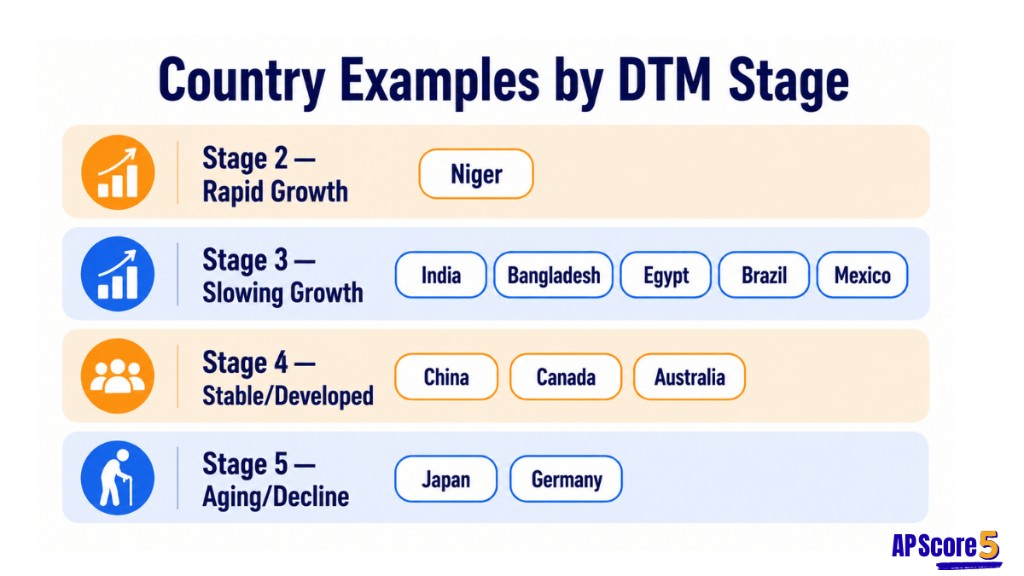
Match the prompt topic to a country, then explain rates. The chart below groups all eleven examples by DTM stage so you can see which countries fit rapid growth, slowing transition, stable development, or aging decline. For mortality or disease wording, pair your answer with the epidemiological transition guide.
Figure - DTM Country Examples Stage Exam
FRQ Topic
Best Country Example
Rapid population growth
Niger
Youthful population
Niger, Egypt
Fertility decline
India, Bangladesh, Brazil, Mexico
Urbanization and lower birth rates
Brazil, Mexico, India
Population momentum
India
Population policy
China
Aging population
Japan, Germany, China
Low natural increase
Canada, Australia
Immigration-supported growth
Canada, Australia, Germany
Labor shortages
Japan, Germany, China
Need sentence frames? Use the FRQ country guide on this page before the mini quiz.
Development link
Newly Industrialized Countries and DTM Stages
A newly industrialized country (NIC) is a state that has moved from a mainly agricultural economy toward factory production, services, and global trade in a relatively short period. On the AP Human Geography exam, NICs matter for the Demographic Transition Model because industrialization often lowers death rates first, then birth rates — but the timeline is faster and less uniform than the classic European sequence in many textbooks.
NICs are not a separate DTM stage. They are countries you can place along the model using birth rate, death rate, fertility, urbanization, and age structure — the same evidence you use for any country example. The trap is assuming every NIC is “Stage 4” because it has factories or a large GDP. Many NICs still show Stage 3 fertility decline with continuing growth, while others already face Stage 4 or Stage 5 aging concerns.
Why do NICs compress the demographic transition?
Industrial jobs cluster in cities, which raises the cost of raising children and expands access to education, especially for women. Governments and clinics spread basic health care and family planning, so death rates fall quickly. Birth rates often drop within one or two generations instead of over a century. That compression is why the same NIC can have skyscrapers and export manufacturing while parts of its population still show youthful pyramids and rapid natural increase.
Regional inequality inside a NIC makes stage labels harder. Coastal factory zones may look like late Brazil urbanization or Mexico migration patterns, while rural areas may still resemble earlier transition patterns. Always note internal variation when a stimulus describes “a newly industrializing country” without naming which region.
Youthful population and urban pressure during development
Classic Asian NICs such as South Korea, Taiwan, Singapore, and Hong Kong are often cited in textbooks for very fast transition toward low fertility and aging workforces. They follow the same logic as the examples above even when they are not on every country list.
Strong AP sentence:A newly industrialized country can illustrate the Demographic Transition Model because industrialization and urbanization tend to lower death rates and then birth rates, producing a compressed transition that may place the country in Stage 3 or Stage 4 even while population momentum or regional inequality continues.
Connect NIC discussion to industrial and economic development when a prompt asks how factories, trade, or urban jobs change population patterns — not only to memorized stage numbers.
Common Mistakes Students Make
The biggest mistake is treating the DTM like a perfect country-labeling system. The DTM is not meant to permanently classify every country into one exact stage — it explains broad patterns of demographic change.
Mistake
Better AP Approach
Saying every country fits one stage perfectly
Explain that the DTM is a model and countries can show mixed patterns
Naming a country without explanation
Always explain birth rate, death rate, fertility, or growth
Confusing Stage 2 and Stage 3
See Stage 2 vs 3: Stage 2 keeps high birth rates; Stage 3 shows falling birth rates
Forgetting migration
Some Stage 4 countries grow through immigration
Assuming development always means growth
Some developed countries face aging and decline
Calling every NIC “Stage 4”
Use rates and pyramids; many NICs are still Stage 3 or mixed — see NICs and DTM stages
Eight AP-style questions on country examples — five marked hard because they require explanation, not just naming a country.
Question 1: Which country is the strongest example of rapid population growth and a youthful population?
Correct: C. Niger is a strong example of high fertility, youthful age structure, and rapid population growth.
Question 2: Which pair of countries is most useful for explaining Stage 5-style aging population challenges?
Correct: C. Japan and Germany are useful for discussing low fertility, aging populations, labor shortages, and pension pressure.
Question 3: A country has falling birth rates, low death rates, increasing urbanization, and slowing population growth. Which example would best fit this pattern?
Correct: A. India is commonly used to discuss Stage 3-style transition, fertility decline, and population momentum.
Question 4: Canada and Australia are often classified as Stage 4, yet their populations continue to grow. Which factor most commonly explains growth despite low natural increase?
Hard
Correct: B. Stage 4 countries like Canada and Australia often have low natural increase; net immigration frequently keeps total population growing.
Question 5: A response states China is a simple Stage 4 case with no demographic challenges ahead. What is the best correction?
Hard
Correct: D. China is often taught as Stage 4, but AP answers should also note aging, very low fertility, and policy-driven demographic change — not a single static label.
Question 6: Fertility has fallen for years, but the population keeps growing because a large share of people are still young adults and children. Which example fits best?
Hard
Correct: A. Population momentum means growth can continue after fertility falls when the age structure still has many people entering reproductive years — a key India talking point.
Question 7: Which pairing best supports the claim that the DTM is a simplified model and countries can show mixed-stage traits?
Hard
Correct: C. Egypt and China illustrate that stage labels are debated: regions differ, rates change at different speeds, and one country can show more than one DTM pattern.
Question 8: For an FRQ on how development and urbanization reduce birth rates, which country is the strongest single example?
Hard
Correct: B. Brazil links urbanization, development, and falling fertility — a clear Stage 3 toward Stage 4 example with consequences you can explain in prose.
Prompt: A student claims that the Demographic Transition Model is only useful for memorizing stages.
A. Explain why real-world country examples make the DTM more useful.
B. Identify one country that can be used to explain rapid population growth.
C. Identify one country that can be used to explain aging population challenges.
Real-world examples make the DTM more useful because they show how birth rates, death rates, fertility, development, and age structure affect actual countries. Niger can be used to explain rapid population growth because it has a high birth rate and youthful population. Japan can be used to explain aging population challenges because it has very low fertility, long life expectancy, and possible population decline.
Quick answers
Frequently Asked Questions
What is a real-world example of the Demographic Transition Model?
Niger is a strong example for rapid population growth because it has a high birth rate and youthful population. Japan is another strong example because it shows Stage 5 patterns such as aging, very low fertility, and possible population decline.
Which country is the best Stage 2 DTM example?
Niger is one of the clearest Stage 2 examples because it helps explain high fertility, falling death rates, rapid population growth, and a youthful population.
Which countries are good Stage 3 DTM examples?
India, Bangladesh, Egypt, Brazil, and Mexico can be used to explain Stage 3 transition because they show falling birth rates, improving development, urbanization, and slowing population growth.
Which countries are good Stage 4 DTM examples?
Canada and Australia are useful Stage 4 examples because they have low birth rates, low death rates, high development, and slow natural increase. Immigration plays an important role in their population patterns.
Which countries are good Stage 5 DTM examples?
Japan and Germany are strong Stage 5 examples because they show very low fertility, aging populations, labor shortage concerns, and pressure on pension and healthcare systems.
Can a country fit more than one DTM stage?
Yes. The DTM is a simplified model. A country may show features of more than one stage, and different regions inside a country may have different demographic patterns. Review the DTM hub overview for rate vocabulary.
Why are real-world examples important for AP Human Geography?
Real-world examples move you beyond memorization. They show how birth rates, death rates, development, fertility, urbanization, migration, and aging actually shape population patterns on the Unit 2 hub.
What is the best way to use DTM examples in an FRQ?
Name the country, identify the demographic pattern, describe birth or death rates, and explain a consequence such as rapid growth, aging, migration, labor shortages, or pressure on services. Then practice with DTM practice questions.
Final Takeaway
Real-world examples help AP Human Geography students understand how population change actually works. Niger for rapid growth, India and Bangladesh for fertility decline, Brazil and Mexico for urbanization and slowing growth, China for low fertility and aging, Canada and Australia for Stage 4 and immigration-supported growth, Japan and Germany for Stage 5-style aging challenges.
The AP exam does not reward memorizing country names alone — it rewards explanation. Always connect a country example to birth rates, death rates, natural increase, fertility, development, migration, or age structure.