Binary 101₂ equals decimal:
Q1Explanation: 4 + 1 = 5.
AP Computer Science Principles · Unit 2 · Data
Unit 2 · Conversion · ~8 min read
Binary to decimal conversion is an AP CSP Unit 2 skill where you translate a base-2 number into its base-10 value. The key is simple: write the binary place values, then add only the values under 1s.
On this page, you will learn the step-by-step method, see worked examples, avoid common mistakes, and practice small AP-style conversion questions.
Binary to decimal conversion adds powers of two where bits are 1. Write place values 1, 2, 4, 8 under the bits, then sum only the values under 1s—1010₂ is 8 + 2 = 10.
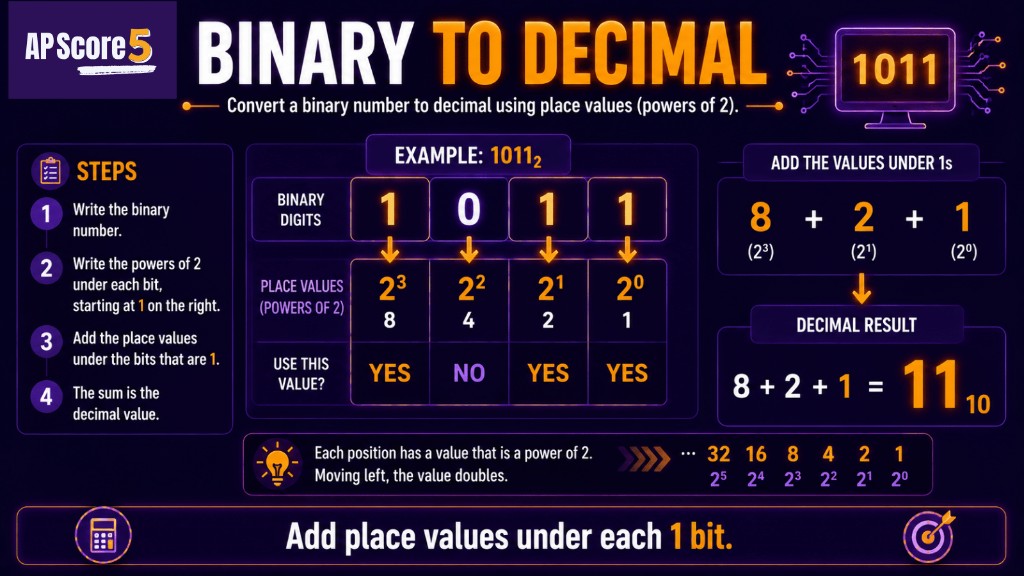
Binary to decimal conversion translates a base-2 number into its base-10 value. AP CSP expects you to use place values, not treat the string like a decimal numeral.
From right to left, positions are powers of two: 1, 2, 4, 8, 16, 32, 64, 128. Each step left doubles the value. Most exam items use four to eight bits.
| Bit position (right → left) | Place value |
|---|---|
| Ones | 1 |
| Twos | 2 |
| Fours | 4 |
| Eights | 8 |
Place values: 4, 2, 1. Bits: 1, 0, 1. Add 4 + 1 = 5.
Place values: 8, 4, 2, 1. Add 8 + 2 = 10.
Add 8 + 4 + 1 = 13.
Add 8 + 4 + 2 + 1 = 15.
AP CSP may ask the reverse on a few items: find the largest power of two that fits, subtract, mark a 1, repeat. Decimal 10 → 1010₂; decimal 13 → 1101₂. This page focuses on binary → decimal; use the same place-value row to check your work.
Stems use small strings such as 101, 1010, 1101, or 1111. Wrong options often multiply by ten or drop a place value. Show the power row on scratch paper until the habit is automatic.
Twelve topic checks on small conversions. Choices shuffle on load.
Binary 101₂ equals decimal:
Q1Explanation: 4 + 1 = 5.
Binary 1010₂ equals decimal:
Q2Explanation: 8 + 2 = 10.
Binary 1101₂ equals decimal:
Q3Explanation: 8 + 4 + 1 = 13.
Binary 1111₂ equals decimal:
Q4Explanation: 8 + 4 + 2 + 1 = 15.
Binary 1001₂ equals decimal:
Q5Explanation: 8 + 1 = 9.
Right-to-left binary place values start with:
Q6Explanation: Each position doubles.
A student says 100₂ is "one hundred." The correct decimal value is:
Q7Explanation: Binary 100 is 4, not base-10 one hundred.
Decimal 10 in binary is:
Q8Explanation: 8 + 2 = 10 → 1010₂.
Decimal 13 in binary is:
Q9Explanation: 8 + 4 + 1 = 13 → 1101₂.
Leading zeros in 00101₂ change the value by:
Q10Explanation: Leading zeros do not change numeric value.
Which place value sits under the rightmost bit?
Q11Explanation: The ones place is on the right.
When converting binary to decimal, zero bits:
Q12Explanation: Zeros keep alignment; only 1s add.
Write the place values under each bit from right to left: 1, 2, 4, 8, 16. Add only the place values where the bit is 1 and ignore zeros. For example, 1010₂ is 8 + 2 = 10. Say the powers aloud while you trace so you do not skip a column.
101₂ is 4 + 1 = 5 in decimal. The rightmost 1 is in the ones place, the middle 0 adds nothing, and the left 1 is in the fours place. Students sometimes read 101 as one hundred because they treat it like base 10.
1010₂ is 8 + 2 = 10. The 1 in the eights place and the 1 in the twos place contribute; the zeros only hold positions. This pattern appears often on AP CSP Unit 2 items.
Each bit position is a power of two starting at 1 on the right: 1, 2, 4, 8, 16, 32, 64, 128. Moving left multiplies the place value by two. AP CSP expects you to use these values, not memorize huge tables.
Line up place values, circle every 1, and add those values only. This sum method beats trying to multiply the string as if it were decimal. Practicing 101, 1010, 1101, and 1111 builds speed for exam-sized numbers.
Zeros do not add to the total, but they keep bit positions aligned. In 1001₂, the middle zeros separate the 8 and 1 places. Dropping a zero column is a common reason a correct-looking string gives the wrong decimal.
Treating binary digits like base-10 place values is the top error—reading 100₂ as one hundred instead of four. The second trap is skipping a column when a zero sits between two ones. Write the power row every time until the habit sticks.
No. AP CSP usually tests small binary strings to check place-value reasoning, not long hand division. If a stem shows many digits, check whether the question actually limits bit width before you calculate a huge value.
Convert your result back to binary using place values or the subtract-largest-power method. If you started with 13 and wrote 1101₂, summing the bits should return 13. That round-trip catches transposed digits quickly.
Open the bits-and-bytes guide if file-size units still feel fuzzy, then data compression for ratios. Take the eighteen-question Unit 2 quiz when conversions feel solid, and use the fifty-question practice set for mixed review.