What do bacteria and viruses have in common?
What do bacteria and viruses have in common is that both can contain genetic material, cause infections, spread between hosts, evolve through mutation and selection, and trigger immune responses. For AP Biology, separate those similarities from the key difference: bacteria are living prokaryotic cells, while viruses are noncellular particles that must use host cells to reproduce.
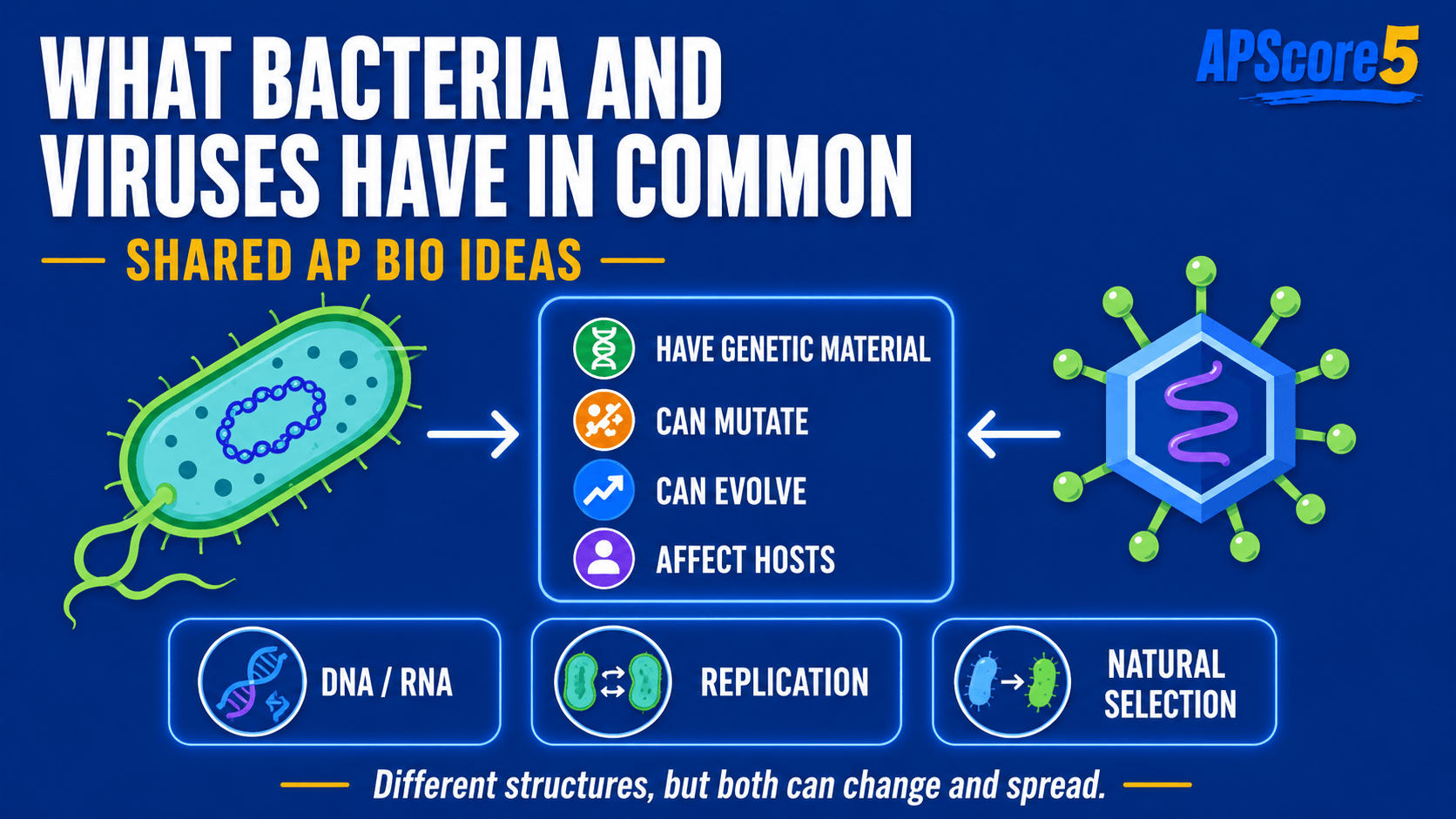
Quick answer box: bacteria and viruses similarities
Students often learn bacteria and viruses together because both appear in infection, immunity, mutation, and evolution questions. That grouping is useful, but it can hide the main AP Biology distinction: bacteria are cells, while viruses are not cells.
| Similarity | What it means |
|---|---|
| Contain genetic material | Bacteria have DNA; viruses may have DNA or RNA. |
| Can cause infections | Both can invade or affect a host organism. |
| Can evolve | Mutations and natural selection can change populations over time. |
| Interact with cells | Bacteria are cells; viruses infect host cells. |
| Can trigger immune responses | The body detects and responds to both. |
| Can spread between organisms | Both may be transmitted through air, fluids, surfaces, food, water, or vectors. |
AP Bio takeaway: they are similar in how they affect organisms, but very different in structure and reproduction.
The main similarities between bacteria and viruses
The safest way to answer this keyword is to name the shared biological themes first, then immediately show the cell-vs-noncell contrast. AP Biology usually rewards cause-and-effect reasoning more than memorized lists, so connect each similarity to genetic information, host interaction, or evolution.
1. Both contain genetic material
Bacteria contain DNA as their genetic material. Viruses contain either DNA or RNA depending on the type of virus. This matters because both bacteria and viruses can pass genetic information across generations or infection cycles. When a mutation changes that genetic information, the population can change over time.
2. Both can cause disease
Some bacteria are pathogenic, meaning they cause disease. Some viruses also cause disease by infecting host cells and using them to make more viruses. The shared idea is infection; the difference is how each agent reproduces once it reaches the host.
| Bacterial diseases | Viral diseases |
|---|---|
| Strep throat | Influenza |
| Tuberculosis | COVID-19 |
| Food poisoning | HIV/AIDS |
| Lyme disease | Measles |
Student warning: not all bacteria are harmful. Many bacteria are helpful in digestion, decomposition, nitrogen cycling, biotechnology, and ecosystem nutrient flow.
3. Both can evolve through mutation and selection
Bacteria and viruses can both change over time. Mutations may create variation, and natural selection can increase the frequency of traits that improve survival or transmission. Bacteria can evolve antibiotic resistance, while viruses can evolve variants that spread more effectively or escape existing immune responses.
This is why the topic connects naturally to natural selection and Hardy-Weinberg. Hardy-Weinberg gives you a baseline model for allele frequencies; infection examples show how real populations can shift when selection pressures are strong.
4. Both interact with host cells
Bacteria can live inside or outside host cells depending on the species. Viruses must enter host cells because they cannot reproduce on their own. Once inside, viruses rely on host enzymes, ribosomes, and membranes to copy genetic information and assemble viral particles.
For Unit 6, this is where you should connect viruses to gene expression, cellular machinery, and protein synthesis. Review transcription vs translation when you need to explain how a viral gene becomes a viral protein inside the host.
5. Both can trigger immune responses
The immune system recognizes bacteria and viruses as foreign. White blood cells, antibodies, inflammation, and other defenses may respond. AP Biology questions may describe an infection and ask how cells detect foreign molecules, why a response changes over time, or how antigen recognition helps protect the organism later.
What structures do bacteria and viruses have in common?
Bacteria and viruses both have genetic material and some kind of outer protective structure, but the details are different. This is the target phrase what structures do bacteria and viruses have in common: genetic material plus a protective boundary or coat.
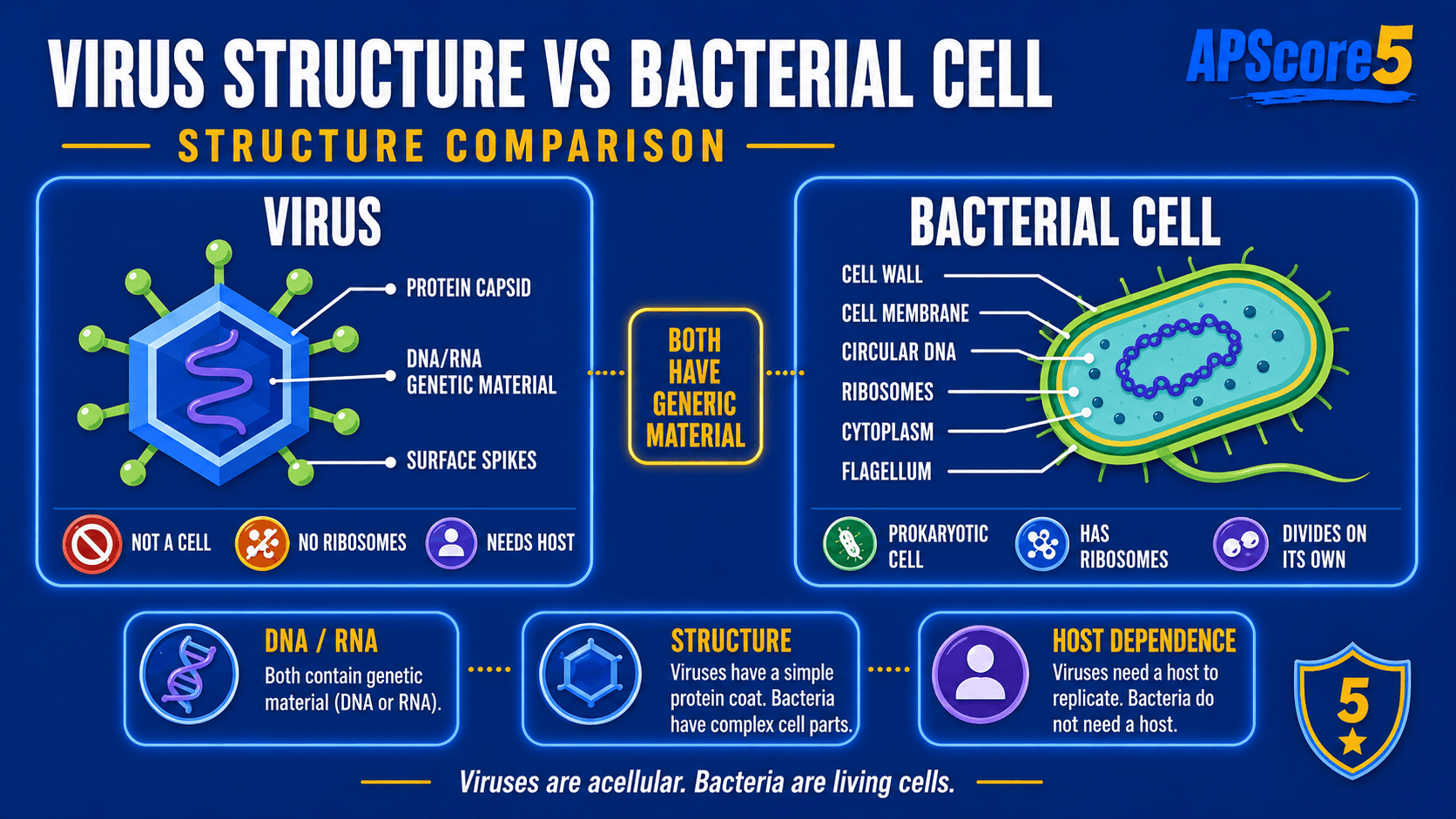
| Structure | Bacteria | Viruses |
|---|---|---|
| Genetic material | DNA | DNA or RNA |
| Protective covering | Cell wall and cell membrane | Protein capsid, sometimes envelope |
| Ribosomes | Yes | No |
| Cytoplasm | Yes | No |
| Cell membrane | Yes | Some have an envelope, but not a true cell membrane |
| Cellular structure | Prokaryotic cell | Not a cell |
Key point: the biggest structural similarity is that both contain genetic material and have a protective outer layer. The biggest difference is that bacteria are cells and viruses are not.
How are bacteria and viruses different?
The keyword asks about similarities, but AP Biology students need the contrast to avoid wrong answer choices. If a multiple-choice option says viruses have ribosomes, cytoplasm, or independent metabolism, reject it.
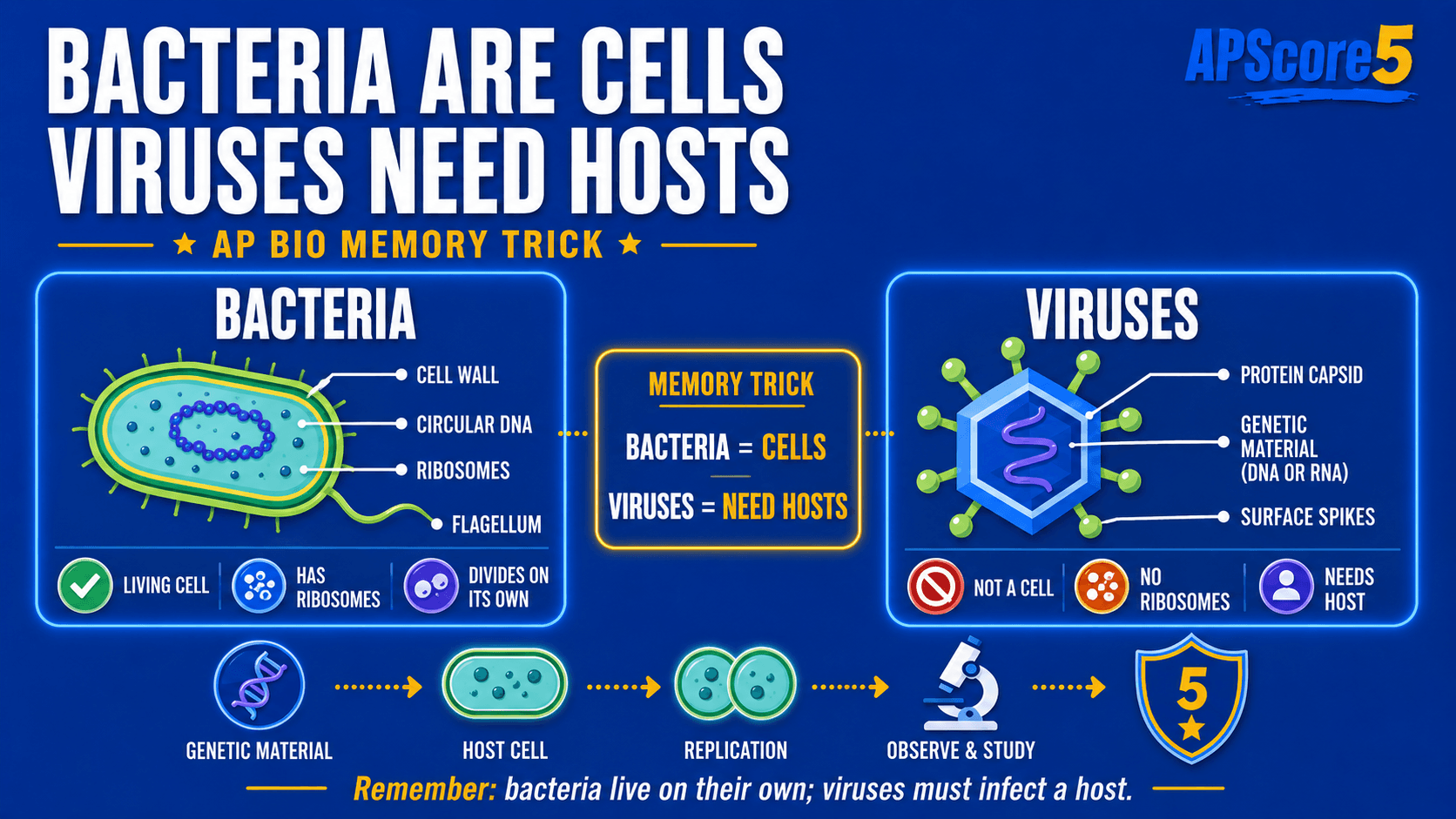
| Feature | Bacteria | Viruses |
|---|---|---|
| Living or nonliving? | Living organisms | Usually considered nonliving |
| Cell type | Prokaryotic cell | Not a cell |
| Genetic material | DNA | DNA or RNA |
| Reproduction | Binary fission | Requires host cell |
| Ribosomes | Present | Absent |
| Metabolism | Yes | No independent metabolism |
| Treated with antibiotics? | Sometimes | No |
| Size | Larger | Smaller |
The biggest AP Biology difference
Bacteria can reproduce independently by binary fission. Viruses cannot reproduce without a host cell. That one contrast explains many other differences: bacteria have ribosomes and metabolism; viruses use host ribosomes and host energy.
Why are viruses not considered living cells?
Viruses are not considered living cells because they fail major cell-theory criteria. They are not made of cells, do not have cytoplasm, lack ribosomes, and cannot reproduce independently. They can evolve, but evolution alone does not make something a cell.
| Virus feature | Why it matters |
|---|---|
| No cytoplasm | They are not organized like cells. |
| No ribosomes | They cannot make proteins alone. |
| No independent metabolism | They do not use energy like cells. |
| Cannot reproduce independently | They need a host cell. |
| Not made of cells | This violates cell theory. |
What do all viruses have in common?
The phrase what do all viruses have in common shifts the comparison away from bacteria and asks about viral features only. All viruses have genetic material, a protein capsid, dependence on a host cell, the ability to evolve, and a host range that limits which cells they infect.
| Feature | Description |
|---|---|
| Genetic material | DNA or RNA |
| Protein capsid | Protective protein coat |
| Host dependence | Need a host cell to reproduce |
| Ability to evolve | Mutations can lead to variation |
| Specific host range | Many viruses infect specific cell types |
Connect back: viruses and bacteria both have genetic material and can evolve, but only bacteria are complete living cells. For a broader Unit 6 overview, review viruses and bacteria in AP Biology, then use the AP Biology viruses key concepts page for a virus-only review.
What are three things bacteria and viruses have in common?
If a prompt asks for three shared traits, choose answers that are true for both groups without accidentally treating viruses like cells. The strongest three are genetic material, evolution, and host interaction. Each one lets you write a complete AP Biology explanation instead of a single vocabulary word.
| Shared trait | Exam-ready explanation |
|---|---|
| Genetic material | Bacteria use DNA; viruses use DNA or RNA, so both can carry heritable information. |
| Evolution | Mutations can create variation, and selection can favor traits that improve survival or transmission. |
| Host interaction | Both can affect living organisms and trigger cellular or immune responses. |
A weaker answer would say both reproduce, because that wording hides the difference. Bacteria reproduce by binary fission; viruses replicate only after entering a host cell. If you mention reproduction, write the contrast in the same sentence.
Why do antibiotics work on bacteria but not viruses?
Antibiotics reveal one of the clearest differences between bacteria and viruses. Many antibiotics target bacterial structures or processes, such as cell wall synthesis, bacterial ribosomes, or DNA replication enzymes. Those targets exist in bacteria because bacteria are cells with their own metabolism and protein-synthesis machinery.
Viruses do not have cell walls, cytoplasm, ribosomes, or independent metabolism. A virus inside a host cell uses host machinery, so an antibiotic that blocks bacterial ribosomes will not automatically stop a virus. Antiviral drugs must target viral entry, genome copying, protease activity, reverse transcriptase, or release of new viral particles.
For AP Biology, the treatment question is really a structure question. If a drug works on a structure viruses lack, it will not treat viral infections. This is why the statement \"antibiotics treat viruses\" is a common distractor.
How can bacteria and viruses both spread between organisms?
Bacteria and viruses can both move between hosts through respiratory droplets, contaminated food or water, blood and body fluids, surfaces, or biological vectors such as ticks and mosquitoes. The shared idea is transmission: a pathogen or infectious particle moves from one organism or environment to another.
The biology after transmission is different. A bacterium that reaches a suitable environment may divide, use nutrients, and produce toxins or other molecules that affect tissues. A virus must attach to a compatible host cell, enter it, release genetic material, and redirect host machinery toward viral replication.
That distinction helps you handle scenario questions. If the prompt emphasizes growth on a nutrient plate, binary fission, or antibiotic sensitivity, think bacteria. If it emphasizes host receptors, capsids, viral genomes, or use of host ribosomes, think virus.
How does this connect to gene expression and regulation?
This topic belongs in Unit 6 because both bacteria and viruses help students reason about genetic information. Bacteria show how prokaryotic cells regulate genes through operons, reproduce by binary fission, and gain variation through transformation, transduction, or conjugation. Viruses show how genetic material can redirect a host cell's transcription and translation systems.
When a viral genome enters a host cell, the outcome depends on gene expression. Viral genes may be transcribed into RNA, translated into capsid proteins or enzymes, and assembled into new viral particles. In retroviruses, RNA is copied into DNA first, which is why the central dogma is often tested alongside viruses.
A strong answer connects structure to mechanism: viruses lack ribosomes, so they depend on host ribosomes for translation. Bacteria have ribosomes, so they can express their own genes and divide independently. That is the Unit 6 reason this comparison matters.
How should you write this comparison on an AP Biology FRQ?
Use a two-column mental model. In the first column, list the shared trait. In the second column, explain the different mechanism. This prevents vague answers such as \"both are germs\" or \"both make people sick,\" which are too casual for AP Biology scoring.
For example, write: \"Both bacteria and viruses contain genetic material, but bacteria are prokaryotic cells with DNA, cytoplasm, and ribosomes, while viruses contain DNA or RNA inside a capsid and depend on host cells.\" That sentence gives the similarity and the contrast in one move.
If the question asks whether viruses are living, do not focus only on disease. State that viruses can evolve and contain genetic material, but they lack cellular organization, independent metabolism, and independent reproduction. If the question asks about bacteria, emphasize prokaryotic cell structure, binary fission, and gene regulation.
AP Biology example: bacteria vs virus questions
Choose an answer to reveal feedback. The explanation stays hidden until you select an option.
Question 1
A student claims that bacteria and viruses are similar because both can reproduce on their own and both contain ribosomes. Is the student correct?
Question 2
Which feature is shared by bacteria and viruses?
Question 3
Why do antibiotics treat many bacterial infections but not viral infections?
Question 4
A virus enters a host cell and uses host ribosomes to make capsid proteins. Which AP Biology idea is most directly involved?
Question 5
Which statement best explains why viruses can evolve even though they are usually considered nonliving?
Common student mistakes
| Mistake | Correction |
|---|---|
| Thinking all bacteria are harmful | Many bacteria are beneficial. |
| Thinking viruses are cells | Viruses are not made of cells. |
| Thinking antibiotics treat viruses | Antibiotics target bacteria, not viruses. |
| Thinking viruses have ribosomes | Viruses lack ribosomes. |
| Thinking bacteria and viruses reproduce the same way | Bacteria divide; viruses replicate using host cells. |
How to avoid the traps
Before choosing an answer, ask three questions: Is this agent a cell? Does it have ribosomes? Can it reproduce independently? Bacteria answer yes to all three. Viruses answer no to all three, even though they can contain genes and evolve.
Simple memory trick
Bacteria are living cells. Viruses are genetic instructions in a protein package.
That does not mean viruses are simple or unimportant. It means they depend on host cells to carry out processes that bacteria can perform on their own. When you see a prompt about viral replication, think host machinery; when you see binary fission, ribosomes, cytoplasm, or metabolism, think bacteria.
FAQs
What do bacteria and viruses have in common?
Bacteria and viruses both contain genetic material, can cause disease, can evolve, interact with host cells, and can trigger immune responses.
What do viruses and bacteria have in common structurally?
Both have genetic material and some type of protective outer structure. Bacteria have a cell wall and membrane, while viruses have a protein capsid and sometimes an envelope.
Are bacteria and viruses both living?
No. Bacteria are living prokaryotic cells. Viruses are usually considered nonliving because they are not cells and cannot reproduce without a host.
Can bacteria and viruses both cause infections?
Yes. Both can cause infections, but they do so in different ways. Bacteria can grow and divide independently, while viruses must infect host cells.
Do bacteria and viruses both have DNA?
Bacteria have DNA. Viruses may have DNA or RNA depending on the virus.
Do antibiotics work on both bacteria and viruses?
No. Antibiotics work against many bacterial infections, but they do not treat viral infections.
Final AP Bio takeaway
Bacteria and viruses have several things in common: both contain genetic material, can cause disease, evolve, spread between hosts, and interact with cells. But the most important AP Biology distinction is that bacteria are living prokaryotic cells, while viruses are noncellular particles that must use host cells to reproduce.
For exam questions, write the comparison as a two-part answer: first name the shared feature, then state the cell-based difference. That habit keeps you from choosing tempting answers that treat viruses like small bacteria.