
What are viruses and bacteria in AP Biology?
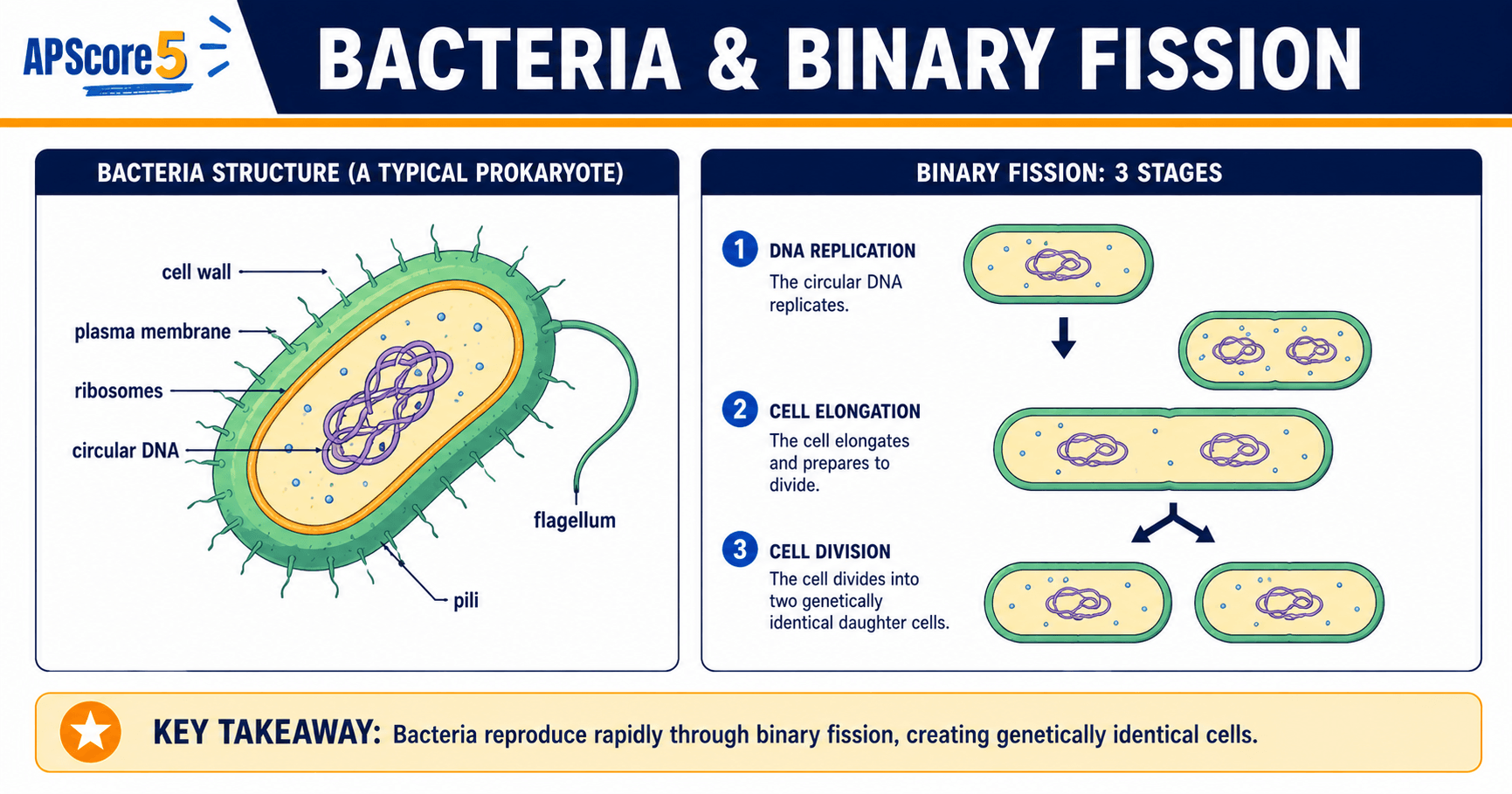
Viruses and bacteria both affect living organisms, but they are very different. Bacteria are living prokaryotic cells with DNA, ribosomes, metabolism, and binary fission. Viruses are nonliving infectious particles made of genetic material inside a protein capsid. They cannot reproduce without a host cell.
In one sentence: Bacteria are living prokaryotic cells that reproduce independently, while viruses are nonliving infectious particles that must hijack host cells to replicate.
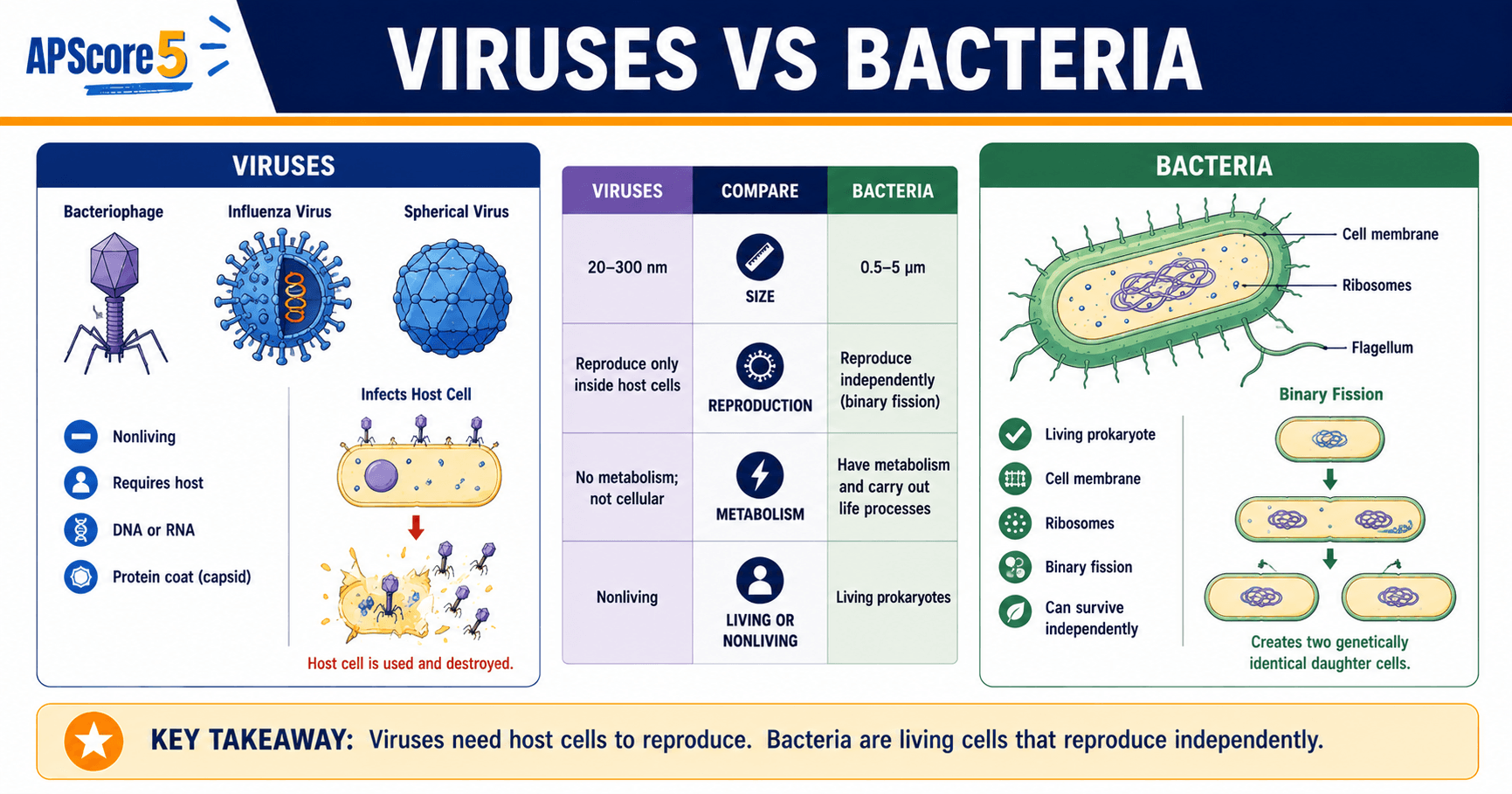
Plain-language snapshot
- Viruses are not cells.
- Viruses need host machinery to replicate.
- Bacteria are prokaryotic cells.
- Bacteria reproduce by binary fission.
- Bacteria gain variation through transformation, transduction, and conjugation.
- Operons regulate bacterial gene expression.
Viruses vs bacteria AP Biology — at a glance
Key idea: Use this virus and bacteria difference snapshot when a stimulus asks whether something is cellular or infectious.
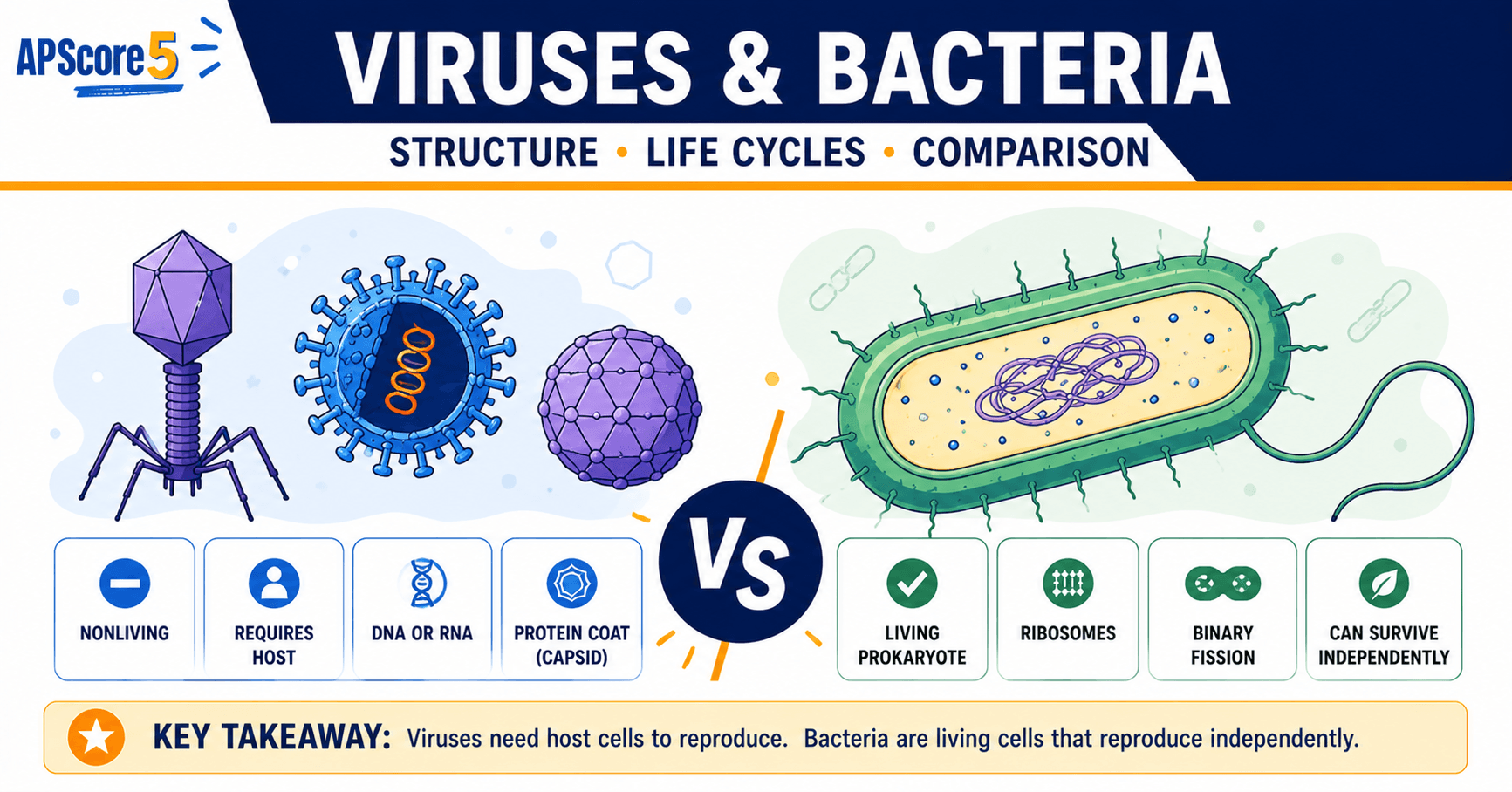
Use this viruses vs bacteria AP Biology table to compare structure, reproduction, and genetic material.
If a prompt asks for shared traits before differences, use the focused guide to what bacteria and viruses have in common to separate overlap from the cell-versus-noncell distinction.
| Feature | Bacteria | Viruses |
|---|---|---|
| Living? | Yes — meets standard cell-based life criteria | No — cannot reproduce alone |
| Cellular structure | Prokaryotic cell with cytoplasm, ribosomes, cell wall | No cells — nucleic acid + capsid (sometimes envelope) |
| Genetic material | Circular DNA chromosome + plasmids | DNA or RNA; single- or double-stranded |
| How they reproduce | Binary fission (asexual) | Hijack host — lytic or lysogenic cycle |
| Size | About 1–10 micrometers | About 20–300 nanometers (much smaller) |
Why the comparison matters: the living versus nonliving distinction is the most-tested single fact about viruses on the AP Biology exam. Memorize it. The cellular versus noncellular distinction is a close second.
Viral genes still borrow host transcription and translation—map hijacking stories onto the transcription mechanism step list before you explain polymerase placement.
Finished virions export proteins built the same way as enzymes you decode on translation at ribosomes, even though viruses lack their own ribosomes.
Need the whole DNA→RNA→protein arc in order? Skim what comes first transcription or translation before you sketch lytic timelines.
How are viruses different from bacteria?
For viruses vs bacteria AP Biology MCQs, start with one fact: bacteria are alive; viruses are not.
Key idea: Bacteria are complete cells with metabolism, nutrients, responses, and independent reproduction. AP trap: size alone never proves life—focus on metabolism and autonomous reproduction.
Viruses are particles that cannot reproduce without invading a host cell first.
Bacteria are cellular
They have a plasma membrane, cytoplasm, ribosomes, peptidoglycan cell walls, and a circular DNA chromosome in the nucleoid. Many carry plasmids.
Viruses are not cellular
A virion packages nucleic acid inside a protein capsid. Some animal viruses steal an envelope from host membranes.
Bacteria reproduce alone
Binary fission copies DNA and splits one cell into two daughters—no host required.
Viruses require hosts
Viral genes program new particles, but viruses lack metabolism, ribosomes, and polymerases suited for independent replication.
Bacteria use DNA genomes
Chromosomal DNA is double-stranded and circular in typical AP contexts.
Viruses vary genome chemistry
Phages may use DNA; influenza, coronaviruses, and HIV illustrate RNA strategies.
Are viruses living or nonliving?
Most biologists answer no. Compare traits directly:
| Criterion | Bacteria | Viruses |
|---|---|---|
| Cellular structure | Yes | No |
| Metabolism | Yes | No |
| Independent reproduction | Yes | No — needs host |
| Response & homeostasis | Yes | No |
| Genetic material | Yes | Yes |
| Evolution by selection | Yes | Yes |
Viruses satisfy genetic material plus evolution, not cell metabolism or autonomous reproduction—so AP Biology treats them as nonliving particles.
Common trap: Antibiotics can treat many bacterial infections, but they do not kill viruses.
Common trap: Viruses can evolve, but they are still not considered cellular life.
Exam cue: Distractors often list life traits and ask what viruses lack—pick metabolism or independent reproduction.
How does viral replication work?
Viruses replicate through lytic or lysogenic pathways that share early steps—attachment and entry—then diverge.
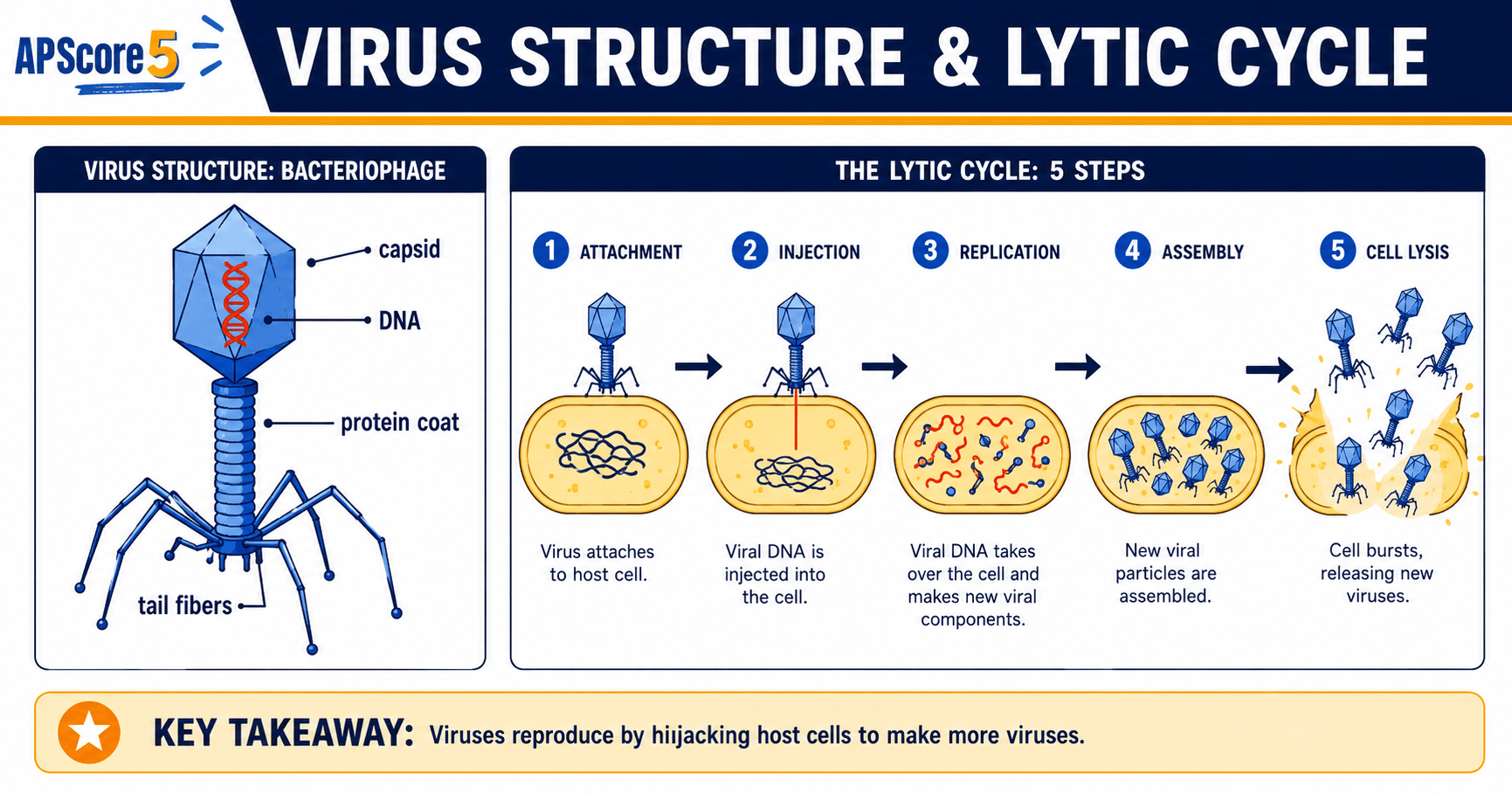
- Attachment: Viral proteins bind host receptors; specificity decides which species or tissues get infected.
- Penetration / injection: Phages inject nucleic acid through cell walls; enveloped viruses often fuse membranes.
- Replication and synthesis: Viral genes redirect ribosomes, nucleotides, and amino acids toward viral parts.
- Assembly: Genomes package into capsids; many virions accumulate inside one cell.
- Lysis: The cell bursts, releasing virions to infect neighbors.
The lytic route is fast and lethal—think many acute infections and classic phage labs.
For a virus-only walkthrough of capsids, envelopes, host dependence, and replication steps, review the AP Biology viruses key concepts support page after this section.
Lytic vs lysogenic cycle AP Biology explained
The lysogenic cycle integrates viral DNA into host chromosomes and waits instead of lysing immediately.
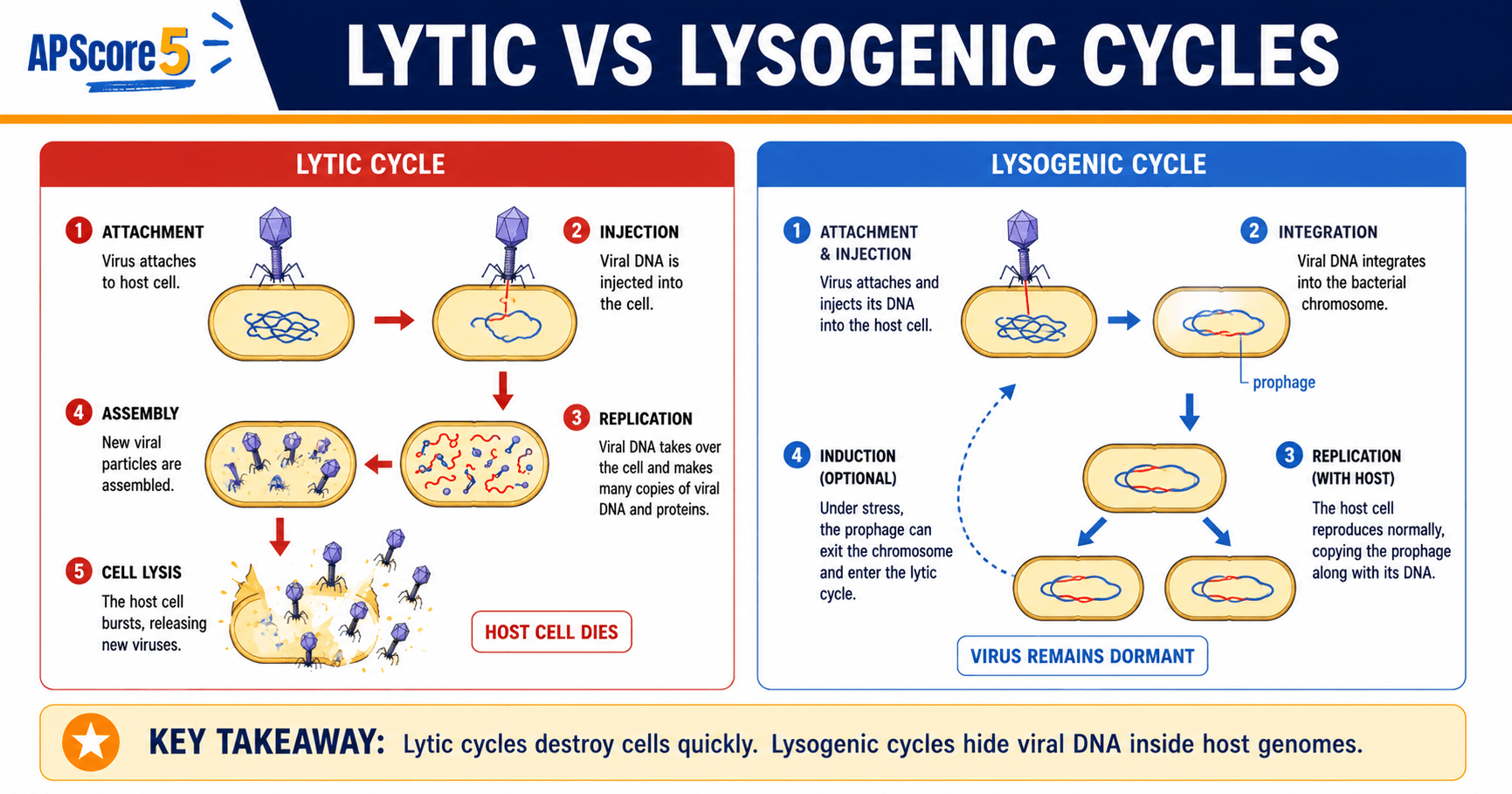
This lytic vs lysogenic cycle AP Biology comparison distinguishes immediate viral replication from dormant viral DNA integration.
| Stage | Lytic cycle | Lysogenic cycle |
|---|---|---|
| Attachment | Virus binds host | Virus binds host |
| Penetration | Genome enters cytoplasm | Genome enters cytoplasm |
| Next step | Immediate replication | Genome integrates as prophage |
| Host fate | Rapid death via lysis | Survives; daughter cells inherit prophage |
| Outcome | Many virions released | Dormancy; may induce lytic burst later |
| Timing | Hours | Can last years |
| Examples | T4 phage, common cold viruses | λ phage, herpes, HIV provirus stage |
Induction: Stress such as UV light can excise a prophage and restart lytic replication—linking environmental cues to outbreaks.
AP reasoning: Lysogeny trades immediate burst size for survival during harsh conditions.
If you want a faster study pass before the MCQs, use the AP Biology virus review guide for structure, replication, and exam-takeaway wording.
Retrovirus reverse transcriptase, HIV, and the central dogma
Retroviruses (including HIV) carry RNA but build DNA first using reverse transcriptase, reversing the usual DNA→RNA→protein flow—a flagship retrovirus reverse transcriptase HIV storyline on the exam.
- HIV binds CD4 on helper T cells.
- Envelope fusion delivers the RNA genome.
- Reverse transcriptase copies RNA into DNA.
- Viral DNA integrates as a provirus.
- Host enzymes transcribe viral genes and translate proteins.
- New virions assemble and spread; CD4 counts fall over years.
This matters for AP Biology Unit 6 biotechnology labs because reverse transcription also powers cDNA workflows.
How do bacteria reproduce and gain genetic variation?
Key idea: Binary fission clones cells quickly but does not shuffle alleles like meiosis.
Common trap: Binary fission creates clones unless mutations or horizontal gene transfer introduce variation.
Bacterial transformation transduction conjugation move DNA between cells—preview those pathways before the cards below.
Transformation
Cells import naked DNA from lysed neighbors—Griffith’s bacterial strains highlighted this pathway historically.
Transduction
Phage particles accidentally package bacterial DNA and donate it to the next infection.
Conjugation
A pilus bridges cells so plasmids such as the F factor copy into recipients. Lab plasmids use the same DNA-transfer logic—see the biotechnology AP Biology guide for PCR, gels, and transformation.
Why exam writers care
Resistance plasmids spread faster under antibiotic selection—preview AP Biology Unit 7 natural selection reasoning.
What is an operon? Lac operon vs trp operon
An operon bundles prokaryotic genes into one transcription unit with shared promoter/operator control.
- Promoter: RNA polymerase landing zone.
- Operator: DNA switch region where repressors bind.
- Structural genes: enzymes for one metabolic story.
lac operon — inducible (default OFF)
Without lactose, the lac repressor sits on the operator. When allolactose binds the repressor, it releases, RNA polymerase proceeds, and lactose-processing enzymes appear.
trp operon — repressible (default ON)
Low tryptophan keeps synthesis genes active. High tryptophan activates the repressor (corepressor scenario) so the operator blocks transcription.
Common trap: The lac operon turns on when lactose is available; the trp operon turns off when tryptophan is abundant.
This lac operon vs trp operon AP Biology table compares inducible and repressible gene regulation.
| Operon | Regulates | Default | Signal effect | Purpose |
|---|---|---|---|---|
| lac | Lactose breakdown | OFF | Lactose turns genes ON | Save ATP without substrate |
| trp | Tryptophan synthesis | ON | Tryptophan turns genes OFF | Stop making excess amino acid |
Negative regulation recap: both rely on repressors blocking operators—lac waits for substrate; trp listens for product abundance.
Real-world examples of viruses and bacteria
Use this virus and bacteria difference quick-reference list when a stimulus names a pathogen and you must classify structure, genome type, or cycle.
| Microbe | Type | Why it matters |
|---|---|---|
| HIV | Retrovirus | Reverse transcriptase story; immune targeting |
| SARS-CoV-2 | RNA virus | Spike-receptor binding; vaccine antigen design |
| Influenza | RNA virus | Antigenic drift and shift narratives |
| T4 phage | DNA virus | Classic lytic diagram |
| λ phage | DNA virus | Lysogeny and induction lab model |
| Herpes simplex | DNA virus | Latency and recurrence |
| E. coli | Bacterium | lac operon reference strain |
| S. pneumoniae | Bacterium | Griffith transformation |
| M. tuberculosis | Bacterium | Resistance evolution case studies |
| Cyanobacteria | Bacterium | Photosynthesis and Earth history tie-ins |
Biotechnology contexts revisit these microbes when cloning into plasmids or expressing human insulin in bacterial hosts—follow the AP Biology course overview for lab-heavy units.
Test yourself in 5 seconds
Which of the following is the BEST evidence that viruses are NOT alive?
How viruses and bacteria appear on the AP Biology exam
This microtopic routinely feeds multiple MCQs and FRQ parts across gene expression prompts.
AP Exam Answer Template
Viruses are not considered living because they lack cellular structure, metabolism, and independent reproduction. Bacteria are living prokaryotic cells with DNA, ribosomes, metabolism, and binary fission.
Score booster: Pair every virus prompt with “needs host machinery,” and every bacterium prompt with “has ribosomes + independent replication.”
In multiple-choice questions
- Identify missing life traits for viruses.
- Predict lac operon behavior when lactose binds repressors.
- Name reverse transcriptase chemistry.
- Distinguish horizontal gene transfer from binary fission.
In free-response questions
- Antibiotic kill curves plus conjugation scenarios.
- Operon diagrams with mutations.
- Lytic versus lysogenic predictions.
- Retrovirus integration explanations.
Common stimulus types
Operon cartoons, phage life cycles, growth tables, replication curves, phylogenies with bacterial clades.
AP writing formula
Identify → explain mechanism → predict outcome → connect to evolution, regulation, or central dogma exceptions.
Example sentence: “RNA polymerase accesses the lac genes because allolactose removes the repressor from the operator, so β-galactosidase rises—classic inducible regulation when lactose is present.”
Viruses vs bacteria comparison table
Use this master viruses vs bacteria AP Biology sheet when a stimulus lists antibiotics, vaccines, size, or genome type—tie each row back to living vs nonliving logic.
| Feature | Bacteria | Viruses |
|---|---|---|
| Living? | Yes | No |
| Cellular | Yes (prokaryotic) | No |
| Size | 1–10 μm | 20–300 nm |
| Genetic material | DNA chromosome + plasmids | DNA or RNA |
| Reproduction | Binary fission | Lytic / lysogenic |
| Metabolism | Yes | No |
| Ribosomes | Yes | No |
| Peptidoglycan wall | Yes | No |
| Variation sources | Mutation, transformation, transduction, conjugation | Mutation, recombination during infection |
| Antibiotics | Often effective | Not targeted by classic antibacterial drugs |
| Vaccines | Some bacterial vaccines exist | Many antiviral vaccines focus on viral proteins |
| Natural selection | Yes | Yes |
| AP units | Unit 6 & 7 links | Unit 6 replication stories |
Common AP Bio mistakes about viruses and bacteria
- Calling viruses alive—cite metabolism and autonomous reproduction gaps.
- Swapping lytic speed with lysogenic dormancy.
- Claiming eukaryotes use operons—they do not.
- Mixing inducible lac with repressible trp logic.
- Saying antibiotics cure viral infections—they do not.
- Forgetting retroviruses violate the simple central dogma.
- Labeling binary fission as sexual—it is asexual; variation needs HGT pathways.
Why this topic belongs in AP Biology Unit 6
Unit 6 (Gene Expression and Regulation) explains DNA→RNA→protein flows and how cells tune them.
- Bacterial operons deliver crisp regulation stories.
- Viruses hijack transcription and translation machinery.
- Retroviruses showcase enforced exceptions to linear central dogma sketches.
- Plasmids and transformation underpin recombinant DNA labs.
For signaling overlaps, compare viral attachment with ligand specificity in AP Biology Unit 4 cell communication.
Long-session study guide for viruses and bacteria
Decode stimuli & diagrams
Why viruses vs bacteria framing matters
Unit 6 connects molecular mechanics to exam prompts. When you read stimulus labels about infection, regulation, or horizontal transfer, you are usually deciding whether the scenario involves autonomous cellular machinery or borrowed host machinery. That distinction predicts which answer choices are even eligible.
Reading bacteriophage diagrams quickly
- Attachment: host specificity lives at the receptor.
- Entry: injection versus fusion.
- Outcome: replication now (lytic) versus genome tucked in host DNA with survival (lysogenic).
If you see a straight line to bursting, call lytic; if integrated DNA persists, call lysogenic.
Central dogma exceptions as a checklist
- RNA → DNA appears → flag reverse transcriptase.
- Viral proteins without viral ribosomes → flag stolen host ribosomes.
Those two checks resolve many distractors about enzymes or organelles viruses do not possess.
Operons as efficiency machines
Bacteria batch transcription because transcription–translation coupling rewards speed. Repression at the operator is negative regulation in both classic stories: lac turns useful genes on when substrate exists; trp turns synthesis off when product piles up.
FRQ habit: name default states before you narrate the signal.
Drugs, scale & surfaces
Antibiotics versus antivirals
Antibiotics target bacterial structures like peptidoglycan or prokaryotic ribosomes. Viruses lack those targets, so questions about treating influenza with penicillin-class drugs are testing basic mechanism boundaries. Keep that boundary tight even when symptoms feel similar in everyday language.
Vaccine versus antimicrobial nuance
- Vaccines: train immunity with antigens.
- Antibiotics: kill or slow bacteria.
- Antivirals: target viral enzymes or entry.
Use precise vocabulary—e.g. neutralizing antibodies when prompts involve spike epitopes.
Size scales that silence silly distractors
Viruses are tens to hundreds of nanometers; bacteria are micrometers. Filters that retain bacteria may still pass virions. Items about filtration or microscopy hinge on those orders of magnitude.
Envelope versus naked virus defenses
Enveloped viruses rely on membrane fusion; detergent-sensitive surfaces hint at envelopes in experimental stems. Naked capsids resist alcohol differently on surfaces—exam prompts rarely demand disinfectant chemistry but may ask why enveloped viruses behave distinctly when membranes perturb.
Classic mechanisms
Laboratory anchors
Griffith used rough and smooth pneumococcus to argue for a transforming principle—modern framing calls it transformation. Hershey-Chase reinforced nucleic acid as hereditary material for phage. You do not need lab trivia dates; you need cause-effect verbs that match those experiments.
HIV sequence as an ordered chain
- Bind → fuse → reverse transcribe → integrate → transcribe → translate → assemble → exit.
If an FRQ scrambles the order, reorder using gates: integration requires DNA; translation requires mRNA.
Population thinking & horizontal transfer
Binary fission yields clones until mutation or horizontal transfer intervenes.
- Conjugation: plasmids through a pilus.
- Transduction: bacterial DNA inside phage particles.
- Transformation: naked DNA from lysed neighbors.
Stress-induced induction
UV or chemical stress can induce prophage excision because switches sense host viability. Link stress to fitness reasoning without inventing molecular detail beyond course expectations: temperate phages wait for productive bursts.
Writing prompts about promoters & operators
When stems mutate promoters or operators, predict polymerase access before you narrate activators. If RNA polymerase cannot bind, genes stay silent regardless of small molecules; if repressors cannot bind operators, genes may run constitutively and waste ATP.
Mutations in lacI versus lacO
Repressor mutations versus operator mutations produce distinct phenotypes: defective repressors fail everywhere; operator mutations block docking even when repressor molecules remain abundant. Practice predicting ON versus OFF states before answering.
lac operon beyond lactose alone
cAMP–CRP themes occasionally ride alongside lactose stories—positive regulation boosts polymerase recruitment when glucose is low even before lactose logic executes. If a stimulus pairs glucose restriction with lactose addition, mention layered regulation carefully without inventing numbers.
Lysogenic switching vocabulary
Excision, circularization, and packaging verbs belong to induced prophage narratives. If FRQs ask why temperate phages persist in harsh environments, emphasize reversible dormancy and broader dispersal after induction.
Plasmid conjugation vs chromosome transfer
Chromosomal DNA rarely conjugates wholesale via simple F+ setups unless integrated fertility factors rearrange into Hfr strains—outside everyday AP drills but worth recognizing when prompts explicitly describe prolonged mating experiments.
Numeric instincts for growth curves
When graphs compare infected versus uninfected cultures, ask whether the curve shows latent replication inside cells versus extracellular counts. Flat bacterial growth paired with rising viral titer often signals intracellular assembly before burst.
Connections across units
Connecting Unit 4 signaling
Viral attachment mimics ligand-receptor recognition. Mention specificity when prompts compare susceptible versus resistant cells—without drifting away from Unit 6 mechanisms.
Connecting Unit 7 evolution
Resistance alleles on plasmids spread faster under antibiotic selection. Tie conjugation to increased allele frequency when stems describe hospitals or agricultural antibiotic use.
Exam craft & precision
Practice translating molecular verbs
Say binds, sterically blocks, recruits polymerase, terminates transcription—not vague “regulates.” Each verb ties to a molecular interaction graders expect.
Exam pacing when stimuli stack
Skim figure captions before slow paragraph reads—captions often declare molecule identities missing from prose. Underline enzymes once per stimulus so polymerases do not blur together.
Host restriction as experimental logic
Restriction enzymes defend bacteria against foreign DNA; cloning pipelines tweak methylation or select strains lacking enzymes so recombinant plasmids survive. Mention enzymes only when stems reference cutting at palindromes.
Bioinformatics bridges
Reverse transcriptase powered cDNA libraries connect to sequencing pipelines—when FRQs mention converting mRNA into DNA libraries, tie the enzyme explicitly rather than vague “processing” language.
Capsid symmetry (optional depth)
Many textbooks mention helical versus icosahedral capsids; AP rarely demands geometry proofs. Mention symmetry only when stimuli label diagrams—prioritize replication cycles and tropism.
Endotoxin versus exotoxin guardrail
Gram-negative membranes release endotoxin LPS when lysed; some pathogens secrete exotoxin proteins. Viral stems rarely hinge on this, but bacterial clearance items sometimes do—match vocabulary to the stimulus.
Spontaneous mutation vs selection
Mutation supplies raw variation slowly; selection amplifies resistant clones quickly after antibiotics apply pressure. Frame antibiotic narratives with both supply and sorting so graders see full reasoning.
Checkpoint before you submit
Reread your FRQ focusing on verbs—each sentence should tie to polymerases, repressors, receptors, or membrane events when the prompt demands mechanisms. If a sentence could describe sociology instead of molecules, rewrite with concrete actors.
Latency vocabulary (enveloped viruses)
Some enveloped viruses persist in neurons or lymphocytes across dormancy windows analogous in timing to lysogeny, though mechanics differ. Reserve “lysogenic” for integrated prophage DNA in bacteria unless the stem describes integrated viral genomes in eukaryotes.
Study cadence
- Monday: short quiz on definitions.
- Wednesday: timed MCQs + error log.
- Friday: FRQ outline, not full prose.
- Weekend: flashcards for missed IDs only.
Under timed pressure, use one loop: label the biological actor (virus, bacterium, enzyme), name the interaction (binds, blocks, integrates), then connect to outcome (expression on/off, resistance spread, or burst timing). That sequence matches how AP rubrics reward mechanism language without padding.
Viruses and bacteria flashcards
Every fifth card advance triggers an ad placeholder with a three-second countdown before the next card appears.
Viruses and bacteria AP Biology practice questions
Viruses and bacteria FRQ practice
Prompt: Researchers study E. coli carrying an operator mutation that prevents the lac repressor from binding. Cultures grow in (1) glucose without lactose or (2) lactose without glucose.
- (A) Define operon, operator, and repressor.
- (B) Predict lac transcription in condition (1) and justify mechanistically.
- (C) Predict lac transcription in condition (2) and justify mechanistically.
- (D) Explain how the mutation helps or hurts fitness depending on environment.
Sample 4-point response
(A) An operon groups bacterial genes transcribed together; the operator sits near the promoter as a repressor docking site; the repressor protein blocks RNA polymerase progress when bound.
(B) Transcription stays ON without lactose because the mutated operator cannot trap the repressor, so polymerase accesses structural genes even though glucose-only medium would normally favor shutting unnecessary lactose enzymes.
(C) Transcription also proceeds with lactose present because repressor binding was the limiting step—lactose binding becomes irrelevant once the operator cannot interact.
(D) On lactose-rich medium constitutive expression can help cells harvest sugar instantly; on glucose-only medium wasting ATP on unused enzymes lowers fitness—selection favors tight regulation when environments fluctuate.
Rubric: 1 pt precise definitions · 1 pt condition (1) prediction + mechanism · 1 pt condition (2) prediction + mechanism · 1 pt trade-offs tied to selection.
Viruses and bacteria AP Biology FAQ
What is the difference between viruses and bacteria?
Bacteria are living prokaryotic cells with metabolism and binary fission. Viruses are nonliving infectious particles (genetic material in a capsid) that replicate only inside hosts. Bacteria are typically about 100× larger than viruses.
Are viruses living or nonliving?
AP Biology treats viruses as nonliving: no cells, metabolism, or independent reproduction. They have genetic material and can evolve. Standard life criteria stress cellular organization and autonomous replication—viruses fail those tests.
What is the difference between the lytic and lysogenic cycle?
Lytic: replicate immediately and lyse the host. Lysogenic: viral DNA integrates as a prophage and may stay dormant for years before inducing lytic replication.
How do bacteria reproduce?
Asexually by binary fission—one cell copies its chromosome and splits into two daughters (clones). New alleles come from mutation plus transformation, transduction, and conjugation.
What is an operon?
A cluster of bacterial genes transcribed together from one promoter with a shared operator. Prokaryotes only. lac is inducible; trp is repressible.
How is the lac operon different from the trp operon?
lac is inducible—often OFF until lactose removes the repressor. trp is repressible—often ON until abundant tryptophan activates the repressor to shut transcription off.
How do retroviruses like HIV work?
RNA genome plus reverse transcriptase makes DNA that integrates into host chromosomes; the host builds new virions. HIV infects CD4 helper T cells and weakens immunity over time.
What are the three ways bacteria gain genetic variation?
Transformation: uptake of free DNA. Transduction: bacteriophage moves DNA between cells. Conjugation: plasmid transfer through a pilus.
Why is HIV called a retrovirus?
It reverses the usual DNA→RNA flow: reverse transcriptase copies RNA into DNA before integration and expression—a central dogma exception.
Are bacteriophages viruses?
Yes—viruses that infect bacteria (phages). T4 typifies the lytic cycle; λ phage models lysogeny and induction.
Why is this topic in Unit 6 of AP Biology?
Unit 6 is gene expression and regulation: operons simplify prokaryotic control; viruses hijack transcription and translation; retroviruses extend central-dogma exceptions; transformation and plasmids underpin biotechnology labs.