What is the essential AP Biology virus review?
AP Biology virus review comes down to this: viruses are noncellular particles with DNA or RNA inside a protein capsid, and they require host cells to reproduce. For Unit 6, connect viral structure to host-cell gene expression, lytic and lysogenic replication, mutation, natural selection, and immune recognition.
AP Virus Shortcut
- Viruses are not cells.
- Viruses contain DNA or RNA.
- Viruses lack ribosomes.
- Viruses use host cells to reproduce.
- Lytic = fast replication + lysis.
- Lysogenic = viral DNA hides in the host genome.
Quick answer: what is a virus in AP Biology?
A virus is a noncellular infectious particle made of genetic material surrounded by a protein coat. Some viruses also have an outer membrane-like envelope.
| Virus Feature | What It Means |
|---|---|
| Genetic material | DNA or RNA that carries viral instructions. |
| Protein capsid | Protective protein coat around the genetic material. |
| Host-cell dependence | Viruses must use a living host cell to reproduce. |
The most important AP Biology point is this: viruses are not made of cells and cannot reproduce independently. That is why many biology courses describe viruses as nonliving or not fully living.
Are viruses living or nonliving?
Direct answer: AP Biology usually treats viruses as nonliving because they are not cells and cannot reproduce without a host.
Viruses are usually considered nonliving because they do not meet the full requirements of life. They do have genetic material, and they can evolve over time, but they cannot reproduce without a host cell.
| Life Process | Do Viruses Do This Independently? |
|---|---|
| Have cells | No |
| Have cytoplasm | No |
| Have ribosomes | No |
| Carry out metabolism | No |
| Maintain homeostasis | No |
| Reproduce on their own | No |
What are viruses made of?
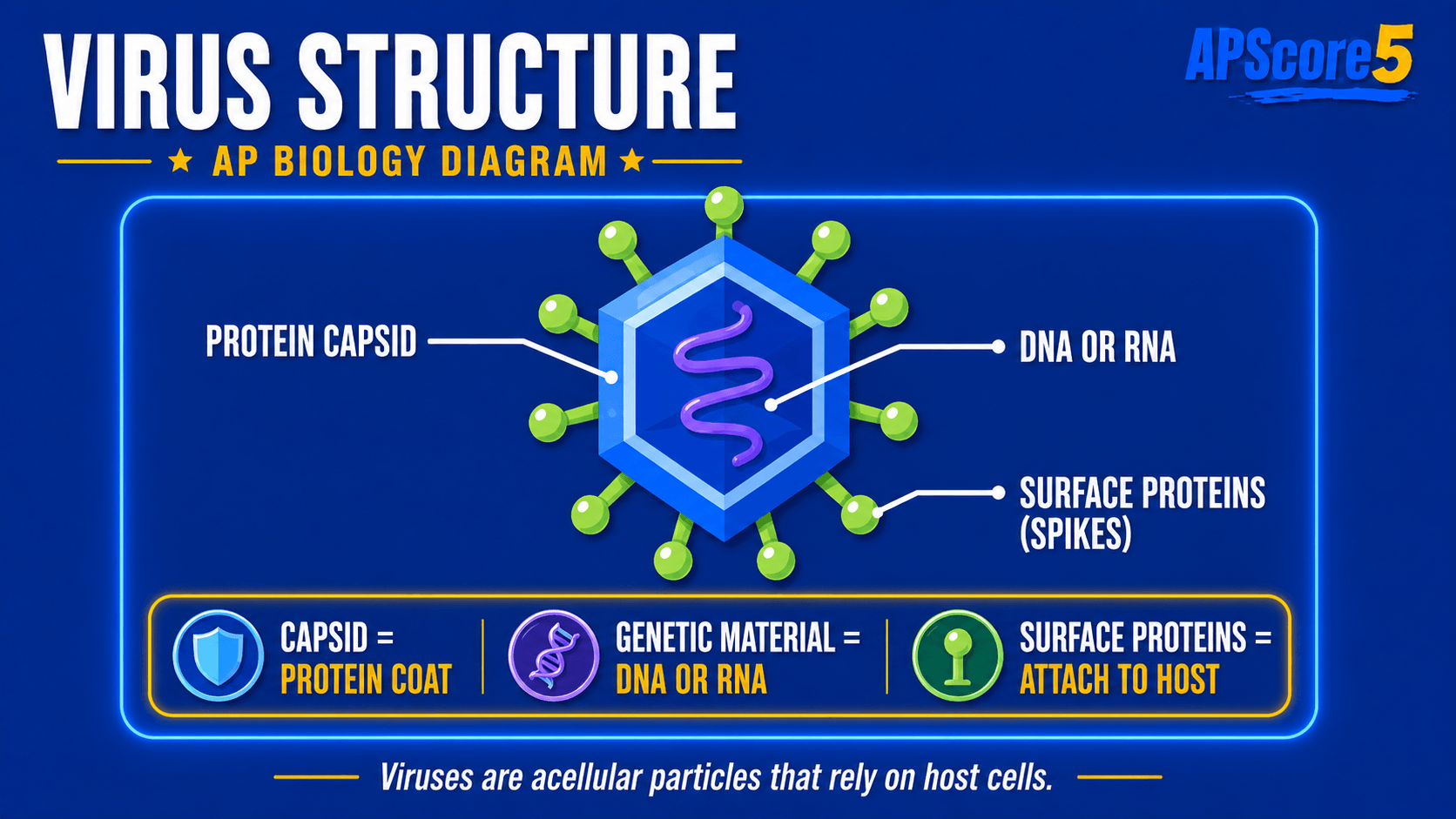
Direct answer: A virus is genetic material packaged in a protein capsid, sometimes with an envelope and attachment proteins.
A virus is much simpler than a cell. It is basically genetic information packaged for delivery into a host cell. Most viruses contain nucleic acid, a protein capsid, sometimes an envelope, and sometimes surface proteins or spikes.
1. Viral genetic material
Viruses contain genetic material, but not all viruses use the same type. This matters because AP Biology often connects viruses to DNA replication, transcription, translation, and mutation.
| Type of Viral Genome | Example Concept |
|---|---|
| DNA | Some viruses carry DNA as their genetic material. |
| RNA | Some viruses carry RNA as their genetic material. |
| Single-stranded genome | One strand of nucleic acid. |
| Double-stranded genome | Two complementary strands. |
2. Protein capsid
The capsid is the protein coat that surrounds and protects the viral genome. It shields viral DNA or RNA, gives the virus shape, and helps some viruses attach to host-cell receptors.
3. Viral envelope
Some viruses have an outer covering called an envelope. The envelope is often derived from the host cell membrane when the virus exits the host cell, so it connects viruses to membrane structure, proteins, recognition, and specificity.
How do surface proteins control host specificity?
Many viruses have surface proteins that bind to host-cell receptors. This is like a molecular match. It explains why one virus may infect respiratory cells while another infects immune cells or liver cells.
| Virus Part | Host Cell Part |
|---|---|
| Viral surface protein | Host-cell receptor |
| Attachment proteins | Cell membrane proteins |
| Viral specificity | Determines what cells can be infected |
AP Bio takeaway: viral infection often depends on protein shape and receptor binding. That connects viruses to protein structure, cell communication, membrane receptors, evolution, and immune response.
How do viruses reproduce?
Direct answer: Viruses reproduce inside host cells by using host ribosomes, enzymes, and energy to copy genomes and build new viral particles.
Viruses do not reproduce by binary fission, mitosis, or meiosis. Instead, viruses replicate by entering a host cell and using the host's machinery to make more viruses.
| Step | What Happens |
|---|---|
| Attachment | Virus binds to host-cell receptor. |
| Entry | Viral genome enters the host cell. |
| Replication | Viral genetic material is copied. |
| Protein synthesis | Host ribosomes make viral proteins. |
| Assembly | New viral particles are built. |
| Release | New viruses exit the host cell. |
The key phrase for AP Bio is: viruses use host-cell machinery. They depend on host ribosomes, enzymes, nucleotides, amino acids, ATP, and cellular systems.
Virus Replication Reasoning Ladder
The virus binds to a specific host-cell receptor.
Viral genetic material enters the host cell.
The viral genome is copied using host or viral enzymes.
Host ribosomes translate viral mRNA into viral proteins.
Viral genomes and capsid proteins assemble into new viral particles.
New viruses exit the host cell, sometimes by lysis.
What happens in the lytic cycle?
Direct answer: The lytic cycle quickly produces many new viruses and often destroys the host cell by lysis.
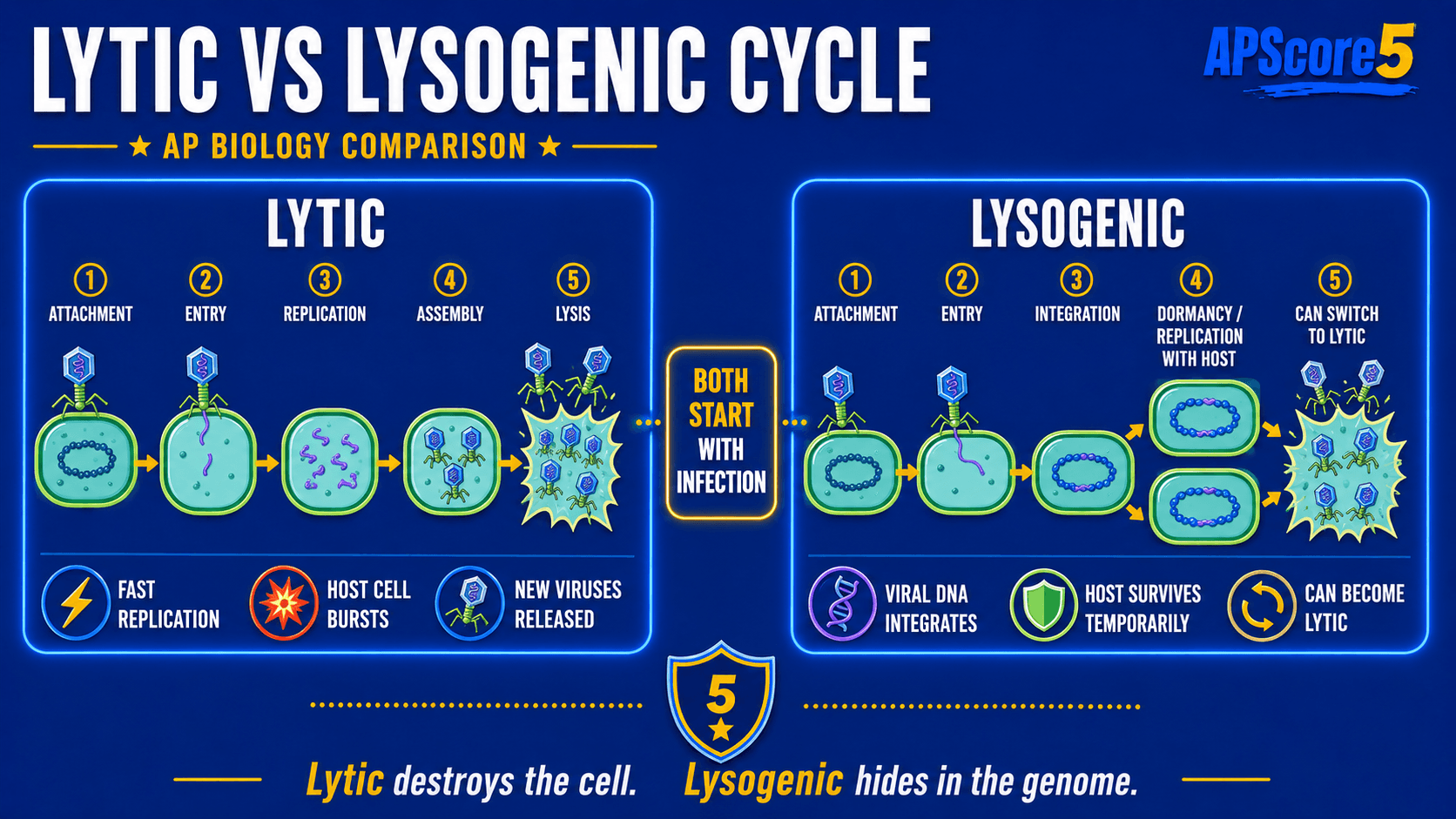
The lytic cycle is a viral replication cycle where the virus quickly produces many new viruses and often destroys the host cell. A bacteriophage infecting a bacterial cell, making many new phages, and causing the bacterial cell to burst is a classic lytic-cycle example.
| Step | Description |
|---|---|
| Attachment | Virus attaches to host cell. |
| Entry | Viral genetic material enters. |
| Replication | Viral genome is copied. |
| Protein production | Host ribosomes make viral proteins. |
| Assembly | New viruses are assembled. |
| Lysis | Host cell bursts and releases viruses. |
Memory trick: lytic means the cell lyses. If a question describes the host cell bursting and releasing many viruses, it is describing the lytic cycle.
What happens in the lysogenic cycle?
Direct answer: The lysogenic cycle integrates viral DNA into the host genome, where it can remain dormant before later activation.
The lysogenic cycle is a viral replication cycle where viral genetic material becomes part of the host cell's genome and may remain inactive for a period of time. In bacteria, viral DNA integrated into the bacterial chromosome is often called a prophage.
| Step | Description |
|---|---|
| Attachment | Virus attaches to host cell. |
| Entry | Viral DNA enters. |
| Integration | Viral DNA joins host DNA. |
| Dormancy | Viral DNA is copied with host DNA. |
| Induction | Viral DNA may become active later. |
| Lytic cycle | Virus may begin producing new particles. |
Memory trick: lysogenic means viral genes hide in the host genome.
How do lytic and lysogenic cycles compare?
| Feature | Lytic Cycle | Lysogenic Cycle |
|---|---|---|
| Speed | Usually faster | Can remain inactive. |
| Host cell | Often destroyed quickly | Not destroyed immediately. |
| Viral genome | Used to make new viruses right away | Integrated into host genome. |
| Main result | Cell lysis and virus release | Viral DNA copied with host DNA. |
| AP Bio clue | Cell bursts | Viral DNA becomes part of host DNA. |
The most important difference is that the lytic cycle quickly makes new viruses and destroys the host cell, while the lysogenic cycle allows viral genetic material to be copied with the host genome before becoming active later.
Why do bacteriophages matter in AP Biology?
A bacteriophage, or phage, is a virus that infects bacteria. Bacteriophages are important in AP Biology because they clearly show the difference between viruses and cells.
| Feature | Description |
|---|---|
| Infects bacteria | Uses bacterial cells as hosts. |
| Contains genetic material | DNA or RNA depending on the phage. |
| Has a capsid | Protein coat protects genome. |
| Uses host machinery | Depends on bacterial ribosomes and enzymes. |
| May enter lytic or lysogenic cycle | Depends on virus and conditions. |
Bacteriophages are often used in biology examples because they show how genetic material can enter a cell and affect gene expression. They are also historically important in experiments showing that DNA is genetic material.
How do RNA viruses and reverse transcriptase work?
Some viruses contain RNA instead of DNA. A special type of RNA virus called a retrovirus uses an enzyme called reverse transcriptase, which makes DNA from an RNA template.
This reverses the usual flow of genetic information. The usual pattern is DNA → RNA → protein. For retroviruses, the pattern is RNA → DNA → RNA → protein, and the viral DNA can integrate into the host genome.
How Viruses Connect to Gene Expression
Direct answer: Viruses connect to Unit 6 because viral genes must be expressed using host-cell machinery.
Viruses are a strong Unit 6 topic because they depend on gene expression. Gene expression means using genetic information to make functional products, usually proteins.
| Host Cell Machinery | How Virus Uses It |
|---|---|
| Ribosomes | Make viral proteins. |
| Enzymes | Copy genetic material. |
| ATP | Provides energy. |
| Amino acids | Build viral proteins. |
| Nucleotides | Copy viral genomes. |
| Membrane system | Helps some viruses exit or form envelopes. |
Viruses are real examples of genetic instructions being expressed through cellular machinery. Review Unit 6 gene expression and regulation, the central dogma, transcription vs translation, translation, and mutations when you connect viral genes to viral proteins and evolving variants.
Why do viruses evolve quickly?
Viruses can evolve quickly because mutations occur during replication, and viral populations can produce many copies in a short time. RNA viruses often have especially high mutation rates because RNA copying can be less accurate than DNA copying.
| AP Bio Concept | Connection |
|---|---|
| Mutation | Creates genetic variation. |
| Natural selection | Some variants spread more successfully. |
| Host immunity | Immune pressure can favor certain variants. |
| Reproduction rate | More replication means more chances for mutation. |
| Fitness | Better transmission can increase viral success. |
Do not say viruses try to evolve or want to infect more people. A better AP Bio explanation is: random mutations create variation, and variants with traits that improve replication or transmission may become more common through natural selection.
How do viruses compare with bacteria?
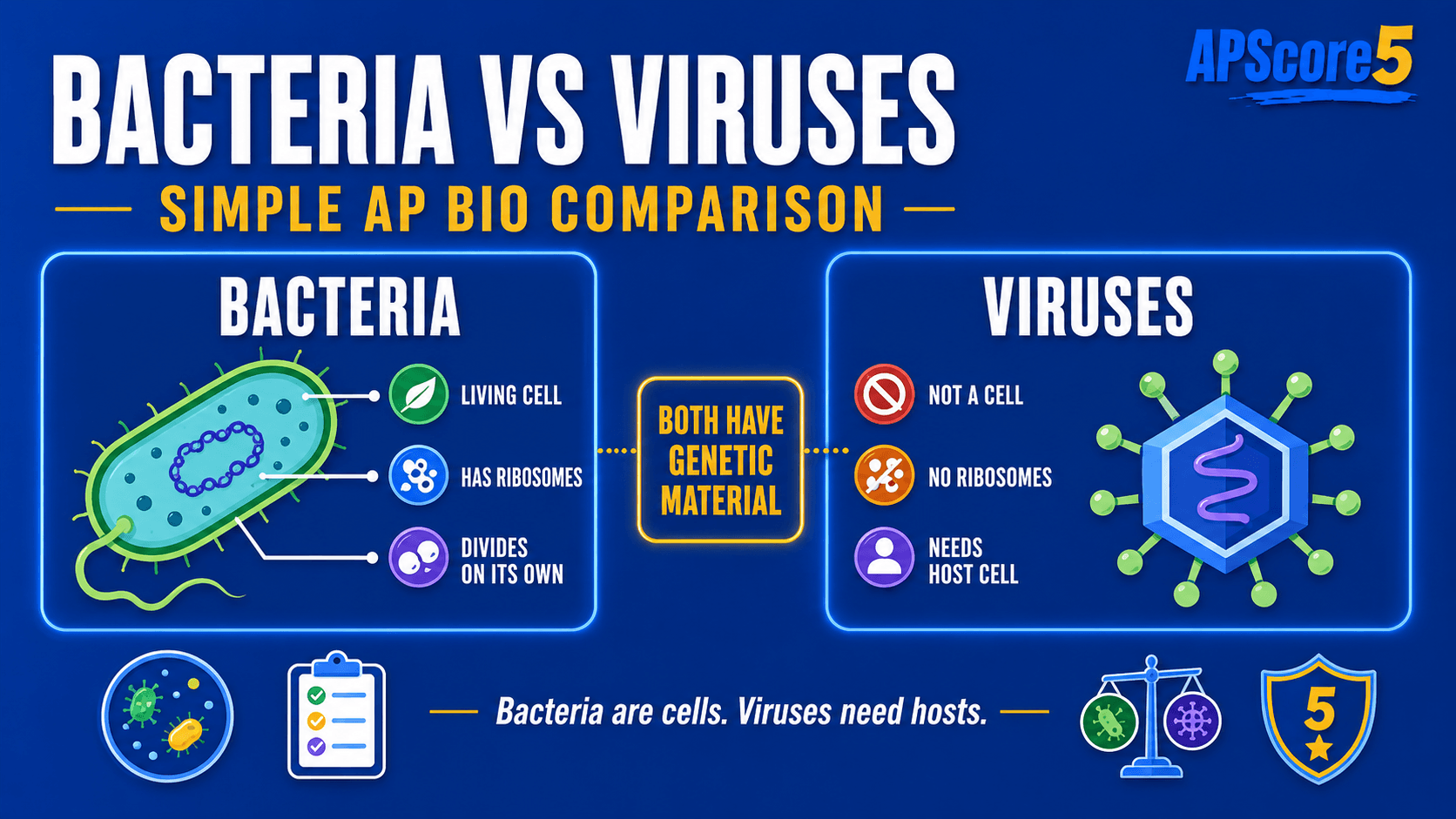
Direct answer: Bacteria are living cells with ribosomes and metabolism; viruses are noncellular particles that need host cells to replicate.
Viruses and bacteria are often confused, but they are very different. For the full cluster explanation, review viruses and bacteria in AP Biology, the focused guide to what bacteria and viruses have in common, and the broader AP Biology viruses key concepts.
| Feature | Virus | Bacterium |
|---|---|---|
| Cell? | No | Yes |
| Living? | Usually considered nonliving | Living organism |
| Genetic material | DNA or RNA | DNA |
| Ribosomes | No | Yes |
| Metabolism | No independent metabolism | Has metabolism |
| Reproduction | Requires host cell | Binary fission |
| Antibiotics | Do not work | May work |
| Size | Smaller | Larger |
Do antibiotics, immunity, and vaccines connect to viruses?
Antibiotics do not work on viruses. Antibiotics target bacterial structures or processes such as cell wall synthesis, ribosomes, bacterial enzymes, and metabolic pathways. Viruses do not have cell walls, ribosomes, or independent metabolism, so antibiotics cannot target them in the same way.
The immune system detects viral infections through innate immunity, interferons, antibodies, T cells, and memory cells. Viruses are often inside host cells, so the immune system must sometimes target infected cells, not just free viral particles.
Vaccines prepare the immune system to recognize a pathogen or part of a pathogen before a real infection occurs. The goal is not to cause disease; the goal is to create immune memory.
What AP Biology virus mistakes and terms should you know?
Common AP Virus Mistakes
| Term | Meaning |
|---|---|
| Virus | Noncellular infectious particle. |
| Capsid | Protein coat around viral genome. |
| Envelope | Outer membrane-like covering in some viruses. |
| Host cell | Cell infected by a virus. |
| Bacteriophage | Virus that infects bacteria. |
| Lytic cycle | Viral cycle that produces viruses and lyses host cell. |
| Lysogenic cycle | Viral cycle where viral DNA integrates into host genome. |
| Prophage | Viral DNA integrated into bacterial DNA. |
| Retrovirus | RNA virus that uses reverse transcriptase. |
| Viral specificity | Ability of a virus to infect certain cells. |
What do you actually need to know for AP Biology?
For AP Biology, focus on six ideas: viruses are not cells, viruses contain genetic material, viruses require host cells, viruses can evolve, viruses connect to gene expression, and lytic and lysogenic cycles are different. These are the review points that most often decide tricky answer choices.
- Viruses lack cytoplasm, ribosomes, and independent metabolism.
- Viruses may have DNA or RNA.
- Viruses use host ribosomes, enzymes, energy, and materials.
- Mutation and natural selection can change viral populations.
- Viral genes use host machinery to make viral proteins.
- Lytic causes rapid production and cell lysis; lysogenic allows viral DNA to hide in the host genome.
AP-style practice questions
Choose an answer to reveal feedback. The answer stays hidden until you select an option.
Question 1
A virus is usually not considered a living organism because it:
Question 2
Which structure is found in bacteria but not in viruses?
Question 3
During the lytic cycle, the host cell usually:
Question 4
A virus enters a host cell and its DNA becomes part of the host chromosome. Which cycle is most likely occurring?
Question 5
Why can viruses evolve even though they are not considered cells?
Question 6
Which viral structure is the protein coat that directly surrounds the genome?
Question 7
Which enzyme allows a retrovirus to make DNA from an RNA template?
Question 8
Why do antibiotics usually fail to treat viral infections?
Mini FRQ: Are Viruses Living?
A student claims that viruses are living organisms because they contain genetic material and can evolve.
- Part A: Identify one feature of viruses that supports the student's claim.
- Part B: Identify one feature of viruses that weakens the student's claim.
- Part C: Explain why viruses require host cells to reproduce.
Scoring checklist
- 1 point: identifies genetic material or evolution as evidence supporting the claim
- 1 point: identifies lack of cells, ribosomes, metabolism, or independent reproduction as evidence against the claim
- 1 point: explains that viruses require host ribosomes, enzymes, energy, and molecules to produce viral particles
Sample answer
- Part A: Viruses contain genetic material (DNA or RNA) that can mutate, so viral populations can evolve over time.
- Part B: Viruses are not made of cells and do not have ribosomes, cytoplasm, or independent metabolism.
- Part C: Viruses cannot copy their genomes or make proteins on their own. They use the host cell's ribosomes, enzymes, ATP, and raw materials to assemble new viral particles.
FAQs
What is a virus in AP Biology?
A virus is a noncellular infectious particle made of DNA or RNA surrounded by a protein capsid, and some viruses also have an envelope.
Are viruses living or nonliving in AP Biology?
Viruses are usually considered nonliving because they are not cells, lack ribosomes and metabolism, and require host cells to reproduce.
What are viruses made of?
Viruses contain nucleic acid (DNA or RNA) inside a protein capsid. Some viruses also have an envelope and surface proteins for attachment.
Do viruses have ribosomes?
No. Viruses do not have ribosomes. They use host-cell ribosomes to translate viral mRNA into proteins.
How do viruses reproduce?
Viruses reproduce by entering a host cell and using host machinery to copy their genome, make viral proteins, assemble new particles, and release them.
What is the difference between lytic and lysogenic cycles?
The lytic cycle quickly makes new viruses and lyses the host cell, while the lysogenic cycle integrates viral DNA into the host genome before activation later.
What is a bacteriophage?
A bacteriophage is a virus that infects bacteria. Phages are common AP Biology examples of lytic and lysogenic cycles.
What is a retrovirus?
A retrovirus is an RNA virus that uses reverse transcriptase to make DNA from an RNA template, which can integrate into the host genome.
What is reverse transcriptase?
Reverse transcriptase is an enzyme that copies RNA into DNA. Retroviruses use it to reverse the usual DNA-to-RNA flow of genetic information.
Why do viruses connect to AP Biology Unit 6?
Viruses connect to Unit 6 because they use host-cell machinery for gene expression, including copying genetic material and translating viral proteins.
How are viruses different from bacteria?
Bacteria are living prokaryotic cells with ribosomes and metabolism that reproduce by binary fission. Viruses are noncellular particles that require host cells to replicate.
Do antibiotics work on viruses?
No. Antibiotics target bacterial structures or processes such as cell walls, ribosomes, enzymes, and metabolism; viruses lack those targets.
Why can viruses evolve?
Viruses can evolve because their genetic material can mutate, creating variation that natural selection can act on across viral populations.
Final AP Biology takeaway
Viruses are noncellular infectious particles that carry genetic instructions but rely on host cells to do the work. They lack ribosomes, cytoplasm, metabolism, and independent reproduction, so they are usually considered nonliving. For AP Biology, remember: viruses connect to Unit 6 because viral genes use host-cell machinery for replication, transcription, translation, protein production, mutation, and evolution.