Most students lose AP points by calling every cultural spread "expansion." The students who score 5s know the hearth has to keep the idea.
Expansion diffusion AP Human Geography is when an idea, religion, innovation, or trend spreads outward from a hearth while the trait stays strong at the origin. This guide gives you the 5-step expansion process, the 3 subtypes (contagious, hierarchical, stimulus), real-world examples, and AP-style practice.
What is expansion diffusion in AP Human Geography?
Use this 45–60 word answer on timed items, then drill the 5-step process below.
Expansion diffusion is when a cultural trait, idea, religion, innovation, language, or trend spreads outward from a hearth while the trait remains strong at the origin. People do not have to move. The three AP Human Geography subtypes are contagious diffusion, hierarchical diffusion, and stimulus diffusion — each spreads in a different way.
Expansion diffusion always runs the same five-step path. Expansion diffusion AP Human Geography is not just the opposite of relocation — it has its own mechanics, and the AP exam rewards students who can describe them step by step.
Each step takes about 10 seconds once you know the pattern. Total: 50 seconds to map any expansion diffusion scenario.
1
Step 1 — Hearth
At a glance: Find the hearth — where did the idea begin?
In one sentence: The hearth is the cultural origin point, and naming it is the first move in any expansion diffusion answer.
A hearth is the place where a cultural trait, religion, innovation, or idea first appeared. On the AP exam, the hearth might be a city (Paris for haute couture), a region (the Fertile Crescent for early agriculture), or a specific place (Mecca for Islam). The hearth still exists strongly even after the idea has spread.
If the stem never names an origin, ask where the trait logically began. Examiners reward a labeled hearth even when the map only shows one bold dot.
Pair the hearth with the trait: Jerusalem for Christianity, Seoul for K-pop industry patterns, Los Angeles for Hollywood film distribution. The label anchors every later step.
What to look for
Clear single origin named or implied
Cultural anchor (city, region, religious site)
The idea is still practiced at the origin today
What it tells you
Where to anchor your FRQ answer
Which cultural processes are likely
What region the question is testing
Common student mistake: students forget to name the hearth and only describe the spread.
Worked micro-example: Christianity's hearth is Jerusalem and the eastern Mediterranean; the religion is still practiced there today.
At a glance: Identify how contact happens between the hearth and new places.
In one sentence: Contact can be physical, digital, social, religious, political, or commercial — and the type of contact often points to the subtype.
Contact is the bridge from hearth to spread. Trade routes, missionaries, social media, urban networks, conversion campaigns, celebrity influence, and corporate supply chains each create a different adoption path.
On MCQs, contact language often appears before the diffusion label: preaching, reposts, fashion week, franchise openings, or policy announcements from a capital.
Skipping contact and jumping straight to "it spread" costs partial credit. Name the medium, then name expansion and the subtype.
What to look for
A network, route, or medium connecting hearth to other places
Who encounters the idea first (peers, elites, converts)
Whether contact is face-to-face, digital, or institutional
What it tells you
Peer contact often signals contagious diffusion
Cities or celebrities first often signal hierarchical diffusion
Cross-cultural contact with change often signals stimulus diffusion
Common student mistake: skipping contact and jumping to "and then it spread."
Worked micro-example: K-pop spreads through social media platforms and label distribution — that contact mechanism made global hierarchical-plus-contagious patterns possible.
At a glance: Describe how the idea moves outward across space.
In one sentence: Spread is the geographic process — the idea reaches new places without the original people having to move.
Spread is what makes expansion diffusion expansion. The trait radiates outward, jumps between cities, or follows networks while most adopters stay home.
Distinguish spread from relocation: if the story is only about migrants carrying culture, relocation is the primary label. Expansion needs outward adoption without everyone leaving the hearth.
Note speed and pattern. Rippling outward from one city suggests contagious contact. Capitals first, then villages, suggests hierarchical spread.
What to look for
Outward movement from a named origin
Pattern: rippling, jumping between cities, or networked
New places adopting over time
What it tells you
Speed and pattern hint at subtype
Whether distance decay appears in the narrative
How many regions are affected
Common student mistake: confusing spread with migration.
Worked micro-example: Buddhism spread along trade routes through monks and merchants — outward spread from South Asia without mass migration of the entire population.
At a glance: Notice what gets adopted versus what gets changed.
In one sentence: If new places adopt the idea as-is, it is contagious or hierarchical; if they modify it, it is stimulus.
Adoption is where subtype labels earn points. Identical practice in nearby towns fits contagious expansion. Elite-led copying from a capital fits hierarchical expansion.
Modified menus, blended rituals, or localized architecture signal stimulus diffusion — the core idea arrived, but the local form changed.
Some prompts describe two zones: uniform adoption near the hearth and adapted adoption far away. Name a different subtype for each zone under one expansion umbrella.
What to look for
Identical practice in the new place
Modified or localized version
Speed and who adopted first
What it tells you
Subtype identification for FRQs and MCQs
Whether acculturation language is appropriate
If a second diffusion stage will follow
Common student mistake: assuming adoption is automatic once the idea arrives.
Worked micro-example: McDonald's adopted in India looks different — beef removed, McSpicy Paneer added. That is modified adoption, so stimulus diffusion fits at the receiving places.
At a glance: Confirm the hearth still has the trait — this is what makes it expansion, not relocation.
In one sentence: Expansion diffusion's defining feature: the origin does not lose the idea when it spreads.
The hearth keeping the trait separates expansion from relocation-only stories. Jerusalem remains a religious center, Paris remains a fashion capital, Los Angeles remains a film hearth.
On FRQs, add one sentence that the origin still practices or produces the trait. That sentence is often the comparison point against relocation.
Stimulus diffusion still has a strong hearth — local modification happens at the edges, not by erasing the source form.
What to look for
Original place still actively practicing or producing the trait
Pilgrimage, headquarters, or industry still centered at origin
Language in the stem: still strong at source, remains a center
What it tells you
Confirms expansion rather than relocation alone
Supports a two-type answer when migration also occurred
Earns the hearth comparison point on rubrics
Common student mistake: students describe spread perfectly but forget to confirm the hearth still has it — losing the comparison point.
Worked micro-example: Hollywood films spread globally; Los Angeles is still the world's primary film production hearth.
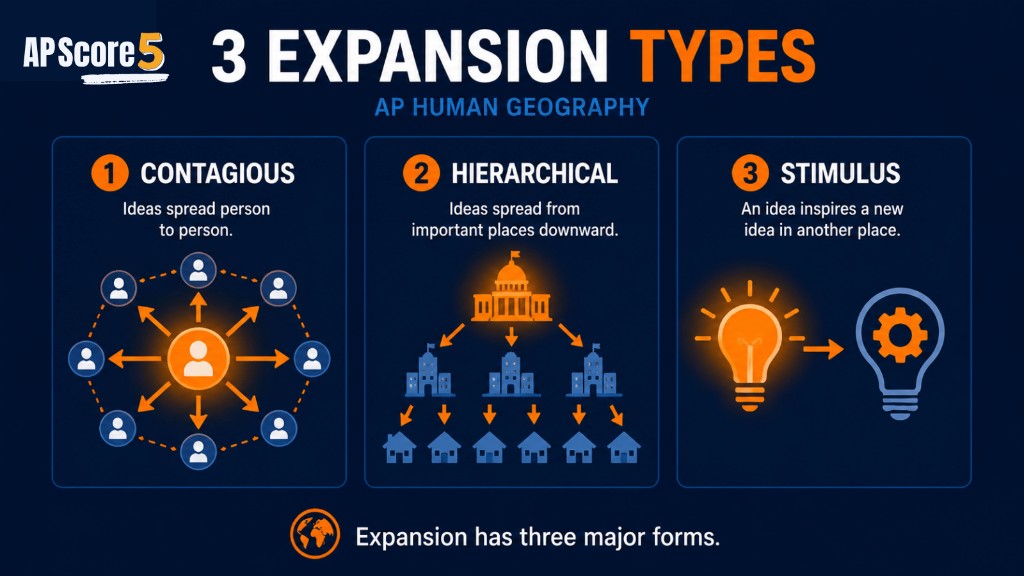
The three subtypes — contagious, hierarchical, and stimulus — are the most-tested part of expansion diffusion on the AP Human Geography exam. Each has its own page with deeper detail.
Figure - Three Types Expansion Diffusion AP HUG
Contagious Diffusion
Rapid person-to-person spread with no hierarchy needed — viral trends, rumors, memes, or illness moving by direct contact.
AP exam tip: On any expansion diffusion FRQ, name the subtype AND a defining feature. Subtype alone is partial credit.
Real-world examples
Expansion diffusion examples for AP Human Geography
Use this table to connect real cases to the correct expansion subtype. Say the hearth, the spread mechanism, and the subtype in one FRQ sentence when you can.
Example
Subtype
Why it fits
Christianity
Expansion (often hierarchical or contagious)
Spreads from Jerusalem and the eastern Mediterranean while the hearth remains a major religious center.
Islam
Expansion (hierarchical along trade and political networks)
Radiates from Mecca and Medina outward; the Arabian hearth stays central to the faith.
K-pop
Hierarchical diffusion
Seoul entertainment companies and stars lead adoption; fans worldwide follow elite-produced content.
McDonald's in India
Stimulus diffusion
The global brand spreads without founders migrating, but menus adapt for local tastes and dietary rules.
Buddhism along trade routes
Hierarchical diffusion
Ideas move from South Asian hearths through merchants and political centers before reaching ordinary adopters.
Hollywood films
Hierarchical diffusion
Los Angeles studios and distributors release films to world markets from a single entertainment hearth.
TikTok trend
Contagious diffusion
A meme or dance spreads rapidly peer to peer through shares and reposts without a formal power hierarchy.
Fashion from Paris
Hierarchical diffusion
Design houses and fashion weeks in Paris set styles that filter down to boutiques and consumers elsewhere.
Christianity, Islam, and Buddhism illustrate hearths that stay central while belief spreads through contact networks — often hierarchical along trade or political routes, sometimes contagious in nearby communities.
K-pop, Hollywood, Paris fashion, and TikTok trends show how elite centers or peer networks lead adoption. McDonald's in India is the classic stimulus case: the brand expands globally, but the product changes locally.
Compare
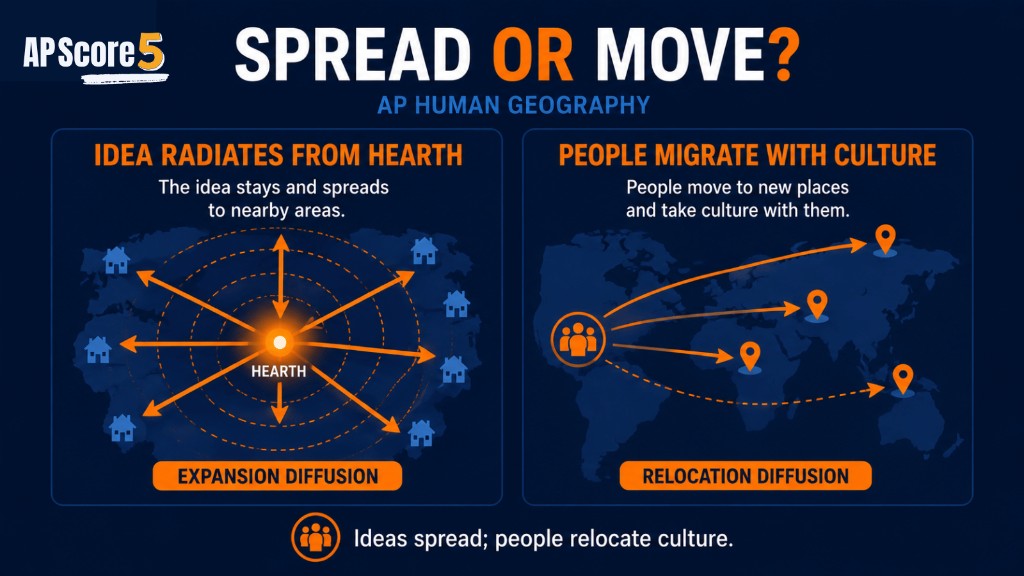
Expansion diffusion vs relocation diffusion
Students confuse these two most often. Resolve the mechanism first: did people move, or did the idea spread from a hearth?
Figure - Expansion Vs Relocation Diffusion Compare
Feature
Expansion diffusion
Relocation diffusion
Core mechanism
Idea spreads outward from a hearth
People move and carry culture with them
Migration required?
No mass migration required
Physical movement of people is required
Hearth role
Origin stays strong and influential
Trait may exist at origin and destination after movers leave
Typical AP clue words
Hearth, outward spread, still strong at source, viral, capital, adapted
Migrants, settlers, immigrants, diaspora, brought with them
Quick exam rule
Expansion = idea spreads; hearth keeps the trait
Relocation = people move; culture moves with them
Simple rule: Expansion = idea spreads. Relocation = people move.
How to identify expansion diffusion on the AP exam
Scan for hearth language first, then check whether movers are required. Use the clue table like a checklist on MCQs and FRQs.
Clue word
What it means
Likely label
Hearth
Single cultural origin named in the stem
Expansion diffusion
Outward spread
Idea radiates from one place to others
Expansion diffusion
Still strong at source
Origin remains a center after spread
Expansion diffusion
Viral / peer to peer
Rapid contact among equals, no elite ladder
Contagious diffusion
Capital / celebrity / elite city
Major center or famous person leads first
Hierarchical diffusion
Adapted / localized / modified
Core idea changes to fit local culture
Stimulus diffusion
Preaching / conversion
Belief spreads without mass migration
Expansion diffusion
Brought with them
Carriers physically moved
Relocation diffusion (not expansion)
Four-step identification checklist
Is there a named hearth where the trait began?
Is the hearth still practicing or producing the trait after spread?
Did the idea reach new adopters without mass migration from the hearth?
Which expansion subtype matches the contact pattern — contagious, hierarchical, or stimulus?
On timed MCQs, underline hearth and migration verbs before you read the answer choices. That habit cuts wrong picks on mixed relocation-expansion items.
Your turn
Your turn: sort this expansion scenario
A new religious movement begins in one city, spreads outward through preaching and conversion to surrounding regions, while the original city remains a major religious center. In nearby smaller towns, the movement is practiced exactly as taught. In a distant country with a different existing religion, the new movement is adapted — its rituals are modified to fit local customs.
Common mistakes
Expansion diffusion traps that cost AP points
✕Trap: Any fast spread = contagious
✓Better reading: Fast spread can be hierarchical if it starts with elites, celebrities, or major cities.
✕Trap: Expansion just means spread
✓Better reading: Expansion means the hearth keeps the trait while the idea moves outward.
✕Trap: If a religion crosses borders, that's relocation
✓Better reading: Religion can cross borders through conversion (expansion) or through migrants (relocation) — check the mechanism.
✕Trap: Stimulus diffusion means the idea disappears at the hearth
✓Better reading: Stimulus is a subtype of expansion — the hearth still has the original form.
✕Trap: Hierarchical only means political power
✓Better reading: Hierarchical also includes celebrities, major cities, wealthy groups, and influencers.
✕Trap: I described the spread, so I'm done
✓Better reading: The AP point is also naming the subtype and the continued hearth.
Practice
Expansion diffusion AP Human Geography: practice MCQs
50 questions from simple hearth scenarios to tough two-process stories. Choices shuffle at display time. Read the explanation, then use Next question. An ad appears after every 5th reveal.
0Correct
0Answered
0%Accuracy
StartStatus
Question 1 of 50Expansion basics
7-day expansion diffusion study plan
Day 1
Walk the 5 steps on Christianity from memory.
Day 2
Walk the 5 steps on K-pop / a global trend from memory.
Day 3
Walk the 5 steps on McDonald's in India (stimulus case) from memory.
Frequently asked questions about expansion diffusion
What is expansion diffusion in AP Human Geography?
Expansion diffusion is the spread of a cultural trait, idea, religion, innovation, or trend outward from a cultural hearth while the trait stays strong at the origin. People do not have to migrate for the idea to reach new adopters.
What is a simple definition of expansion diffusion?
An idea spreads from one place to surrounding areas, and the place where it began still keeps the trait.
What are the 3 types of expansion diffusion?
Contagious diffusion, hierarchical diffusion, and stimulus diffusion are the three expansion subtypes on the AP Human Geography exam.
What is an example of expansion diffusion in AP Human Geography?
Christianity spreading outward from Jerusalem while Jerusalem remains a major religious center is a classic expansion diffusion example.
How is expansion diffusion different from relocation diffusion?
Expansion diffusion spreads an idea from a hearth without requiring mass migration. Relocation diffusion happens when people move and carry culture with them.
Is stimulus diffusion a type of expansion diffusion?
Yes. Stimulus diffusion is one of the three subtypes of expansion diffusion. The idea spreads outward, but adopters change or adapt it locally.
Is hierarchical diffusion a type of expansion diffusion?
Yes. Hierarchical diffusion is an expansion subtype in which spread moves from powerful people, major cities, or elite centers to smaller places.
You have the 5-step expansion process and the 3 subtype overview. Step 4 zooms in on contagious diffusion — the viral, peer-to-peer subtype that confuses many AP MCQs.