Which is the best example of big data?
Q1Explanation: Big data usually involves very large, complex, fast-moving, or varied datasets that require computers to process.
AP Computer Science Principles · Unit 2 · Data
Unit 2 · Big data · ~10 min read
Big data, privacy, and data bias are important AP Computer Science Principles Unit 2 topics because data can create both benefits and risks. Large datasets can help people make predictions, detect patterns, improve services, and solve problems.
But data collection can also expose personally identifiable information, reveal private behavior, allow re-identification, or create unfair outcomes when the data is incomplete or biased.
In AP CSP, big data refers to very large, complex, fast-moving, or varied datasets that computers collect, store, process, and analyze. Big data can reveal useful patterns, but it can also create privacy risks when personal information is exposed or re-identified and data bias when datasets are incomplete or unrepresentative.
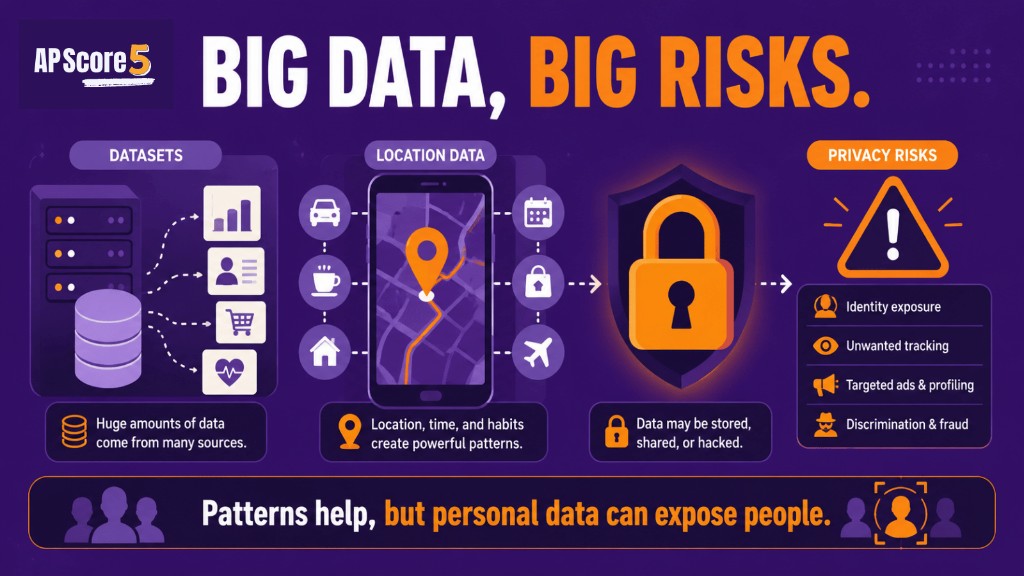
Big data helps detect patterns and improve services, but large-scale data collection can also create privacy and tracking risks.
In AP CSP, big data refers to very large, complex, fast-moving, or varied datasets that computers are used to collect, store, process, and analyze. Big data can reveal useful patterns, but it can also create privacy risks if personal information is collected, shared, exposed, or re-identified. Data bias happens when a dataset is incomplete, unrepresentative, or collected in a way that leads to unfair or misleading outcomes.
Tiny example: A navigation app can use location data from millions of phones to estimate traffic, but that same location data could expose where people live, work, or travel.
For how tags and file context affect privacy before big-data scale, see the metadata study guide. The AP CSP Unit 2 Data hub maps every Phase 1 topic in this unit.
Big data means more than “a lot of numbers.” In AP CSP, big data usually means datasets that are large, complex, fast, or varied enough that computers are needed to store, process, and analyze them.
| Feature | Meaning | Example |
|---|---|---|
| Volume | A very large amount of data | Millions of search queries |
| Velocity | Data changes or arrives quickly | Live traffic updates |
| Variety | Many types of data | Text, images, location, clicks |
| Complexity | Hard to analyze manually | Health records across hospitals |
Big data can help people find patterns, make predictions, personalize services, detect fraud, improve transportation, track disease spread, recommend content, and study large-scale behavior.
| Area | Big Data Benefit |
|---|---|
| Transportation | Predict traffic and suggest faster routes |
| Health | Detect disease patterns or treatment trends |
| Education | Identify topics students struggle with |
| Business | Recommend products or detect fraud |
| Weather | Improve forecasting using many sensor readings |
Examples of big data include location data from millions of phones, search engine queries, online shopping behavior, streaming activity, health records, weather sensor data, and learning platform activity.
Data privacy is about how personal information is collected, stored, shared, protected, and used. In AP CSP, privacy questions often focus on what data could reveal about a person and how that information could be misused.
Personally identifiable information, or PII, is data that can identify a specific person. PII can identify someone directly or help identify them when combined with other information.
| Type of PII | Example |
|---|---|
| Direct identifier | Name, email address, phone number |
| Government identifier | Social Security number, student ID |
| Location data | Home address, GPS location |
| Biometric data | Face scan, fingerprint, voiceprint |
| Account data | Username, login credentials |
| Health data | Medical history or fitness records |
Tracking data can reveal where people go, when they move, what services they use, and what routines they follow. Location data is especially sensitive because it can expose homes, schools, workplaces, and habits.
Example: A fitness app that records running routes may reveal where a student lives or what time they exercise.
Re-identification happens when data that seems anonymous is linked with other data to identify a person. Even if names are removed, location, timestamp, device, or behavior patterns may still reveal identity.
Example: A dataset without names may still identify a person if it includes a unique pattern of locations and times.
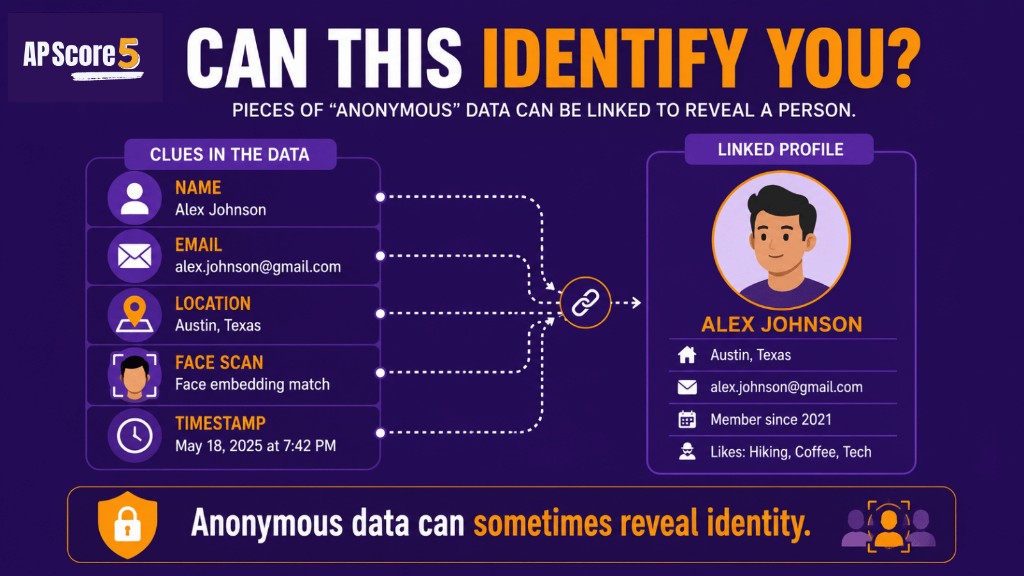
Even anonymous-looking datasets can sometimes reveal identity when multiple data clues are combined together.
Photo EXIF and file tags are one path to sensitive location data; the metadata guide explains that foundation without repeating it here.
A data breach happens when unauthorized people access private data. Data can also be misused when it is collected for one purpose but used for another purpose without clear consent.
Example: A company may collect user activity for app improvement, but that data could create risks if it is shared, sold, leaked, or used to profile people.
Data bias happens when a dataset is incomplete, unrepresentative, or collected in a way that produces unfair or misleading results. In computing, biased data can lead to biased decisions or predictions.
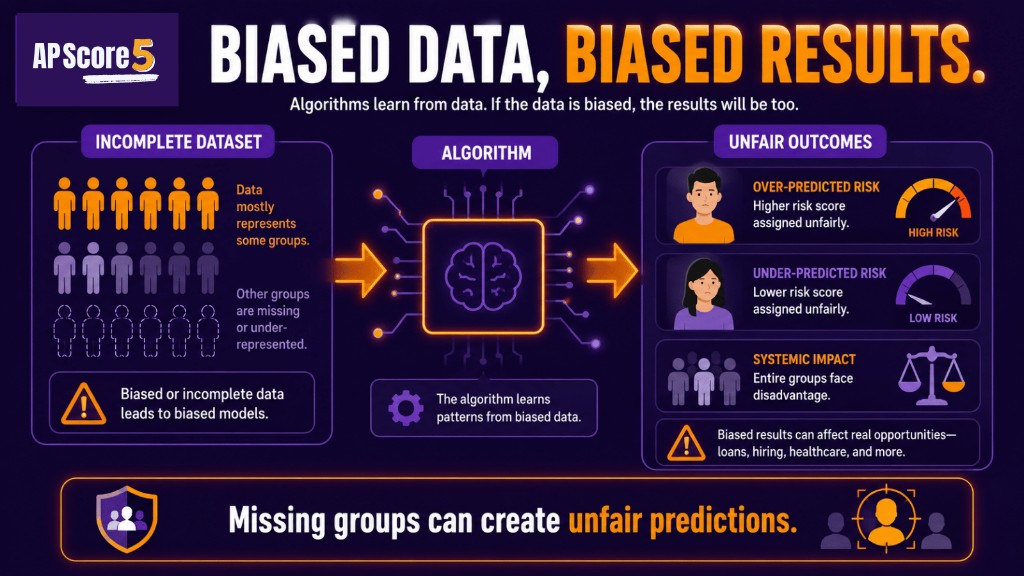
Incomplete or unrepresentative datasets can cause algorithms to produce unfair or misleading outcomes.
Data bias can happen when some groups are missing, underrepresented, overrepresented, or measured differently. It can also happen when the data collection method favors certain people, locations, devices, or behaviors. Sampling bias is one cause when the sample does not represent the population you claim to study.
| Cause | Example |
|---|---|
| Missing group | Survey leaves out students without internet access |
| Underrepresentation | Training data has too few examples from one population |
| Overrepresentation | Dataset mostly contains data from one region |
| Collection bias | App only collects data from users with smartphones |
| Historical bias | Past unfair decisions appear in the data |
Training data is data used to teach a machine learning system or prediction system. If the training data is biased, the system may learn biased patterns and produce unfair results.
Example: If a facial recognition system is trained mostly on one group of faces, it may perform worse for people who were underrepresented in the training data.
Biased data can lead to unfair outcomes in systems that make recommendations, predictions, classifications, or decisions. This matters in AP CSP because computing innovations can affect real people.
| System | Possible Bias Risk |
|---|---|
| Facial recognition | Worse accuracy for underrepresented groups |
| Hiring algorithm | Repeats past hiring bias |
| Loan prediction system | Treats groups unfairly based on biased history |
| School analytics system | Mislabels students if data is incomplete |
| Recommendation system | Reinforces narrow or biased content patterns |
A strong AP CSP answer often explains both sides of data use. Big data can create powerful benefits, but the same collection and analysis can create privacy, security, and bias risks.
| Big Data Benefit | Related Risk |
|---|---|
| Better traffic predictions | Location tracking |
| Personalized learning | Student privacy concerns |
| Health trend detection | Exposure of sensitive health data |
| Fraud detection | False positives or biased decisions |
| Product recommendations | Profiling or filter bubbles |
| Disease tracking | Re-identification of individuals |
AP CSP answer pattern: Use this pattern: Benefit + Risk + Specific Example.
Example: A navigation app can use big data to predict traffic and suggest faster routes, but it may create privacy risks if users’ location histories are stored or exposed.
A navigation app uses location data from many users to estimate traffic and suggest routes. The benefit is better traffic prediction. The privacy risk is that users’ location patterns could reveal homes, workplaces, or routines.
A health app can analyze heart rate, sleep, steps, and exercise patterns to give useful wellness insights. The risk is that health data is sensitive and could expose personal medical or lifestyle information.
A recommendation system can use viewing, shopping, or listening history to suggest content. The benefit is personalization. The risk is that the system may profile users or reinforce narrow patterns.
A facial recognition system may help identify people in images or security systems. The risk is that biased training data can make the system less accurate or unfair for some groups.
A school learning platform can use student activity data to identify weak topics and suggest practice. The risk is that incomplete data may mislabel students or expose learning behavior that should stay private.
AP CSP questions usually test whether students can explain benefits, risks, and tradeoffs clearly. The strongest answers are specific, not vague.
Example: Location data from many vehicles can help estimate traffic congestion and suggest faster routes.
Example: GPS data could reveal where users live, work, or travel regularly.
Example: If training data underrepresents one group, a prediction system may be less accurate for that group.
After this page, try the Unit 2 quiz for a short mixed checkpoint or the 50-question practice set for full exam-style endurance.
| Mistake | Correction |
|---|---|
| Saying big data is always good | Big data has benefits and risks |
| Saying big data is always bad | Big data can solve real problems |
| Giving vague privacy risks | Name what data is exposed and why it matters |
| Thinking anonymous data is always safe | Re-identification can still happen |
| Thinking PII only means name | Location, biometrics, account data, and combinations can identify people |
| Ignoring biased data | Incomplete data can create unfair outputs |
| Blaming only the algorithm | The dataset and collection process can also create bias |
| Forgetting examples | AP CSP answers should use specific scenarios |
| Confusing privacy and bias | Privacy is about exposure/misuse; bias is about unfair or misleading outcomes |
| Term | Student-Friendly Definition |
|---|---|
| Big data | Very large, complex, fast, or varied datasets |
| Data mining | Finding patterns in large datasets |
| Prediction | An estimate based on data patterns |
| Personally identifiable information | Data that can identify a specific person |
| PII | Short for personally identifiable information |
| Privacy risk | A chance that personal information is exposed or misused |
| Tracking | Collecting data about a person’s behavior or location |
| Re-identification | Linking anonymous data back to a person |
| Data breach | Unauthorized access to data |
| Consent | Permission to collect or use data |
| Data bias | Unfair or misleading patterns in data |
| Training data | Data used to teach a prediction or machine learning system |
| Algorithmic bias | Unfair output from a computing system |
| Data minimization | Collecting only the data needed |
Need to memorize these terms? Use the AP CSP Unit 2 flashcards. For a one-page formula and trap list, open the Unit 2 cheat sheet.
These are short topic checks. For the full mixed Unit 2 set, use the 50-question practice page. Tap an answer to reveal the explanation. Choices shuffle on load.
Which is the best example of big data?
Q1Explanation: Big data usually involves very large, complex, fast-moving, or varied datasets that require computers to process.
Which is a benefit of using big data in a navigation app?
Q2Explanation: A navigation app can use location data from many users to identify traffic patterns and suggest better routes.
Which is an example of personally identifiable information?
Q3Explanation: An email address can identify or help identify a specific person, so it is PII.
A fitness app stores users' exact running routes. What is one privacy risk?
Q4Explanation: Location data can reveal sensitive patterns such as home location, routines, or frequently visited places.
A dataset has names removed but includes detailed location and timestamp patterns. Why could this still be risky?
Q5Explanation: Re-identification can happen when anonymous-looking data is linked with other information to identify people.
A facial recognition system performs poorly for a group that was underrepresented in training data. What is the main issue?
Q6Explanation: If training data is incomplete or unrepresentative, a system can produce biased or unfair results.
Which statement best explains data bias?
Q7Explanation: Data bias can occur when data collection or representation is unfair, incomplete, or misleading.
Which answer gives both a benefit and a risk of big data?
Q8Explanation: Strong AP CSP explanations often identify both a useful benefit and a specific risk.
A school learning platform predicts which students need extra help, but it has little data from students who often work offline. What is the concern?
Q9Explanation: Missing or incomplete data can lead to unfair or inaccurate predictions.
Which practice best reduces unnecessary privacy risk?
Q10Explanation: Data minimization reduces risk by avoiding unnecessary collection.
A company collects shopping history to recommend products. Which is a possible benefit?
Q11Explanation: Shopping data can help personalize recommendations, but privacy and profiling risks may remain.
Why is "collect more data" not always enough to fix bias?
Q12Explanation: Bias may continue if the additional data does not better represent the affected groups.
Check each skill when you can explain it without looking at notes.
0 of 7 ready
Big data in AP CSP means very large, complex, fast-moving, or varied datasets that computers are used to collect, store, process, and analyze. Big data can reveal useful patterns but also create privacy and bias risks.
A benefit of big data is that it can reveal patterns and support predictions. For example, location data from many users can help a navigation app estimate traffic and suggest faster routes.
A privacy risk of big data is that personal information may be exposed, tracked, shared, breached, or re-identified. Location, health, biometric, and account data can be especially sensitive.
PII stands for personally identifiable information. It is data that can identify a specific person, such as a name, email address, phone number, home address, student ID, location data, biometric data, or login information.
Re-identification happens when data that seems anonymous is linked with other information to identify a person. Location, timestamp, device, or behavior patterns can make re-identification easier.
Data bias in AP CSP happens when a dataset is incomplete, unrepresentative, or collected in a way that can lead to unfair or misleading results. Biased data can cause computing systems to make unfair predictions or decisions.
Biased data can create unfair outcomes when a system learns from incomplete and unrepresentative examples. For example, a system trained mostly on one group may work less accurately for groups that were underrepresented.
For AP CSP big data questions, name a specific benefit, a specific risk, and a clear example. Strong answers avoid vague claims and explain how the data affects people or decisions.